Build A Food Delivery and Ordering App Like Talabat
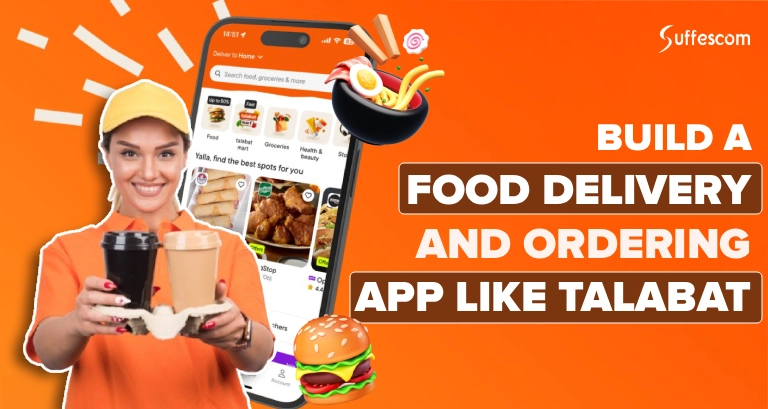
Food delivery apps have become a reliable way for people to order meals from restaurants. An app like Talabat brings restaurants, customers and delivery riders into one system where ordering food becomes fast.
Talabat allows users to order food and groceries instantly. Restaurants receive and manage orders through their dashboard while delivery partners use a rider app to accept and deliver orders.
This model has gained very high momentum in recent years. The global online food delivery market is anticipated to cross $505.05 billion by 2030, supported by growing smartphone usage and the rise of on demand services.
Because of this high growth, many startups want to launch an app like Talabat. But to build an app like Talabat requires multiple integrated apps and a reliable backend system. These components directly impact the cost to launch a food delivery app like Talabat.
This guide discusses how to develop a food delivery app like Talabat and the cost associated..
Overview of the Talabat Business Model
Talabat is based on a marketplace business model that provides three key elements with a single digital platform. The system controls restaurant listings and delivery management.
What Is Talabat and How Does It Work?
Talabat is a food delivery service platform that enables people to place orders of food and groceries through a mobile application or website to restaurants located nearby. The platform manages restaurant discovery and everything in one platform.
Here are some key facts about Talabat:
- Founded in 2004
- Operates in 8+ countries across the Middle East
- Serves 6+ million active users across the region
- Lists tens of thousands of restaurants and grocery stores
- Processes millions of food orders every month
The platform works through a simple process. Customers open the app, search for preferred restaurants, add items to cart and place an order. The restaurant gets the order request with preparation time. A delivery partner then picks up the order and delivers it to the customer.
Want to launch an app like Talabat?
Partner with our app development team to build a delivery platform for your business.
Key Features Required in an App Like Talabat
A platform like Talabat works through multiple apps and dashboards. Each module serves a different user group. The customer app handles ordering. The restaurant panel manages menus and incoming orders. The delivery partner app manages pickups and deliveries. The admin panel controls the entire platform.
1. Customer App Features
The customer app is the main interface where users discover restaurants and place orders.
User registration and profiles
Users create accounts using email or social login and create profiles and add addresses with this feature.
Restaurant search and filters
Integrate a feature where people search restaurants by cuisine, price range or delivery time.
Real time order tracking
A feature to track the order status from confirmation to delivery through live updates.
Multiple payment options
Integrate option for payment support for credit cards, digital wallets and cash on delivery.
Ratings and reviews
Feature for users to rate restaurants and share feedback based on their ordering experience.
Multi language support
Your Talabat clone app should support multiple languages to serve users across different regions.
Chat support
In app chat allows customers to communicate with support agents or delivery partners during an order.
2. Restaurant Panel Features
Restaurants use a dedicated dashboard to handle their menus, preparation and incoming orders.
Menu management
Restaurants add menu items, update prices, upload food images and manage availability.
Order management dashboard
Include a dashboard that shows new orders preparation status and delivery updates.
Sales analytics
A feature for restaurants to view their monthly sales report for better visibility.
Inventory management
Restaurants track ingredient availability and update item stock status.
Order history and reports
Feature to access past orders and performance reports.
Promotions and discounts
Restaurants create offers, discount codes and promotional deals with this feature.
Restaurant profile management
Restaurants update business hours, location, contact details and images.
3. Delivery Partner App Features
Delivery partners rely on a rider app to manage deliveries and track earnings.
Order notifications
Delivery partners receive alerts when a new delivery request is available.
Navigation and route optimization
Integrated maps in Talabat like apps help riders reach restaurants and customer locations through the fastest route.
Earnings dashboard
Riders track completed deliveries, daily earnings and incentives.
Delivery status updates
Feature for delivery partners to update order status, such as picked up or delivered.
Availability controls
Riders can switch online or offline based on their working hours.
Order history
The app shows past deliveries along with earnings and performance data.
4. Admin Panel Features
The admin panel controls the entire food delivery ecosystem and manages platform operations.
User management
Feature for the admin to manage customer accounts, restaurant partners and delivery riders.
Commission management
Admins define platform commission rates for restaurants and delivery charges through this feature.
Analytics and reporting
The dashboard shows order volume, revenue, user activity and platform performance.
Restaurant onboarding
Option for admin to approve new restaurants and verify business details.
Delivery partner management
Feature to verify riders' track performance and manage payouts.
Content and promotion management
Admins manage banners featuring restaurants and promotional campaigns.
Cost to Launch a Food Delivery App Like Talabat
The cost to launch a food delivery app like Talabat depends on various aspects. A simple food and grocery delivery may cost less while a complete marketplace with modern features will cost more.
On average the cost to launch a food delivery app like Talabat ranges between AED 30,000 to AED 130,000+.
Estimated Development Cost Breakdown
| App Complexity | Estimated Cost | Estimated Timeline |
| MVP Version | AED 30,000 – AED 50,000 | 2 – 4 months |
| Mid-Level Platform | AED 50,000 – AED 90,000 | 4 – 6 months |
| Full-Scale Platform | AED 90,000 – AED 130,000+ | 6 – 10 months |
An MVP usually focuses on the main ordering and delivery functions. This helps businesses launch fastly and validate the market before investing in advanced features.
Cost by Development Stages
The total cost to develop a food delivery app like Talabat is spread across different development stages.
| Development Stage | Estimated Cost |
| Product Research and Planning | AED 3,000 – AED 8,000 |
| UI and UX Design | AED 5,000 – AED 15,000 |
| Frontend Development | AED 8,000 – AED 30,000 |
| Backend Development | AED 7,000 – AED 25,000 |
| Third Party Integrations | AED 3,000 – AED 10,000 |
| Testing and Quality Assurance | AED 2,000 – AED 7,000 |
| Deployment and Launch | AED 2,000 – AED 5,000 |
| Support & Maintenance | 10 – 15% of total cost yearly |
Factors That Affect the Cost of Developing a Talabat-Like App
Several technical and product decisions influence the total cost to create a food delivery app like Talabat.
1. App Complexity and Feature Set
The number of features included in the platform impacts app development cost. A basic version with just ordering and delivery features requires less development effort. A full marketplace platform includes advanced tools for restaurants and administrators which increases complexity.
Key factors include:
- Number of apps such as the customer app and delivery partner app
- Advanced features like loyalty programs and promotions
- Real time delivery tracking and order updates
- Multi language and multi currency support
- Analytics dashboards and reporting tools
2. UI/UX Design Requirements
User interface and user experience design determine how easily users can navigate the app. A simple layout with basic components requires less design work. Custom interfaces animations and optimized user flows require additional design effort.
Design factors that affect cost include:
- Custom app interface design
- Responsive layouts for different devices
- Interactive elements and animations
- User journey optimization
- Design consistency across all apps
3. Backend Infrastructure
The backend system handles the core functionality of the platform. It manages user accounts, restaurant listings, orders and delivery tracking. A scalable backend is required to handle high traffic and large volumes of orders.
Backend requirements that influence cost include:
- Database structure and data management
- Server architecture and cloud hosting
- Real time order processing
- API development for mobile apps
- System scalability for growing user traffic
4. Third-Party Integrations
Food delivery platforms depend on external services to support payments and communication. Integrating these services requires additional development work.
A. Payment gateways
Payment integrations allow users to complete transactions securely within the app.
Common integrations include:
- Credit and debit card processing
- Digital wallet payments
- Online banking payments
- Secure payment authentication
B. Maps and GPS APIs
Map services enable location based restaurant discovery and delivery navigation.
Typical map features include:
- Restaurant location mapping
- Real time delivery tracking
- Route navigation for delivery partners
- Distance and delivery time calculation
C. Notifications
Notification systems keep users updated about order status and platform activity.
Common notification features include:
- Push notifications for order updates
- SMS alerts for confirmations
- Promotional notifications for offers
- In app alerts for delivery progress
5. Maintenance and Support
After launch, the platform requires regular maintenance to ensure smooth performance. Updates, bug fixes and server monitoring are necessary to keep the app stable as user activity increases.
Maintenance requirements include:
- Regular app updates and improvements
- Bug fixes and performance optimization
- Server monitoring and uptime management
- Security updates and data protection
- Technical support for users and partners
6. Development Team Location
Development costs vary based on the region where the team is located. Teams in North America and Western Europe usually charge higher hourly rates compared to teams in Asia or Eastern Europe.
Factors related to team location include:
- Hourly development rates
- Availability of skilled developers
- Communication and project management
- Long term maintenance and support costs
7. Platform Choice
The choice of platform also affects the overall development budget. Businesses can develop separate native apps for Android and iOS or use cross platform frameworks.
Platform decisions that influence cost include:
- Native Android app development
- Native iOS app development
- Cross platform frameworks like Flutter or React Native
- Maintenance requirements for multiple platforms
Planning the budget for a Talabat-like app?
Our team can help you estimate the development cost and choose the right approach!
Tips to Reduce Food Delivery App Development Costs
Start With an MVP
Starting with MVP app development helps you to deploy your app with only the main features. This approach is particularly beneficial because it decreases initial development costs and helps businesses to test ideas.
Example: Instead of launching loyalty programs and advanced analytics in the first version, the MVP can aim at basic functionalities like restaurant listings and order placement.
Cross-Platform Development
You can also go for a cross-platform app, where app developers create one codebase for both iOS and Android. It decreases cost and development time.
Example: Frameworks like Flutter allow you to launch both Android and iOS apps without maintaining two codebases.
Use Ready-Made APIs
A lot of complex features like payments and maps, can be incorporated using existing APIs and using these services decreases the requirement to create complex systems from the start.
Example: Integrating Google Maps for navigation, Stripe or PayTabs for payment processing and Firebase for push notifications instead of building internally.
Outsource Development
Outsourcing the project to a mobile app development company can reduce hiring and infrastructure costs. These teams are also flexible and provide different engagement models to choose from.
Example: Building an in-house team for app development can cost you a lot more than partnering with an app development agency that already has the required expertise.
Step-by-Step Process to Build an App Like Talabat
To create a food delivery app like Talabat requires many stages. Partnering with an app development company is important to develop the best Talabat clone app in the market.
1. Market Research and Planning
The process starts with market research and product planning. Businesses study local food delivery demand and identify the target audience. At this stage, the structure features and development roadmap are defined.
Key activities include:
- Analyzing competitors and delivery platforms
- Identifying target users and service locations
- Defining core features and platform modules
- Selecting the technology stack
- Creating an Talabat like app development roadmap
2. Wireframing and UI/UX Design
UI/UX designers then start creating wireframes to define how the app functions. This stage aims at creating a simple ordering experience for customers and reliable dashboards for restaurants and delivery partners.
Design tasks include:
- Creating wireframes for app screens
- Designing user flows for ordering and delivery
- Building UI layouts for customer restaurant and rider apps
- Designing the admin dashboard
- Optimizing navigation and usability
3. App Development
Once the designs are finalized developers start building the platform. This includes creating mobile applications, backend systems and APIs that connect all modules.
App Development includes:
- Building the customer mobile application
- Developing restaurant and delivery partner panels
- Creating backend architecture and databases
- Payment gateways and notifications integration
- Incorporating order management and delivery tracking
4. Testing and Quality Assurance
Before launching the platform goes through detailed testing to ensure reliability and performance. Developers check whether all features work properly and fix any issues.
Testing includes:
- Functional testing of all features
- Performance testing for high order volumes
- Security testing for payments and user data
- Fixing bugs and system errors
- Validating user experience
5. App Launch Deployment and Maintenance
The Talabat-like application is released to the cloud servers after testing, and the app is released on the App Stores. After the app is launched, constant maintenance is needed to ensure that the app is stable and reliable for the users.
This stage includes:
- App store submission and approval
- Cloud server deployment and configuration
- Monitoring system performance
- Releasing regular app updates
- Fixing bugs and improving features based on user feedback
Technology Stack Used to Build an App Like Talabat
| Development Layer | Technologies Commonly Used |
| Frontend (Customer & Rider Apps) | Flutter, React Native, Swift (iOS), Kotlin (Android) |
| Web Dashboard (Admin & Restaurant Panel) | React.js, Angular, Vue.js |
| Backend Development | Node.js, Django, Laravel, Ruby on Rails |
| Database | PostgreSQL, MySQL, MongoDB |
| Cloud Infrastructure | AWS, Google Cloud, Microsoft Azure |
| Maps & Location Services | Google Maps API, Mapbox |
| Payment Gateway Integration | Stripe, PayTabs, PayPal |
| Push Notifications | Firebase Cloud Messaging (FCM), OneSignal |
| Real-Time Order Tracking | WebSockets, Socket.io |
How Food Delivery Apps Like Talabat Make Money
When businesses build a food delivery app like Talabat the revenue model usually comes from multiple sources within the marketplace. Since your platform is going to connect restaurants, customers and delivery partners every transaction creates an opportunity to generate revenue.
Commission From Restaurants
Top food and grocery delivery apps like Talabat earn the largest portion of revenue through restaurant commissions. Every time a user places an order, your app will take a percentage from the total order value.
- Charge 10% to 30% commission per order depending on restaurant category
- Offer lower commission plans for small restaurants to onboard more partners
- Provide premium placement packages with slightly higher commission
- Increase commissions for restaurants that use platform delivery services
This model works well because restaurants gain access to a large customer base without building their own ordering system.
Subscription Plans
You can introduce subscription programs in your Talabat clone app for frequent users. Customers pay a monthly or yearly fee and receive benefits that encourage repeat orders.
- Free delivery membership plans
- Exclusive discounts on partner restaurants
- Priority delivery for subscribers
- Special deals during peak dining hours
Subscription plans increase user retention and generate recurring revenue.
Advertising and Promotions
Restaurants usually compete for visibility inside food delivery apps. Your food delivery app can monetize this demand by providing sponsored and promotional placements.
- Sponsored restaurant listings in search results
- Featured restaurants on the home screen
- Paid promotional campaigns during peak hours
- Banner advertisements inside the app
Restaurants that appear in promoted positions usually receive more orders which makes these placements valuable.
Service and Convenience Fees
Platforms can add service charges to each order to cover payment processing platform usage and operational costs.
- Platform service fees per order
- Small order handling charges
- Convenience fees for online payments
- Peak hour service surcharges
Even a small service fee can generate significant revenue when order volumes grow.
Restaurant SaaS Tools
A Talabat-like platform can also offer software tools to restaurants for an additional fee. These tools help restaurants manage operations and understand customer demand.
- Restaurant analytics dashboards
- Customer behavior insights
- Menu performance reports
- Marketing campaign tools for restaurants
These additional services create long-term revenue streams beyond just order commissions in your Talabat clone app.
Discuss Your Food Delivery App Idea With Our Experts
Connect with us today to get a free 30-minute consultation!
Popular Food Delivery Apps Competing With Talabat in the Middle East
The food delivery market has become highly competitive, with many platforms offering multiple services through one platform. While Talabat remains a major player, a number of other apps have built user bases across different countries in the region.
| App | Services Provided |
| Deliveroo | Food delivery, restaurant partnerships, scheduled deliveries, order tracking, in-app payments |
| HungerStation | Food delivery, grocery delivery, restaurant discovery, promotional deals, order tracking |
| Jahez | Food ordering, restaurant listings, delivery tracking, digital payments, customer loyalty programs |
| Carriage | Food delivery, grocery delivery, restaurant search, real-time delivery tracking, online payments |
| Careem | Food delivery, grocery delivery, ride-hailing, package delivery, digital wallet payments |
Future Trends in Food Delivery App Development
Food delivery apps are constantly evolving as new technologies improve ordering experiences.
AI-Based Order Recommendations
Artificial intelligence helps analyze user behavior, past order preferences and browsing patterns to recommend any relevant meals or restaurants. This improves user engagement and increases repeat orders. Key capabilities include:
- Personalized food and restaurant recommendations
- AI based meal suggestions based on order history
- Smart search results based on user preferences
- Dynamic recommendations during peak meal times
Drone and Autonomous Delivery
Autonomous delivery technologies are being tested to decrease delivery time and logistics costs. Drones and delivery robots can transport orders without being based entirely on human riders. Key developments include:
- Drone based short distance deliveries
- Autonomous delivery robots for local areas
- Reduced delivery time in high density locations
- Lower operational costs for last mile logistics
AI-Based Delivery Route Optimization
Advanced algorithms analyze traffic patterns and rider availability to assign the quickest delivery routes. Integrating AI-based route optimization will help with better flexibility. Features include:
- Real time route optimization for delivery partners
- Automatic assignment of the nearest available rider
- Traffic aware navigation for faster delivery
- Reduced fuel consumption and delivery delays
Voice-Based Ordering
Voice recognition technology is gradually being integrated into food and grocery delivery apps. This allows users to place orders through voice commands. It includes:
- Voice search for restaurants and dishes
- Voice enabled order placement
- Integration with voice assistants
- Faster ordering experience for frequent users
Predictive Demand Analytics
Predictive analytics helps platforms predict estimated order demand in various areas and time periods. This helps with better delivery planning. Benefits include:
- Demand forecasting based on order data
- Better delivery partner allocation
- Improved restaurant preparation planning
- Decreased delivery delays during high demand periods
Conclusion
Food delivery platforms like Talabat depict how a well-built marketplace can connect customers, restaurants and delivery partners in one system. However, creating such a platform requires multiple apps, a reliable backend and integrations. Also, the rising demand for online ordering has led many startups and restaurant businesses to explore opportunities in this space.
Building a reliable platform requires complete planning and the best approach. Partnering with a food delivery app development company can help you develop an app like Talabat that supports every basic and advanced feature.
Start Building Your Custom Food Delivery Platform Today
FAQs
1. What is a Talabat-like food delivery app?
A Talabat-like app is an online food ordering and delivery platform that connects customers, restaurants, and delivery drivers in a single ecosystem. These apps allow users to browse nearby restaurants, place orders, track deliveries in real time, and pay digitally.
2. How much does it cost to develop an app like Talabat?
The cost to develop a food delivery app like Talabat typically ranges between AED 30,000 and AED 130,000+, depending on complexity, technology, and features.
3. What are the essential features required to build a Talabat-like app?
A successful on-demand food delivery app requires features that improve user experience and simplify order management. Essential features include restaurant search and filters, menu browsing and order customization, secure online payments, real-time order tracking, ratings and reviews, menu management, order management dashboards, order alerts, and map integration.
4. How long does it take to develop a Talabat-like food delivery app?
The development timeline for a Talabat-like app generally ranges from 2 to 9 months, depending on the level of customization.
Using agile development methodology can speed up the process while ensuring the app remains scalable and user-friendly.
5. What technologies are used to build apps like Talabat?
Modern food delivery app development uses a combination of frontend, backend, and cloud technologies.
Common tech stack includes:
-Frontend: Flutter, React Native, Swift, Kotlin
-Backend: Node.js, Django, Laravel
-Database: PostgreSQL, MongoDB
-Cloud Infrastructure: AWS, Google Cloud
-Real-time tracking: Google Maps API, Mapbox
-Payment Integration: Stripe, PayTabs, PayPal
6. Can startups build a Talabat clone app?
Yes, startups can launch a Talabat clone app to enter the online food delivery market quickly. Benefits for startups include faster time-to-market, lower development cost compared to building from scratch and pre-built food delivery features
7. How do food delivery apps like Talabat make money?
Food delivery platforms generate revenue through multiple monetization strategies. Common revenue models include:
-Commission from restaurants on every order
-Delivery charges paid by customers
-Subscription plans for restaurants
-In-app advertisements and promotions
-Surge pricing during peak hours
8. What challenges are involved in developing a Talabat-like platform?
Developing a multi-vendor food delivery marketplace involves several technical and operational challenges. Key challenges include:
-Managing real-time order tracking
-Handling high traffic during peak hours
-Ensuring secure payment processing
-Coordinating multiple stakeholders (restaurants and drivers)
-Maintaining fast delivery logistics
9. Why is the UAE market ideal for launching a food delivery app?
The UAE food delivery market is one of the fastest-growing digital sectors due to high smartphone usage and busy lifestyles. Key reasons include strong demand for online food ordering apps, high internet and smartphone penetration and growing restaurant industry
10. How can you scale a food delivery app after launch?
Scaling a Talabat-like food delivery platform requires strategic technology and marketing improvements. Key growth strategies include expanding to new cities or regions, adding more restaurant partners and implementing AI-based food recommendations
11. Is it better to build a food delivery app from scratch or use a clone script?
Both approaches have advantages depending on business goals.
A custom food delivery app development approach offers complete flexibility, while a Talabat clone script allows faster deployment and lower costs. Businesses aiming for long-term scalability usually prefer custom solutions with advanced integrations and unique features.
12. How can an app development company help create a Talabat-like app?
An app development company like Suffescom Solutions specializes in food delivery app development for startups and enterprises in the UAE. They help create a food delivery from start to end.