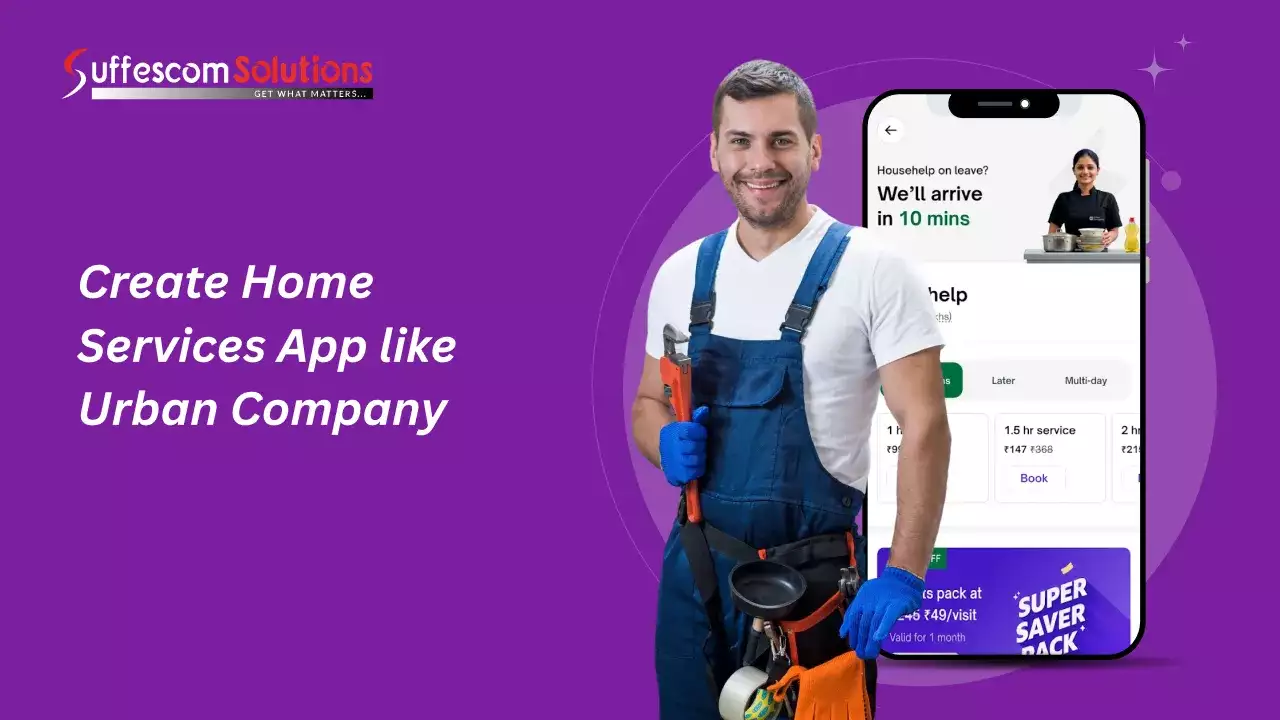
Urban Company shows how a simple idea can grow into a big business when it solves a real problem. Many people have trouble finding a trusted cleaner or repair worker. Skilled workers also struggle to get regular jobs. Urban company spotted this gap and built a platform to connect both in a simple, reliable way.
Started in 2014, the company centered its value proposition on a single pillar: trust. They checked every worker before listing them. They trained workers and made clear steps for each service. By introducing clear, fixed pricing, they gave their users the much-needed certainty about the cost. This made their app reliable from the user's perspective and fueled a high retention rate and organic growth through user-amplified brand advocacy. Over time, they added more services. Today, Urban Company operates in many cities and serves millions of users daily.
If you want to build a similar app for the UAE, here is a comprehensive app development plan with costs, timelines, and key focus areas.
A home service app like Urban Company is based on a full-stack, on-demand platform that acts as a two-sided marketplace. It connects users with pre-screened and trained professionals for home services.
It operates on a high trust model, providing standard pricing, instant booking, and quality control for services like cleaning, maintenance, and beauty, etc.
It works from three main angles: the user's, the provider's, and the platform's management, as explained below:
On the user side, the app enables the following functionality:
1. Service Discovery: To support smooth service discovery, there are filters:
2. Booking & Scheduling: The app supports instant booking with real-time availability for professionals. It also includes flexible time slots and reminders.
3. Payments & Tracking: Users can pay securely through integrated payment gateways. They can track service progress in real time.
4. Feedback & Reviews: After completion, users can rate and review the service.
Here are the functionalities the app can support concerning service providers:
1. Registration & Verification
2. Job Management
3. Earnings & Insights
On the platform side, the app provides the following tools:
1. Service Oversight
2. Operational Analytics
3. Issue Resolution
Quick handling of:
Urban Company basically operates as an aggregator business model that connects customers with verified professionals. Here are the common ways their primary revenue is generated, along with supplementary methods:
Before building the app, you need to plan what you need to do to make your app launch-ready. This is where you start from. You don't just rush into a full platform from day one. Instead, you start with a clear, focused plan.
The plan includes identifying the essential features that make the app work, like service browsing, booking, and payments. You have to make sure these features are not adding extra complexity to the build. A clear scope helps you save time, cut costs, and prevent delays.
The goal at this stage isn't to build everything, but to build what's needed to launch and test the idea in the market.
Not every feature needs to be part of the first version of your app. So, the right way to get started is to focus on features that solve the core problem for users and providers. While doing so, you also need to make sure the development stays lean and efficient so as to avoid overspending.
Must-Have Features for an MVP:
By concentrating on these important features, the MVP development allows you to launch faster, gather real user feedback, and validate the idea before investing in advanced functionalities.
Once the MVP proves the concept, additional features can be gradually added to enhance the user experience, improve retention, and increase revenue.
Defining Your USPs
When you decide to land in a crowded market, it's really important to define your unique selling propositions that clearly help users understand what sets you apart. That's when they pick you over the others.
For a home services app, the USP could focus on:
A strong USP helps you attract users. It plays a crucial role in building trust and driving repeat bookings. Defining it early helps shape your features, design choices, and marketing strategy.
Scope for Scalability
It's not just the features and design that you have to plan and begin with initially, but also the scalability. It ensures how easily your app would be able to manage more users, providers, and bookings without slowing down.
These are the areas you have to focus on:
Thinking about scalability from day one avoids costly rework and makes it easy to capture new market opportunities.
Performance is a key factor that you cannot compromise on. Slow or unreliable apps push users away. So, during the mobile app development, whether Android or iOS development, these are the areas that you should keenly focus on:
Performance optimization greatly affects the following metrics:
Once you have planned the app, set the features, and thought about scalability and performance, the next step is deciding how to build it. Each approach has its own advantages depending on your budget, timeline, and how much customization you need.
| Development Option | What It Is | Pros | Best For |
| White label solution | Pre-built platform you can brand and customize slightly |
| Startups with a limited budget or time |
| Clone app development | App modeled after successful platforms like Urban Company |
| Founders who want a ready-to-go solution |
| Custom software development | Built from scratch based on your exact needs |
| Businesses prioritizing long-term growth |
Once you have defined your app idea, features, scalability, and development approach, the next step is putting the plan into action. A clear, structured approach helps you move faster and lowers risks.
The cost and timeline of the app are greatly influenced by:
Based on our experience building a wide range of apps in this space, this is our realistic estimate of the cost, timeline, and effort required to launch a functional, scalable home services app.
| Development Approach | Estimated Cost (USD) | Typical Timeline |
| White label solution | AED 8,000 | Ready Made Solution |
| Clone app development | AED 20,750 - 30,000 | 3-4 weeks |
| Custom Software development | AED 40,500 - 8,50,00 | 4-5 months |
So, this is a standard software development cost range in the Middle East. Please note that these figures are estimates and can vary based on your app's complexity, features, platform choice, and customization requirements.
When developing an app in a highly competitive service platform sector, the most common challenges app founders face are the following:
The biggest challenge for a home services app is delivering services that are consistent and reliable. Users are only likely to trust your services when they know that they are verified providers. Poor-quality or unverified workers can quickly erode their trust. It eventually hurts your business reputation.
Here is what you can do to avoid it:
Ingrain service quality deeply into your platform architecture. This means your system should be able to support:
1. Build a structured onboarding flow with:
2. Use role-based logic and job state transitions to ensure process consistency
3. Define service level checklists and steps within the app
4. Implement a post-service feedback system with weighted ratings and automated flags for low-performing providers
5. Set up backend rules, like temporarily suspending providers below a rating threshold or with repeated cancellations
6. Use push notifications and even driven architecture to notify users and admins of:
7. Build admin-side analytics to track KPIs like:
Another major challenge for home services apps is having the right number of providers at the right time. While approaching your app development, you should deeply focus on the real-time matching and allocation problem. Because if the platform has too few providers in a given location or time slot, it can lead to delayed bookings or increased cancellations.
Similarly, an oversupply of providers without sufficient demand can result in low job allocation and provider churn.
To address this challenge, here is what must be done at the development level:
1. Build systems to track provider availability dynamically based on:
2. Use system flags and time-based scheduling to ensure accurate supply visibility
3. Control booking slots based on provider density to avoid overbooking or underutilization in specific areas.
4. Introduce backend rules to increase prices or offer incentives during high-demand periods to attract more providers
5. Build dashboards that show demand hotspots so providers can position themselves strategically
6. Reduce booking friction by assigning jobs to the best-matched available provider
7. Use historical booking data to predict:
8. Implement matching logic that considers
In-home services apps face a core system challenge in handling real-time bookings. Your users expect instant confirmations from you. And service providers rely on accurate schedules to manage their workload. Without a reliable real-time system in place, the following issues might arise:
Here's how to address this at the development level:
1. Using an event-driven architecture, such as WebSockets or real-time databases, to instantly update provider availability across user and provider apps.
2. Integrate push notifications, SMS, or in-app messaging to keep users and providers updated on booking status changes in real time.
3. Add backend validation to detect overlapping bookings or scheduling conflicts before confirming a request.
4. Design a dedicated scheduling module that can handle high-frequency booking requests during peak hours without latency.
5. Implement temporary booking locks or transaction-based systems. This will prevent multiple users from booking the same time slot at the same time.
6. Ensuring that booking creation, payment processing, and slot allocation happen as a single atomic operation to avoid partial failures.
The key to success in launching a home service app like Urban Company is to thoughtfully plan its development. It all starts with choosing the right development company, one that deeply understands the industry, market, and challenges. As a veteran mobile app development company with years of expertise and hands-on experience working in similar industries, we believe we can guide you in the right direction. Whether you want a fast and affordable launch or have a long-term vision, we help you get on the right track. Book a free, no-obligation consultation with our experts and gain access to professional guidance and insights.
The cost of developing a successful home services app like Urban Company typically starts from AED 30,650 and can go up to AED 1,40,250, depending on your requirements.
Several factors influence the overall cost, including app features, platform (Android or iOS app development), UI/UX design complexity, third-party integrations, and the development team's expertise.
For a more accurate cost estimate tailored to your business needs, share your specific requirements with us and get started with a consultation tailored to your business needs.
The time required to develop a home services app like Urban Company typically ranges from 2 to 6 months, depending on the app's complexity and features.
A basic version with essential functionality can be developed in a shorter timeframe, while a more advanced app with custom features, multiple integrations, and a scalable architecture may take longer. Key factors affecting the timeline include design requirements, platform selection, development approach, and testing phases.
For a more precise timeline aligned with your project scope, share your requirements with us, and we will begin a detailed project plan.
A home services app must include the following:
Without these core functionalities, it becomes difficult to deliver a smooth UX and build trust among customers. For more information, connect with us and get started with a customized app strategy.
A home service app like Urban Company acts as a bridge between customers and service professionals. Users can browse available services, book appointments, track service professionals in real time, and make secure online payments, all within the app.
On the other hand, service providers can accept or manage bookings, track their schedules, and monitor their earnings through a dedicated dashboard.
For a deeper understanding of how such an app can be designed as per your business model, get in touch with us and start building your custom solution.
The right tech stack for a home services app like Urban Company depends on what you want to build and how fast you want to grow.
Most apps today use tools that are fast, flexible, and easy to scale. A solid setup looks like this:
Flutter and React Native help you build one app that works on both Android and iOS. This saves time and money. Node.js is great for handling many users at once. Django works well if your app needs strong security and a clean structure.MongoDB is useful when your data keeps changing. PostgreSQL is better when you need accuracy, like handling payments or bookings. Cloud platforms like AWS and Google Cloud keep your app running smoothly even when more users join.
If you are not sure what fits your idea, it's better to plan the tech stack based on your features first, not trends. Get started with a free expert consultation with us!
It depends on your budget and how fast you want to launch.
Cross-platform apps are a good choice if you want to save money and build faster. You can create one app and run it on both Android and iOS. This works well for most startups and early-stage ideas.
Native apps are built separately for each platform. They usually run faster and feel smoother, especially for heavy features. But they take longer to build and cost more to maintain.
For most home services apps like Urban Company, starting with a cross-platform app makes sense. You can test your idea, get users, and then move to native later if needed.
Drawing from experience, the common challenges where most home services apps struggle are as follows:
But as an experienced agency with a proven portfolio of building and scaling multiple home services platforms across the Middle East, we fully understand how to tackle these issues effectively. We design the system to handle high user loads, ensure secure payments, streamline provider management, and make bookings smooth and reliable. This approach allows us to deliver an app that works smoothly in the real world.
Here are the most common ways a home service app can make money:
Getting skilled service providers on board is one of the biggest challenges for a home services app like Urban Company. To attract them, you need to offer real value from day one.
Start with low commissions initially so they earn more while testing your platform. Another important thing is fast payouts, as providers want to see their earnings quickly. Strong onboarding support is also important to guide them through profile setup, training, and booking management.
The key is trust and simplicity. Providers need to feel the app makes their work easier, not harder. If they see clear benefits, they will stay loyal and even bring more professionals to your platform.
You can start by targeting Google Ads aimed at UAE audiences searching for local services. You can consider pairing this with local SEO to ensure your app shows up when people search for services in their city.
You can also leverage social media marketing and referral programs. The key to success with your strategy is consistency. At first, focus on a few channels, test what works, and double down on strategies that drive both user growth and repeat bookings.
An MVP version typically costs AED 12,500 to AED 30,650, depending on features and speed of development. The exact price depends on the number of features, the design complexity, and how quickly you want to launch.
An MVP usually includes core functionalities such as user registration, service booking, a basic provider dashboard, secure payments, and ratings/reviews. Advanced features such as real-time tracking, chat, and surge pricing can be added later as the app grows.
Building an MVP first helps you test the idea, attract early users, and gather feedback without spending too much upfront. Once the app gains traction, you can invest in more features and scale confidently.
Yes, for a home services app like Urban Company, you almost always need separate apps for users and service providers, plus an admin panel. Having a Customer app, a Provider app, and an Admin panel is the standard approach, and it’s the most practical way to build a scalable, reliable home services platform.
UI/UX is one of the most important factors for a home services app like Urban Company. It directly affects bookings and user trust. If the app is confusing or slow, users may abandon it before booking a service. Good UI/UX makes it easy for users to find services, book quickly, and pay without friction. It also builds confidence in your platform, which keeps users coming back.
Yes. AI can add real value to a home services app like Urban Company, making it smarter and more efficient. AI development is most commonly used to support the following features:
Yes. Real-time tracking is very important for a home services app like Urban Company. Showing the provider's live location and estimated arrival time builds trust. Users feel in control, know when to expect the service, and are less likely to cancel. It also reduces confusion and support calls, making operations smoother.