Forex Trading App Development with Crypto Wallet: Features, Cost & Benefits
Key takeaways: The UAE is a serious market for fintech and digital-asset products. DIFC alone hosted 1,677 A [...]
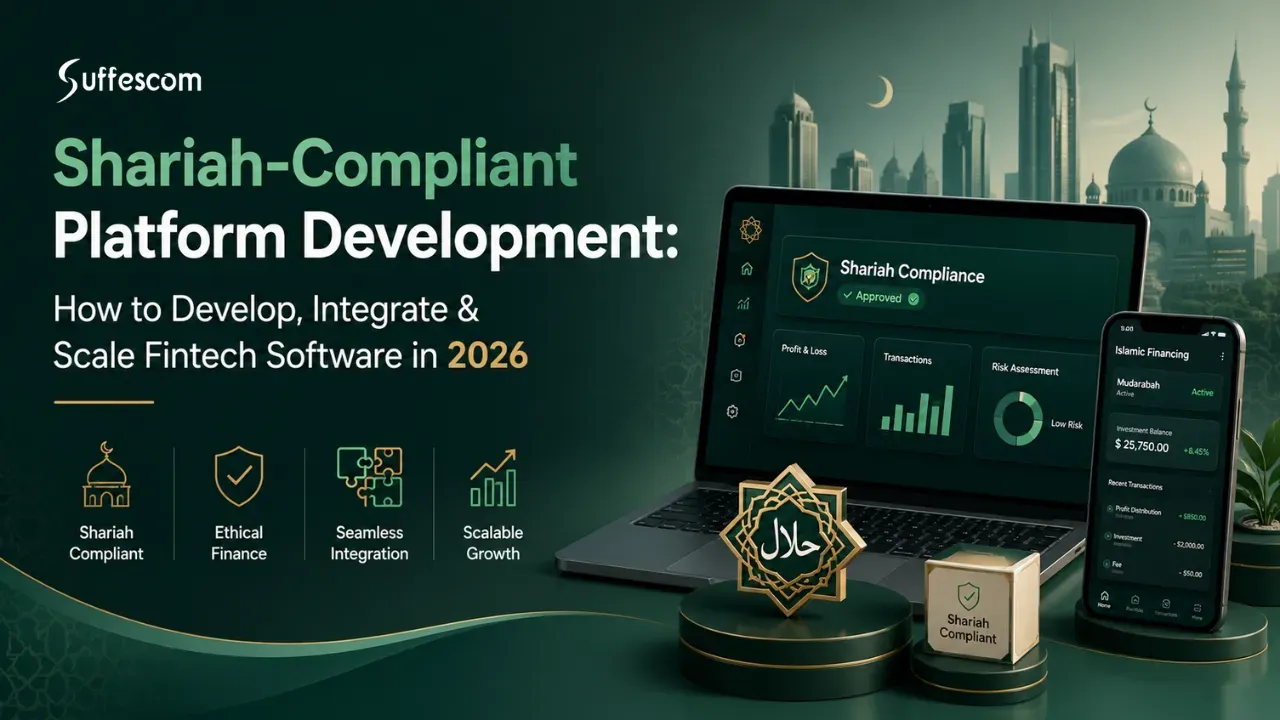
Shariah-compliant platform development is about building financial systems that follow Islamic finance rules and use modern technology at the same time. These systems help people invest, save, borrow and manage money in a way that's fair and transparent and follows Shariah principles.
Shariah-compliant platform development is about creating financial technology apps and software that do not use interest-based transactions. Instead they use trade and profit-sharing models. For example when someone wants a loan the system buys something and sells it to the person at a price they agree on. The person does not have to pay interest. This way the process follows law.
Now in 2026, these systems are getting better because of intelligence, automation and cloud technology. Companies are not just making banking apps anymore. They are making Islamic financial technology systems that can check transactions as they happen, find fraud and make sure everything follows Shariah rules automatically.
A key part of making these systems is designing the architecture. A good Shariah-compliant platform has layers, such as managing products, checking for compliance, keeping track of money and being governed by Shariah scholars. New systems also have layers that use intelligence to analyze how users behave and make better decisions. Another important part is integration. These platforms connect with banks, payment gateways, companies that verify identities and blockchain systems. This allows users to send money, invest and manage their assets across different financial systems.
It is also very important that these platforms can handle a lot of users without slowing down. A made platform should be able to handle thousands or even millions of users. That is why companies use cloud systems like Amazon Web Services or Google Cloud when they make financial technology. The process of making these platforms usually starts with research and planning to make sure everything is compliant with Shariah rules. Then comes designing the system, making a version integrating with other systems, testing and finally launching. Each step makes sure the platform is strong technically. Follows Shariah rules.
Overall Shariah-compliant software development is about combining principles based on faith with modern digital technology. It allows companies to make financial technology products that're fair and can compete globally while still following Islamic values. Shariah-compliant platform development is very important, for people who want to use systems that follow Shariah principles.
The market for fintech is really taking off. This is because people want services that are fair and easy to use. They want to be able to do things on their phones and online. Old style banking is changing to use apps and computer programs that can think for themselves.
At the time Islamic finance is getting noticed all around the world. This is because it does not use interest and it focuses on being fair and using things to back up money.
The Islamic fintech sector is growing fast. This is a chance for new companies, banks and Islamic fintech companies in 2026 to do something new with Islamic fintech. The combination of banking and Islamic finance that follows Shariah rules is creating a huge opportunity for Islamic fintech companies.
| Region | Growth Driver |
| UAE | Strong digital banking adoption + government-backed fintech regulations |
| Saudi Arabia | Vision 2030 initiative pushing fintech innovation and financial diversification |
| Malaysia | Mature Islamic finance ecosystem with strong regulatory frameworks |
| Indonesia | Largest Muslim population in the world driving massive demand for halal financial products |
These regions are not only adopting fintech faster but are also actively supporting Islamic financial innovation through policies, sandboxes, and digital banking licenses.
This market is growing. Here's why:
- People want banks to care about what they care about.
- Mobile apps are taking over from going to the bank.
- Governments are helping digital finance grow.
- Companies are making Islamic fintech platforms using AI.
This means companies that make Shariah-compliant platforms, neobanks, investment apps and digital wallets have a chance to succeed in 2026 and beyond.
Shariah-compliant fintech is financial technology systems that follow finance principles. These systems use digital tools like mobile apps and cloud systems but they make sure that all financial activities are fair and follow the rules of Shariah law.
Shariah-compliant fintech is different from traditional fintech. Traditional fintech often uses interest-based lending and speculative investments.. Shariah-compliant fintech focuses on being fair and transparent. It also makes sure that every transaction is backed by an asset or a genuine service. The profit is shared in a way between the people involved in the transaction.
The investor and the business share profits and risks fairly.
One important thing to know about fintech development is that Shariah compliance cannot be added later. It must be part of the system from the beginning. This means that the product design, database logic, transaction flows and even artificial intelligence systems must follow Shariah rules by default. Shariah-compliant fintech must be built with these rules in mind so it is fair. Follows the principles of Shariah law. Shariah-compliant fintech is about making financial technology systems that are fair and follow the rules of Shariah law.
For example a Shariah-compliant fintech app does things differently. It does not give a personal loan with interest. Instead, it uses a Murabaha model. The Shariah-compliant fintech app buys a product like a car. Then it sells the car to the customer. The customer and the app agree on a fixed profit margin.
The customer pays for the car in installments. The customer does not pay any interest.
This way the transaction is transparent. It is also asset-backed. The Shariah-compliant fintech app is fully compliant with principles. At the time, it offered a modern digital banking experience.
In terms Shariah-compliant fintech is about combining modern financial technology with Islamic finance rules. These rules are ethical. Shariah-compliant fintech creates a system that's innovative. It is also value-driven. Shariah-compliant fintech is an option for people who want to use modern financial technology and follow Islamic principles.
Start developing a platform that aligns with Islamic finance principles and modern technology.
A Shariah-compliant fintech platform is built using these layers. Each layer of the CORE ARCHITECTURE does a job. It handles things like finance rules, compliance, transactions and intelligence.
This makes sure the system is secure and scalable and follows principles completely.
This is the layer that users see. It is where Islamic financial products are offered to users in a format.
Examples include things like
This layer of the CORE ARCHITECTURE focuses on how users interact with services. It is supposed to be simple and easy to use on devices.
This is the important part of Islamic fintech systems. The Compliance Engine makes sure that every transaction is done according to Shariah rules.
The main jobs of the Compliance Engine are:
For example: if the Compliance Engine sees a transaction that involves interest, which is not allowed by Shariah rules the Compliance Engine will stop the transaction. Send it somewhere else. The Compliance Engine is very important because it helps the Islamic fintech system follow Shariah rules.
This layer manages all financial records and ensures transparency in every transaction.
Key functions:
This ensures that all money movements are fair, traceable, and compliant.
This layer connects our platform with scholars and compliance authorities.
The main things it does are:
For instance a new financial product needs Shariah board approval before it can be launched.
An example is when a new financial product cannot go live until the Shariah board approves it.
This is the advanced Data Intelligence Layer that uses Artificial Intelligence and data analysis to make better decisions.
The Data Intelligence Layer does a lot of things.
Key functions of the Data Intelligence Layer are:
For example the Data Intelligence Layer can use Artificial Intelligence to find transactions and mark them for review before they cause any risk to the Data Intelligence Layer.
Simple Understanding
In terms this 5-layer model makes sure of the following:
This architecture is the foundation of modern Islamic fintech platforms in 2026. It brings together finance, technology, compliance and intelligence into one system. The 5-layer model ensures that financial products are easy for users.
This model is key to Islamic fintech platforms.
| Phase | Description |
| Phase 1 | Research and Shariah compliance planning to define rules, goals, and financial models |
| Phase 2 | API-first architecture design for scalable and flexible system structure |
| Phase 3 | MVP development including wallet, user onboarding, and basic transaction features |
| Phase 4 | Integration of banking APIs, payment gateways, and KYC/AML verification systems |
| Phase 5 | Compliance testing with Shariah review and fatwa approval from scholars |
| Phase 6 | Final launch followed by scaling, optimization, and continuous improvements |
Shariah-compliant fintech platforms need to have things that people want, things that administrators want and also things that use intelligence to make sure everything works well and follows the rules of Islam. Shariah-compliant fintech platforms have to do this to be sure they are doing things right. They have to follow principles and make sure everything is okay.
| Category | Features |
| User Features | Halal investment portfolios, Zakat automation, BNPL (Murabaha-based), multi-currency wallets |
| Admin Features | Compliance dashboard, audit logs, reporting system |
| Advanced Features | AI robo-advisory, tokenized Sukuk, Islamic DeFi layer |
These things all work together to make a digital system. The things that users can do help people manage their money in a way that's okay with Shariah rules. The things that administrators can do make sure everything is transparent and that they are in control. Some other things, like computers that can give advice, help people make decisions by suggesting smart and ethical ways to invest their money. This also includes a way to do things in a secure and decentralized way based on something called blockchain and it is all about Islamic finance.
In other words , all these things make the platform a good and honest place and it is also smart and able to grow while making sure it follows the rules of Islamic finance and is up to date with the latest financial technology standards.
A Shariah-compliant fintech platform uses a modern, scalable tech stack to ensure performance, security, and compliance. Each layer of technology plays a specific role in building a fast, secure, and AI-ready financial system.
| Layer | Technology |
| Frontend | Flutter / React Native |
| Backend | Node.js / Java Spring Boot |
| Database | PostgreSQL / MongoDB |
| AI Layer | Python, TensorFlow |
| Blockchain (optional) | Ethereum / Hyperledger |
| Cloud | AWS / Google Cloud |
This stack supports mobile-first development, real-time transactions, AI-driven compliance, and secure cloud deployment. It ensures the platform is scalable, efficient, and ready for global Islamic fintech markets in 2026.
A Shariah-compliant fintech platform does not work alone. It needs to work with other systems to be a complete digital financial system. This is what we call the integration ecosystem. The integration ecosystem is very important for making the system bigger, following rules and making users happy.
Some important things that need to be connected include Open Banking APIs. These APIs let us get to bank information in a way and make transactions happen in real time. Payment gateways help us process payments easily using cards, wallets or bank transfers. We use AML/KYC providers to check user identities and stop fraud. This helps us follow rules. Core banking systems connect our fintech platform with banks. This helps with account management and processing transactions. In advanced systems blockchain networks are used to be transparent, make smart contracts and create tokenized assets.
Making all these systems work together is very expensive because each system needs to be safe, fast and follow all the rules. The integration ecosystem is one of the things that costs a lot of money when building fintech systems. This is because each system must be secure, fast and fully follow the rules. The INTEGRATION ECOSYSTEM plays a role in all of this.
For example if a user puts money into a Shariah-compliant app the app will use different things.
All these things have to work at the same time.
If one of these things does not work right the whole process can stop working.
That is why planning how all these things work together is very important when we build fintech systems like a Shariah-compliant app.
The cost of building a Shariah- fintech platform is something that depends on the size of the Shariah-compliant fintech platform. It also depends on the features of the Shariah- fintech platform and the things it needs to work with. The Shariah-compliant fintech platform needs to follow rules and this costs money.
When the Shariah-compliant fintech platform gets more complex it costs money because of things like artificial intelligence and keeping things safe and secure and following the rules that are in place for the Shariah-compliant fintech platform.
| Scale | Estimated Cost |
| MVP | AED 12K – AED 20K |
| Mid-Scale | AED 20K – AED 30K |
| Enterprise | AED 30K – AED 40K+ |
In words, when we start with a basic version, we focus on simple things like digital wallets and getting users started. For big platforms we need advanced things like artificial intelligence for compliance, blockchain and the ability to work in many countries. These extra costs are important but often forgotten. They help build a fintech system that's secure, follows rules and ready for the future.
Build systems that support millions of users without compromising compliance.
Shariah-compliant fintech platforms use multiple revenue models that are ethical, transparent, and aligned with Islamic finance principles. Instead of earning interest, these platforms generate income through services, partnerships, and value-added financial solutions.
1 Transaction fees: Small charges on each successful payment or transfer.
2 Subscription plans: Monthly or yearly fees for premium features like advanced analytics or investment tools.
3 Asset management fees: Charges for managing user investments in halal portfolios or Sukuk.
4 BNPL margins: Profit earned through Murabaha-based buy-now-pay-later models instead of interest.
5 API licensing (B2B fintech): Charging other businesses to use fintech APIs for payments, compliance, or KYC.
For example an Islamic investment app may have an account that is free but if you want to get advice on your investments from a computer program you have to pay for it. When you buy something using a service like BNPL, the company that runs the service gets a fixed amount of money from the sale of charging interest.
These ways of doing business make sure that the people running the service are making money in a way that's fair and follows the rules of Shariah and they can keep doing this for a long time, which is what Islamic investment apps and services, like BNPL are trying to do to follow Shariah and stay in business for a long time.
Scaling a Shariah- fintech platform needs a strong foundation in technical, business and compliance areas. This is to support growth and increasing users worldwide.
Fintech systems today use a microservices architecture. This breaks the platform into services that can be updated and scaled easily. Event-driven systems help with real-time transactions. Native deployment on platforms like AWS or Google Cloud ensures the platform is always available, secure and performs well globally.
To grow globally platforms must follow financial regulations in each country. They also need to localize, including language support and region-specific financial rules. This helps users trust and use the platform more.
Islamic fintech has a special requirement. A multi-fatwa engine system. This applies Shariah rules based on region or financial product. It ensures compliance while expanding internationally.
An Islamic neobank expanding from UAE to Malaysia must adjust payment rules, currency systems and Shariah interpretations. It must do this while keeping one backend system.
In terms of scaling a Shariah-compliant fintech platform means building something that is fast, flexible and compliant. It must be ready for Islamic finance markets.
Building a Shariah- fintech platform is really tough. There are technical problems and regulatory issues that come up. We also have to deal with user-related challenges.. The good thing is that each of these challenges can be solved. We just need to use the architecture and design approach, for Shariah-compliant fintech platforms. This way we can make sure that our Shariah-compliant fintech platform works well and meets all the requirements.
| Challenge | Solution |
| Compliance complexity | Modular compliance engine |
| Regulatory differences | Region-based rule engine |
| User trust issues | Transparent UX + audit logs |
One of the problems with Islamic finance platforms is making sure that every single transaction follows Shariah rules. This can get really complicated when the platform gets bigger. To solve this problem we use a tool that checks each transaction one by one to make sure it is Shariah compliant.
Another problem is that different countries have financial rules. We deal with this by using a system that adjusts to the rules of each region including what the local laws and fatwa say.
Islamic finance is about trust so we need to make sure that users feel safe and secure. We do this by being open and honest with them, showing them exactly what is happening with their money and keeping a record of everything.
In terms of using the right technology and being transparent is the key to overcoming these challenges. Shariah compliance and transparency are crucial for finance and we need to get them right to build user trust in the platform and make sure that every transaction is Shariah compliant.
Shariah-compliant fintech platforms have to follow strict rules about money. These rules are different, in each country. Every region has its people who make sure that financial services are safe and honest and follow the rules of Islamic finance. It is really important to know what these rules are so you can build a Shariah- fintech platform that can work all over the world with Shariah-compliant fintech platforms.
| Region | Authority |
| UAE | CBUAE, DIFC, ADGM |
| Saudi Arabia | SAMA |
| Malaysia | Bank Negara Malaysia |
In the United Arab Emirates the companies that deal with money and technology are looked after by CBUAE, DIFC and ADGM. These organizations help ideas for digital banking and Islamic finance.
In Saudi Arabia, the Saudi Central Bank, which is also known as SAMA, is in charge of making sure that companies that deal with money and technology follow the rules. SAMA really wants to help Saudi Arabia achieve its Vision 2030 goals for changing to technology.
Bank Negara Malaysia does a job of keeping the Islamic finance system running smoothly. It is one of the best in the world.
Each of these organizations makes sure that the companies that deal with money and technology follow the laws and the principles of Shariah. For companies that want to do business in these places it is very important to follow the rules. This is necessary for expanding and making sure they comply with the rules in the long term. The companies that deal with money and technology or fintech companies need to do this to be successful.
In 2026 Shariah-compliant fintech is changing fast with new technologies that make it safer, easier to follow the rules and better for users. These changes are making the future of digital finance better by making the systems work smarter, work faster and be more open.
There are things that are making this happen.
For example an Islamic investment app in 2026 may use AI to say yes to halal investments, let people log in using face ID and offer tokenized Sukuk that users can buy and sell on a marketplace that uses blockchain. All while making sure everything follows Shariah rules.
Shariah-compliant fintech is getting better because of these trends it is becoming safer, more automated. It can be used by people all around the world. Shariah-compliant fintech is really. It is making Islamic digital finance more secure and easier to use.
A good user experience and product strategy is very important for Shariah- fintech platforms. This is because users need to feel that they can trust the platform and that it is easy to understand and use when they are doing transactions. The design of the platform should look good. Also show that it is transparent and follows the rules at every step.
For example an Islamic banking app may welcome users in Arabic. It may then guide them through three steps to sign up and show them a dashboard. On this dashboard every investment clearly shows if it has been approved by Shariah. This helps build trust and clarity and users are more likely to keep using the app for a time. Shariah-compliant fintech platforms like this one make users feel safe and happy. The Shariah-compliant fintech platforms are very good at helping users do transactions in a simple way.
Shariah-compliant fintech platforms are being used in real life financial situations. These examples show that Shariah-compliant fintech platforms can work together with technology to create financial systems that are fair and easy to use. Shariah-compliant fintech platforms are making systems that are good for everyone and can be used by a lot of people.
An Islamic neobank is a completely digital banking system that does not have physical branches and adheres to the principles of Sharia. This type of system employs profit-sharing, asset-based financing, and fee-based systems rather than interest. These services include deposit products, money transfer systems, budgeting solutions, and various financial services offered via mobile applications.
Example: The customer opens an account with an Islamic neobank through a mobile application. The customer may conduct instantaneous transfers of money, receive payroll payments, and make investments in halal portfolios. Profits earned by the bank will be shared with the client, who does not earn interest but gets part of the profit from the investment.
Halal investment applications enable individuals to invest solely in stocks that are compatible with Sharia law, Sukuk, and mutual funds. Such applications automatically scan organizations and filter those that engage in activities relating to alcohol, gambling, or earning interests.
Example: An individual is looking forward to investing in foreign stocks. He uses an application to invest in halal stocks alone and gets suggestions from artificial intelligence about portfolios and risks involved in the process.
The Zakat automation system is designed for calculating and distributing Zakat conveniently through technological means. It monitors the assets of the users such as savings, gold, investment portfolios, and earnings to compute the amount of Zakat that should be given out.
Example: A user integrates his/her bank accounts and investment portfolio into a fintech application. The Zakat is calculated annually, and the user can make donations directly to Islamic organizations.
There are Shariah-compliant BNPL platforms where the transactions are made in installments using Islamic finance concepts such as the Murabaha concept. This concept involves buying a good or product before reselling it to the consumer at a certain profit margin.
Scenario: A consumer decides to buy a smartphone through a Shariah-compliant financial technology application. The application buys the smartphone for the consumer and resells it at a certain price to be paid in installments. No interest is charged in the transaction.
Selecting an appropriate development partner becomes a crucial step when creating a Shariah-compliant fintech solution. Product performance is determined by both technological expertise and awareness of financial legislation, Islamic concepts, and system scalability.
It goes without saying that your fintech development partner should be proficient in the relevant area. In other words, he or she needs to have extensive experience in designing payment gateways, online banking solutions, or investment platforms that have already been implemented and tested. It helps you be sure that your partner understands how to incorporate various technical elements such as transaction, wallet, or live processing functionality into the app.
Your partner must possess profound knowledge about the specifics of Islamic financial systems, including various terms, such as Murabaha, Ijara, and Sukuk, and how to create an application that does not use any interest-based logic. Finally, the partner needs to have an understanding of regional regulations in areas such as UAE, Saudi Arabia, or Malaysia.
In this scenario, for instance, where a business decides to launch an Islamic neobanking platform in the United Arab Emirates, it needs to be clear about the vendor's understanding of the Central Bank of the UAE requirements, designing banking processes that are compliant with the Shariah law, and making sure that the APIs connect securely with local banks.
In other words, having the appropriate vendor will play the role of a technological expert and compliance consultant.
To maintain security, compliance, and competitiveness after rolling out the Shariah-compliant fintech platform, regular maintenance is crucial. It will help to guarantee sustainability and continuous growth in business.
Planning for Maintenance Costs
It is important that businesses budget around 15-20% of the amount spent on the initial development each year for maintenance purposes. This includes fixing bugs, paying for server use, and upgrading.
Updating Compliance Regulations
The law changes frequently, as do Shariah rules, depending on where you work. For example, the law may be different in the UAE compared to Saudi Arabia and Malaysia. Businesses must stay updated to avoid problems.
Plan for Scaling Up
There should be a roadmap for adding more functions to your platform. This way, it will continue to compete well in the industry and remain relevant.
For instance, if there is an app for Islamic investments, it may start by providing basic portfolios for halal investments. It then grows and develops by introducing AI-based robo advice, serving multiple countries, and integrating automatic Zakat calculation capabilities.
Simply put, post-launch development helps the platform to continually grow and develop for its users' benefit.
Platform-as-a-Service (FPaaS)
The API-first approach to fintech implies the construction of a platform in such a way that it can be accessed easily by other banks, startups, and other firms. This strategy does not involve the creation of closed systems but involves exposing all elements through secure APIs.
This will help fintech companies to grow faster because their partners will be able to integrate into their services such as payment gateway, wallet service, and others without needing to start from scratch.
Example
For instance, an Islamic fintech firm will be able to provide the Shariah-compliant payment API for multiple banks. The bank can include this in its mobile application while also utilizing its compliance engine.
Automated Compliance Engines
The use of AI will be pivotal in ensuring automated verification of transactions in accordance with Shariah in real-time.
Predictive Halal Scoring Systems
Artificial intelligence will help assess firms and rate them according to their halal score based on their financial activities, thereby facilitating informed investment choices.
Example
For instance, the AI can allow investors to make investments automatically after passing the halal test while rejecting any other stocks prior to investment.
In conclusion, Shariah-compliant fintech platform development in 2026 is where finance meets advanced technology, which allows transparent and fully compliant digital financial ecosystems. Starting from architecture and integrations to AI based compliance and global scalability, every component should be designed with Shariah principles at its core.
As demand increases, partnering with a software development company becomes very important to building secure platforms that align with regulatory requirements.
Q1. What is Shariah-compliant fintech development?
A process of developing digital financial solutions that adhere to the principles of Islamic finance, excluding such aspects as interest (riba), uncertainty (gharar), and gambling (maysir).
Q2. How much would it cost to develop a Shariah-compliant fintech solution?
From AED 12,000 to over AED 40,000, depending on functionality, AI integrations, and other factors.
Q3. Why do Islamic fintech solutions have to be compliant?
To ensure all financial operations comply with Shariah regulations and avoid any possible risks.
Q4. What are examples of Islamic financial instruments?
Murabaha, ijara, sukuk, profit-loss-sharing schemes.
Q5. Are there any AI solutions integrated into Islamic fintech platforms?
Yes, AI is used for detecting potential frauds and conducting compliance checks among other purposes.
Q6. In what ways do Islamic fintech solutions differ from traditional ones?
They don't employ interest-based financial solutions and focus on asset-based models and risk-sharing solutions.
Q7. Which countries are leaders in terms of Islamic fintech development?
UAE, Saudi Arabia, Malaysia, and Indonesia.
Q8. Which technologies are used?
Common technology stacks include Node.js, Java, Flutter, PostgreSQL, AWS, and AI technologies such as Python and TensorFlow.
Q9. Is blockchain implemented in Islamic fintech?
Yes, it includes tokenized Sukuk, smart contracts, and transparent transaction history.
Q10. What is a compliance engine?
A compliance engine is a combination of AI and rules that verifies all transactions in terms of Shariah compliance.
Q11. How long does development take?
Development takes from 8 to 20 weeks for MVP development and from 4 to 8 months for large-scale platforms.
Q12. What is the Shariah Supervisory Board?
A council of Islamic experts who examine financial products.
Q13. Is it possible to automate Zakat?
Yes, fintech applications may automatically collect and allocate zakat funds to the right person based on users' balance.
Q14. What is Islamic BNPL?
A Buy Now Pay Later solution based on Murabaha with fixed profit rather than interest.
Q15. Why is AI critical in Islamic fintech?
It automates operations, increases security, enables personalization, and guarantees continuous Shariah compliance.

Senior Content Strategist
Jonathan Raabe is a content marketing professional, focusing on mobile apps, software engineering, artificial intelligence, SaaS, cloud computing, and digital transformation. Jonathan works with visionary brands to translate complicated concepts into content that can be easily understood by their audiences. As an expert in his field, Jonathan strives to create content that is thought-provoking and backed by facts, while at the same time building brand authority and trust.



Related Blogs
Hear directly from clients who partnered with Suffescom to turn their digital ideas into secure, scalable, and high-performing products.

“Suffescom delivered a HIPAA-compliant telemedicine app exceeding expectations, with strong data security and thoughtful development strategies from start to finish.”

“Suffescom helped us build a smart property management and virtual tour platform. Their expertise in AI helped us attract more qualified leads.”

“Suffescom delivered a modern hotel booking app perfectly aligned with customer expectations, which helped us boost sales by 40%.”
“We needed real-time fleet tracking and route optimization. Suffescom developed a platform that reduced our operational expenses in the first quarter.”

“We needed a smart itinerary planner with AI features for tourists. Suffescom delivered beyond our expectations and helped us increase bookings.”