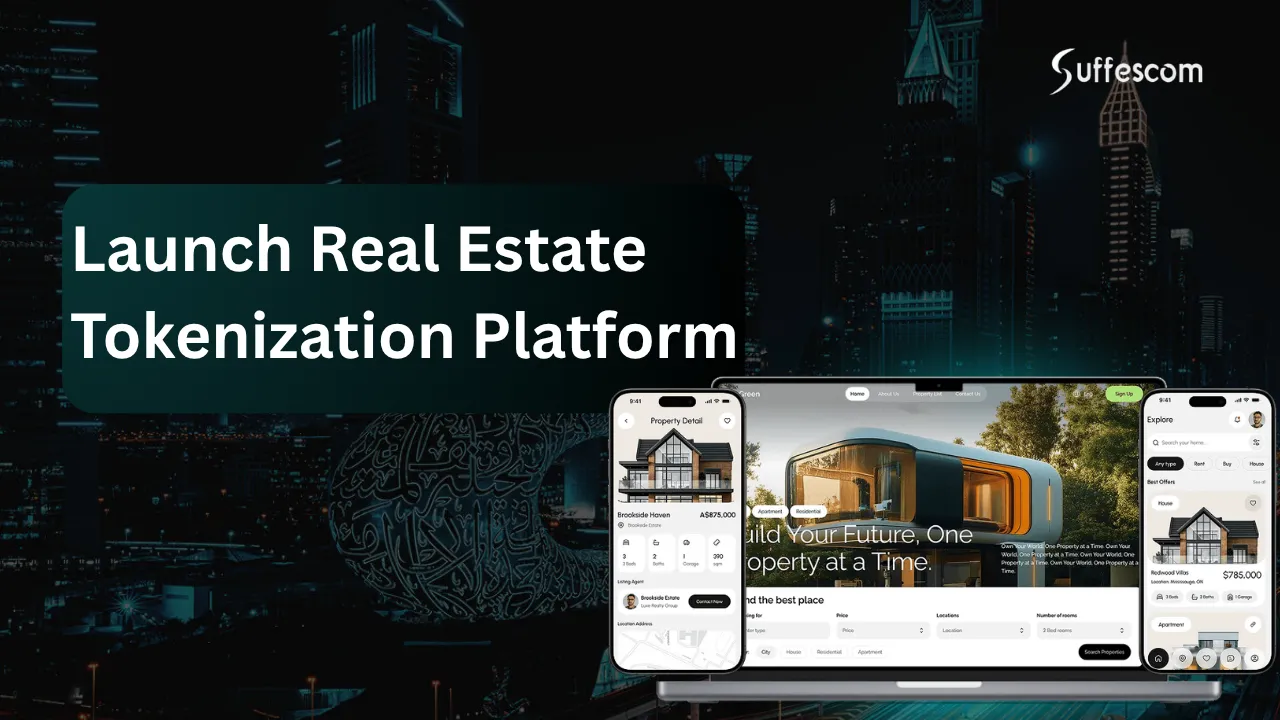
The real estate market in the UAE is anticipated to reach a staggering US $709.67bn in 2026, and the global market sees over $400 bn in transactions each year, yet access to high-value properties remains limited for most investors. High entry costs and low liquidity make it hard to participate in premium assets. This gap creates a high need for a better way to invest.
Real estate tokenization platform solves this problem by turning property into digital shares on a blockchain. Each share represents a small part of the asset, so investors can buy, sell and trade without large capital. It also makes transactions faster and more transparent.
In this guide, you will learn how to develop a real estate tokenization platform. It covers core concepts, key features, technology choices, legal aspects and cost factors so you can build a platform that is secure and ready for real users.
Real estate tokenization is the approach of converting property ownership into digital tokens on a blockchain. Each token shows a share in the asset. Investors can buy small portions of the full property and not the whole. This makes access easier and improves liquidity as well.
Key stats include:
A tokenized property is not just digital shares as it requires a precise structure that connects the physical asset and blockchain layer. Each component plays a role in guaranteeing smooth transactions and regulatory alignment.
Core components:
| Aspect | Traditional Real Estate | Tokenized Real Estate |
| Ownership | Full or joint ownership | Fractional digital ownership |
| Entry Cost | High capital required | Low minimum investment |
| Liquidity | Very low | High with trading options |
| Transaction Speed | Weeks or months | Hours or days |
| Transparency | Limited | High via blockchain |
| Accessibility | Restricted to a few investors | Open to global investors |
| Paperwork | Heavy and manual | Mostly digital and automated |
There are a lot of reasons why you should create a tokenized real estate platform for the UAE market:
Real estate tokenization works on a clear flow where a physical property is changed into digital assets and offered to investors through a platform. Every stage of operation connects legal ownership with blockchain execution to guarantee transparency and efficiency.
The process starts with selecting a property that has investment potential. Different factors like location and rental yield are considered. Once selected, the asset is evaluated through professional valuation to know its market worth and expected returns.
After valuation, the property is placed under a legal entity like an SPV. The method establishes a connection between the tangible asset and its digital tokens while securing the rights of investors. The current stage requires compliance to meet regulatory standards.
At this stage, the property is digitized into tokens using blockchain technology. Each token shows a fractional share of the asset. The total number of tokens depends on the asset value and investment model. Blockchain networks like Ethereum or Polygon are used to guarantee security and scalability.
After the creation of tokens they are listed on the real estate tokenization platform where investors can invest and purchase tokens. The platform must have a hassle-free onboarding process that allows users to go through their registration and identity verification easily.
After the initial sale, tokens can be traded on a secondary marketplace. This allows investors to buy or sell their shares based on market demand. It improves liquidity and gives flexibility, which is not available in traditional real estate investments.
Turn your property assets into digital investment opportunities with our expert development team!
Demand for tokenized real estate is rising fast in the UAE due to high property values, rental yields and a large base of global investors. Many investors want exposure to premium assets in cities like Dubai but prefer flexible entry and faster exit options.
Residential tokenization is used for ready to rent units where income starts coming from day one. Instead of waiting for full ownership, investors buy shares in income producing homes and receive periodic rental payouts.
Commercial assets are tokenized when there are long term tenants and fixed lease agreements. This creates a predictable income that can be distributed to token holders.
This model digitizes pooled real estate portfolios and rather than a single asset investors hold tokens by multiple properties, which decreases risk exposure.
Tokenization allows access to properties in a lot of countries without direct ownership issues. Investors in UAE can participate in foreign markets without dealing with any transfer process issues.
Liquidity is driven by platforms where tokens can be traded after initial purchase. This is where most investor activity happens once assets are live.
A real estate tokenization platform should be built with compliance and investor trust at the core. Let’s explore the features that your real estate tokenization platform should definitely have.
Quick onboarding feature with identity checks using Emirates ID or passport. Include AML screening and support for both individual and corporate investors.
List the verified properties only with valuation and rental data like details. Use an SPV approach and convert assets into blockchain based digital records.
Add a feature to enable fractional ownership through secure token creation. Use audited smart contracts to automate ownership transfer and rental income distribution.
Provide a simple dashboard to track holding and transaction history with instant updates in the platform.
Support AED and international payments via bank transfer, cards and crypto wallets.
Create an in-platform trading system so investors can buy and sell tokens smoothly with real time pricing and liquidity.
Add tools in the real estate tokenization platform for automated reporting and transaction monitoring to meet UAE regulatory expectations.
Add a feature during real estate tokenization development of both Arabic and English interfaces to serve local and international investors with ease.
Include a feature to add secure escrow mechanisms to hold investor funds and release based on transaction milestones.
Allow tokenization of off-plan projects with payment plans and staged ownership distribution.
To build a real estate tokenization platform in UAE, you need to follow an approach that is reliable and combine blockchain development with a user-focused design.
Begin by defining how your real estate tokenization platform will operate and generate revenue. This includes deciding if you will focus on residential or mixed assets. A defined model helps with both technical and legal decisions. You can also hire a blockchain development company in Dubai to help you in each phase of platform development.
Choosing the appropriate blockchain is very important in real estate tokenization development for performance and cost. The choice impacts transaction speed and smart contract flexibility.
In the UAE, legal structuring is a main part of real estate tokenization platform development. You need to align with real estate laws, securities regulations and investor protection standards before the final launch.
Next, design an architecture that connects the frontend and backend with blockchain layers. This includes user management systems and smart contract integration. This particular approach helps in future upgrades and expansion.
To develop a real estate tokenization platform, it is important to aim for easy onboarding and smooth investment flows. A user-focused UI increases trust and decreases drop offs rates during registration and transactions.
This is the core real estate tokenization development phase, where all components are developed and integrated. It includes blockchain integration and backend systems.
Before launch, the platform should be tested in different scenarios. This includes functional testing and performance checks. Security is a main aspect that our app development company aims to prevent vulnerabilities in the platform.
Launch the tokenization platform with a defined market strategy and focus on attracting property owners and investors. Use partnerships with developers to build traction on the platform.
After launch, constant support is needed to guarantee smooth operations in your real estate tokenization platform. This includes system monitoring, regular updates, and more. Ongoing maintenance helps in scaling the platform and adapting to regulatory changes in UAE.
Unlock liquidity and attract global investors with a secure digital platform!
The cost to develop a real estate tokenization platform depends on feature depth, blockchain integration and compliance requirements and ranges between AED 30,000 to AED 150,000+. The UAE market establishes its pricing through two factors which include the legal structuring and the KYC/AML integration.
| Complexity Level | Estimated Cost (AED) | Estimated Timeline | Features Included |
| Basic Platform | AED 30,000 – AED 60,000 | 4 – 6 weeks | User onboarding, property listing, basic token issuance, simple dashboard |
| Mid-Level Platform | AED 60,000 – AED 100,000 | 6 – 10 weeks | KYC/AML integration, smart contracts, payment gateway, wallet integration, improved UI/UX |
| Advanced Platform | AED 100,000 – AED 150,000 | 10 – 16 weeks | Secondary marketplace, multi-currency support, enhanced security, scalable backend |
There are many factors that impact the final cost to create a real estate tokenization platform, including:
| Layer | Technology Options | Purpose |
| Blockchain Network | Ethereum, Polygon, Binance Smart Chain | Token creation, ownership tracking, and transaction execution |
| Token Standards | ERC-20, ERC-721, ERC-1400 | Defines how real estate tokens are structured and managed |
| Smart Contract Development | Solidity, Hardhat, Truffle | Build and deploy smart contracts for token issuance and automation |
| Backend Development | Node.js, Python (Django), Java (Spring Boot) | Handle business logic, APIs, user management, and transactions |
| Frontend Development | React.js, Next.js, Vue.js | Build user interface for investors and admins |
| Database | PostgreSQL, MongoDB | Store user data, transaction history, and platform records |
| Wallet Integration | MetaMask, WalletConnect, Coinbase Wallet | Enable users to store and manage digital tokens |
| Payment Integration | Stripe, PayTabs, local UAE payment gateways | Support fiat transactions and payment processing |
| Cloud Infrastructure | AWS, Google Cloud, Azure | Hosting, scalability, and system performance |
| Security Layer | SSL, Firewalls, Multi-factor authentication | Protect platform from cyber threats and unauthorized access |
| KYC/AML Integration | Sumsub, Shufti Pro, Onfido | Identity verification and compliance management |
| APIs and Integrations | REST APIs, GraphQL | Connect third-party services and enable platform functionality |
| Analytics and Monitoring | Google Analytics, Mixpanel, custom dashboards | Track user activity and platform performance |
A real estate tokenization platform in UAE should be built with compliance at its core. Since tokenized assets represent ownership and income rights, this implies that tokenized assets are governed by regulated financial activities.
Classification of the tokens should be determined at the initial stages of the platform setup. In situations where the tokens offer ownership or income, they are considered to be securities. This has a direct effect on your platform issues, markets, and facilitates the trading of these tokens.
Protecting the investors is fundamental in gaining confidence and long term uptake in your real estate investment platform. Your platform needs to have a clear communication flow of property details, risks, and returns.
KYC and AML processes are mandatory for platform operations. Your platform should provide protection of user identity and check financial activity of your platform to avert fraud.
The decisions of licensing are dependent on your platform model and services. The UAE offers good regulatory frameworks that define the way that your tokenized real estate platform will run.
Several tokenization systems of real estate are beginning to integrate DeFi capabilities to add more value to property tokens. It covers lending out against tokens and liquidity pools. It enables consumers to invest their property tokens into a larger digital finance environment.
AI integration is increasing to automate property valuation and risk assessment. These systems use market information, rental patterns, and past prices to provide real time information. This enhances better decision making between the operators of the platform as well as the investors.
Develop your real estate tokenization platform so it supports cross-border investors and multi-region property listings. This needs multi-currency support, a global compliance layer and an infrastructure to support international transactions and users.
Tokenization platforms are now being built with features tailored for institutional investors. This consists of bulk investment, reporting, regulatory dashboards and portfolio management applications. Institutional entry is driving platforms to become more robust and secure.
Platforms are adapting to changing regulations by building compliance into the system itself. This includes automated transaction monitoring and reporting. The platform that is already compliance-ready will grow quicker as regulations become more transparent and will be trusted by investors.
A monetization strategy guarantees that your real estate tokenization platform generates consistent revenue.
Revenue will be generated from your platform when new properties are onboarded and tokenized. Property owners or developers pay a fee to convert real estate assets into digital tokens and list them on the platform.
Each investment or trade creates an earning opportunity in your real estate investment platform. Fees are applied to token purchases and sales on primary listings and secondary market activity.
Continued revenue will be generated from the management of tokenized properties. This involves operations, reporting and distribution of rental returns to investors.
Another monetization model by which you can generate revenue is a fee that is charged to property owners for listing assets on the platform.
The more people engage in trading activities, the more revenue is accumulated on every single transaction made on the marketplace. This becomes a key income stream as liquidity improves.
Additional revenue in your platform will come from offering advanced features to high-value investors. This includes early access to deals and priority investment options.
Integrate a monetization model of recurring revenue by providing subscription-based plans to users for better insights and platform benefits.
Suffescom brings 13+ years of experience in blockchain and software development, delivering digital platforms in 30+ industries. Our developers build reliable real estate tokenization platforms with the best technical and business alignment.
Our development team works with the most popular blockchain networks, such as Ethereum and Polygon, to create safe and effective tokenization systems. This guarantees a smooth token issuance, ownership and execution of transactions.
We develop a real estate tokenization platform with a clear understanding of UAE real estate market and regulatory expectations. Compliance features like investor verification are integrated to support smooth operations.
At Suffescom, our real estate app development team handles the complete tokenization platform development process from planning to deployment with the latest technologies integration.
At Suffescom, each platform is built based on specific business goals. If focused on residential or commercial assets, features are built and integrated to match the investment model and audience.
Our blockchain developers integrate security at every level, including smart contract audits and data protection layers. This helps protect investor funds and platform operations.
We provide post-launch support that includes maintenance and updates. This guarantees that the real estate tokenization platform stays stable and adapts to new requirements over time.
Discuss your business idea with our blockchain experts and receive a tailored roadmap!
A real estate tokenization platform uses blockchain technology to convert property assets into digital tokens representing fractional ownership. It enables secure, transparent, and accessible real estate investment in the UAE market.
Real estate tokenization platform works by linking property ownership with smart contracts on blockchain networks, allowing investors to buy and trade tokenized property shares with full transparency and regulatory compliance.
The real estate tokenization platform is popular due to lower investment barriers, high liquidity, and strong government support for blockchain and digital asset innovation in the UAE real estate sector.
To develop a real estate tokenization platform, you need blockchain development, smart contract integration, KYC/AML compliance, and a secure digital platform tailored to UAE real estate regulations and investor needs.
You must comply with UAE regulations from authorities like the Dubai Land Department and ensure proper asset backing, investor protection, and AML compliance.
Key technologies that are used in real estate tokenization platform development include blockchain networks like Ethereum, smart contracts, cloud infrastructure, and secure APIs for seamless real estate transactions.
Investors gain fractional ownership, portfolio diversification, improved liquidity, and access to premium UAE properties with lower capital investment.
The cost to make a real estate tokenization platform ranges between AED 30,000 to AED 150,000+, depending on features, blockchain integration, compliance, and security requirements, typically ranging from mid to high investment levels in the UAE market.
Essential features of the real estate tokenization platform should include KYC verification, tokenization modules, smart contracts, investor dashboards, and secure payment gateways for smooth operations.
Yes, real estate tokenization is secure when built with blockchain encryption, audited smart contracts, and compliance with UAE regulations, ensuring safe and transparent transactions.
Yes, foreign investors can participate through tokenized platforms, especially in freehold areas, enabling easy cross-border property investment.
The future is strong, driven by blockchain adoption, fintech growth, and increasing demand for digital real estate investment solutions in the UAE.


Hear directly from clients who partnered with Suffescom to turn their digital ideas into secure, scalable, and high-performing products.

“Suffescom delivered a HIPAA-compliant telemedicine app exceeding expectations, with strong data security and thoughtful development strategies from start to finish.”

“Suffescom helped us build a smart property management and virtual tour platform. Their expertise in AI helped us attract more qualified leads.”

“Suffescom delivered a modern hotel booking app perfectly aligned with customer expectations, which helped us boost sales by 40%.”

“We needed real-time fleet tracking and route optimization. Suffescom developed a platform that reduced our operational expenses in the first quarter.”

“We needed a smart itinerary planner with AI features for tourists. Suffescom delivered beyond our expectations and helped us increase bookings.”