
Real-World Asset Tokenization UAE: Complete Guide to Regulations, Benefits, Use Cases & Development Cost
Key Takeaways Real World Asset (RWA) tokenization enables fractional ownership, improved liquidity, and transpare [...]
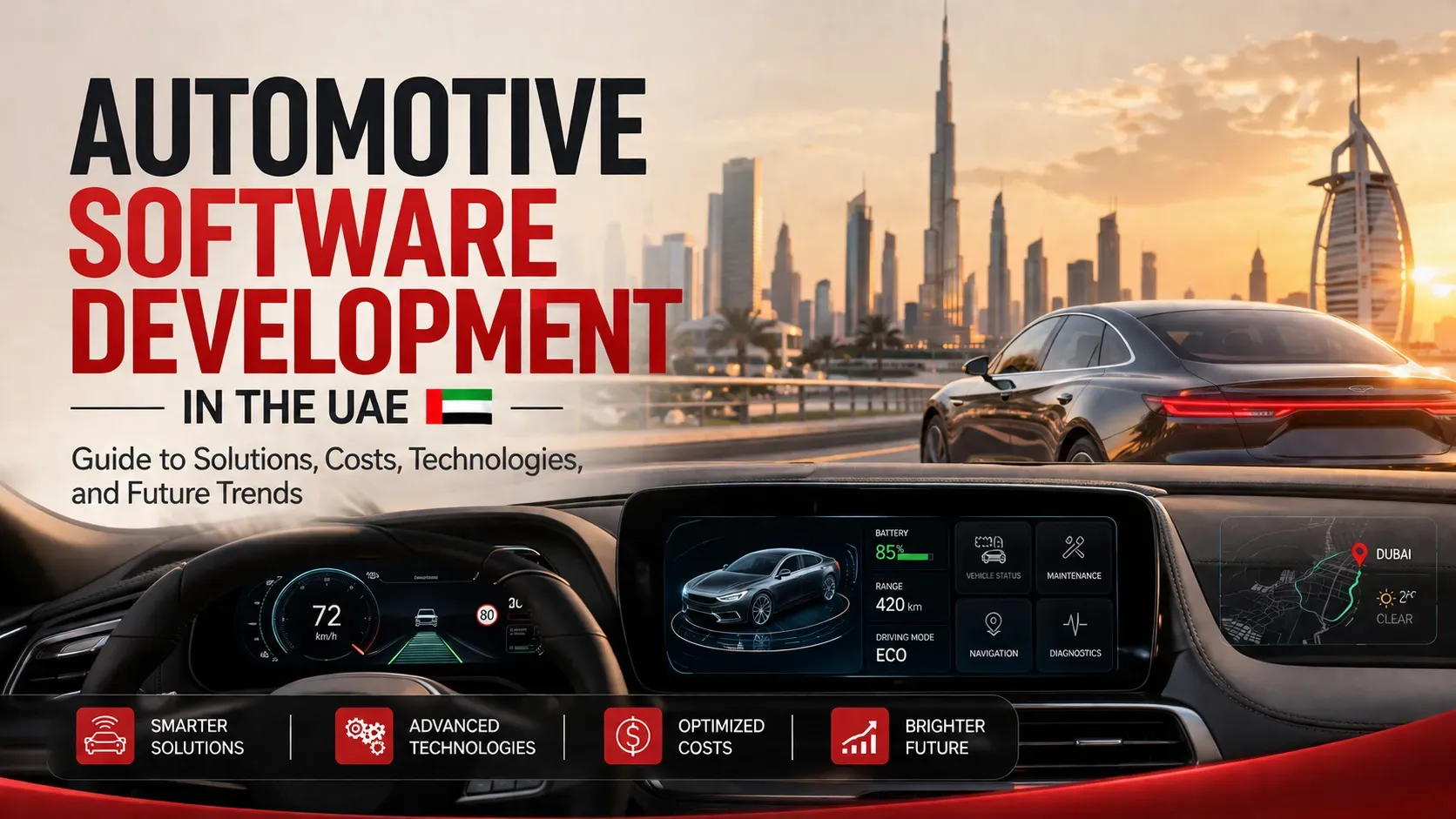
The UAE automobile industry is changing fast because of the advent of the Internet of Things, artificial intelligence, EVs, and connected cars. In 2025, the UAE electric vehicle market generated USD 2.9 billion in revenue. By 2033, it is predicted that it will reach a total of USD 32.7 billion in revenue.
Through software solutions that include intelligent fleet management, predictive maintenance, EV charging software, connected car apps, and other solutions, companies working in the automotive sector can achieve better efficiency and customer experience.
This guide provides information about the various types of automotive software, the benefits of implementing them in a business, their development cost, key technologies used, compliance, and current trends in the UAE's automotive market.
Automotive software development means the development of software solutions that allow enhancing performance and connections between the vehicle and its users, and improving interaction between the two. It can be applied to any type of software, from embedded to cloud solutions, mobile solutions, or artificial intelligence solutions that are developed in order to enhance vehicle performance. With the growing connectivity and software orientation of modern vehicles, automotive software is becoming especially important in intelligent mobility, fleet management, electric cars, and self-driving vehicles.
Embedded automotive software is found within the electronic control unit and the hardware parts of the car. The software performs vital tasks like engine control, braking system, steering mechanism, battery management, airbags, ADAS, and entertainment systems. Embedded automotive software has been developed to be efficient and reliable in terms of performance so as to function effectively under any condition.
Example: An EV manufacturer uses embedded software to check the temperature of the battery and then adjusts the cooling system due to the extreme summer temperatures in the UAE.
Cloud-based systems allow vehicles to communicate their data to remote servers. This system allows the management of fleets, diagnosis of vehicles, predictive maintenance, telematics, over-the-air (OTA) software updates, and analytics dashboards. Using cloud systems, companies get access to data on the vehicles and make necessary decisions.
Example: A logistics firm running 500 delivery vans could track vehicle condition, fuel consumption, and maintenance needs from one dashboard.
Mobile apps help drivers, fleet operators, and vehicle owners to communicate with connected cars using their mobile phones and tablets. The typical functions of such mobile applications include lock/unlock, digital car key, tracking of vehicles, service appointment scheduling, EV charger management, battery monitoring, and push notifications. Such applications help to provide a better user experience and customer engagement.
Example: A connected vehicle application allows one to remotely lock/unlock the vehicle, check its battery status, find out its location, and control climate settings.
UAE's automotive industry is undergoing digital transformation through connected cars, e-mobility, intelligent transport systems, and data-driven fleet management. In an effort to enhance efficiency and safety while meeting customer expectations, the market for automotive software keeps on growing.
Intelligent transport infrastructure is being used by the government to ensure safety on roads and effective traffic management and mobility solutions. Intelligent transportation, intelligent traffic systems, and digital infrastructure are the foundations for automotive software that will be able to interact and make decisions in real time. All this demonstrates the strong push driven by Dubai to promote an autonomous transportation strategy.
Dubai Autonomous Transportation Strategy intends to make 25% of all transport in Dubai autonomous within the next 14 years. The strategy will lead to fewer road accidents and losses from them (12%), increased individual productivity (13%), and savings of 396 million hours spent on transport annually. Also, there will be less need for parking spaces; hence, urban land can be used more effectively.
The quick rise in the number of electric cars has led to the need for software tools in aspects such as charging, battery management, energy efficiency, payment methods, and the electrification of fleets. With more organisations and consumers embracing electric vehicles, software has become very important in guaranteeing efficient charging operations and improving the car's performance.
The Commercial Transport Sector, according to the Roads & Transport Authority in Dubai, has seen growth in excess of 40% in 2025. There has been an increase in the number of licensed companies from 12,100 to 16,917, while the total vehicle count has increased by 25% to 500,000 units. The sector is contributing USD 2.29 billion to the economy of Dubai.
Modern automobiles are able to generate huge volumes of data using different types of sensors, cameras, GPS technology, and Internet of Things devices. The automotive software processes all the information gathered from these sources and makes it useful for remote diagnosis, predictive maintenance, tracking of the automobile, analysis of the driver's behaviour, and over-the-air updates.
With the advancements being made in connected vehicle technology, the UAE government is spending more than AED 1.5 billion on smart mobility applications like ITS and connected vehicle technology. With the investments being made, there is an accelerated adoption of over-the-air (OTA) technology that contributes to the development of the connected car OTA security market.
Automotive software is used across the entire mobility value chain, starting from connected cars, fleets, electric vehicle charging, dealerships, and more. It all comes down to what your business needs and what you want to achieve through digitalization.
| Software Solution | Purpose | Industries Benefiting |
| Connected Car Platforms | Enable:
|
|
| Fleet Management Software | Track vehicles
|
|
| EV Charging Software |
|
|
| Telematics Platforms | Collect and analyze vehicle data to improve: Safety, Maintenance, Operational efficiency |
|
| Dealer Management Systems (DMS) | Streamline: Vehicle sales, Inventory, Customer management, After-sales services |
|
| Predictive Maintenance Software |
| Mining and transport companies |
| Automotive Marketplace Platforms |
|
|
The right features will dictate the efficiency of automotive software in improving operations, enhancing customer experience, and adding business value. The following are the most effective capabilities for automotive businesses in the UAE.
Real-time tracking relies on technologies like Global Positioning Systems, Internet of Things devices, and telematics systems for tracking the movements and behavior of the driver, usage of fuel, and the effectiveness of the route used. The information is helpful in improving the performance of the fleet.
Example: A logistics firm that handles delivery trucks in Dubai can track the routes, fuel use, and whereabouts of the trucks in real time, aiding dispatchers in minimizing any delays.
Predictive maintenance through AI analysis of vehicle data is used to detect any failures that could happen in the future. Early detection of such problems helps companies reduce the time during which the vehicle is idle, decrease repair costs, and increase its longevity.
Example: An AI system can detect any abnormal engine or battery behavior and notify maintenance staff before an incident happens to help save money on unnecessary repairs.
Through OTA updates, manufacturers are able to send software updates without needing cars to be taken to dealerships or servicing centres. It will become much simpler to introduce features, security patches, and keep cars updated throughout their lifespan.
Example: A manufacturer of cars can issue software updates for security patches or infotainment features remotely to many connected cars without having the owners bring their car to the service centre.
The software for battery monitoring will monitor the battery health, cycles of charging, temperatures, and energy consumption. Intelligent thermal management ensures protection of the battery in the varying climate conditions in the UAE, and ensures effective charging and increases its life.
Example: The EV operator can monitor the battery temperature while fast charging and get an alert in case of overheating, which will increase the life expectancy of batteries in the hot weather of the UAE.
The automotive software needs to offer a simple experience for all kinds of customers. The availability of the software in English and Arabic, as well as other popular languages, makes it easier for users to access and navigate through the system.
Example: An app for a car-sharing service in the UAE can be provided in two languages, that is, Arabic and English, which would facilitate booking and provision of other services to residents, tourists, and expatriates.
ADAS technology is used to develop intelligent safety technologies including a lane departure warning system, collision avoidance technology, an adaptive cruise control system, and a driver monitoring system. This technology assists in reducing accidents, enhancing drivers' confidence, and helping in complying with vehicle safety standards.
Example: If the driver accidentally drifts out of their lane, the technology may send a warning signal or even help to correct their course back on track.
The digital key technology allows one to lock, unlock, start, and monitor a car via the smartphone application. The technology works in tandem with remote diagnostics and alerts that increase convenience while improving vehicle security and access.
Example: A car rental business can issue temporary digital keys to their customers via an app, which will enable them to unlock and start the car without getting a physical key.
Automotive software not only facilitates the transformation of tasks into the digital format but can also enable organizations to save money, become more efficient, and make more informed decisions thanks to the availability of vehicle data in real time. The proper software solution will help any organization involved in fleet management, dealing with EV charging, or running a dealership.
With the use of data about traffic, vehicle position, and delivery schedules, the fleet management system can provide optimized driving routes for the users of the fleet management software. This means that for a courier firm delivering goods in Dubai, the firm can optimize its driving route so as to avoid traffic jams.
Operators use vehicle monitoring and maintenance solutions to detect any faults that could lead to equipment malfunction. For instance, a bus operator may receive information that one of their buses needs to be serviced to prevent breakdowns that could affect operations.
Dealer management systems enable dealers to automate inventory, customer management, service booking, and warranty services. For example, a car dealership can immediately find out about the availability of vehicles, book service appointments for clients, and manage client communications.
These platforms track charger availability, energy usage, and transactions to enable effective management of charging facilities. For instance, EV charging facility operators in the UAE can immediately detect an offline charger and dispatch maintenance teams to ensure that revenue is not lost and clients are offered charging points.
Below is the table that shows how automotive software can make various business organizations more efficient by lowering operational costs.
| Business Type | How Automotive Software Reduces Costs |
| Logistics & Transport |
|
| Fleet Operators |
|
| Automotive Dealerships |
|
| EV Charging Operators |
|
Automotive software in modern times is based on cutting-edge technology that allows cars to connect, process information, make decisions automatically, and provide safe driving experiences. All these technologies help companies create smart and scalable mobility solutions.
It analyzes large volumes of vehicle data. It automates decision-making in the vehicle to increase operational efficiency. Eg: a fleet management platform with AI can predict engine failure before it happens, so that businesses can schedule maintenance; This will help avoid the issue and thus will not face downtime.
It learns from current and historical data. And it improves the performance of the system. Eg: The route optimisation system will learn over time about traffic situations across Dubai. It can suggest quicker routes for delivery during peak hours.
It allows vehicles, sensors, and infrastructure to communicate with each other. Eg: The sensors in a delivery truck will provide current data on fuel level, tyre pressure, engine health, etc to a main dashboard.
5G allows high-speed and less delay in communication between vehicles and the surroundings they are in. Eg: connected vehicles are capable of getting real-time data on traffic updates and communicating with the traffic signals, thus reducing congestion and the risk of accidents on roads.
It allows processing and storage of data from vehicles and fleets in one common location. Eg: a logistics firm can monitor huge numbers of vehicles from various cities on a common cloud-based dashboard without having individual infrastructure.
It processes the data on the vehicle or outside on the devices nearest to the vehicle, rather than sending data to the cloud. Eg: An ADAS system capable of identifying a pedestrian will send an instant alert for emergency braking within milliseconds even if it is disconnected from the internet.
It creates immutability and security of vehicle data and the transaction records. Eg: Used car providers will have verifiable vehicle service history information which can be seen by the customers before purchasing the vehicle.
They create virtual copies of the actual vehicle. Eg: fleet managers can predict battery life based on simulation, diagnose component wear, and also analyse the scheduled maintenance plan, without removing the actual vehicle from service.
Here is a summary of key technologies and components in automotive software enabling interconnected, intelligent, scalable automotive software solutions currently:
| Technology | Role in Automotive Software |
| Artificial Intelligence (AI) |
|
| Machine Learning (ML) |
|
| Internet of Things (IoT) |
|
| 5G Connectivity | Supports ultra-fast communication for: Connected vehicles, V2X systems, Autonomous driving applications |
| Edge Computing | Processes critical data closer to the vehicle, reducing latency for faster and safer decision-making. |
| Blockchain | Secures vehicle records, digital identities, transactions, and connected mobility ecosystems. |
| Digital Twins | Creates virtual vehicle models to simulate performance, predict failures, and optimize maintenance. |
The development of automotive software requires an effective process that integrates innovation, efficiency, security, and compliance. Each phase is a prerequisite for the next, helping organizations reduce the risk of software development, thereby developing efficient software on time.
It is impossible to begin successfully without understanding the purpose of the business and the objective of the software that needs to be created.
With all the requirements now having been identified, the next step is to design an architecture that would allow for future scalability and also provide a good user experience to the users.
The following table provides an overview of the key architectural elements for modern automotive software solutions.
| Architecture Component | Purpose |
| Frontend Applications | Deliver user experiences across mobile, web, and in-vehicle interfaces. |
| Backend Services | Manage business logic, authentication, APIs, and data processing. |
| Cloud Infrastructure | Enable data storage, remote access, analytics, and scalability. |
| Integration Layer | Connect vehicles with telematics, IoT devices, payment gateways, maps, and enterprise systems. |
| Data Management | Securely store and process vehicle, driver, and operational data. |
After the finalization of the architecture, development begins for the frontend, backend, embedded, and cloud computing infrastructure. At the same time, the integration of software with the connected vehicle parts is initiated to create the integrated mobility ecosystem.
Testing of the program is done before putting it into use to ensure it functions appropriately in real-world conditions.
This is where the software implementation phase begins. The constant monitoring and upgrading of the software ensures that the system is strong, efficient, and relevant to the requirements of the clients as well as the company.
The expense related to developing software for automobiles is different based on the nature of the solution being developed, the features, integrations, security aspects, as well as new technologies like AI, IoT, and cloud computing. Be it fleet management systems, EV charging solutions, or a connected car solution, understanding the factors that influence costs will be beneficial to you.
The following table shows cost estimates for developing various kinds of automotive software. The costs indicated below can be used as a general guide depending on the scope of your project.
| Software Solution | Estimated Development Cost (AED) |
| Basic Automotive Mobile App | AED 190,000 – 430,000 |
| Fleet Management Platform | AED 430,000 – 1,080,000 |
| Connected Vehicle Platform | AED 720,000 – 2,150,000+ |
| EV Charging Management Platform | AED 600,000 – 1,680,000 |
| IoT Development for Enterprise solutions + AI development | AED 1,910,000+ |
While these estimates provide a starting point, the final investment depends on several technical and business considerations.
Each automotive software development project has its own particularities. The following aspects have the biggest effect on the total cost of the project.
| Development Level | Estimated Cost (AED) |
| Basic Automotive Solution | AED 190,000 – 430,000 |
| Mid-Level Automotive Solution | AED 430,000 – 1,080,000 |
| Advanced Automotive Solution | AED 1,080,000 – 2,150,000+ |
Instead of focusing on developing all features at once, many companies start off by creating a minimum viable product that they can then scale up depending on user reviews and market demand. It is easier to make sure that your product is viable in the market without huge upfront investments.
The use of automotive software technology is revolutionizing the way companies can manage their cars and become more efficient. It is enabling different companies such as fleet management services, car dealers, EV chargers, and insurance providers to improve their processes in order to compete effectively in a rapidly changing mobility environment.
Fleet management software enables companies to keep track of their vehicles, drivers, and other activities using one system. This software gives real-time information to increase productivity while decreasing fuel expenses and vehicle downtime.
Connected vehicle systems improve the ownership experience by facilitating communication between the vehicle and mobile apps, cloud, and other connected devices.
With the development of the UAE's EV charging system, the need arises for software that can help manage the chargers effectively and ensure a smooth charging process.
These usage-based insurance applications collect data on vehicle usage and drivers for the accurate determination of premiums, along with promoting safer driving.
ADAS and driverless car software enhance road safety through the ability to assist in the detection of hazards and intelligent response to changes in driving conditions.
With the increased connectivity of vehicles, it is essential for automotive software to secure important information, provide protection against attacks, and meet compliance regulations. Regardless of whether you are designing a telematics application, connected vehicle application, or electric vehicle charging, security and compliance should be considered throughout the development process.
The software used in automobiles captures personal data, such as drivers' identities, locations, and usage habits. These organizations need to adhere to the privacy laws of the UAE for proper data collection and processing.
Some of the aspects that these organizations need to consider are:
Current vehicles use several interconnected systems that constantly exchange data. Using international cybersecurity standards will help companies minimize security threats, increase software reliability, and gain customer confidence.
The table below shows some of the commonly used standards in the development of automotive software.
| Standard | Purpose |
| ISO/SAE 21434 | Provides a framework for managing cybersecurity risks throughout the vehicle lifecycle. |
| ISO 26262 | Defines functional safety requirements for electrical and electronic systems in road vehicles. |
| UNECE WP.29 | Establishes cybersecurity and software update requirements for connected vehicles. |
While not every automotive solution requires compliance with each standard, understanding these frameworks helps businesses build software that aligns with global industry best practices.
Besides meeting regulatory requirements, the right kind of security protocols should be established to secure the vehicle and mobility solution against attacks from the cyber world.
A secure connected mobility solution ensures that you have minimized the risks of cyber threats.
The software development process for this kind of automotive program is far more complex than the development of normal web or mobile software. The developers have to worry about performance, security, compliance, and other concerns in such a manner that would ensure the software is capable of dealing with future advancements of the car.
Every project that uses automotive software will have its own technical and operational issues. The following table presents some of the most common issues that companies encounter and the solutions to these issues.
Cybersecurity Threats
Since connected vehicles produce large quantities of sensitive data every day, cyberattacks targeting vehicle APIs can exploit vulnerabilities, gain access to stored data, or interfere with related services. While robust encryption, strong authentication, and regular security monitoring are essential in reducing these risks.
Integrating Existing systems with new technologies
Some companies in the automotive sector rely on outdated legacy ERP/CRM/dealership management software. In a real-world scenario, new customer-facing apps would require seamless synchronization of product inventory, servicing data, and client-based information with older systems, without an unnecessary and expensive replacement process.
Managing Massive Quantities of Vehicle Data
Connected vehicles produce immense quantities of data from GPS tracking devices, sensors, cameras, and other devices. For instance, two thousand fleet management vehicles could generate millions of data points a day that need to be quickly and reliably processed, stored, and made available through mobile apps and other enterprise applications. Cloud and edge computing offer robust solutions.
Regulatory Compliance issues
Automotive software must be compliant with a range of privacy and vehicle-related rules. A connected vehicle system collecting its driver's location data may be required to adhere to particular privacy legislation in the UAE and international automotive cybersecurity standards where applicable.
Scalability requirements
Businesses in the automotive sector should create software with future expansion in mind. For example, an automotive application must perform consistently on every one of its users' devices once it scales up to tens of thousands, while ensuring that each individual user's experience isn't affected. Cloud computing helps here.
Real-time functionality
The majority of automobile applications need an instantaneous reaction to take appropriate action and ensure optimal performance; for example, an obstacle detection functionality needs to happen in the smallest possible timeframe to offer support to a driver in a potentially perilous scenario. To reduce data delay while using edge devices, vehicles need to connect directly to them with very high speed.
Multiple Systems Integration
Modern automotive software must simultaneously connect to a variety of integrated and external systems. For example, an e-mobility system must communicate in real-time with many other services such as third-party payment platforms, customer service apps, charging apparatus, map providers, and customer databases.
The UAE is fast-tracking its journey towards connected, intelligent, and autonomous mobility. With government-led efforts in smart transportation and sustainable innovation, automotive software is transcending from conventional in-vehicle software to safer and continuously connected driving experiences.
Below are the trends that will shape the future of automotive software development in the UAE.
Software-defined vehicles (SDVs) have made cars into intelligent platforms that will be able to get upgrades even when they are not at the factory. Through software updates, manufacturers can make upgrades, increase vehicle performance, and also increase the security level of the car.
Some of the key trends in SDVs are:
AI is becoming the backbone of self-driving technology, as it allows cars to sense their environment, evaluate the road, and make decisions in real time. As the UAE continues to build its smart mobility infrastructure, AI-equipped automobile technology will become increasingly important in ensuring road safety and efficient traffic management.
Some of these innovations are:
V2X communication allows vehicles to communicate with their surroundings, which includes the infrastructure, other vehicles, and devices. It helps to enhance situational awareness, decrease traffic congestion, and provide safety in transportation.
Technologies used in V2X include:
The digital twin technology is employed to create a virtual version of the vehicle that helps in simulating real-life situations before releasing any software upgrades. The following are some common uses of the technology:
The design of automotive software requires technical expertise that goes beyond the usual technical skills required when designing apps. If you are looking to design a connected car platform, a fleet management software solution, electric vehicle charging software, or telematics software, your project requires technical expertise in innovation and integration. At Suffescom, we offer technical expertise that is coupled with business acumen to design your automotive software.
Whether you're developing a brand-new mobility solution or upgrading an existing one, we provide full software development services that cover all stages of your project.
We make use of the most modern technology to develop intelligent automotive solutions that are capable of growing together with your company.
Security and reliability are built into every step of our development process and allow businesses to be confident when releasing their software products.
Engagement does not stop once our software has been deployed. We cooperate with you to optimize performance, add functionality, and adjust software according to evolving needs to make sure that your automotive platform continues to be relevant as your company grows.
Need a piece of automotive software developed specifically for you? Consult our specialists and get your own development strategy.
Automotive software development is changing the game in the manufacturing process, connectivity, and management of cars in the UAE. Whether through fleet management and intelligent car systems, electric vehicle charging point solutions, or even autonomous mobility, companies are making use of automotive software in order to increase efficiency, enhance the customer experience, and leverage revenue-generating opportunities. As technology advances, companies that want to stay ahead in today's automotive world will have to invest in automotive software.
Whether you are developing automotive software applications or building an intelligent connected mobility platform, it pays to choose the right technology partner for the job. Suffescom combines deep industry knowledge with cutting-edge technology to provide you with the best possible automotive software solution. Contact our experts now to discuss your automotive software project.
The automotive software development process entails designing and implementing digital technologies for connected cars, fleet management solutions, electric car charging solutions, telematics, dealership software, and in-vehicle software. These digital technologies optimise vehicle operation, provide a superior user experience, enable operational automation, and contribute to the smart mobility future.
The growth in the use of connected cars, electric vehicles, and intelligent transportation systems in the UAE has seen an increase in the need for automotive software. This is because firms are making investments in technology to enhance their fleet management and customer engagement.
The price for developing automotive software varies based on the project's complexity, features, integration, and technology stack. On average, however, the cost of basic automotive software begins from AED 190k, while the cost of connected vehicles may be around AED 1.9 million.
The time required for developing these products depends on the nature of the projects being done. For an entry-level automobile development project, it would take anything between three and six months, but for bigger projects with the use of AI and IoT, it takes nine to eighteen months.
Companies have the capability to develop their own fleet management software, connected vehicle platform, EV charger management system, telematics system, predictive maintenance platform, dealership management system, automobile marketplace, and mobile app for car owners.
Artificial intelligence may be employed in predictive maintenance, analysis of the driver's behavior, route planning, fraud detection, autonomous driving, and creation of a personalized experience in the car. In addition, it is possible for companies to analyze data related to cars for operational purposes and to reduce maintenance expenses.
There are several applications currently used in cars, such as:
Fleet management software will help to:
All these tools will be helpful in cutting down costs and improving the efficiency of the business.
Software-defined vehicles are referred to as motorized vehicles whose functions can be controlled through software. This type of car gives room for software updates to improve the performance of the vehicle.
EV software handles the following:
This helps improve charging efficiency and increase battery lifespan.
Automotive software is obliged to comply with industry standards such as ISO/SAE 21434 – cybersecurity standard and ISO 26262 – functional safety standard. Companies are obliged to ensure the security of their APIs and implement encryption and authentication systems.
Contemporary software for automobiles can be interfaced with the following:
Services offered by the organization include:
Select a partner who is proficient in automobile technology, familiar with artificial intelligence and the Internet of Things (IoT), is equipped with strong security protocols, adopts an efficient software development methodology, and possesses excellent communication skills.
Even though the current software is user-friendly, it lacks the ability to customize and scale up. Customized software designed for the automobile industry will be developed according to your needs and scalable as well.

Senior Content Strategist
Jonathan Raabe is a content marketing professional, focusing on mobile apps, software engineering, artificial intelligence, SaaS, cloud computing, and digital transformation. Jonathan works with visionary brands to translate complicated concepts into content that can be easily understood by their audiences. As an expert in his field, Jonathan strives to create content that is thought-provoking and backed by facts, while at the same time building brand authority and trust.



Related Blogs