Why Mobile Apps Fail in UAE & Saudi Arabia: 15 Critical Mistakes That Cost Businesses Users, Revenue & Market Share
The UAE is among the best-connected nations globally, where mobile internet drives communications, daily life, and comme [...]

Businesses in the UAE and Saudi Arabia lead the GCC countries in their quest for digital transformation by making massive investments in mobile application development to increase customer satisfaction, enhance automation, and grow their businesses. Mobile apps have been integrated into corporate strategies in sectors such as finance, health care, retail, logistics, and public services.
But whether your app will succeed in a highly competitive market depends greatly on which development partner you choose. On a surface level, it does not seem such a hard task, but it really impacts your software development. This guide will help you in choosing a mobile app development partner in the UAE and Saudi Arabia.
The selection of the appropriate vendor for the creation of a mobile application is one of the most important decisions that the enterprise will have to make in the process of its digital transformation. This applies to the situation whether the enterprise wants to create a mobile app for its clients or build a platform for increasing the productivity of its employees.
As a result of doing business in rapidly developing digital economies such as the UAE and Saudi Arabia, the firm encounters various challenges in regard to compliance issues, evolving customer requirements, and increased competition. The selection of a suitable vendor should therefore not be based on cost alone.
Adoption of enterprise mobile solutions is increasing in the Gulf Cooperation Council countries as organisations continue their pursuit of innovative and digital-first customer experience. Government initiatives such as Saudi Arabia's Vision 2030 and the UAE's digitisation initiatives are prompting companies to adopt mobile technology to enable innovative practices.
Organisations in different industries, including banking, healthcare, retail, logistics, and even governmental departments, now depend on mobile apps to enhance accessibility, automate processes, offer real-time services, and engage customers.
It is not the lack of ideas that makes many enterprise apps fail, but the incorrect choice of a vendor for the project. Working with an inexperienced or ill-fitting vendor may create a serious threat to the company and the development process itself.
Typical problems may include:
All of the above can negatively affect the ROI of the project. The cost of a data breach is more than the financial impact alone.
A good agency not only helps with the software development but also assists companies in managing risks, speeding up processes and developing solutions for their sustainable growth.
| Factor | Right Vendor | Wrong Vendor |
| Time-to-Market | Faster Launch | Project Delays |
| Security | Compliance-Ready Architecture | Security Vulnerabilities |
| Cost Control | Predictable Budget | Cost Overruns |
| User Adoption | High Engagement & Retention | Poor User Experience |
| Scalability | Future-Proof Solution | Costly Rebuild Required |
| Support | Ongoing Maintenance & Optimisation | Limited Post-Launch Support |
When it comes to choosing vendors for businesses from the UAE and Saudi Arabia, this task should be treated more as an investment decision rather than a procurement one because the proper development partner will be a valuable asset in innovation and growth.
Enterprise organisations should have a clear picture of their own needs before considering mobile application development companies. The mobile applications created for the UAE and Saudi Arabia are expected to be highly innovative and to match the expectations of the sophisticated users.
The more a company knows about the requirements of the region, the more likely it is to provide an adequate solution to the client's problems.
The UAE upholds its record for being an innovator in digital technology at the international level. Businesses have started to use mobile applications to improve customer experience, automate activities, boost efficiency, and earn money digitally.
A number of mobile applications for enterprises in the UAE include:
The increasing digital transformation has made it necessary for companies to seek mobile apps that are secure, scalable, and that fit in well with the business processes.
The Vision 2030 program in Saudi Arabia is contributing towards extensive digital transformation within both the public and private sectors in the country. There is substantial investment in technology for upgrading service delivery systems, increasing operational efficiency, and implementing economic diversification strategies.
Some of the uses of mobile apps in assisting Saudi firms include:
Thus, it is normal that many companies will look for partners in mobile application development that have a history of creating enterprise-class applications.
Various industries have specific requirements that greatly affect the design of the mobile app, as well as the security measures required to implement them. Knowledge of such requirements will help organisations choose vendors that have expertise in the particular field.
Banking & Fintech
Financial institutions need to have extremely secure mobile apps that are able to process sensitive information and transactions.
Key requirements for building a compliant fintech app include:
Healthcare & Telemedicine
Healthcare organisations need applications that improve patient access while maintaining strict data privacy and security standards.
Common features include:
Retail & E-commerce
Retail businesses focus on delivering seamless shopping experiences that drive engagement and conversions.
Typical requirements include:
Logistics & Supply Chain
Logistics companies rely on mobile technology to improve visibility, efficiency, and operational control.
Common capabilities include:
Government & Public Services
It is becoming common for governments to use mobile apps in order to enhance citizens’ participation.
Key requirements often include:
With clear industry requirements set out in advance for vendors to understand, it will increase the likelihood of success when selecting a development partner that can add real business value.
All app development firms do not have the same skills and support to provide. Even though some firms are able to develop applications, fewer are capable of providing a business-oriented, secure, and scalable application.
In order to minimise the risk involved and maximise ROI, UAE and Saudi firms should consider the following aspects when selecting vendors.
The technical expertise of the vendor serves as the basic requirement for a successful project. Measure the vendor’s experience in developing applications that are native, cross-platform, cloud-native, and enterprise applications.
Look for expertise in:
Knowing what the industry entails will make the job a lot easier since there is less chance of running into unforeseen problems in the process of development.
Vendors with GCC experience typically have a stronger understanding of:
Ask for examples of projects completed within your industry and region.
Portfolio strengths reflect both technical expertise and business knowledge. When reviewing a portfolio, assess:
Measure business performance instead of concentrating exclusively on visuals.
The most technically advanced application will not succeed if users have trouble navigating through it. Strong UI/UX capabilities should include:
Agile development is important for modern enterprise applications to allow for flexibility and improvements. An effective Agile process typically provides:
Cloud-native architectures improve scalability, security, and operational efficiency.
Evaluate experience with:
The security aspect must be integrated into all parts of the development process. Ask vendors about:
Many enterprise applications rely on integrations within internal systems and external platforms.
Common integrations include:
Strong integration expertise reduces operational complexity and improves efficiency.
Many enterprises are now exploring AI-powered mobile experiences.
Relevant capabilities may include:
Choose a vendor that can support future innovation requirements.
Comprehensive testing helps prevent costly issues after launch.
A mature QA process should include:
The testing and maintenance costs of an existing mobile app in the UAE are generally higher than the costs of performing regular maintenance on a timely basis.
Mobile app development does not end after deployment.
Evaluate support offerings such as:
Long-term maintenance is critical for application stability.
Enterprise applications must support future business growth.
Discuss how the vendor approaches:
Scalability should be considered from day one.
The organisations working in the UAE and Saudi Arabia need localisation components that may be ignored by global vendors.
Examples include:
Local expertise can improve user adoption and market success.
Poor communication is one of the most common causes of project delays.
Assess:
Transparency throughout development is essential.
The lowest quote is not always the best value.
Look for vendors that provide:
A transparent commercial model helps avoid budget surprises later in the project.
Choosing a mobile application development provider becomes difficult in cases where several service providers have been found to be equally competent. An enterprise should employ an assessment framework that enables it to objectively measure these vendors against those criteria that matter most for its enterprise.
A service provider scorecard enables decision-makers to evaluate a provider's technical skills, security standards, industry expertise, customer support, payment plans, and communication processes in a standardised manner.
First, pick the most appropriate set of criteria to assess your project and assign a weight to each criterion based on its significance in contributing to the success of the organisation's business. For example, hospitals and health care facilities would pay more heed to their security and compliance, while retail companies would care about usability and time-to-market.
Next, you will need to rank each potential partner in relation to the selected criteria according to a common rating scale. By calculating the weighted ratings of each partner, one will be able to select the one that best meets their needs.
The list of evaluation criteria to be considered might include the following:
| Evaluation Criteria | Weight (%) |
| Technical Skills | 20 |
| GCC Experience | 15 |
| Security Compliance | 15 |
| Design Expertise | 10 |
| Support Services | 10 |
| Pricing Model | 10 |
| Communication | 10 |
| Innovation Capability | 10 |
| Total Score | 100 |
This framework may be tailored according to specific objectives, industry needs, and the degree of risk tolerance by enterprises. The main idea here is that all potential vendors must be rated based on the same criteria, and emphasis should be put on creating long-term value instead of short-term savings.
The creation of a scoring system will lead to better decision-making and a traceable process of evaluating the vendors.
Compliance must be integral to the vendor selection phase, particularly for organisations operating in highly regulated environments. The mobile application might involve the handling of sensitive personal information, financial data, health data, and other critical business information, thus making compliance an absolute necessity.
Prior to choosing the developer, enterprises need to ensure that the vendor is familiar with the relevant regulations in the UAE and Saudi Arabia and adheres to recognised security practices in software development.
Steps have been taken by the UAE to improve data protection regulations to cope with the rapidly advancing digital economy in the country. Organisations dealing with personal data collection, processing, and storage will have to ensure that mobile applications meet relevant data protection and privacy regulations.
In the vendor selection process, inquire about their experience in:
The vendor needs to have the capability to show how the security and privacy requirements are implemented in the application's lifecycle.
Regulations that govern the collection, processing, sharing, and protection of personal data by organisations are provided in the Personal Data Protection Law (PDPL) of Saudi Arabia.
Organisations must ensure that their potential vendors have knowledge of the following PDPL-related matters:
Different sectors might have more obligations to comply with than just data protection regulations. Examples include:
Banking & Fintech
When developing a Fintech app, you generally need to focus on the following aspects:
Healthcare
In healthcare app development, the following obligations are always at the key focus:
Government & Public Sector
In government apps, following are the key areas that matter:
Retail & E-commerce
Retail industry have to deeply focus on the below mentioned aspects during app development:
Enterprises should prioritise vendors with proven experience in their specific industry.
Cloud infrastructure choices could have far-reaching compliance ramifications. Based on the particular industry and the demands of a given project, a company might want to determine where its data is going to be stored, processed, and backed up.
Evaluation issues include:
A reputable vendor must be capable of providing answers to these questions.
| Requirement | UAE | Saudi Arabia |
| Data Protection Requirements | ✓ | ✓ |
| Personal Data Privacy Controls | ✓ | ✓ |
| Data Residency Considerations | Varies by Industry | Often Required |
| Cloud Hosting Compliance | ✓ | ✓ |
| Security Audits | Recommended | Recommended |
| Industry-Specific Regulations | Sector-Based | Sector-Based |
| User Consent Management | ✓ | ✓ |
| Data Encryption Standards | ✓ | ✓ |
Compliance cannot ever be viewed as an activity that occurs after development is completed. Any company that considers compliance matters when selecting a vendor will be less susceptible to expensive fixes, security compromises, and other legal matters in the future.
The most significant decisions that companies have to make before initiating an application project involve the selection of the approach that will be used for the creation of the app. Different companies opt for either creating applications in-house or outsourcing development.
There are different pros and cons associated with each strategy, and the proper one is selected based on various considerations.
Hiring a development team internally provides companies with full control over the process and resources.
Benefits of hiring a development team internally include:
Nevertheless, it is quite costly to hire a development team and keep them on board.
By outsourcing, businesses can leverage external expertise without incurring the cost of building their own team.
Some of its main advantages are:
It can be a preferred option for companies seeking digital transformation with stable budgets.
The use of a specialist development team allows combining internal development with classic outsourcing. The outsourcing provider creates a team that is totally dedicated to the client’s project but still operates within the framework of the provider’s operations.
Advantages include:
It is especially useful for companies that plan to constantly develop their products.
There can be no universal strategy applicable to each and every organisation. Organisations must analyse the skills available within the company, budget limitations, project complexity, and organisational expansion plans.
For many organisations, outsourcing or specialised development teams are the better options due to quicker access to relevant skills, cutting-edge technology, and industry experience.
| Criteria | In-House | Outsourcing | Dedicated Team |
| Cost | High | Medium | Medium |
| Speed to Launch | Medium | Medium | High |
| Flexibility | High | Medium | High |
| Access to Expertise | Limited to Internal Team | High | High |
| Management Effort | High | Low | Medium |
| Scalability | Medium | High | High |
| Recruitment Burden | High | None | None |
| Long-Term Control | High | Medium | High |
The committed team concept works best for a number of businesses in the UAE and Saudi Arabia. Yet again, the right solution to adopt is based on the organisation's objectives and resources.
There are many ways of determining if a vendor has the capability of undertaking an IT project, some of which include the website, portfolio, and sales pitch. However, these tools do not give a complete picture of what the vendors are capable of. Hence, before signing any contract, it is essential that corporations conduct thorough due diligence.
There is nothing that cannot be answered with a good question.
Technical capabilities need to be evaluated beyond fundamental development capabilities.
One may consider asking:
Such questions will help understand whether the supplier will be able to support both present and future business needs.
Security should be one of the key criteria of consideration, especially when dealing with confidential customer and business information.
Some of the questions to ask are as follows:
Good project governance plays an important role in keeping a project on time and under budget.
Ask vendors:
Good communication processes can go a long way towards reducing any misunderstandings and project delays.
Post-launch support is just as important as development itself.
Questions to ask include:
A strong support framework ensures long-term application stability.
Commercial transparency helps enterprises avoid unexpected costs and contractual disputes.
Consider asking:
The objective here is that all matters regarding cost, ownership, responsibility, and expectations be clear before any development commences.
Through posing such questions from the outset, UAE-based companies, as well as those based in Saudi Arabia, would have a much better understanding when choosing vendors for mobile app development projects.
Knowledge of development costs is an essential element in the process of choosing a vendor for software development. Although price must not be the deciding factor during this process, it is important for enterprises to have real budgeting expectations prior to beginning a project.
The cost of developing a mobile application in the UAE and Saudi Arabia will depend largely on the complexity of the application, the features required, the technology stack, integration needs, security measures, and support needed for the application.
Instead of concentrating on the cheapest offer, enterprises should consider the total value added by the vendor to the project.
Several factors influence the total investment required for an enterprise mobile application.
Key cost drivers include:
The more sophisticated the application, the greater the development effort and associated costs.
There is considerable variation among enterprise applications in terms of size and complexity. While the exact price would be dependent on the specificities of each particular project, the numbers below will provide an adequate baseline for UAE and Saudi Arabian enterprises wishing to create their own mobile applications.
| App Type | UAE Cost Range | Saudi Arabia Cost Range |
| Basic App | AED 40k – AED 120k | SAR 40k – SAR 120k |
| Mid-Level App | AED 120k – AED 350k | SAR 120k – SAR 350k |
| Enterprise App | AED 350k – AED 1000k | SAR 350k – SAR 1000k |
| AI-Powered App | AED 500k – AED 1500k | SAR 500k– SAR 1500k |
Many organisations budget for development but underestimate the costs associated with operating and maintaining an application after launch.
Common hidden expenses include:
Such costs may form a considerable percentage of the total cost of ownership for the application.
It is for this reason that companies should ask for a cost breakdown from prospective suppliers before making their final decision.
Even highly financed digital transformation projects have been known to fail due to bad vendor selection decisions by the firms. Delays in project completion, overruns in budgets, cybersecurity problems, and low rates of user acceptance are some of the problems that can be attributed to poor decision-making in the evaluation and selection process.
Here are some common reasons why most mobile apps fail in UAE.
Choosing vendors based on the fact that they had offered the lowest bid is another very common mistake.
Even though cost is a very significant factor, opting for the cheapest choice can be quite risky since it can come with such disadvantages as:
The initial cost will result in higher expenses in the future.
Organisations tend to be concerned primarily with functionality when selecting vendors without regard for their compliance needs.
This may lead to numerous problems in the course of a project, including:
Organisations working in areas like banking, finance, healthcare, and government must consider vendors with prior compliance experience.
An elegant website and an excellent portfolio are not always an indication of performance in projects.
Prior to selecting a vendor, businesses need to:
References from past clients tend to uncover many facts that may remain hidden during a sales call.
Most application software is created with present-day requirements in mind, but does not take future growth into account.
With increased users, processing, and data volumes, applications that are not properly designed may have:
Scalability must be a fundamental issue at the outset
Ambiguous contracts can lead to misunderstandings, conflicts, and unforeseen costs throughout the development process.
Some of these key areas are:
The structured contract ensures mutual benefits and sets clear expectations before development starts.
By avoiding these common pitfalls, you can increase the chances of success and help UAE and Saudi companies choose the right development partners.
Not all mobile application companies which claim to offer enterprise-level services have the necessary skills, procedures, and means of providing such support for complicated projects. Some red flags may be very obvious, while some will only emerge during the process of development, when it would be too late to switch to another vendor.
Knowing the red flags could help enterprises in the UAE and Saudi Arabia make the right choices.
The absence of any experience in projects should be an immediate red flag.
Avoid vendors who:
Performance in the past is usually one of the best predictors of future success.
The professional provider must have a clearly defined development methodology and project management system.
Red flags will be:
Without a systematised process, there is a higher risk of project delay and cost overruns.
A price that is notably lower than its competition is usually associated with some underlying sacrifices.
Possible issues include:
Businesses should emphasise value and competence over low bids.
Security must be ingrained into the software development life cycle.
Red flags may include:
Enterprise apps with poor security pose significant business risks.
Application development for the UAE and Saudi market environments usually needs knowledge about local business customs, regulations, language preferences, and user expectations.
Vendors who have little or no experience of the GCC may find it difficult to cope with:
Most vendors emphasise development but provide very little support after deployment.
Check for vendors who:
A mobile application needs maintenance to stay secure, stable, and compatible with changing technology.
Communication challenges frequently transform into risks for projects in the long run.
The warning signs of this risk may include:
Communication difficulties prior to signing the contract will hardly improve in the course of development.
Respected vendors are generally ready to give you client references, customer testimonials, or case studies.
You need to be careful if the vendor:
Reference checking is still one of the best ways to validate vendor capabilities.
| Red Flag | Potential Risk |
| No Relevant Portfolio | Poor Project Execution |
| Unclear Development Process | Delays and Budget Overruns |
| Extremely Low Pricing | Quality and Support Issues |
| Weak Security Practices | Compliance and Data Risks |
| No GCC Experience | Localisation and Market Challenges |
| Limited Post-Launch Support | Long-Term Operational Problems |
| Poor Communication | Project Misalignment |
| No Client References | Unverified Capabilities |
The early identification of these indicators will help businesses save a lot of time, money, and effort. A dependable mobile application development partner needs to prove their transparency, technical skills, security knowledge, and success stories in the UAE and Saudi Arabia.
The world of mobile applications continues to change quickly in the GCC region. With organisations stepping up their efforts in digital transformation, enterprise apps are becoming smarter and business-critical.
Knowing where the trend is going to lead may help enterprises select suitable developers for their future needs, not only for what they currently require.
AI is now an essential part of any business application solution. AI is being used by enterprises nowadays to automate processes, personalise, and make better decisions.
Some common use cases of AI are:
With the rise of AI solutions in the UAE and Saudi Arabia, companies are now looking for a development partner with real expertise in implementing AI into mobile solutions.
Following the footsteps of successful platforms like WeChat and Careem, many organisations have begun to adopt the model of a super app, which integrates multiple services into one app.
Advantages include:
This trend is especially applicable to financial institutions, retailers, transportation companies, and governmental organisations.
Low-code and no-code platforms are helping organisations accelerate application delivery and reduce development timelines.
Enterprises are using these platforms to:
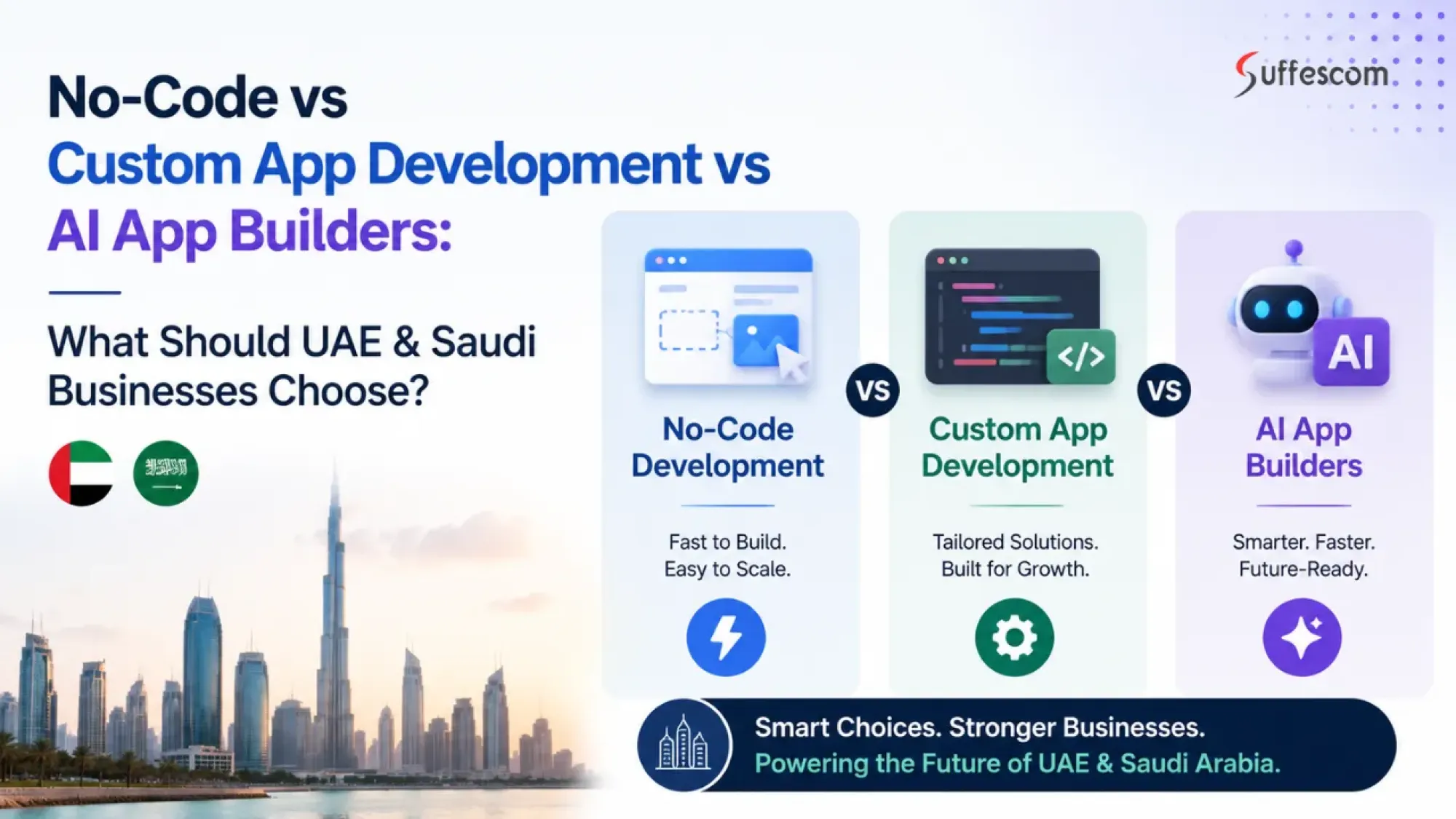
Although custom programming is essential for developing complex enterprise applications, low-code platforms are beginning to be considered as part of the larger digital transformation process. It's never about no-code vs custom app development, but rather your own specific needs, honestly.
There are various reasons why cloud-native architectures have been gaining popularity since they allow for increased flexibility and scalability.
Key advantages include:
With increasing cloud adoption in the GCC, companies prefer vendors who have capabilities in cloud engineering and DevOps.
As the nature of cyber threats becomes increasingly complex, security is evolving from a necessity into an advantage.
Modern enterprise applications increasingly incorporate:
Security has now become one of the primary needs of various organisations such as banks, hospitals, fintech firms, and governments.
It is going to affect the design, implementation, and management of mobile applications of organisations operating in the UAE and Saudi Arabia. Organisations that opt for vendors dealing in these new technologies can cope with the new demands.
Choosing a developer to create your mobile application will usually involve more than one person, each of whom might have his/her own criteria and concerns. Although the CIOs would be more interested in technology, the procurement team will be more focused on risk and value for money.
The use of a checklist can enable you to assess the vendors thoroughly.
A Chief Information Officer should focus on long-term technology alignment and business value.
Key evaluation points include:
The Chief Technology Officer must analyse technical skills, scalability, and architecture.
The following points need to be considered:
The goal is to ensure the application can evolve without creating future technical debt.
Procurement officers should concentrate on commercial viability, stability of the vendor, and contract protection. Important evaluation criteria include:
A structured procurement review helps reduce financial and operational risks.
Digital transformation leaders should evaluate how effectively a vendor can support innovation and organisational change.
Questions to consider include:
| Evaluation Area | Checklist |
| Relevant Enterprise Portfolio Reviewed | ✓ |
| GCC Market Experience Confirmed | ✓ |
| Security and Compliance Capabilities Assessed | ✓ |
| Technical Expertise Validated | ✓ |
| Development Methodology Reviewed | ✓ |
| Cloud and Integration Experience Verified | ✓ |
| Scalability Strategy Discussed | ✓ |
| Support and Maintenance Services Evaluated | ✓ |
| Client References Checked | ✓ |
| Pricing and Commercial Terms Reviewed | ✓ |
| Intellectual Property Ownership Confirmed | ✓ |
| SLAs and Support Commitments Defined | ✓ |
With the aid of the checklist, businesses operating in the UAE and Saudi Arabia would be able to make more informed vendor selection decisions and avoid project delays, non-compliance, budget overruns, and scalability problems.
The selection of the appropriate mobile app development vendor is undoubtedly one of the key decisions that enterprises have to make as part of their digital transformation efforts. Indeed, the partner that enterprises will select will be responsible not only for timelines and budget but also for issues such as the security of the software solution being developed, compliance with relevant regulations, scalability and many others.
Focusing exclusively on price, one should assess vendors considering criteria such as technical skills, experience in the relevant industry, local market experience, security, development processes, and even post-development support capacity. A structured vendor selection process will enable enterprises to mitigate any risks associated with the project and increase the likelihood of the creation of a successful mobile application. Suffescom helps enterprises in the UAE and Saudi Arabia create, develop, and scale mobile applications tailored to their needs and industry requirements.
Evaluate the company’s technical skills, industry experience, portfolio strength, security, and post-launch services first. Businesses must also ensure that the company has previous experience handling UAE regulation compliance, localisation, and enterprise-scale projects.
It is important for Saudi firms to focus on selecting service providers that possess technical knowledge, know-how of the Saudi market needs, compliance with PDPL requirements, project implementation processes, and scalability application development.
The price of creating mobile applications in Dubai lies within the range of AED 350k and AED 1000k based on the complexity of the program, its ability for integration, security, etc. The enterprise applications with artificial intelligence are much more costly.
Mobile app development for an enterprise is often between 4 and 12 months. This is mainly due to a number of reasons, including the size of the project, project specifications, and many others.
The firms can benefit from having access to unique skills, reduced development times, and lower costs thanks to outsourcing. Outsourcing would be an excellent choice for many firms based in the UAE in order to accelerate their process of digitalisation.
Consider more than just the visual design aspect and take into account project complexity, relevance to your industry, user experience design, scalability, customer achievements, and business outcomes. Further information can also be gained through case studies and customer testimonials.
Although the requirements for certification differ based on industries, businesses often seek vendors that abide by established standards like ISO 27001, OWASP Security Guidelines, and best practices for secure software development.
GCC background can positively impact a project. Providers who know about UAE and Saudi laws, Arabic localisation issues, payment systems, and user behaviour are better suited to provide the application successfully.
Saudi Arabia's main legislation on the protection of data privacy is the Personal Data Protection Law (PDPL). It regulates the processing of data by organisations and concerns many different digital platforms functioning in the country.
It is necessary for all mobile apps that have any personal information to follow the data protection rules as per the UAE regulations. The following are the basic guidelines for mobile apps regarding data protection.
The dedicated development team comprises the developers, designers, testers, and others who work on your project alone. This will help increase flexibility and cooperation in the long term without the cost of creating your own development team.
A good software provider will make sure that the software will have maintenance, debugging, performance tracking, security upgrades, OS upgrades, and technical support when the software has been released.
Clearly define project requirements, evaluate your vendors, check the references of your customer, look at security and compliance, have clear contracts, and have structured project management in place throughout the development process.
While the best combination of technologies depends on the company’s needs, many modern enterprise software solutions use cloud computing, AI, API, data analysis, automation, and better security.
Develop a scorecard for vendor evaluation that considers technical skills, industry knowledge, security ability, communication processes, support facilities, innovations, and prices. A systematic structure enables objective decision-making.
Some common indicators include unreasonable prices, lack of experience with enterprises, weak security measures, confusion about development procedures, poor communication, no customer references, and insufficient post-development support services.

Senior Content Strategist
Jonathan Raabe is a content marketing professional, focusing on mobile apps, software engineering, artificial intelligence, SaaS, cloud computing, and digital transformation. Jonathan works with visionary brands to translate complicated concepts into content that can be easily understood by their audiences. As an expert in his field, Jonathan strives to create content that is thought-provoking and backed by facts, while at the same time building brand authority and trust.



Related Blogs