Forex Trading App Development with Crypto Wallet: Features, Cost & Benefits
Key takeaways: The UAE is a serious market for fintech and digital-asset products. DIFC alone hosted 1,677 A [...]
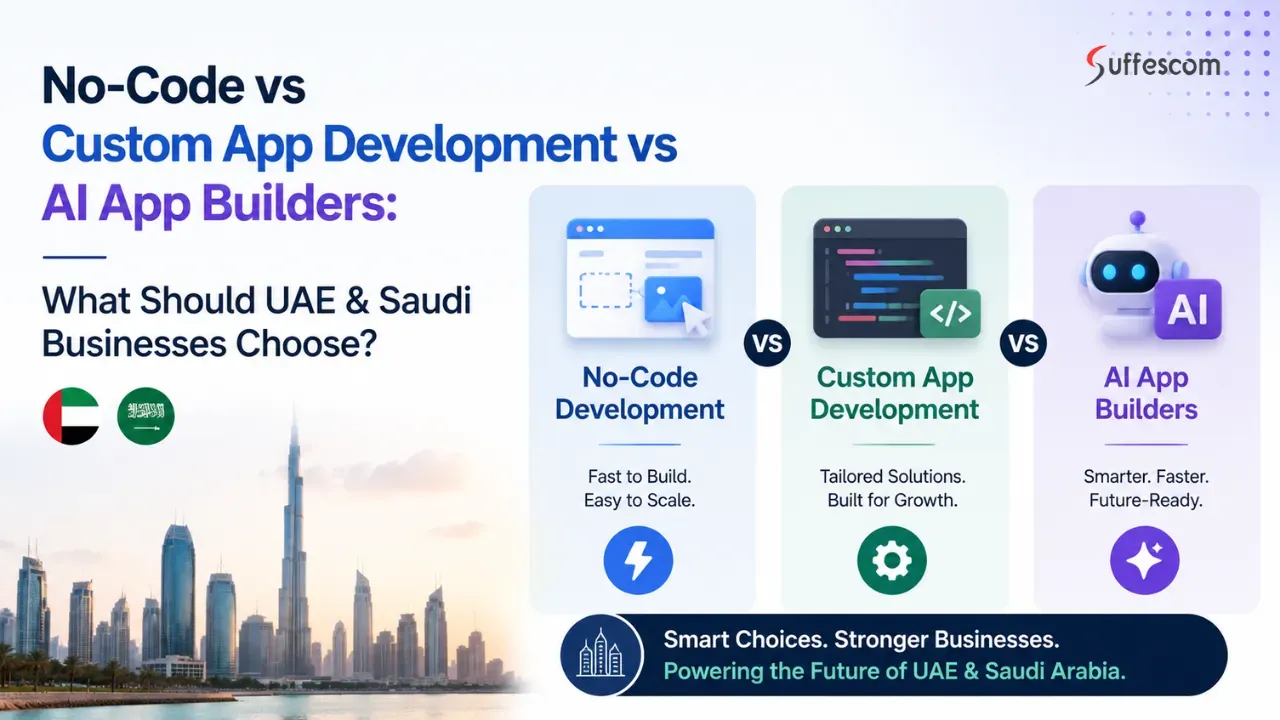
AI has revolutionised the way companies develop software applications. Nowadays, startups, SMEs, and enterprises operating in the UAE and KSA region have more options in terms of developing their idea into a full-fledged application. Starting a new business is now more accessible than ever, given that you can use an AI app builder to quickly create a functional app or access no-code platforms to launch your products without typing a single word. Y Combinator, a premier startup accelerator, in its Winter 2025 batch, revealed that almost 25% of startups reported that around 95% of their codebase was generated by AI. A Stack Overflow Developer Survey of over 65,000 developers found that 76% were already using or planning to use AI coding tools in their workflow.
With everyone having access to these AI-driven development tools, it brings about the question of whether these tools have the capability to deliver what you want. Can they match your business strategy in the long run? Can an app created with no-code development actually grow as you grow? Can it scale to meet regulatory demands? Will it connect with existing infrastructure? This is where the dilemma kicks in when you have to choose between no-code development and custom app development.
To simplify this for you, we have enlisted the key differences between these development approaches. Let's study the strengths and weaknesses of each and compare their costs. Alongside, learn which approach offers the best scope for scalability, security, ROI, and more, so you can make an informed decision.
Applications can be built using no-code development by using visual interfaces, drag-and-drop components, and pre-defined workflows without needing coding in any traditional manner.
Tools such as Bubble, Glide, and Microsoft Power Apps have enabled developers to build applications without hiring an entire development team. The interface design, database, and workflows can all be accomplished through visual interfaces without coding.
The biggest strength of no-code development is the speed at which businesses can validate ideas, deploy their MVPs, and automate internal processes.
Custom application development involves the creation of applications from scratch through the use of programming languages.
In contrast to no-code application development, custom application development allows full control of the application architecture, user experience, security, integration, and scalability. For businesses operating in strictly regulated environments, like health care, financial services, logistics, government institutions, or corporations, custom application development appears to be the most preferable approach because of security and compliance issues.
Despite being generally more expensive and lengthy, custom application development ensures a good start for future development and success.
Now there are AI app builders that allow you to develop an interface, workflows, a database, and sometimes even some backend elements based on natural language prompts.
With the use of this technology, developers do not need to design each screen and workflow on their own. They can just specify what they need, and the AI system creates a working sample for them.
For instance, a businessman can type a description of a customer panel, booking service, inventory system, or an internal panel, and then the AI app builder will create an MVP version automatically.
Many businessmen utilise AI app builders to increase the speed of development of their MVPs, prototypes, and automate routine processes.
However, not all AI-developed applications are fit to be deployed into production. Generated code quality, scalability, security features, integration capabilities, and maintainability of these applications may vary immensely.
The increasing usage of no-code platforms, AI-based app developers, and custom development in the UAE and Saudi Arabia is associated with digital transformation projects being undertaken all over the GCC region.
There is more pressure on firms to embrace digitalisation, improve customer experience, automate processes, and come up with innovative digital products. On the other hand, there is stiff competition in industries such as ecommerce, fintech, healthcare, logistics, real estate, and government services.
On the surface level, many people confuse no-code development with development with AI app builders. Let’s compare all three development approaches on some key aspects and understand, with the help of an example, what the key difference is between all three.
| Feature | No-Code Platforms | AI App Builders | Custom Development |
| Development Speed | Very Fast | Extremely Fast | Moderate to Slow |
| Initial Cost | Low | Low to Moderate | High |
| Scalability | Limited to Moderate | Moderate | Excellent |
| Security | Platform-Dependent | Varies by Platform | Fully Customizable |
| Customization | Limited | Moderate | Unlimited |
| Maintenance | Managed by Vendor | Partially Automated | Managed by Development Team |
| Compliance Readiness | Limited for Complex Regulations | Varies by Platform | Fully Tailored for Compliance |
| Enterprise Integration | Basic to Moderate | Moderate | Extensive |
| Vendor Dependency | High | High | Low |
| Long-Term ROI | Moderate | Moderate to High | High for Scalable Businesses |
Although comparison tables are a good way to start, they often do not give the whole picture.
For instance, a startup validating a concept in Dubai might greatly profit from a no-code solution since speed is more important than scalability here. At the same time, a Saudi fintech startup might need custom software from day one due to regulatory, security, and integration concerns.
AI app builders, on the other hand, can immensely increase development pace and cut expenses; however, businesses should think about whether AI solutions can handle operational requirements, business processes, and scaling plans.
In other words, the most successful projects are not built via the cheapest and fastest method possible. They are built using the approach that matches the objectives and requirements of the company and its customers.
In the next sections, we will look into the criteria that companies operating in the UAE and Saudi Arabia should consider before making their choice among no-code, AI, or custom development solutions.
The choice of a development strategy cannot be viewed through the prism of cost-effectiveness and time frames only. The firms in the UAE operate in a highly dynamic digital landscape, with demands for the customer, government policies, and technology uptake continuously rising.
Before deciding on either no-code tools, an AI application builder, or custom software development, UAE companies need to take into consideration the following aspects.
Privacy and security of the data involved in the process are now key factors for any organisation dealing with customers', employees', and business-related information.
No matter how you approach mobile app development or build an ecommerce portal, a fintech solution, or an enterprise system, compliance is something to be taken into consideration from the start, not after releasing the product.
The majority of no-code platforms and AI-based application builders use third-party architecture, a shared environment, or a security framework that might be enough for small apps. However, regulated industries often require more flexibility and control of the data storage, access, encryption, auditing, and security practices.
With custom development, it is possible to focus on UAE Personal Data Protection Law (PDPL).
It is very rare that any business runs on just one software. Nowadays, different types of software have to be used, like CRM software, ERP software, accounting software, payment software, human resources software, inventory management software, and customer support software. There might also be a need for government-based integrations depending upon the nature of the industry.
The capability of connecting these different systems effectively can greatly influence operations.
The United Arab Emirates has a multi-cultural society, hence the need for a distinct user experience that is often neglected by many companies in their planning stage.
Most applications have to be catered for in both Arabic and English languages, and at the same time maintaining uniformity across all platforms. It involves right-to-left interfaces, localisation of content, processes tailored for each region, and many more.
While some no-code and AI-based platforms provide multilingual features, customisation through custom development provides more flexibility when building a highly localised user experience.
One of the most typical errors that companies make while choosing a platform for development is opting only for what fits current needs.
The app may start by supporting just several hundred users, but it will eventually have to support several thousand or millions of users, transactions, and interactions. Growing means additional stress on infrastructure, databases, integration, security, and performance.
A no-code solution usually works great for starting apps, but limitations may come with growth in the amount of data, the number of users, and processes. The same thing can happen with the AI-developed apps, depending on how the system is architected.
In situations where a business intends to grow in a significant way, this should be evaluated carefully.
Different businesses have different operational, security, and compliance requirements, which may influence the selection of the development method.
Healthcare organisations may need patient data protection and integration of systems. Fintech businesses may need some advanced tools for user identity verification and fraud detection. Logistics companies usually rely on integrations related to real-time vehicle tracking, route planning, and fleet management. Ecommerce companies may need complex payment processing, inventory management, and customer experience personalisation solutions.
As demands become increasingly specific, flexibility and customizability tend to become more critical.
Although no-code development platforms and AI-powered application generators are great for particular tasks, businesses that operate in highly regulated industries or those that have more technical demands are likely to figure out that custom development suits their needs best.
The lesson here is quite simple: the development approach is not necessarily the most cost-effective or rapid one, but rather one that meets your business demands and allows you to grow further.
Digital transformation in Saudi Arabia is among the most aggressive initiatives taking place globally. As firms in the UAE upgrade themselves, provide digital services, and embrace innovative technology, the need for applications, enterprise software, and artificial intelligence solutions continues to rise.
But the selection of development approaches goes beyond the analysis of speed and cost. Businesses need to take into consideration digital transformation aspirations at the national level, the security and regulatory aspects, as well as the specific demands of Saudi customers and corporations.
Prior to making decisions about choosing a no-code solution, an artificial intelligence application builder, or a custom approach, organisations should review the following considerations.
The Saudi Vision 2030 initiative is speeding up the adoption of digital technologies in the public and private sectors.
Today, more companies invest in automation, digital experience for customers, cloud computing, AI, data-led insights, and smart business processes. Therefore, companies will have to provide scalable, secure, and growth-oriented digital services.
However, while technologies like no-code and AI-led development can assist in the fast launch of solutions, it is crucial to choose technology that will develop with business needs.
Security has risen to become the primary concern when dealing with customer and organisational sensitive information.
The need to analyse whether there are secure ways of storing the information, processing it, and accessing it has become paramount in many organisations. This requirement becomes even more essential for companies operating in the financial industry, healthcare industry, government organisations, telecommunications, and critical infrastructure.
Most No-code platforms and AI application creators operate in environments that are managed by the vendor itself. This can become a problem because the organisation might lack insight into the infrastructure configuration and security. This solution is appropriate for some businesses, while others prefer custom-built products.
The adoption of digitalisation in Saudi Arabia by consumers has been swift in the ecommerce, finance, transport, health, learning, and entertainment domains.
In line with the growing adoption, customers are starting to demand applications that must be fast, user-friendly, personalised, and functional on mobile platforms.
Applications that suffer from performance problems, low functionality, poor localisation, and bad user experience are likely to face a challenge in very competitive markets.
This is why businesses need to check whether their application development methodology is capable of providing the needed user experience.
Some industries have far higher expectations regarding regulations than other sectors. Government bodies always impose stringent security policies, audit controls, data governance policies, and integration with pre-existing digital technology architecture. In healthcare, there is an obligation to safeguard patient data while maintaining operational efficiencies and compatibility of the system. Fintech companies usually have regulations surrounding customer validation, transactions, security measures against fraud, monitoring, and regulatory reports.
Such cases generally involve high levels of customisation, security measures, integration, and compliance management.
No-code platforms and AI application building tools can fast-track development in less complicated applications, but for businesses working in heavily regulated industries, sometimes only customised development proves to be the right choice that helps them meet their requirements and demands.
Saudi Arabia has been going through its digital revolution at a very quick pace. The future applications are those that are created from a foundation that ensures long-term security, compliance, scalability, and innovation.
The concept of no-code development has changed how companies develop software by making software development possible for people who lack technical expertise. While the process that required an entire team of developers is now often done using visual development environments, no-code development also has its strengths and weaknesses.
If companies are seeking a way to develop applications quickly, no-code solutions might be the answer for them. Nonetheless, just like other development approaches, no-code development has certain capabilities and drawbacks that need to be considered.
Key Benefits of No-Code Platforms
Probably the most important benefit of no-code development is the speed.
It allows organisations to get from the idea to the application ready to work within several days or even weeks instead of several months. Thus, no-code is great for startups validating their ideas, organisations trying new business models, or companies looking to achieve quick digital transformation.
Another benefit is a smaller initial investment. As many things in the process, such as infrastructure, hosting, security management, development environment, etc., are already provided by the platform, organisations may cut down initial development costs.
No-code development platforms make organisations less dependent on technical teams. Business people, operations managers, and entrepreneurs may work on developing and editing the app without having to know anything about programming.
Other benefits include:
For organisations prioritising experimentation, quick deployment, and effectiveness, all those benefits may be extremely valuable.
Although no-code technologies make it easier to develop applications, they have their own limitations that become clear as the complexity of applications increases.
The majority of all no-code platforms will operate within a fixed framework offered by the vendor of such platforms. This can result in situations where businesses will find it hard to implement any customised feature or logic in their application.
There could also be performance-related problems as the number of users grows. Whatever works well for just a few thousand users won't work anymore once an application becomes enterprise-scale.
Other issues that companies might face include:
Of course, these limitations won't apply to all projects, but they can be very problematic in some cases.
No-code development usually works best where speed and simplicity matter more than customisation. Some common use cases are as follows:
In such cases, a business may be able to meet its needs without having to create a completely custom solution.
The trick is making sure that the needs in the future will be in line with what the platform can do.
| Industry | Common No-Code Use Cases | Why Businesses Choose No-Code |
| Startups & Entrepreneurs | MVP development | Faster launches, lower upfront costs, reduced risk before scaling |
| Retail & Ecommerce | Online stores, customer portals, loyalty apps, and inventory workflows | Quick deployment and easier process automation |
| Real Estate | Property management portals, lead generation systems, and customer engagement platforms | Faster digitisation and improved customer experience |
| Education | Enrollment systems, student portals, and communication workflows | Streamlined administration and improved operational efficiency |
| Hospitality & Tourism | Reservation systems, guest service apps, operational dashboards | Enhanced customer experience and simplified operations |
| SMEs | Internal workflow automation, CRM systems, and reporting dashboards | Reduced manual work and improved productivity |
| Professional Services | Client portals, appointment scheduling, and project management tools | Faster process management and improved service delivery |
| Industry | Why No-Code Becomes Limiting | Preferred Long-Term Approach |
| Fintech | Complex compliance, security requirements, and transaction processing needs | AI-Assisted + Custom Development |
| Healthcare | Patient data privacy, regulatory compliance, and EHR integrations | Custom Development |
| Logistics software development | Real-time tracking, route optimisation, and large-scale workflows | Custom Development |
| Government & Public Sector | Security, governance, scalability, and compliance requirements | Custom Development |
| Large Enterprises | Advanced integrations, high user volumes, complex business logic | Custom Development |
| Telecommunications | High-performance infrastructure and extensive system integrations | Custom Development |
AI app builders represent some of the most powerful and potentially most disruptive trends within software development today. Rather than building applications by laying out interfaces manually, setting up databases, writing code, and designing workflows from scratch, business users can now use natural-language prompts to generate most of an application in minutes. For startups and other companies scrambling to move fast to get an application into the market, the implications - quicker development cycles and less expense - are enticing. But even as they can do some pretty cool things, app builders aren’t a magic wand. They have their strengths and their weaknesses.
AI application builders tap into massive pre-trained language models, frameworks for development, and automation to churn out user requirements into working software components.
To give you an idea of what a prompt might look like to describe an app:
“Build a customer booking application with registration and logins, payments and automated reminders, and an admin dashboard.”
This platform generates screen layouts, workflows, databases, APIs, and even snippets of the code required to make an app tick. Most AI dev tools are able to help with:-
While once it could have taken weeks, it can now take a few hours. This makes AI developers appeal for a quick prototype and initial phase of building an app.
AI-driven development has the number one benefit of speed.
By automating a lot of the busy work that typically eats into developers' time, companies have the capacity to drastically decrease the development timeframe and allow teams to spend more time developing business logic, enhancing the end customer's experience, and verifying that there's market demand.
In practice, this translates to a range of advantages, including:
For new startups in Dubai or Riyadh who want to move quickly from idea to proof-of-concept without incurring a hefty upfront cost, a few minutes spent with an AI app maker might be one of the most direct routes to that goal. And while non-traditional developers may have been the first to jump on these, veteran software development shops are now also turning to the use of these tools to boost efficiency.
Though AI app creators are quick to generate apps, they pose certain risks that organisations must consider.
The creation of applications through AI ensures functionality, but there is no guarantee that it creates an application with proper architecture, scalability, security, and compliance. The output from such programs will be as efficient as the prompts used and the capabilities of the system.
Problems that arise include:
Another challenge is that sometimes the AI program generates the right code with certain inefficiencies that are not easily detected until the application starts operating.
These are some of the reasons why an organisation should not rely solely on AI output for important systems.
AI app generators work best when speed, experimentation, and iterations are the main priorities.
They are especially suited for:
But the more complex the application becomes, the more customised, secure, compliant, and scalable solutions become necessary, which goes beyond the abilities of AI-generated solutions.
For many companies, the best approach might be a combination of two approaches: using AI to increase productivity and reduce routine, and having developers who will take care of the proper architecture, security, integrations, compliance, and scalability.
In other words, AI app builders will greatly decrease the time required to transform an idea into an application. The question is whether the generated solution will be able to withstand the business processes after the initial deployment.
In contrast to no-code solutions and AI app builders, where efficiency is paramount, custom app development takes a significantly different strategy. In this process, software is constructed from the ground up according to an organisation's business operations as opposed to creating it based on preset templates or from automated functions. Businesses preparing to invest in growth, run complex processes, or operate in government-regulated sectors may require the independence and flexibility to ensure an everlasting product, yet these may come at greater financial investment prices as well as a higher timeframe, due to the intricacy of application production.
One of the main benefits of a custom-made application is full control of the process of designing and maintaining the app. Each aspect of the user interface design, from the database architecture to the integration capabilities and business logic, is created specifically for the company's needs.
In contrast to no-code apps, which limit functionality, and AI-generated apps, which follow certain patterns, with a custom-made app, companies have an opportunity to create unique elements that can be used for a competitive advantage. This benefit is especially useful when creating apps with:
With a custom-made app, companies do not need to adapt their business processes to certain restrictions of the platform.
The need for compliance and security has been steadily increasing in industries like fintech, healthcare, logistics, public services, and enterprise management.
Developing custom software gives a company more control over the data storage, processing, encryption, and access. Security systems tailored specifically for the company’s risk level, regulatory compliance, and policies can be implemented.
These features include:
For companies that manage sensitive customer data or operate in a regulated environment, these features may be hard to get from generic no-code and AI-generated software.
In line with business growth, applications have to cater to an increasing number of users, transaction volumes, integration needs, and operational requirements.
Custom applications are developed with scalability in mind. The infrastructure, databases, APIs, and backend services may be optimised based on the projected business growth instead of being limited by the capabilities of the third-party platform.
This enables companies to scale more effectively where:
For companies intending to develop enterprise-level applications, scalability is among the main reasons why custom development is favoured.
Custom software development comes with many benefits, but that does not mean that it fits every project. First, one should consider the price. It is much more expensive to develop software from scratch than to use no-code platforms and an AI application builder.
Another problem is the longer development period. The development of a custom application will take several months, compared to no-code apps and AI builders that can be ready to go within weeks and even days.
Moreover, one should take into account:
Cost is usually one of the first considerations for a business when choosing among no-code platforms, AI app creators, and custom software development. Yet, considering only the cost of development might mislead you.
What seems like a cheap option at first might turn out to be quite costly in the long run because of fees, limitations on scalability, integration issues, maintenance problems, or even re-development.
It's not about how cheap one approach will be right now, but how valuable it will be in the long term.
The numbers presented below are only an estimate of how much it would cost to develop software applications in the UAE and Saudi Arabia. The real cost may differ based on the complexity and other aspects of the project.
| Business Type | No-Code | AI App Builder | Custom Development |
| Startup MVP | AED 10k – 50k | AED 8k – 40k | AED 50k – 250k+ |
| SME Application | AED 35k – 120k | AED 25k – 100k | AED 150k – 600k+ |
| Enterprise Platform | AED 100k – 350k | AED 75k – 500k | AED 500k – 3M+ |
| Ecommerce App | AED 25k – 150k | AED 20k – 120k | AED 120k – 1M+ |
| Internal Business Software | AED 15k – 100k | AED 10k – 80k | AED 100k – 750k+ |
On the surface, no-code and AI-based solutions seem significantly cheaper than custom development. But for some companies, this factor alone may prove to be very attractive.
However, things get complicated when the needs of the business are taken into consideration for a longer period of time.
Many organisations tend to overlook the costs that come into existence post-deployment of the application.
No-code applications usually involve subscription costs that go up based on the number of users, storage requirements, or utilisation of any extra features. There might be other types of recurring costs, such as premium integration, workflow, and additional features.
The use of AI applications might be easy at first; however, businesses might end up spending more time and money improving and enhancing generated code, making the application secure, performing better, and adding features that cannot be done by AI applications.
Some of the underestimated costs can be:
In analysing development options, companies need to focus on the total cost of ownership (TCO), not just on upfront costs.
A no-code approach might be cheaper in its first year, but additional platform payments, lack of scalability, and migration costs will add up later. The same applies to AI-based solutions, which need to be optimised and redeployed as the company's needs change.
Custom app development is likely to cost the most in terms of upfront investment, but companies get complete control over the application and the entire development strategy. As a result, they become less dependent on third-party suppliers.
The typical cost distribution is as follows:
| Cost Trend Over 3 Years | No-Code | AI App Builder | Custom Development |
| Initial Investment | Low | Low | High |
| Recurring Platform Costs | High | Moderate to High | Low |
| Scaling Costs | Moderate to High | Moderate | Moderate |
| Migration Risk | High | Moderate | Low |
| Vendor Dependency Costs | High | High | Low |
| Long-Term Ownership Value | Low | Moderate | High |
It certainly doesn't imply that custom development is the most economical choice for everyone. For a startup that tries out an idea, it doesn't make economic sense to spend a lot of money on building a custom platform. In addition, a small internal workflow app might never pay off a full custom development.
The most economical approach is the one that meets the needs of the application, its expected development direction, compliance issues, and the company's goals.
For some businesses, the quickest way to validate their idea is no-code, while for other companies, the quickest way to innovate is AI builders. However, for businesses that create strategic digital products meant to grow for years, custom development often proves to be the most efficient solution.
When it comes to doing business today, timing plays a major role. The more swiftly a company is able to introduce a new product, test out an idea, get customer feedback, and make money from it, the more likely that it will be able to develop a competitive edge.
That is one of the biggest reasons why no-code platforms and AI app builders have been enjoying growing popularity in the UAE and Saudi Arabia. There is no need for businesses to wait for months before testing their ideas or introducing their new digital products.
While quick deployment may be good, it does not necessarily mean that businesses should sacrifice other important aspects in order to deploy their solutions more quickly.
Development timeframes differ based on project complexity, integrations, design considerations, regulations, and testing. The following is an estimate of the development timeframe for various business applications.
| Project Type | No-Code | AI Builder | Custom Development |
| MVP | 1–4 Weeks | Few Hours – 2 Weeks | 2–4 Months |
| Ecommerce App | 2–8 Weeks | 1–6 Weeks | 3–8 Months |
| Enterprise System | 1–3 Months | 1–3 Months | 6–18 Months |
The distinction is clear right away.
A startup entrepreneur from Dubai may actually design and implement a basic MVP through an AI app builder within a week. A no-code solution can generate a more sophisticated MVP within a couple of weeks. And although the customisation process provides many more options and possibilities, it takes considerably more time to develop them.
It is one of the main factors behind the popularity of these technologies among companies.
Although fast launches are vital, the organisations have to take into account their actions following a successful launch. Most companies put much emphasis on decreasing their time spent on development while failing to understand the difficulties that come with further application development. New features, an increased number of users, complex integration issues, changing compliance policies, and rising performance demands come up. It is at this point that the difference between rapid and sustainable development is highlighted.
The platforms for no-code development and artificial intelligence application creation perform well in speeding up the early product development process. The no-code platforms can help organisations:
However, with the development of more complicated features, businesses might run into some limitations that would hinder their future development. What was easily customizable, scalable, and integrable at the early stages becomes hard to implement later on.
Custom development, however, is quite the opposite.
More time is needed for the initial development since each piece of the solution is created specifically for the company. And yet, such a strategy will often help establish a solid foundation for future growth, adding features, working with large audiences, integrating systems, and meeting new regulations.
When it comes to UAE and Saudi businesses, the best approach here is not necessarily about picking the fastest choice. It is rather about picking the one that will combine the immediate and future needs and goals of the business.
If you need to validate an idea quickly, then the fastest option will suit you perfectly well. However, if your aim is building a business-critical platform that will help you grow and innovate in the coming years, the extra time needed for custom development will definitely pay off.
Ultimately, it all comes down to how you consider your speed to market as an element of the decision-making process.
Many companies in the UAE and Saudi Arabia find that security and compliance are not options but necessities. An incident like a data breach, non-compliance, or security threat can cost money, reputation, productivity, and even regulatory penalties.
With the advent of no-code platforms and AI applications, many more opportunities are opening up for developing applications, and with them come new concerns regarding data governance, infrastructure control, access management, and compliance.
Before choosing a path for development, it would help to know how security and compliance can influence the choice.
Firms conducting business in the UAE need to become responsible for their use of personal and business data. Firms collecting, processing, storing, and transferring customers' data must take proper steps to secure the data.
Applications may deal with sensitive data, which can include customer data, payment data, employee data, transaction history data, and other business operation data. This means that considerations regarding security and privacy need to be included in the application design process right from the start.
While considering no-code platforms and AI-powered apps, businesses need to consider:
Custom-built applications provide more freedom for firms to implement privacy and data governance policies.
Continued emphasis is being placed by Saudi Arabia on issues like data governance, cybersecurity, and digital trust as part of its digital transformation efforts.
Institutions dealing with customer data, health care data, financial data, government data, or enterprise data should make sure that their applications are compliant with the expectations set out by regulators.
The important factors may include:
For organisations working in regulated industries, securing the architecture and ensuring compliance must be seen as critical requirements from the start and not as afterthoughts.
The no-code platforms come with various security measures that might make the application development process easy for small-scale projects. But organisations need to be aware that the security mechanisms depend on the platform provider.
It will lead to restricted visibility on infrastructure settings, security architecture, and other system-level controls.
Some of the risks associated are:
All these will not create any issue for small-scale applications, but the risk factor becomes critical when the security requirements increase.
AI application builders create another array of security risks. Although the ability to build applications quickly is inherent to AI, not all AI-generated code satisfies enterprise security requirements. Security vulnerabilities can hide in workflow generation, in API, in authentication mechanisms, and in back-end logic.
Most typical issues are as follows:
There is no doubt that AI-generated applications can become very efficient starting points; however, security audits must be conducted first.
Big companies, governmental agencies, healthcare providers, financial firms, and regulated businesses typically opt for custom development, which guarantees maximum control over the project.
With custom-developed software, one can design the security architecture to fit specific needs without being confined to the platform's capabilities.
Such an option offers the following benefits:
It is especially beneficial in cases when applications perform critical functions, handle sensitive data, or have to comply with regulatory standards.
In conclusion, there is no such thing as a perfectly secure development strategy – security is determined by how the software is developed, configured, maintained, and governed throughout the application's entire lifetime.
However, as regulatory standards grow, the amount of sensitive data and the overall complexity of the projects increase, companies find themselves in need of maximum control over the development processes. In the case of companies based in the UAE and Saudi Arabia, security should be considered not as a feature, but as an investment in the business.
A lot of organisations base their decision-making process for development on their current needs. The problem here is that a successful application hardly ever remains unchanged.
If you develop an MVP serving a couple of hundred users, later it will have to scale to accommodate tens of thousands of clients. An internal utility app might transform into a mission-critical system required in several different departments. Extra integrations, bigger database, higher transaction rate, growing client demands – all of those place additional strain on an application.
That's why scalability has to be assessed long before the development process starts, rather than when growth reveals limitations of the existing architecture.
It's not about whether your application works today; it’s about whether it will work efficiently tomorrow.
No-code solutions are built with development acceleration and reduced technical complexities in mind. For start-ups and small-scale enterprises, this may prove to be an incredible boon.
But scalability is one of the very first hurdles that organisations run into as their applications get more complicated.
With increasing users and complicated workflows, businesses will experience:
It is not rare for no-code applications to work wonderfully until the initial growth period of a business. The problem is when a business needs enterprise-grade features that go beyond the capabilities of a platform.
That is when businesses have to choose between working within the limitations of the platform or building the application from scratch.
Developers can significantly decrease the development time using AI-based apps, but the scalability of such products will be highly dependent on the application quality and its infrastructure.
Although AI can deliver functional applications fast enough, it might not always focus on its future scalability. Sometimes, generated applications can have technical problems depending on the level of complexity.
Some of those issues include:
Such problems may not even occur when it comes to small-scale applications or MVPs. But for companies that expect significant growth, the question of possible scalability is important to consider.
Custom development represents the best way to scale since infrastructure, database, API, and overall architecture can be created with future business scaling needs in mind.
Unlike platform-imposed constraints, custom-built solutions allow creating an optimal solution in terms of performance, stability, and scalability.
Custom applications can be engineered to work with:
With scaling, more resources can be used without altering the application architecture.
Such scalability is one of the main reasons why enterprises, fintechs, healthcare companies, logistics providers, and governments favour custom-built solutions for critical applications.
The following table provides a high-level view of how each development approach typically performs across common growth scenarios.
| Growth Factor | No-Code | AI Builder | Custom |
| 10K Users | Good | Good | Excellent |
| 100K Users | Moderate | Moderate | Excellent |
| 1M Users | Limited | Moderate | Excellent |
| API Integrations | Moderate | Moderate | Excellent |
| Complex Workflows | Moderate | Moderate | Excellent |
Although no-code and AI-based development tools may be able to handle early growth quite efficiently, it’s important to keep in mind that scalability is not only about being able to serve more users.
Scalability is also about the ability to do the following:
For those who focus on validating ideas and entering the market fast, no-code and AI apps may be a great solution for scalable development in the short term. In case an organisation needs to develop long-term digital assets that will help it grow over the years, custom solutions are most likely to be the best foundation.
It's very simple: scalability issues usually don't arise at the time of launch but rather after the company succeeds.
The advantages of using no-code platforms and AI application creators are obvious. Fast implementation, low cost at the early stage of development, and simplicity of development itself create a tempting offer for any company in need of digitalisation.
However, what many companies tend to overlook is that there might be some dangers that will appear once the software becomes operational.
A cheap solution in terms of development may turn out to be very costly once any problems with security, compliance, scalability, or platform restrictions affect your business.
One of the biggest problems that comes with no-code development is vendor lock-in. Whenever companies decide to create apps using no-code development, there is a possibility that they will become highly reliant on the no-code platform used. This problem may not appear immediately. It will surface once a business needs more flexibility, cost efficiency, and advanced features.
Some of these problems include:
When companies are anticipating rapid growth, then considering a way out before choosing a platform might be equally important as the platform itself.
AI app builders can generate impressive results in a very short period of time. However, speed does not always guarantee quality.
AI models generate outputs based on patterns rather than a true understanding of business objectives, security requirements, or architectural best practices. As a result, generated applications can occasionally contain flawed logic, inefficient workflows, or implementation errors that are not immediately obvious.
Common issues include:
These issues may remain hidden until the application is exposed to real-world users, larger datasets, or more complex operational requirements.
Without proper technical review, businesses risk introducing technical debt that becomes increasingly expensive to resolve over time.
Security is yet another instance where cutting corners could lead to problems down the road.
Applications developed quickly using no-code platforms and AI may lack the necessary security considerations that one may find in more serious projects done by enterprises for their own use.
These issues may include:
One security problem alone can lead to financial loss and many other troubles.
This is something that one should never ignore when dealing with sensitive information such as financial and health information of customers and clients.
Compliance standards continue to change in the UAE and Saudi Arabia, especially in industries like fintech, healthcare, government, telecommunications, and enterprises.
Noncompliance can result in an organisation being exposed to audit, legal problems, operating restrictions, and monetary fines.
Some common compliance risks are:
Many organisations only find out about compliance problems when the regulator, auditor, or enterprise client requires proof of compliance.
Fixing noncompliance post-release will be more costly compared to implementing compliance pre-release.
It's common for companies to think that growth means greater profits. However, growth may have other implications, like technology cost issues. As the number of users grows and processes become more sophisticated, there may be:
Sometimes, companies realise that the technology solution that was helpful in a fast launch is not economically feasible in the long run. This situation occurs especially frequently in cases where applications grow rapidly and start to exceed the assumptions of the platform they were built on.
The message here isn't about avoiding no-code platforms or AI app builder solutions. Such approaches can be extremely helpful if applied wisely. The message is about assessing the risks of solutions along with their advantages.
A technology solution that is more economical in the first six months may prove to be too costly in the long run due to various risks. For example, a company building applications that will turn out to be key business assets has to understand these risks besides being aware of the particularities of each solution.
The winner between no-code, AI app builders, and custom development is subjective.
Which one is better to use is dependent on the goals of the company, its future plans, regulations, budget, and how complex the application you wish to develop is. An option that works well in one case might not fit in another scenario, especially where there are highly sensitive financial transactions or patient data involved.
Instead of trying to find a better method overall, companies should figure out which option suits their needs more.
Time and validation become top priorities for startups.
Often, before going big on software development, startup entrepreneurs have to validate the product's idea, its value proposition, and the business model, as well as gather user feedback and test the market needs.
No code and app builders, powered by artificial intelligence, can then become really powerful when there’s a need for speed and minimum risk. Entrepreneurs will develop an MVP and make a product quickly.
But as for startups, custom development is the most suitable choice to develop a product, technology, or scalable SSaAS product unique for an organisation.
Recommended Approach: No-Code or AI App Builders for validation, Custom Development for long-term scaling.
Small businesses might focus on automation, customer experiences, operations, and expansion, rather than on the implementation of technology solutions. These businesses would benefit from the application of no-code technologies as they enable internal processes automation, portal development for users and customers, workflow implementation, and enhanced efficiency. Meanwhile, development by using AI tools can aid companies in delivering quality software quickly and affordably. In other cases where organisations face specific challenges or are in the process of digitisation with clear objectives, the hybrid development approach might be appropriate.
Recommended Approach: No-Code, AI-Assisted Development, or Hybrid Development.
Ecommerce companies function in very competitive environments where user experience, scalability, integrations, and performance have a direct impact on their bottom line.
The creation of basic ecommerce systems can easily be done via no-code solutions or AI-driven development tools. But as the volume of orders grows and the degree of customisation, inventory management, logistics integrations, and other efforts for retaining customers grow more advanced, limitations will arise.
Growth-oriented businesses switch to custom development.
Recommended Approach: No-Code or AI for early-stage ecommerce, Custom Development for growth-focused brands.
Logistics firms usually need real-time data processing, routing optimisation, tracking, fleet management features, and integration with several operational systems.
All of these often include complicated workflows and massive data transfer between systems.
Though no-code tools can be used for creating simple operational tools, advanced logistics applications will most likely need heavy customisation and scalability.
Recommended Approach: Custom Development.
They work in highly regulated sectors and deal with sensitive information.
Their apps often require secure patient portals, scheduling, integration into an EHR, telehealth, reporting, or access control.
Security, regulatory compliance, reliability, and interconnectivity might take precedence over speed.
Although no-code tools are an option for automating behind-the-scenes business operations, apps that will directly interact with patients or clinicians tend to benefit more from greater user and developer control.
Recommended Approach: Custom Development.
The use cases of fintech applications usually include customer onboarding, identification, transactions, anti-fraud measures, payments, risk management, and reporting.
The security and compliance needs are usually quite significant, but at the same time, the customer demands regarding performance and reliability are extremely high.
Therefore, aspects such as scalability, customizability, auditability, and security become very important.
Despite the possible contribution of AI solutions to some parts of the process, the development of fintech systems usually involves quite rigorous architecture and testing.
Recommended Approach: Custom Development.
Organisations and enterprises operate through complex workflows with multiple departments, thousands of employees, a massive amount of information, and complex integrations. Such companies often rely on several applications within the company and a plethora of external solutions, including CRM, ERP, HR, Financial system, analytics solutions, etc. The applications need to offer a high degree of security, governability, availability, and robustness. Although no-code applications have their role when it comes to automating departmental tasks or processes within the company, they require a much more stable and established framework for enterprise-level development.
Recommended Approach: Custom Development.
It becomes apparent when looking at various types of businesses.
The simpler the application is, and the more speed is required, the more appealing no-code and AI-driven development becomes. However, the more complicated, regulated, scalable, and strategically significant an application is, the more sense custom development makes.
After all, the objective is not about finding the latest method of development or the most budget-friendly one. It is about picking the right development strategy for your business needs now and in the future.
Having analysed costs, scalability, security, compliance issues, and potential outcomes for business, one more question arises:
Which development method should your business opt for?
The answer to this question is determined by your goals.
An early-stage startup looking to validate its business model has completely different needs from a healthcare organisation implementing a patient management system. Just like an ecommerce company that aims to open a new sales channel, a government body aiming to digitalise public services has different needs.
The following methodology can be helpful for business leaders in the UAE and Saudi Arabia.
When time efficiency, cost savings, and ease outweigh the benefits of a complex custom-built solution, no-code development tends to be the optimal choice.
No code solutions may be preferred when:
A no-code development platform can significantly shorten the development time and help you create digital solutions without heavy investments into their development.
AI-based development tools are perfect for cases where you wish to speed up software development yet keep a higher degree of flexibility compared to the average no-code tool.
Try AI app builders when:
In cases where companies need both speed and flexibility, AI-based app builders will come in especially handy.
Customisation is usually the best option if your software is expected to be an important strategic asset for your business.
Think of customisation when:
While customisation comes at a higher price tag, it can bring more benefits than any other option.
The table below provides a simplified view of which development approach is typically best aligned with common business objectives.
| Business Goal | Recommended Approach |
| Validate Idea Quickly | No-Code or AI Builder |
| Enterprise Growth | Custom Development |
| Government Compliance | Custom Development |
| Budget Constraints | No-Code |
| Advanced Integrations | Custom Development |
| Long-Term Competitive Advantage | Custom Development |
Though this framework helps to build a good starting point, most companies usually opt for a combined approach.
So, for instance, a new company can develop an MVP with the help of a no-code tool, employ artificial intelligence tools for faster feature development, and move on to developing a custom application upon achieving product market fit.
Similarly, enterprises can automate their workflows through the use of no-code tools, while at the same time spending money on developing custom applications for their client-oriented platforms and critical systems.
Successful companies never pick a method for building an app simply due to financial or time benefits. Rather, they try to combine the technology-related processes with business goals and needs.
This is because the right question here is never "What option costs less?"
The right question here is "What option will suit us better in three to five years?"
Cost by itself is not what makes an app development project successful.
A product that is priced at AED 35,000 but restricts growth, causes inefficiencies, and needs to be redesigned completely within the next two years might prove more costly than a product that was priced at AED 350,000 but keeps generating value over the long term.
That is why savvy business people make their app development decisions based on the principle of ROI and not solely on the cost of development.
The objective is straightforward – to understand which method of development provides the most value for money spent.
A simplified ROI calculation can be expressed as:
ROI (%) = [(Total Business Value Generated – Total Investment Cost) ÷ Total Investment Cost] × 100
Business value can include:
Total investment should include:
Businesses that focus only on development expenses often overlook these broader factors when calculating actual ROI.
The following example illustrates how ROI outcomes may differ over a three-year period.
| Metric | No-Code | AI Builder | Custom |
| Initial Investment | AED 15,000–75,000 | AED 20,000–100,000 | AED 100,000–1M+ |
| Maintenance Cost | Moderate to High | Moderate | Moderate |
| Revenue Potential | Moderate | High | Very High |
| Scalability Score | Moderate | Moderate to High | Excellent |
| 3-Year ROI | Moderate | High | Very High |
While it may seem initially that no-code wins on ROI because of the small cost associated with getting started, calculating ROI is actually a much deeper topic involving the costs of your customers, your scale, your customer success, operational processes, and even the possibility of scaling in the future. Apps for scaled users, those with a larger automation capacity and long-term goals, create more long-term value.
Consider a startup founder in Dubai launching a new marketplace platform.
The primary objective is to validate market demand before making substantial investments.
In this situation:
The ROI can be best maximised in the short term with a no-code platform or an AI app builder due to its ability to get the founder to market rapidly without incurring much financial risk.
Investment of AED 150k-300k will give you a fully customised application that delays you in launching before proving demand exists, and thereby exposing you to unnecessary risks.
Maximising knowledge for early-stage startups usually yields greater ROI than technical expertise.
Most Likely ROI Winner: No-Code or AI App Builder.
Now consider a growing UAE or Saudi business seeking to automate operations, improve customer experiences, and support expansion.
The company requires:
In this scenario, AI-assisted development or a hybrid approach may provide the strongest balance between affordability and long-term value.
The business can reduce development effort while retaining enough flexibility to support future growth.
As operational complexity increases, some custom functionality may gradually become necessary.
Most Likely ROI Winner: AI-Assisted Development or Hybrid Development.
Now consider a large enterprise, healthcare provider, fintech company, logistics operator, or government organisation.
The priorities are significantly different:
While custom development requires the largest upfront investment, it often delivers the highest long-term ROI because the application becomes a strategic business asset rather than simply a software tool.
Custom-built systems can continue generating value for many years through:
In such an environment, the cost of selecting the wrong platform is usually higher than the cost of the custom build itself. A company that spends AED 500,000 or more on a custom scalable platform might actually end up with a higher return on investment compared to the one that opts for cost savings now.
Most Likely ROI Winner: Custom Development.
The key lesson is that ROI is highly contextual.
Even a startup, SME, or enterprise can select different methods of software development while choosing the right one. The no-code approach provides excellent ROI when the time and validation factor play a crucial role. AI app builders have a great ROI when the business needs innovative development quickly. Custom software development usually provides the greatest long-term ROI when the software becomes essential for business development.
The most successful UAE and Saudi companies do not merely think about how much an application will cost. They would rather think about how much value this application will bring to the business over the next three to five years. This change in the way of thinking is likely to result in making the right decision regarding technology.
The debate on whether to use no-code solutions, AI applications development, or custom applications development will continue to grow, depending on new technologies coming up. Those innovations that currently seem revolutionary and very interesting may turn out to be commonplace in a few years.
The companies working in the UAE and Saudi Arabia have recently become more and more active in carrying out digital transformations and process automation, artificial intelligence implementation, and modernisation of old technologies. That is the reason why application development stopped being the goal of its own and became a critical aspect for business development.
Below are some trends that are expected to define app development in the GCC region in the future.
AI is becoming an integral part of the software development process in today’s times.
AI is being used increasingly to speed up coding, testing, documenting, debugging, workflow management, and software development efficiency without fully automating away the human developers.
Currently, development teams are using AI for:
With further advancements in AI, companies can be assured of shorter and more effective development cycles in the future. Human intervention, however, will still be necessary for designing the architecture, ensuring security and compliance, and making strategic decisions.
The future is not about AI-driven development but AI-assisted development.
Many companies have come to realise that the decision to go for either no-code or custom development is not always mutually exclusive.
Increasingly, many firms are embracing hybrid development approaches by merging the speed of low code/no code with the advantages of custom development.
Examples include:
This method guarantees that the time to develop is kept to a minimum without affecting scalability and customisation.
With the growing number of digital transformation initiatives in the GCC region, hybrid development will be a popular trend.
Firms are progressing from basic workflow automation into more advanced hyperautomation practices.
Hyperautomation is the integration of artificial intelligence, robotic process automation (RPA), machine learning, analytics, and software applications aimed at automating business processes.
The benefits firms are enjoying through hyperautomation include:
Several industries, including banking, health care, logistics, retail, telecommunications, and public sector services, have been actively involved in the adoption of automation practices.
In the GCC region, where competition is increasingly fierce, organisations that succeed in automating their business processes will gain an edge.
Generative AI is having an impact on many more things than just software development.
The use of generative AI by businesses for transforming customer service, content creation, sales processes, data analytics, knowledge management, employee help desks, and decision-making processes is increasing.
Some future business applications of AI are likely to include the following capabilities:
With these developments, businesses will expect applications not just to be software but to have intelligent capabilities.
This means that the possibilities of using software in business are increasing.
What is critical to remember is that app development is becoming strategically essential.
Those companies that keep considering software development merely as a technical requirement might lag behind other companies that treat technological advancement as a business growth driver. Whatever route companies choose to develop their apps (be it no-code platforms, AI app development, custom app development, or mixed development), those that are innovative and at the same time pay attention to scalability and security will have an advantage in the rapidly developing digital economy of the GCC.
The selection of either the no-code platforms, AI app builders, or custom app development is based on your goals, future plans, and vision. No-code platforms are the best for new startups that want to test their business ideas with little or no cost. An AI app builder can be used by any organisation that wants to develop its apps faster and at lower costs. While custom software development takes a longer time to be accomplished, its cost-effectiveness cannot be matched.
When deciding which method to use in developing your application, don't just consider the development costs. For a company operating in the UAE or Saudi Arabia, there are many other factors you need to consider, including compliance, future growth, system integration, customer expectations, and competitive advantage. In reality, the companies that have been successful didn't just choose the fast way of app building but selected the appropriate one for them. It is only this kind of strategy that will give you high returns on investment.
The no-code development allows you to develop apps via a visual interface without any involvement in coding. The low-code development involves some coding but eliminates the need for writing a large chunk of code that needs to be done from scratch. It is quite clear from the term itself that custom app development is the creation of an application using programming languages and frameworks.
They can be! AI app builders are fantastic for rapid prototyping, getting a sense of how something might work, or building quick, internal tools. But complex enterprise applications are usually way beyond the capabilities of a fully automated system – they usually require complex security measures, regulatory controls, custom integrations, and the ability to scale in complex ways. Most of these things still need human developers involved. So, when enterprise use cases arise, companies tend to use AI-assisted development tools, not have the AI do it entirely.
In most cases, for startups, the answer will be no-code solutions. Since you reduce development time to zero and don't need a big development team to get your app off the ground, these are generally going to be the cheapest. AI app builders are a pretty close second option for getting your minimum viable product (MVP) off the ground. However, note that the cheapest solution may not be the most economical in the long run if you end up needing major redevelopment later.
Yes! Many no-code applications are capable of handling thousands of users without any issues. However, like all things, eventually, no-code applications will begin to have scaling issues. This might come as your number of users grows, or if you are adding more integrations, data volumes, and workflows. If you expect large growth, you may want to make sure no-code is going to work for you before committing to the platform.
If you're building an application that is a cornerstone of your business operations, you expect customers to interact with it to do things, and it has to tie into other systems. You're going to want to invest in a custom-built application. This gives you full ownership, complete flexibility over every aspect of the functionality, and unlimited potential scalability. Custom app development is where all of your most critical business operations and all of your best ideas should come to life!
It should be noted that the safety of any AI-generated product heavily relies on the choice of the app developer or software solution you are going to use in your business. Of course, it may create code that has some security vulnerabilities, lacks efficiency, has errors, or simply does not correspond to the best industry practices. You need to check all the security aspects of your AI-generated app carefully before bringing it to the market.
No-code is extremely useful for startups, retail app development, real estate development app development, fintech app, healthcare app development, hospitality, and SME industries that wish to implement an app and/or streamline their process workflows. The primary reason why no-code is best suited for these kinds of situations is that most times, the important thing is that time to market is quick, not customisation.
For startups that exist in Saudi Arabia, you will notice that a large number are leveraging both no-code solutions and AI-powered development to help validate ideas in a cheap and effective manner. As you scale up, though, more complex solutions arise that require integrations and security. Most will migrate to a custom app solution to overcome this hurdle.
Yes, most AI app builders will connect to most payment gateways, ERP, CRM systems, and cloud platforms. You should think about how that works, though. If you are expecting specific API connections, workflows that are not standard, and you have enterprise-level requirements, then you will probably end up needing a custom build anyway.
The cost to develop a custom application solution greatly depends upon the project complexity, the number of integrations, the particular requirements of the business, the number of users, and overall security requirements. However, as a general rule of thumb, one can estimate that the cost to develop an MVP startup application solution will fall somewhere between AED 55k and 220k.
Some no-code platforms have the necessary security controls in place that can meet certain UAE regulatory requirements. In reality, the decision of compliance depends on more factors, including the specific nature of the data being stored, where data is hosted, regulatory access and usage permissions, and the other industry-specific legal compliance rules of a particular vertical.
No-code vendor lock-in occurs when your company is held captive by the costs and limitations of the platform provider. Many no-code platforms require you to use proprietary tools or systems in order to deploy an app, making a future migration to a different platform incredibly complicated. So, usually, when you migrate or redeploy an app built with no-code, it often results in high cost.
There is nothing extraordinary about spending a whole year, or even more, on the development of an advanced enterprise application. Of course, the simpler the software is, the shorter the development time will be, but when it comes to developing unique functionality and connecting it to other systems, the time multiplies.
Yes, absolutely. A common development process among successful startups and even mid-size businesses is to begin with an MVP developed using no-code platforms. These will provide quick insight into market demand and validation on your business concept, and only then, once your concept is fully proven, should you look into making a significant investment in a custom application solution.
It's no surprise to know that AI-powered development and applications are becoming increasingly integrated with standard development workflows to reduce the time and effort involved and improve productivity. AI is unlikely to completely replace developers. But they can turn out to be quite useful, handling repetitive parts, so software developers can focus on the more strategic elements.
The vast majority of business applications are most beneficial with a custom development approach when considering long-term ROI. By fully customising a solution that meets every need of your business, no one else can do it better, and there are far fewer limitations on future growth, and much lower costs of vendor dependence down the road. It does have a higher upfront cost, though, and if this is an issue, startup/SME companies may favour a quicker time to market with a no-code solution to validate and generate funds prior to investing in a custom-developed application.
If an SME needs custom functionality, integration with numerous other systems, and doesn't require unique or proprietary business intelligence that would benefit from a custom, developed solution, then yes. For those on limited budgets and those who are not expecting to scale exponentially within the first couple of years of business, no-code or even AI developers could very easily suffice for many SME's.
Ultimately, the ideal app development partner for you in the United Arab Emirates or Saudi Arabia will have to match your business, your brand, your team, and your aims. They will require a good understanding of what you want to accomplish and how you plan to go about doing so. Seek out the ideal app development partner who understands your industry, communicates effectively, and delivers successful custom software applications time after time.

Senior Content Strategist
Jonathan Raabe is a content marketing professional, focusing on mobile apps, software engineering, artificial intelligence, SaaS, cloud computing, and digital transformation. Jonathan works with visionary brands to translate complicated concepts into content that can be easily understood by their audiences. As an expert in his field, Jonathan strives to create content that is thought-provoking and backed by facts, while at the same time building brand authority and trust.



Related Blogs
Hear directly from clients who partnered with Suffescom to turn their digital ideas into secure, scalable, and high-performing products.

“Suffescom delivered a HIPAA-compliant telemedicine app exceeding expectations, with strong data security and thoughtful development strategies from start to finish.”

“Suffescom helped us build a smart property management and virtual tour platform. Their expertise in AI helped us attract more qualified leads.”

“Suffescom delivered a modern hotel booking app perfectly aligned with customer expectations, which helped us boost sales by 40%.”

“We needed real-time fleet tracking and route optimization. Suffescom developed a platform that reduced our operational expenses in the first quarter.”

“We needed a smart itinerary planner with AI features for tourists. Suffescom delivered beyond our expectations and helped us increase bookings.”