Site Management Software Development Cost in Dubai, UAE
Key Takeaways Site management software development cost in Dubai can range from AED 25,000 for a basic MVP [...]
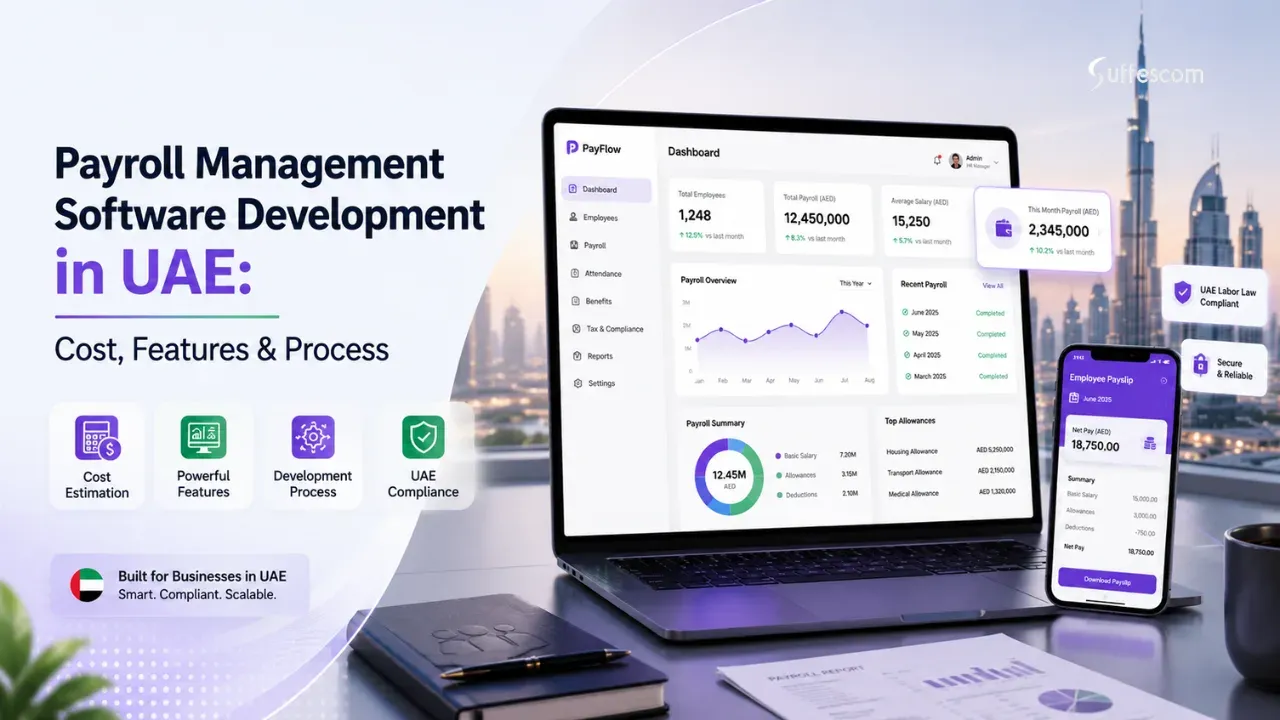
Want similar results? → Get a Free Quote
Just imagine your payroll team could manage attendance, calculate overtime, and prepare WPS files without having to move between spreadsheets and other systems. That's what modern payroll technology will do for a UAE business. More than 99% of private sector employees are covered by WPS, and the accuracy and compliance of payroll are emerging as critical operational concerns.
This is why payroll management software development in UAE needs to go beyond basic salary calculations. A dependable custom payroll software UAE solution can integrate payroll, attendance, leave, employee records, end-of-service benefits, bank integration and WPS workflows. It is important to note that payroll software should not only meet international standards but also be compliant with local MoHRE requirements and the UAE labour law.
The result? A payroll management system that minimises repetitive tasks, increases accuracy and empowers HR and finance teams with pay cycle control.
Payroll software development in UAE refers to building a digital platform that automates salary processing while handling UAE-specific payroll, compliance, employee, and payment requirements.
A UAE payroll management system manages the payroll cycle from the moment an employee is onboarded to the moment their salary is processed, paid, and reported to the UAE government. Key functions include:
A generic payroll platform may not be designed to comply with the UAE payroll and compliance rules and regulations. When developing payroll software in UAE, you should consider the following factors:
The UAE payroll software can be used by companies of varying sizes, payroll systems and business models.
| Business Type | How Payroll Software Helps |
| SMEs | Automates routine payroll without adding unnecessary administrative work. |
| Startups | Creates a structured payroll process as the workforce grows. |
| Enterprises | Handles complex salary structures, approvals, and large employee volumes. |
| Construction companies | Manages diverse workforces, attendance, overtime, and project-based payroll needs. |
| Retail businesses | Supports shift-based employees, overtime, and multiple locations. |
| Hospitality companies | Handles varying schedules, allowances, overtime, and large frontline teams. |
| Healthcare organisations | Manages complex employee records, shifts, allowances, and payroll cycles. |
| Logistics companies | Supports distributed teams, attendance, overtime, and location-based operations. |
| Professional services firms | Simplifies payroll for salaried and specialised employees. |
| Multi-location businesses | Centralises payroll while supporting different branches and workforce structures. |
| GCC businesses expanding into the UAE | Helps adapt existing payroll processes to UAE-specific requirements. |
As businesses expand and employee numbers increase, managing payroll becomes increasingly difficult with spreadsheets and uncoordinated HR systems. If there is a change in attendance, overtime, leave, allowance or deduction, it could impact the final salary calculation. Payroll automation in UAE helps businesses easily link these inputs, process them according to predefined rules, validate payroll data and streamline workflows related to WPS from a single system.
The distinction is highlighted in routine payroll activities like the following:
| Factor | Manual Payroll | Automated Payroll Software |
| Salary calculations | Spreadsheet/manual | Rule-based and automated |
| WPS/SIF preparation | Manual data preparation | Automated or assisted generation |
| Attendance data | Separate systems | Integrated with payroll |
| Leave calculations | Manual updates | Automatically reflected in payroll |
| Gratuity | Manual calculation | Rule-based calculation |
| Payslips | Manually prepared/distributed | Automatically generated |
| Audit trail | Limited and fragmented | Centralised records |
| Payroll reporting | Time-consuming | Faster, on-demand reporting |
| Error detection | Depends heavily on manual checks | Built-in validation rules |
| Scalability | Difficult as workforce grows | Easier to scale |
There are dozens of repeating tasks that come up with payroll on a monthly basis. If these jobs generally rely heavily on manual data entry and spreadsheets, even a small data entry error can impact salary calculations or even be a reason for payroll closure delays. By automating payroll in UAE, businesses can streamline and standardise the process.
The Wage Protection System (WPS) is an electronic wage transfer system where wages are monitored through an authorised financial institution. Payroll software for UAE employers can help them streamline the processes that facilitate accurate and timely WPS salary transfers.
A good payroll management software shouldn't simply be able to calculate monthly payrolls. The key components for effective custom ERP management software in UAE are the following.
A central employee database ensures all contracts, jobs, salary structures, allowances, deductions, bank details, joining dates and employment status are kept in one place. HR teams can update the details of their employees without having to keep separate spreadsheets, while authorised users can access the latest information in all payroll, attendance, leave and reporting modules.
The software uses pre-defined payroll rules to compute basic salary, allowances, deductions, overtime pay, and other components that may apply to the payroll. Such inputs can be processed consistently per pay cycle, and validation checks can highlight missing or unusual information before payroll is processed.
WPS processing is a crucial payroll responsibility for covered UAE employers. Payroll software development in UAE can help to create Salary Information Files (SIF), validate employee and salary information, send the files through internal approvals, and keep track of submissions and processing. This results in a more predictable payroll process and eliminates the need for manual preparation of payroll files before they are sent via the appropriate banking or WPS channel.
The software will be able to compute end-of-service gratuity based on the employee's service history and the current basic salary rules. According to the UAE government, generally, the amount of gratuity is calculated as 21 days' salary for the first five years of service and 30 days' salary for every year after that, up to the applicable rules and limits for expatriate private-sector employees.
Leave may be submitted, reviewed and approved by both employees and managers via the system. Approved leave can be cascaded into payroll calculations, which can help keep the unpaid leave track and balance if required without having to make additional changes to any spreadsheet. After one year of service, UAE private-sector employees are allowed 30 days of paid annual leave, and for those with less than six months but more than one year, two days of annual leave are granted for every month of service.
Payroll software can integrate with attendance systems, biometric devices, time tracking software or HR software to import working hours directly to payroll. Overtime can then be processed based on the rules that are approved, rather than manually on a per-pay cycle basis. It can be very beneficial for shift- or hour-based workers in industries like construction, hospitality, retail, and logistics. Payroll rules need to be customisable to account for various employee categories and working environments, as UAE labour law has specific provisions for working hours and overtime.
Digital payslips can be automatically created after payroll approval, displaying salary components, deductions, overtime, leave adjustments and net pay. An employee self-service portal allows employees to securely access their payslips, update the information that is allowed, request leave, and view payroll information without the need to make multiple contacts to HR.
An UAE payroll software provider can create dashboards to enable HR and financial teams to keep an eye on salary expenses, allowances, deductions, overtime, leave, payroll variances, employee history, and WPS records. Advanced analytics can also warn of unusual payroll changes, overtime expenses, and large deviations from month to month, which can aid teams in investigating the problems before payroll is submitted.
Access to payroll should be restricted with user roles, as it holds important employee and financial information. For instance, a secure payroll management software UAE platform must have role-based permissions, encryption, authentication, auditing, backup options, and activity tracking, allowing only those who are authorised to access and edit information that is relevant to their specific duties.
If a business has multiple companies/branches/locations, they may require different payroll rules, approval processes, cost centres or reporting needs. A multi-entity payroll system can allow for these settings to remain independent while giving the authorised administrators centralised control.
This is particularly useful for developing businesses, franchises and entities with a combination of mainland and free-zone setup. A UAE custom payroll software platform that is scalable can provide support to multiple entities and locations, while not imposing the need to have multiple disconnected payroll solutions within the company.
Simple payroll automation is now assumed. To distinguish a payroll software development company in UAE, companies can implement sophisticated features that will enhance forecasting, decision-making capability, accessibility, and payroll controls. These capabilities are especially beneficial for companies with widespread or extended teams.
AI can look at past payroll trends and alert staff to irregularities before the payroll is processed. For instance, the system may detect an unexpected salary increase, a double payment, overtime hours that seem out of the ordinary, an unusual deduction or major variance from an employee's past payroll history.
Businesses can configure variables to estimate future salary costs through forecasting, using current employees, salary structures, planned salary increases, overtime patterns, leave usage, and more. These insights can help finance teams plan cash needs and benchmark against historical periods in comparison to payroll costs.
HR teams can use an AI-powered payroll assistant to get information and finish repetitive tasks with natural-language queries. For instance, an authorised user may request, "Please provide me with a list of overtime expenses for the sales team for the current month" or “What are the leave requests for pending approvals?
Authorised HR managers, finance teams and employees can access the mobile application on their smartphones or tablets to carry out various payroll-related tasks. Users can view the status of payments, approve leave, view payslips, take action on exceptions and view employee information, all without having to sit at their desktop system.
Predictive analytics can uncover overtime, absenteeism, payroll cost and workforce change patterns. These insights can help businesses determine where payroll costs are likely to rise and explore the factors in operation that led to the rise.
The software can process a comparative calculation of payroll and check the records of payments, approved payroll amounts and the relevant transaction data to discover discrepancies. Payroll automated reconciliation provides finance teams with the ability to identify mismatches before payroll closing.
The payroll platform can send out alerts for important payroll events like upcoming payroll processing deadlines, missing employee data, expired documents, pending approvals, changing payroll rules, etc. as per the configuration. These notifications can assist HR teams in resolving problems before they impact payroll processing.
A chatbot that an employee can interact with and can provide common payroll questions with approved company data. Staff may request information regarding the availability of payslips, leave balances, payroll dates or any other HR policy in use without having to raise an HR ticket for each request.
A simulation engine provides HR and finance teams the ability to test out potential payroll changes before making them. They might be able to simulate how an increase in salary, a new employee, a shift in overtime, or a growth in staff affects overall payroll.
A workflow engine that can be configured can automate the progression of the payroll in the various steps of the process: attendance approval, payroll review, finance approval, processing payment and final payroll reconciliation. Organisations with multiple departments or approval levels will find this to be very useful.
Today's payroll software in UAE can allow for secure API access to link payroll to HRMS, accounting software, attendance software, ERP, banking software and other applications. This minimises the duplication of data and helps build an integrated payroll system.
An extensible payroll architecture can enable businesses to use multiple currencies, entities and country-specific payroll configurations throughout the Gulf Cooperation Council. This enables businesses to continue running a UAE payroll system and ready the system for expansion to other markets in the region without the need to reconstruct the payroll system from scratch.
The UAE payroll software needs to do more than simply calculate accurate salaries. It must provide support for the various regulatory processes involved with payroll, such as payments, employee records, end-of-service settlements, data protection, and more. However, compliance rules vary, depending on the type of employer and jurisdictions, and it's good practice to establish the rules as configurable rules while developing the payroll management system in UAE.
The Wage Protection System (WPS) is an electronic wage-transfer system in the UAE, which tracks the payment of the salary of workers. For establishments covered by WPS requirements, employers are required to process wages through the applicable WPS channels and approved financial institutions.
A WPS payroll software UAE solution can support this process by maintaining employee and salary information, preparing SIF-related data, validating required fields, routing payroll through approvals, and maintaining processing records.
A WPS payroll software UAE solution can help this process in many ways, including:
A payroll solution should include an easy-to-understand record of the preparation and approval of each payroll period. Useful controls include:
Employment relationships in the private sector are governed by the UAE labour law, which is mostly based on Federal Decree Law No. 33 of 2021 and its amendments, though some employment relationships and jurisdictions are subject to alternative rules. It includes topics related to payroll such as wages, working hours, overtime, leave, employee records, termination and end-of-service benefits.
The key with payroll software is that these requirements must be expressed in the software's payroll rules, which can be configured. For example:
One of the typical mistakes made in UAE payroll software development is thinking that there is a single payroll configuration that will be suitable for all businesses in the UAE. There may be employment systems specific to special financial jurisdictions.
For instance, there is an employment and data protection framework in place in DIFC. The Employment Law covers matters relating to employee entitlements and end-of-service payments, while the DIFC Data Protection Law regulates the collection, handling and use of personal data within the DIFC.
ADGM is another important example. According to ADGM, it is a financial free zone not subject to the UAE Federal Labour Law and will be governed by the ADGM Employment Regulations 2024 from 1 April 2025 as applicable to an ADGM-registered entity and its employees.
A scalable payroll system should enable administrators to set up multiple:
This flexible setup is much more sensible and efficient for companies that run in multiple regions, including the UAE's free zones, DIFC, and ADGM.
Payroll systems hold some of the most sensitive information an organisation has, including employee names and identification details, bank information, salary records, deductions, employment documents, and even more personal information in some instances. Security should be planned for, not an add-on feature to the architecture.
The UAE Personal Data Protection Law, Federal Decree Law No. 45 of 2021, provides a definition of personal data, obligations regarding its processing, confidentiality and privacy, and a framework for protection.
The best payroll software in UAE must have the following features:
The actual software development costs may vary depending on the functionality, integrations, security needs, location of the development team, and complexity of the project.
Average Payroll Software Development Cost in UAE
Using the range typically applicable when dealing with UAE-based payroll platforms, the following ranges can be used for initial planning:
| Payroll Software Type | Indicative Development Cost | Estimated Timeline |
| Basic payroll MVP | AED 40,000–80,000 | 2–4 months |
| Standard UAE payroll system | AED 80,000–180,000 | 4–7 months |
| Advanced payroll + HRMS | AED 180,000–350,000+ | 6–10 months |
A basic payroll MVP typically includes the following features: Employee management, salary calculations, payslips, basic leave management, payroll reports, and user access controls. It's appropriate for testing the product concept before committing to a bigger platform.
A standard UAE payroll system can incorporate WPS/SIF workflows, attendance and overtime integration, higher security measures, employee self-service, approval workflows, reporting, and banking integrations, among other things. This is the more applicable scope when businesses are particularly interested in custom payroll software in UAE.
An advanced payroll + HRMS solution is a payroll solution that extends beyond payroll to provide more HR capabilities, potentially supports multiple entities, has mobile apps, and may include AI-powered analytics, accounting and ERP integration, complex workflows, advanced reporting, multi-location support, etc. The cost of such projects varies and may reach AED 350,000 or more, depending on the scope of the project.
Once the payroll platform goes beyond processing payrolls, the payroll software development cost in Dubai, UAE, can skyrocket. The key cost factors are:
| Factor | Custom Software | Off-the-Shelf Software |
| Initial cost | Higher | Lower |
| Customisation | Very high | Limited |
| UAE-specific workflows | Can be tailored | Depends on vendor |
| Scalability | High | Vendor dependent |
| Ownership | Greater control | Vendor controlled |
| Integrations | Custom | Pre-built/limited |
| Maintenance | Your responsibility/vendor contract | Usually vendor-managed |
Custom development is more appropriate when the business has a complex salary structure, multiple entities, unique approval processes, or existing systems which need to be integrated. Alternatively, custom development is suitable when the business wants to commercialise the platform as a payroll product.
If the company has standard payroll needs and desires to get up and running quickly, off-the-shelf software might be more practical. This is especially true if the company does not wish to be responsible for the product life cycle.
The first development quote is not necessarily the final cost of possessing a payroll platform. Businesses should also expect to invest in the technology, integrations, maintenance, security and operational support after launching.
Get a tailored cost estimate based on your features, integrations, and business requirements.
A well-planned development process will save on costly alterations later on. Let's take a look at how a typical project of developing a payroll management system in UAE can make it from the initial concept to an end-to-end production-ready platform.
The first step in any payroll project must be the business – not the technology. The development team should gain an understanding of the existing employee management, attendance, leave, salary calculations, approvals, payments and reporting processes of the company.
At this stage, you will study the following:
The aim is to make these requirements a clear product scope. This also helps to differentiate the “must-have” MVP features from the “bunch of bells” feature sets that can be added later in the releases.
With the business needs defined, the team draws a comprehensive line between the business requirements and the corresponding UAE payroll and employment needs. This is where a UAE project for payroll comes in handy from a generic payroll application.
The team determines the relevant WPS workflow, the SIF needs, employee/salary data needs, gratuity rules, leave/overtime calculations, and jurisdiction-specific considerations. In the event of the business being in DIFC, ADGM or another special jurisdiction, its requirements should be examined separately.
At the same time, the technical architecture is defined. This is the structure of the database, the use of APIs, the cloud-based environment, the authentication method, the integration approach, the scale and the security architecture.
There are lots of payroll software users, and each one has a unique requirement for its user experience. HR administrators require detailed employee records, finance teams might be interested in approving payroll and reporting, managers might only need to approve attendance or leave, and employees mostly just need payslips and self-service HR capabilities.
The team of designers develops user flows, wireframes, dashboards, forms, approval screens, reports and mobile interfaces, as needed.
A great payroll interface will simplify complicated details. All important exceptions, approvals, failed transactions and payroll status should be displayed without having to wade through multiple screens.
The main part of the payroll software development in UAE is done here. The backend services, database, authentication, employee management, payroll, approval process, reporting, and other necessary elements are developed.
One of the key things to note about the payroll engine is that it must receive the various salary components consistently. It can deal with simple salary, allowances, deductions, overtime, unpaid leave and the like, as well as the end-of-service calculations and other rules set up during payroll configuration.
A payroll system should have payroll policies which are programmable rather than hard-coded. This makes it simpler to comply with adjustments in firm insurance policies, worker varieties, or applicable policies and laws.
Payroll typically does not work in a vacuum. The next phase is to link the platform to systems that provide or receive payroll information.
Common integrations include:
Integrating more than just two APIs is required for each integration. All of the above needs to be handled by the development team: authentication, data mapping, validation, failed transactions, retries, logging and security.
You can't just try out payroll software by seeing if it opens and buttons function. The big question is whether or not the system yields the correct output in various payroll situations.
The testing should include salary calculation, deduction, overtime, leave, gratuity, payroll approval, WPS-related file generation, integrations, user permissions, reporting and more.
Other security features that need to be analysed through security testing include authentication, access controls, API security, encryption, vulnerability exposure, audit logging, and protection against unauthorised access.
Switching from spreadsheets or an existing payroll system to a new one can be more complex than it seems. Employee information from the past can be in different formats, include duplicate records, lack some information, have incorrect bank account details, or have varying pay scales.
The good migration process consists of:
Reconciliation is especially crucial when it comes to payroll. Before implementing the new system as the main source of payroll data, employee numbers, wages, leave balances and historical data should be checked.
After development and testing, software is rolled out to the production environment. The team sets up domains, cloud infrastructure, security, backups, monitoring, user roles, and integrations, as well as production workflows.
The HR and finance teams need to know about the creation of employees, payroll configuration, payroll exception review, payroll approval, report generation and management of payroll-related workflows pertaining to WPS. Employees should be trained on self-service features and know how to get payslips, and managers on approval functions.
Going live is not the end of payroll management software development in UAE. Business needs, integrations, infrastructure, security threats and regulations can change, making payroll software a continuous maintenance item.
Support which may be available:
This continuous upkeep is particularly crucial for businesses that are based in the UAE. The rules that may apply to a payroll system should be designed to be updateable without rebuilding the payroll engine.
Discuss your requirements with our experts and get a clear development roadmap.
The payroll software technology stack should be chosen with a focus on security, calculation accuracy, integration, scalability and maintainability. Payroll applications deal with delicate staff members and also financial details, so the most affordable or most preferred technology isn't necessarily the best choice.
In an enterprise payroll custom software development architecture, the development team should select technologies that will be able to accommodate complex payroll rules, secure APIs, high availability, and future integration with HRMS, banking, accounting, and attendance systems.
The front end is what HR, finance, administrators and employees will deal with on a day-to-day basis. It should be user-friendly and accessible on desktops, tablets, and mobile devices without compromising the complexity of payroll information.
The selection should not be based solely on the framework but should take into account the complexity of the application, available engineering resources, performance needed, and mobile strategy.
The back-end delivers services such as a payroll engine, employee records, authentication, business rules, APIs, integrations, and reporting services. It's also where developers start to write the logic for making calculations to process payroll data.
The back end of an HRMS project must be modular in nature, particularly if the project is complex. Don't make payroll calculations, employee management, leave, attendance, reporting, authentication, and integrations into one tightly coupled codebase.
Payroll systems must have the ability to keep information about employees, salary, attendance, leave, payment, and audits. Therefore, the database technology should be transactional, reliable, backed up and controlled and should be able to report efficiently.
For cloud infrastructure, businesses can consider:
It's also important that a production payroll platform includes separation between development, testing and production environments. The infrastructure should include automated backups, monitoring, disaster recovery, access control, encryption, controlled deployment processes, etc.
Payroll software is not usually a stand-alone program. It could require exchanging data with HRMS systems, accounting systems, attendance devices, banks, ERP software, identity providers, and other business applications.
A reliable integration architecture should have the following components:
In the end, no one technology stack is the right one for any payroll project. If you are a startup developing a focused payroll MVP, you're likely looking for a simpler architecture, while a large organisation would need a more robust enterprise-level payroll software architecture that comes with other services, enhanced security measures, high availability, and extensive integrations.
There are a number of common pitfalls that UAE businesses should steer clear of when planning their UAE payroll software development.
Free templates of payroll software may not provide UAE-specific functionality like WPS, SIF files, gratuity, leave, salary structures, or jurisdictional differences. These should be reflected in the initial requirements and not during the final development phase.
WPS must be part of a standard workflow, and it is not an export option. It is important to design and test employee data, salary components, SIF generation, validation, approvals, transaction workflows, and records together.
Payroll rules may be different for the employee, entity, and jurisdiction; payroll rules may change over time. The payroll engine can be customised, giving authorised users the flexibility to set up the salary rules, leave rules, overtime rules and deduction rules without changing the application code.
There are numerous scenarios that occur within payroll, such as mid-month hiring, termination, salary changes, paid or unpaid leave, overtime not salary, and termination settlements. These scenarios should be incorporated into development requirements and testing to make sure that the system will perform beyond typical payroll scenarios.
There can be several roundtrips of payroll data prior to its approval. An efficient payroll system in the UAE will keep track of critical activities, such as who changed, approved, or processed the payroll information, including timestamp details and relevant activities.
Authentication, data mapping, error handling, retries and monitoring are involved with banking, HRMS, attendance, accounting and ERP integrations. These should be taken into consideration when you're doing technical discovery to prevent some problems with integration later.
Payroll software is filled with important data such as salary details, banking information, identification details, and employment details. Access to the system should be restricted by design, via role-based access, encryption, secure authentication, API protection, audit logs, regular security testing, system backups, and the like.
Payroll software is not production-ready by itself; it can only be confirmed by technical QA. HR and finance teams should test realistic scenarios of payroll cycles for attendance, leave, overtime, approvals, salary changes, deductions, reporting, payslip generation, reconciliation, amongst others, and WPS workflows.
This is not a mere formality for a payroll software development company in UAE. It is where software validates its calculations and processes against the demands of a real UAE payroll job.
The best option is dependent on the number of employees, the complexity of payrolls, current systems, budget, and level of control and management required by the company.
| Solution | Best For | Customization | Implementation | Scalability |
| Payroll SaaS | SMEs | Low–Medium | Fast | High |
| HRMS with Payroll | Growing businesses | Medium | Medium | High |
| Custom Payroll Software | Specialized businesses | Very High | Longer | Very High |
| Enterprise HRMS | Large organisations | High | Long | Very High |
In such cases, payroll management software in UAE may be the right solution to consider:
SaaS payroll software might be suitable in the following situations:
We can help you evaluate SaaS, HRMS, and custom payroll options for your business.
Payroll automation is more than just speeding up payroll processing for HR teams. The real question is if the investment makes better use of the business's time, saves unnecessary costs and provides increased control over their people as they increase their numbers.
A good payroll management software can bring tangible benefits to multiple aspects of payroll:
The following formula can be used to estimate the annual return that businesses can expect from investing in their payroll:
Payroll Software ROI = (Annual Payroll Savings + Productivity Gains + Avoided Costs – Annual Software Costs) / Annual Software Costs x 100
Direct savings and measurable productivity gains should be considered in the calculation.
Some direct savings can range from things like less time spent on manual payroll administration, spreadsheet management, paper payslips or duplicated software. Productivity benefits include the value of HR and finance hours saved due to automated calculations, approvals, reporting, reconciliation and employee self-service.
Avoidable costs should also be taken into account. This can range from potential payroll cost savings from avoiding extra payroll mistakes, double entry of data, delays in processing or manual labour inefficiencies.
The below timescale is a useful guideline for planning:
| Development Stage | Typical Duration |
| Discovery & requirements | 2–4 weeks |
| UX/UI design | 3–6 weeks |
| Backend development | 8–16 weeks |
| Frontend development | 6–12 weeks |
| Integrations | 4–10 weeks |
| Testing | 3–6 weeks |
| Deployment | 1–2 weeks |
| Overall | Approx. 2–9+ months depending on scope |
Payroll software is going beyond the realm of payroll processing! Systems that are more automated, analytical, integrated, and secure are increasingly a must-have requirement for UAE businesses. The future of payroll software in UAE is set to be influenced by these trends.
Artificial Intelligence can spot irregular payroll behaviours, pinpoint potential mistakes, automate common payroll enquiries, and help HR with repetitive tasks. But payroll rules should always be clear, configurable and auditable when calculating core salary.
Predictive analytics can be used to analyse salary costs, overtime, workforce changes and historical payroll data to predict future expenses. The finance team could leverage these insights to create a budget, and the HR team can determine where costs of the workforce may ramp up.
Future WPS payroll software in UAE solutions can look at payroll information prior to submission and point out any missing information, unusual salary modifications, inconsistent financial details and unexpected payroll differences. This may assist teams in resolving problems earlier in the payroll cycle.
Payroll is becoming more and more a part of a larger workforce platform. Future systems will link employee onboarding with attendance, leaves, payroll, expenses and workforce planning in a single data space to eliminate data duplication.
Authorised users can approve leave, approve payroll exceptions, check on the processing status, and check reports from anywhere using mobile applications. Employees can also access payslips and HR routine requests via their mobile devices.
Certain questions allowed by the AI assistant include those regarding payslips, leave balances, payroll dates, and HR policies. Role-based access is still a key component to ensure that employees don't have access to sensitive salary or workforce data.
With payroll's increasing interconnection, security becomes paramount. Multi-factor authentication, granular permissions, encryption, audit trails, secure APIs, and ongoing monitoring will be more ubiquitous on future platforms, safeguarding employee and financial information.
As businesses grow and expand across the GCC, they could require one platform to accommodate multiple entities yet have different currencies, payroll rules, leave policies and reporting requirements for each jurisdiction.
Cloud-based payroll offers remote access, centralised updates, elastic infrastructure, automated backups, and much more integration with other cloud applications. It can also decrease the workload and expenses of maintaining on-premise payroll systems.
Interactive dashboards provide HR and finance teams with insight into payroll costs, overtime, deductions, headcount, approvals and exceptions. Advanced analytics can take it a step further to display the reasons behind the variation of payroll costs and where they could be going next.
It's not just about the technical details when selecting a development partner for payroll software. The team should be familiar with the payroll process, requirements for UAE, integrations, security, and future needs of the business. At Suffescom, we can assist companies in creating payroll systems that conform to their business needs instead of mandating a specific software model.
At Suffescom, we are creating customised payroll software UAE solutions to meet the company's workforce requirements, salary structure, approval procedure, reporting requirements, and business processes. This enables the platform to grow with the increasing complexity of payroll needs.
A UAE payroll platform must consider local payroll processes, payroll workflows, WPS, SIF processes, gratuity, leave, attendance and compliance requirements. These are taken into account when planning and developing and not as an afterthought.
The platform can be expanded to accommodate a growing number of employees, new entities, new integrations, and increased transactions. The modular design also allows for the addition of new payroll and HR features with ease, as changes will not require the entire application to be rebuilt.
We can cover the entire lifecycle of payroll software development in UAE, from business analysis and UX/UI design to backend development, testing, deployment, and maintenance. This means that businesses have a single development partner in the project.
Today's payroll systems must integrate with HRMS solutions, attendance systems, accounting software, ERP solutions, banking services, and other business applications. We develop API-driven integrations at Suffescom to seamlessly and securely move payroll data between connected systems.
Enhanced functionalities like anomaly detection, predictive analytics, AI assistants, automated validation, intelligent reporting, and workforce cost insights can be added to go beyond just payroll management. The features can help the platform in payroll administration and business decision-making.
There is a need for continuous maintenance of payroll software following the implementation. Technical support, bug fixes, performance optimisation, security updates, integration maintenance, and feature enhancements are all possible to ensure the platform's reliability as business and technology needs change.
From WPS and payroll automation to integrations and AI, build a scalable solution around your business needs.
The process of payroll management in UAE is increasingly being digitalised, but it goes beyond mere automation of the salary calculation process to set up the appropriate system. WPS workflows, SIF files, gratuity, leave, attendance, integrations, security, and the needs of their employees must be taken into account.
When your business is considering payroll software development in UAE, Suffescom a software development company in Dubai can assist in transforming your payroll needs into a safe, scalable, and integration-friendly system tailored to your specific business operations.
The UAE software development payroll price can vary from AED 40,000 to AED 350,000+ based on the scope. The total price can impact significantly features, integrations, security, AI capabilities and multi-entity support.
The time to build a basic payroll MVP is approximately 2–4 months, and that of a standard UAE payroll platform is 4-7 months. The rollout of an HRM system with advanced payroll solutions can take between 6 months and 10 months and so much more.
The Wage Protection System (WPS) acts as an electronic wage transfer system to track employee pay through designated financial institutions. There are a number of WPS-related processes that can be aided by payroll software, such as preparing salary data or generating SIFs.
The payroll system should enable the WPS workflow that applies and the correct preparation of a SIF for employers subject to the requirements of WPS. How this is to be implemented will depend on the employer, banking arrangement, and requirements of the MoHRE.
Core features include employee management, salary calculation, attendance, leave, overtime, gratuity, payslips, reporting, role-based access, WPS-related workflows, etc. Its capabilities can be further expanded with banking, HRMS, accounting and attendance integrations.
Yes. When a staff member's service history, basic salary, and any applicable rules are known, a correctly set up payroll system can calculate the relevant advantages when a staff member's service period concludes. The calculation engine should be able to be configured, as eligibility and applicable rules may be different.
Yes, payroll platforms can connect with the supported banking and payment systems via API or another approved method. The actual integration will vary depending on the bank, payment process, technical access and requirement.
Yes. Payroll software can integrate with biometric devices, time tracking systems, attendance monitoring tools and HR management systems. Then approved attendance and overtime information can be transferred to the payroll process automatically.
Payroll software is mainly orientated towards processing payroll, processing deductions, making payments, generating payslips and various other payroll workflows. HRMS includes a wider spectrum of HR activities like recruitment, employee management, attendance, performance, leave, payroll, etc.
When a startup has specific payment needs or workflows, or intends to commercialise the software, custom development is a good option. A SaaS (Software as a Service) solution may be more cost-effective and quicker when processing regular payroll.
When the cloud payroll is properly encrypted and secured with appropriate access controls, authentication, monitoring, backups and secure infrastructure, it can be secure. Before deployment, businesses need to consider the provider's security measures and data handling protocols.
Yes. A multi-entity payroll configuration can take care of multiple companies with different employees, payroll setups, approval workflows, cost centres and reports. Authorised users can get an overall view in centralised administration.
Yes. With proper system design, a payroll management system in UAE can be helpful for staff working in Dubai, Abu Dhabi and other UAE areas. The system can be used to group employees by entity, location, department and applicable payroll configuration.
Yes. Employee self-service portals can enable employees to view payslips, access approved payroll information, view leave balances, and request leave. By using role-based permissions, employees are only able to access information that is relevant to their role.
Yes. AI can be used for payroll forecasting, anomaly detection, intelligent employee queries, reporting, and exception identification. But the key payroll calculations must still be managed by unambiguous and traceable business rules.
Some of the most popular integrations are WPS workflows, banking systems, HRMS systems, attendance systems, accounting software, ERP systems, identity systems, and employee self-service applications. The integrations needed are dependent on the existing technology environment of the company.

Senior Content Strategist
Jonathan Raabe is a content marketing professional, focusing on mobile apps, software engineering, artificial intelligence, SaaS, cloud computing, and digital transformation. Jonathan works with visionary brands to translate complicated concepts into content that can be easily understood by their audiences. As an expert in his field, Jonathan strives to create content that is thought-provoking and backed by facts, while at the same time building brand authority and trust.



Related Blogs