Forex Trading App Development with Crypto Wallet: Features, Cost & Benefits
Key takeaways: The UAE is a serious market for fintech and digital-asset products. DIFC alone hosted 1,677 A [...]
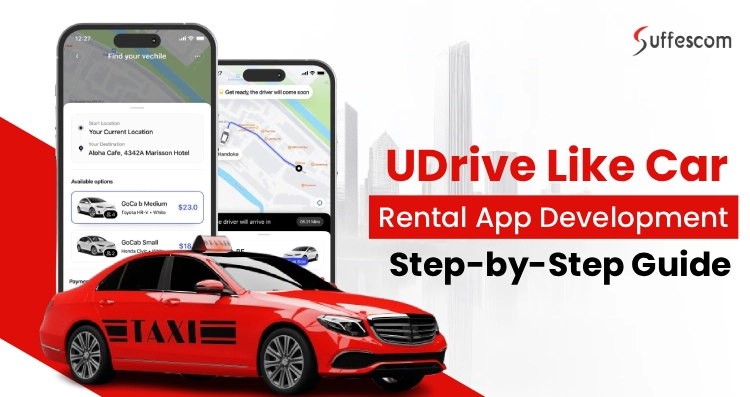
When it comes to car rentals, people no longer want to wait at rental counters, fill out paperwork, or depend on rigid booking schedules. Customers look for mobility to be instant, digital, and available exactly when and where they need it. That’s why car rental apps like Udrive have been gaining massive traction. With Udrive, users can easily locate, unlock, and drive a car within minutes through a mobile app.
These apps do not need to operate through rental offices. Their work is automated, smart, and digital with smart fleet management, digital KYC, in-app payments, and real-time vehicle tracking. The result? A scalable, location-agnostic business model that allows companies to reach a much broader audience while significantly reducing operational overhead.
This technology driven performance is even seen in the market growth and is most visible in the United Arab Emirates. Also, the global car rental market is anticipated to reach USD 278.03 billion by 2030, which shows the demand for such solutions.
Now, as more entrepreneurs and mobility companies look to enter this booming industry and build an app like UDrive, there is always one question that pops:
What does it really take? What features, technology, and cost are needed to build a car rental app like Udrive?
This step-by-step guide to UDrive-like car rental app development will cover each and every aspect for you. We will be discussing in detail what features it has and all the other features, architecture, and investment factors you must keep in mind in order to launch a successful and profitable self-drive rental platform.
Udrive, founded by Hasib Khan, is an app-driven self-drive car rental platform, based and operated in Dubai. It is a completely digital, on-demand mobility model, allowing users to rent and drive a car instantly. Thus, there is no need to follow the traditional rental processes such as visiting rental officers, going from one counter to another, or making deposits.
Udrive enables users to locate nearby cars through its mobile app, book instantly, and unlock the vehicle using a one-time password (OTP). And once you are done with your trip, the car can be parked in any legal public area in the city. It is available for both iOS and Android users.
Udrive has positioned itself as one of the leading app-based self-drive rental platforms in the region. It is a Series B company and has raised $17.3 million in funding from OHI Group of Companies and Dubai Cultiv8.
Discover the Car Via Map - Users open the app and view nearby available cars on a live map.
Flexible Booking Options - Cars can be booked on an hourly, daily, or monthly basis.
Monthly Subscription Plan - Monthly rentals include features like vehicle maintenance, insurance, delivery, and replacement support.
Keyless Access - After booking, customers receive app-based or OTP-based access that allows them to unlock the car. There is no need for physical keys required.
Free fuel and Hassle Free Parking - The pricing generally includes fuel and parking, with no registration fees or security deposits.
Let's discuss how a simple car rental mobile app works:
Digitize your fleet with a powerful car rental mobile app.
Worldwide revenue from the car rentals market is projected to reach US$112.00 billion by 2026 and grow even more to US$135.75 billion by 2030, at an annual growth rate of 4.93% between 2026 and 2030. And by the end of this decade, the market is also expected to serve nearly 776.96 million users globally.
These numbers clearly reflect the accelerating car rental industry growth. If we talk about on a regional level, the Middle East is emerging as one of the most promising markets for car rental app investments. Countries such as the United Arab Emirates, Qatar, and Saudi Arabia attract a huge chunk of international tourists and corporate travellers. It is all because of their extensive investments in airports, highways, smart cities, and urban infrastructure that significantly improve accessibility and connectivity. All of this supports mobility app development trends and creates an ideal condition for on-demand mobility services. Their high-income population and strong preference for premium and luxury vehicles just add the cherry on top!
By 2030, around 75% of total car rental revenue is expected to come from online and mobile channels. The average revenue per user (ARPU), at the same time, is projected to reach US$168.53.
| Metric | Data |
| Global Market Size | $140+ Billion |
| CAGR Growth Rate | 10.5% |
| Self-Drive Segment Growth | 12% CAGR |
| Top Revenue Regions | North America, Middle East, Europe |
It's very essential to be aware of what features your UDrive like app would need to grow successfully. We have divided the features on the basis of three major categories. Let’s discuss them in detail: -
The user application is the conversion engine of your platform. It must focus on speed, clarity, and trust.
Social & OTP login
Users should be able to register and log in using mobile OTP or social accounts. When the onboarding is friction-free, it improves sign-up completion and repeat usage. And once verified, one should not be forced to repeat the same steps again for every booking.
KYC & document upload
Smart search & advanced filters
Users must be able to quickly find the right car based on:
Clear filters means significantly reduced browsing time, which in turn directly increases booking conversions.
Real-time map & GPS tracking
A live map shows nearby available vehicles and navigation directions. And this is one of the most important features in a well-functioning car rental app. This is critical for self-drive and free-floating rental models where cars can be parked across multiple zones.
It also enables:
Simple booking & reservation management
Users should be able to:
Keeping a short, step-by-step booking flow will help prevent drop-offs and abandoned bookings.
Secure payment gateway integration
The app must support:
Users should always see a transparent price breakdown, including rental time, insurance, add-ons. Automatic invoice generation after each trip builds financial clarity and trust.
In-app notifications
Push notifications keep users informed about:
These alerts reduce late returns and improve engagement.
In-app chat & emergency support
Users should be able to quickly contact support through chat.
A dedicated emergency or panic button allows renters to report:
Trip history, invoices, ratings & feedback
The app should maintain a complete record of:
Ratings and feedback help improve service quality and provide social proof for new users.
The vendor panel enables fleet owners and partners to operate efficiently without technical dependency.
Fleet management system
Vendors manage:
A clean fleet management interface increases supply participation and encourages owners to scale their fleet within the platform.
Availability scheduling
Owners can define:
This prevents conflicts and double bookings. Thus, maximizing the usage of the vehicles.
Vehicle performance analytics
The system provides insight into how each car performs. It may include booking frequency, idle time, popular rental durations, and revenue per vehicle. These insights prove to be very helpful for the owners in making data-driven decisions on pricing, upgrades, and fleet expansion.
Revenue dashboard
A transparent earnings dashboard will show:
When there is clear financial reporting, it helps strengthen long-term relationships with vendors.
Maintenance alerts
Automated reminders notify vendors about servicing schedules, inspection dates, insurance renewals, and vehicle health indicators. This helps maintain fleet safety, reduces breakdown incidents, and protects the platform's reputation.
The admin system is the control centre of the entire platform.
User & vendor management
Admins can:
Centralized management ensures consistent service quality and regulatory compliance across the platform.
Live vehicle tracking
A real-time operational map shows:
This improves logistics, security, and fleet planning.
Commission and revenue control
Admins define and manage:
This enables flexible monetization across different markets and partners.
Analytics & reporting
The platform must provide insight into:
These metrics play a great role in guiding expansion decisions, fleet scaling, and pricing strategies.
CMS & promotion management
Admins should be able to manage:
A built-in CMS eliminates the need for technical teams for everyday marketing tasks.
Fraud detection system
Automated systems monitor:
This significantly reduces identity fraud, payment abuse, and unauthorized rentals.
Once your core platform is stable, here are a few more features can further strengthen retention and revenue:
The total car rental app development cost mainly depends on what features you choose for your app, the platforms you target (iOS, Android, or both), the level of automation and connected-car integrations required, and the location and expertise of the car rental app development company you partner with. Let’s discuss everything related to self drive car rental software price in detail: -
| Development Stage | Estimated Cost (AED) | What It Includes |
| UI/UX Design | AED 7,000 – AED 14,000 | User research, wireframes and final designs for onboarding, KYC, car search, booking |
| Frontend Development | AED 9,000 – AED 30,000 | Development of iOS and Android apps, booking flow, real-time map view, car listings, trip screens, notifications, payments UI and in-app support with smooth performance across devices. |
| Backend Development | AED 11,000 – AED 36,000 | Core system for users, vendors and admin, booking logic, trip lifecycle, pricing rules, KYC flow, fleet availability, payments processing, role management and system security. |
| API & Integrations | AED 2,000 – AED 15,000 | Integration with payment gateways, maps, identity verification, notifications, telematics, keyless access systems and external services through secure and scalable APIs. |
| Testing & QA | AED 2,000 – AED 11,000 | Functional testing of booking, payments and trip flows, security testing, performance checks, device compatibility testing and bug fixing before production launch. |
| Total Estimated Cost | AED 30,000 – AED 125,000+ | Final cost depends on feature depth, connected-car integrations, automation level, scalability needs and multi-city or multi-vendor deployment requirements. |
| App Stage | App Complexity | Car Rental App Development Cost | Timeline |
| Basic MVP | Low to moderate complexity. Covers only essential booking, user onboarding, basic admin panel, and payment flow. | AED 30,000 – AED 55,000 | 4-6 weeks |
| Advanced App | Medium complexity. Adds KYC verification, real-time vehicle tracking, push notifications, trip history, vendor panel and operational dashboards. | AED 55,000 – AED 90,000 | 8-10 weeks |
| Enterprise Solution | High complexity. Built for large fleets with automation, advanced analytics, dynamic pricing, corporate bookings, stronger security layers and scalable cloud architecture. | AED 90,000 – AED 125,000+ | 10-14 weeks |
There is a need for a well-structured product strategy and strong operational planning to build a car rental app. Down below is a proven, industry-aligned development process that the successful mobility platforms follow: -
The first step is always about understanding the need and research. Start by understanding how users actually rent cars today and where most existing platforms fall short.
Study leading platforms such as UDrive to analyze:
Do not forget to keep in mind the city-wise demand, understand regulatory constraints/ Also, define your primary customer group, be it tourists, corporate users, or residents.
This research is crucial in product positioning, feature priorities, and revenue strategy.
Your business model determines how your platform earns, scales, and operates.
Commission-based model
You earn a percentage from every booking made on the platform. This model works best for marketplace platforms connecting users with car owners or fleet partners.
Subscription model
Users pay a recurring monthly or yearly fee to access vehicles. Different plans come with different benefits such as maintenance, insurance, and delivery. This model improves predictable revenue and user retention.
Hybrid model
Combines subscription access with per-booking or per-hour charges. It is ideal for urban and enterprise mobility platforms where both long-term and short-term usage coexist.
Choosing the right model early avoids major re-engineering later.
Before starting the car rental app development process, it is important to select the tech stack based on the app's requirements.
| Layer | Recommended Technology | Purpose |
| Frontend | Flutter / React Native | Cross-platform mobile apps with single codebase |
| Backend | Node.js / Laravel | Booking logic, user authentication, fleet management APIs |
| Database | PostgreSQL / MongoDB | Structured booking records, vehicle data, driver documents |
| Cloud | AWS / Google Cloud | Auto scaling, storage, security monitoring |
A reliable app architecture also helps integrate payment gateways and other important verification tools without platform disruption.
Next, the product teams work on design user flows and interaction models. This phase particularly focuses on eliminating friction in the booking journey.
Key design areas include:
Wireframes change into interactive prototypes tested with real users. Early usability validation reduces redesign cost later in app development.
This is the phase where the idea converts into a functional car rental platform. When you hire an app development company, they typically divide the process into user modules, admin systems and fleet management tools.
Core development components include:
App development normally follows an agile sprint cycle where modules are built, tested and refined in iterations. This approach allows better feature validation and controlled scalability as the platform grows.
Once the car rental app development phase is completed, the next step is testing to identify whether the features are working as intended and whether there are any bugs or security issues. As security and reliability therefore, become critical engineering priorities.
Testing stages typically include:
After final QA approval, the car rental application is deployed to app stores with all the guidelines.
Launch involves:
Next, continuous post-launch support is required in the app to focus on uptime monitoring, bug resolution, feature upgrades and fleet expansion to new cities. Continuous iteration guarantees higher booking conversion.
A car rental marketplace generates revenue through multiple monetization streams. Let’s discuss the top revenue models that you can integrate into your car rental app:
In this model, the platform will charge a 10-15% commission per completed trip. This fee is deducted from the booking value before the fleet partner receives payment.
Revenue grows with booking volume and fleet expansion. For example, if a vehicle rents for AED 150 per trip a 20% platform commission generates AED 30 from that booking.
Commission models work well for car rental marketplace platforms where independent fleet owners list their vehicles and the platform manages discovery payments and booking infrastructure.
Frequent users prefer predictable pricing and not just per-trip costs and this is where subscription plans provide vehicle access for a fixed monthly fee.
Different subscription tiers may include:
Another revenue model which you can include in your car rental app is surge pricing, which adjusts rates based on supply and peak hours.
Examples of surge triggers:
Dynamic pricing increases revenue during high demand while ensuring vehicles remain available for urgent bookings.
You can also include additional services in the car rental app to generate some extra revenue besides other models.
It includes:
These extensions improve the car rental app monetization strategy and create revenue touchpoints.
Let’s discuss the challenges that can occur during car rental platform development.
Vehicle damage disputes are quite common in rental operations that’s why the platform should implement inspection workflows before and after every trip.
Car rental businesses operate under strict transportation and insurance regulations which is why the platform should ensure every vehicle listed on the car rental app complies with legal standards.
Failure in regulatory compliance can result in fines or license suspension.
Mobility platforms process payments, identity verification and vehicle access. Fraud attempts may be conducted that can include fake identities, stolen cards or intentional vehicle misuse.
While creating the car rental app, integrate AI fraud detection systems to decrease these threats.
One of the operational issues is supply and demand imbalance. A user may see available vehicles on the map but discover the car is already booked or unavailable. To solve this, solutions can include:
During tourism seasons, large events or holiday booking requests can spike. If the infrastructure cannot handle traffic spikes, the car rental application may experience slow load times or payment errors. Build an app with:
At Suffescom, our app developers build high-performance systems designed for instant booking, vehicle tracking and secure payments. The architecture supports fleet expansion and high user traffic without performance issues.
Our care rental app development company manages the complete development lifecycle from planning to deployment according to your vision and app requirements.
We provide post launch maintenance and support, which includes bug fixes, security updates and performance optimization to keep the platform stable and reliable after launch.
Every platform is built around the client’s business model whether it involves peer-to-peer rentals, corporate fleets, airport rentals or subscription mobility services.
All projects built by our app development company are under strict Non-Disclosure Agreements ensuring full protection of product ideas, technical architecture and business strategies.
Partner with our app development team to bring your idea to market faster.
Developing a car rental app similar to UDrive typically takes 3 to 6 months, depending on the complexity and features included. A basic MVP (Minimum Viable Product) with essential features can be built in 10–12 weeks. However, a full-scale car sharing platform with advanced features may take 5–6 months or more.
The cost of developing a car rental app usually ranges between AED 30,000 to AED 125,000+, depending on the app’s features, technology stack, and development team.
Modern car rental app development uses scalable technologies that support real-time bookings, location tracking, and secure payments.
Popular technologies include:
Starting with an MVP allows you to validate market demand, reduce development cost, and launch faster before adding advanced features like AI pricing, loyalty programs, and predictive fleet analytics.
A car sharing or self-drive rental platform can generate revenue through multiple monetization models:
Yes, GPS tracking integration is essential for modern car rental apps. It enables:
A white-label car rental software solution can be a cost-effective way to launch your platform quickly. Its benefits include:
Security is critical for any car rental marketplace app. Some important security features include:
Yes, most car rental apps integrate global payment gateways such as Stripe and PayPal for secure transactions. These gateways support:
Scaling a car rental marketplace platform requires both technical and operational strategies. Key approaches include:
Car rental apps must comply with regional transportation and data protection regulations. Common requirements include:
Choosing the right car rental app development company is crucial for building a scalable platform. Look for a company that offers:

Senior Content Strategist
Jonathan Raabe is a content marketing professional, focusing on mobile apps, software engineering, artificial intelligence, SaaS, cloud computing, and digital transformation. Jonathan works with visionary brands to translate complicated concepts into content that can be easily understood by their audiences. As an expert in his field, Jonathan strives to create content that is thought-provoking and backed by facts, while at the same time building brand authority and trust.



Related Blogs
Hear directly from clients who partnered with Suffescom to turn their digital ideas into secure, scalable, and high-performing products.

“Suffescom delivered a HIPAA-compliant telemedicine app exceeding expectations, with strong data security and thoughtful development strategies from start to finish.”

“Suffescom helped us build a smart property management and virtual tour platform. Their expertise in AI helped us attract more qualified leads.”

“Suffescom delivered a modern hotel booking app perfectly aligned with customer expectations, which helped us boost sales by 40%.”

“We needed real-time fleet tracking and route optimization. Suffescom developed a platform that reduced our operational expenses in the first quarter.”

“We needed a smart itinerary planner with AI features for tourists. Suffescom delivered beyond our expectations and helped us increase bookings.”