Forex Trading App Development with Crypto Wallet: Features, Cost & Benefits
Key takeaways: The UAE is a serious market for fintech and digital-asset products. DIFC alone hosted 1,677 A [...]
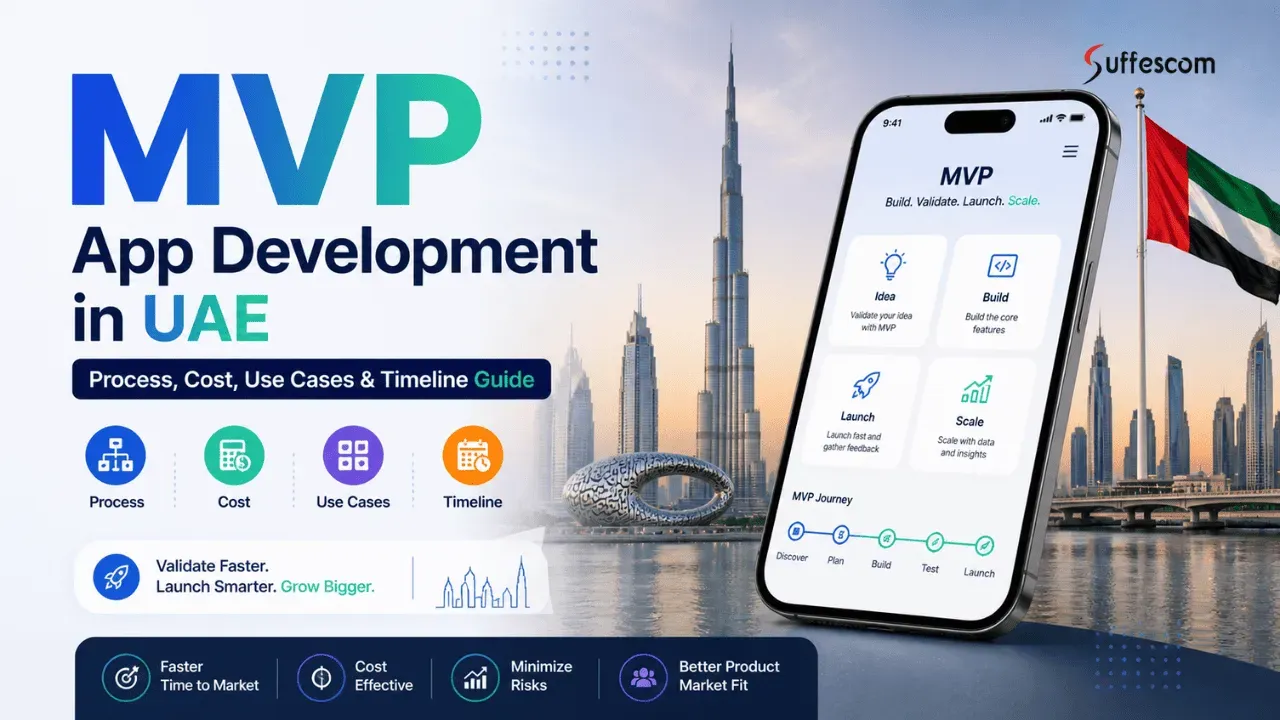
With the increasing speed of today’s digital economy developing a successful mobile or web application isn’t just about having a good idea anymore, it’s about verifying that idea fast, efficiently, and with low risk. This is where MVP (Minimum Viable Product) app development can help. Rather than spending months or years developing a complete product, businesses now choose to launch a basic version of the app with its foundational features, test it in front of actual users, and modify the product according to their real-world feedback.
Developing MVP apps has now become the style for startups, SME’s, and even enterprises as it works ideally with the new development philosophies of product development such as the Lean Startup approach, Agile Development, and Rapid Iteration. By only concentrating on key functionality of an app business can both decrease costs associated with product development, accelerate the app’s timeline to market, and increase the likelihood of achieving product-market fit.
Rapidly growing global technology and startup centers including Dubai and Abu Dhabi in the UAE region have become an increasingly popular location since 2010; examples include Smart City Programs and Digital Transformation Programs launched by the UAE’s official Government portal which support new business start-ups and expand their presence globally by providing an environment conducive for MVP based products and their subsequent growth worldwide.
Building an MVP is now considered necessary within the rapidly changing business environment that exists today (2026). An MVP will allow you to validate your idea, mitigate your risk and speed up your time-to-market regardless of your type of solution whether it is a Fintech Application, Healthcare Solution, On-Demand Service or otherwise.
Now, let’s explore further into MVP resources for the UAE. To summarize MVP development insights as they relate to app creation and development in the UAE:
In summary, MVP development as a foundational resource for creating digital products and a fast track entry point into highly competitive markets like the UAE should be very appealing to many companies right now.
As the use of AI, no-code/low-code platforms and other rapid development tools grows, the question arises; is MVP going to be relevant by the year 2026?
The short answer is—yes, more than ever.
But the role of MVP has evolved significantly.
With the advancements in Artificial Intelligence (AI) we now have a much higher capacity to build and test MVPs without solely relying on guesswork. Businesses are now able to use the power of AI to analyze user behavior, predict trends based on said analysis, and automate processes such as customer support and product testing. This allows MVPs to have a healthy amount of data behind them from the beginning.
According to the World Economic Forum, the use of AI is driving global digital transformation faster than ever before; however, the importance of utilizing an iterative process continues to be very critical to success. You can see more on the topic.
One of the largest advantages of developing MVPs today is the ability to validate ideas much faster than before. Thanks to new tools that incorporate AI, startups are able to conduct market research, test multiple features and receive real-time feedback much faster than using traditional long-term development processes. In turn, businesses will be able to make decisions at a much faster and smarter pace.
For instance, there are some tools (ex. Google Trends) that allow a simple analysis of what is currently in demand in the marketplace and tools (ex. Hotjar) that allows companies to see the actual behavior of their users.
With the help of no-code and low-code platforms, small companies have an easier time creating applications than previously thought possible. Founders can create fundamental MVPs (minimal viable products) using platforms like Bubble and Adalo without requiring extensive technical experience, which can help lower startup expenses and decrease time spent on the creation of these applications.
That being said, no-code and low-code are best suited for the initial validation of your particular product. As your product continues to develop and scale, customization options also become very important, using custom development for these types of projects. You may want to further investigate the tools that both Bubble and Adalo provide.
In 2026, the best way for organizations to compete is to combine AI and MVP. Using AI to shorten and enhance the development process and MVP to create products that have anticipated demand will give an organization a competitive advantage.
Companies that utilize the build → measure → learn model in their development processes will experience lower risk, higher-quality products, and ultimately, greater success in markets like the UAE, which are already very competitive.
Some entrepreneurs believe that the fastest way to get their idea to market is to build their entire product without going through an MVP approach. In reality, however, doing this may result in a greater expenditure, delays in time to market, and ultimately a failed product. Many companies focus all of their resources on developing an entire application before validating the idea, thus wasting valuable time and money and missing the opportunity to launch successfully.
Failure is a common reason for startups to go out of business. Data from multiple sources, including many failure reports, show that one of the main reasons that startups fail is that they build things that no one wants. This doesn't mean the solution to this problem is to not validate your idea. Building a product according to what people will validate helps you build things that real users want.
If you skip the MVP part of product development, it is very easy to invest a lot of money in developing an entire application up front with lots of bells and whistles before confirming that anyone wants to use those features.
The MVP approach, by contrast, focuses on only building the must-have features and then allows companies to do some cost containment and resource allocation before deciding whether or not to build any of the great-to-have features.
If you build an entire application without validating it with users first, it makes it difficult for you to figure out:
Using an MVP method allows you to validate with real users early on in your development process, resulting in your company having a better idea of how to develop a solution that reflects current needs without guesswork.
Many companies take months to develop a complete-featured program prior to deployment. This extended development cycle can be problematic since there is a lot of competition in the marketplace, such as the UAE, where speed is critical to your success. When the product is finished, the market may have changed, and competitors may have already capitalized on the opportunity to get ahead of you. An MVP approach allows you to deploy just the core functionalities quickly, begin to establish yourself, and then make improvements/enhancements to the product based on actual user feedback.
Feature overload is one of the largest pitfalls that applications can encounter during the initial phase of development, by trying to fit too many features into the first version. This adds to the level of development complexity, increases the cost of development and typically results in a poor user experience. Rather than providing clear value, the application becomes too large and confusing to use. An MVP-based development process eliminates the risk by deploying only the core functionalities that resolve the primary user issue so that your product is simpler to develop, more productive in operation and has greater usability.
| Factor | With MVP | Without MVP |
| Cost | Low | Very High |
| Risk | Controlled | High |
| Time to Market | Fast | Slow |
| User Feedback | Early | Late |
| Success Rate | Higher | Lower |
Many successful startups have avoided failure by launching small. As an example, startups in incubators such as YCombinator have used early stage product validation techniques by launching quickly with a minimal product and then enhancing it based on feedback.
Not doing an MVP is often seen as saving time but in most cases creates greater risk and lower rate of success than starting with an MVP. To do it smart: Build your MVP → Validate → Grow with confidence
Turn your app idea into a functional product with real user validation.
MVP needs to be understood prior to developing a mobile app, and due to the fact that businesses confuse MVP with prototype or proof of concept (PoC) when they're all three stages of creating an app…and all serve different purposes.
A minimum viable product (MVP) is the most basic version of an app that has only the minimum features that are needed to solve a problem for your initial users. The ultimate aim of the MVP is not to create the perfect product but to test whether the idea has a market or customer base with the least amount of time and money.
MVP is derived from the Lean Startup Methodology which uses the cycle of build > measure > learn. By utilizing this methodology, the goal of a startup or enterprise is to develop their product as fast as possible while obtaining user feedback so that improvements can be made based on real-user feedback (rather than assumptions). Instead of spending months developing a full-featured product, the company starts with only the core values related to their customers.
To put it simply, an MVP is not a "half-finished product" but rather a strategically created product that has enough features (but not all features) that provides just enough value that can be provided to early adopters. MVPs are one of the most effective methods for creating scalable user-driven applications for both startups or enterprises.
The terms MVP, Prototype, and PoC are sometimes used interchangeably, but they all have different purposes in the product development process.
Prototype: A Prototype is an early visual or interactive representation of the product, used to demonstrate the design, layout and provide a view of how the user interacts with the product (i.e., the user's journey). Prototypes are mainly used to get feedback on the UI/UX design before any development work begins.
Proof of Concept: A PoC, on the other hand, is focused on proving that a product idea can be achieved from a technical standpoint, or "Can you do it from a technology standpoint?" PoCs are typically created for internal purposes only and are not designed for end users.
MVP: An MVP is a functioning product with core features that has been released to real users. The purpose of an MVP is to measure anticipation in the market, get input from users, and learn if a product works in a real-time environment.
Recognizing this distinction helps companies use the correct method during each phase of a product's life cycle, allowing for improved planning, lowered costs, and quicker production periods.
| Aspect | MVP | Prototype | PoC |
| Purpose | Launch product | Visual concept | Test feasibility |
| Users | Real users | Internal/demo | Technical team |
| Development | Functional | Partial | Minimal |
| Goal | Market validation | UI/UX validation | Technical validation |
For both established businesses and startups MVP development provides many benefits by enabling companies to evaluate their concepts rapidly, minimize downtime, and maximize resource use prior to dedicating themselves to full development.
Some key benefits include:
Creating an MVP isn't simply about cutting down on functions; instead, it requires following a systematic and methodical methodology to verify that your item will indeed be usable, user centric and offer a high degree of scalability. An established procedure in the new venture environment of the UAE will help ventures expedite their launch timeframes while decreasing exposure to risk.
The first phase of developing an MVP involves determining if there really is market demand for your concept and how it will solve the issue at hand. A company must first describe in detail the issue being addressed, the expected audience, and the competing businesses currently engaged in digest size discussions. Once this is accomplished the business owners can confidently determine whether there is a viable opportunity for creating an MVP and whether any resources should be allocated for the development of the MVP.
A thorough market evaluation will provide insight pertaining to the end users of your item, what they desire and where the voids in functionality exist. Examples of such evaluation methods include survey methodologies to obtain information about the users expected preferences, using Google V/S to locate internet user trends (trends.google.com) and reviewing user behavioral patterns on google.com. Doing so gives you the ability to support developing an MVP based on real end user functional requirements as opposed to making assumptions regarding end user wants. Ultimately this diminished the chances of developing an MVP that fails or does not produce a profit in the period desired.
The next step, after confirming the concept of the product, is to list out the core features of the product. These will provide the primary value of the product for the user. Rather than developing a comprehensive list of features, companies should concentrate their attention only on the features that directly solve the user's most significant issue.
By using a lean method of developing the product, companies can shorten the time required to get the product to market, as well as their costs to develop the product while still providing the necessary clarity of the product. Focusing on just the essential features, will eliminate any additional complexity while creating a product that is simple, focused, and easily understood/adopted by the end-user.
At this stage, designers will be developing wireframes and prototypes of the app’s interface to make sure that its design is user-friendly and that it provides an intuitive experience for the users.
With such software products as Figma, it is possible to build prototypes and check their usability before starting coding. This will help detect the potential problems with the designs ahead of time and will make sure that the app meets the initial expectations.
The next stage of creating an app is developing its MVP version through agile methodologies. Agile methodologies allow developers to complete each feature separately and in cycles rather than finish the whole app at once.
It provides more flexibility during the process and allows for faster MVP development. Moreover, the agile methodology makes it possible for developers, designers, and other stakeholders to collaborate actively throughout the process.
The MVP's viability is tested in the testing phase of the development process to verify the availability and quality of the product prior to release. Once testing is complete, the MVP is soft launched as a separate phase by offering the product to a closed set of users, or a defined target audience, so that they can provide feedback.
Early launch allows a business to enter a specific market earlier than if they had waited until the product was fully developed and would allow them to make improvements based on their users' experiences. Additionally, a launch of an MVP will enable an organization to determine if the product has any issues related to performance, usability or improvement before the product is launched to a larger audience.
After the MVP is launched, collecting and analyzing user feedback becomes the most important step. Businesses track user behavior, engagement metrics, and feedback to understand how the product is performing.
User feedback enables the business to continue developing the product based on insights obtained from both quantitative and qualitative data through a reiterative process of improvements. This may include adding new functionality over time, optimizing the MVP’s performance, and transforming the MVP from a small-scale product to a fully scalable solution that continues to evolve as long as it remains aligned with market requirements.
It is very important to determine the overall MVP app development cost in the UAE in order to establish your budget for the use of this platform and set expectations on what will be achieved. There are many variables that will influence the final development cost including the complexity of the application (MVP vs. full scale) and its functionality, etc. Since MVPs typically only focus on the core function of the application, MVP development will be significantly less expensive than a full-scale development project.
In general, MVP development provides businesses with an opportunity to bring their product to market at a lower cost but deliver real value to the user. The MVP development process allows companies (startups and enterprises) to validate their ideas without over-utilizing financial resources, making this approach a good option in a competitive marketplace.
👉 In general, MVP app development costs in the UAE range from AED 55,000 to AED 220,000+, depending on the app’s functionality and complexity.
MVP development costs vary a lot based on many factors like the technical requirements of the solution as well as level of complexity and features in the product being built. To break down the cost of MVPs:
Basic MVP (AED 55,000 – AED 90,000)
Basic or simple, the essential features include a user login, simple user interface (UI/UI), and limited functionality. This is an ideal MVP for validating an idea at an early stage.
Medium MVP (AED 90,000 – AED 165,000)
Medium Explorer or mobile Based, the medium MVP includes APIs, dashboard, and third-party integrations; therefore they are ideal for startups with more definitive defined products.
Advanced MVP (AED 165,000 – AED 220,000+)
Advanced MVPs have at least one of three complexities, real-time features, scalable architecture or advanced features such as artificial intelligence or complex integrations.
Cost Table by Complexity
| MVP Type | Features | Cost Range (AED) |
| Basic MVP | Login, simple UI, limited functionality | AED 55,000 – AED 90,000 |
| Medium MVP | APIs, dashboards, integrations | AED 90,000 – AED 165,000 |
| Advanced MVP | Real-time features, AI, scalability | AED 165,000 – AED 220,000+ |
MVP development cost is split over different stages and each of these stages contributes to the overall MVP development budget. The largest portion of the total MVP development budget is typically accounted for in the production phase as it includes coding, backend set up, and the installation of all systems and integrations. Design and testing phases ensure usability and performance.
An effective method for managing business resources associated with MVP development is by using a balanced cost distribution. Investing additional resources in design and user interface/user-experience (UI/UX) design will help improve the overall user experience with the MVP while also investing additional resources on testing will improve product quality. Project management is also a key discipline and contributing factor in keeping the MVP development process efficient and on schedule.
Cost Breakdown Table
| Component | Estimated Cost (%) |
| UI/UX Design | 15–20% |
| Development | 50–60% |
| Testing & QA | 10–15% |
| Project Management | 10–15% |
There are many factors that can contribute to the total MVP cost in the UAE. One of the largest contributing factors is the complexity of the development because the more complex an app is, the more features and integrations will result in extended development duration and higher MVP overall development costs. Furthermore, the decision of whether to build a native application or a cross platform application will also affect the actual MVP total cost.
The technical stack and the level of expertise of the team and third party integration technologies (e.g., payment systems and APIs), are also important considerations. Infrastructure decisions, such as whether to go with cloud hosting or to scale and how quickly, can significantly impact your long-term cost structure.
Focus on Core Features: Build only essential functionalities that solve the main problem, avoiding unnecessary features in the initial phase.
Use Cross-Platform Development: Technologies like Flutter or React Native help reduce development time and cost by building for multiple platforms at once.
Start with Scalable Architecture: Planning scalability early helps avoid expensive rework when the product grows.
Choose the Right Development Partner: Working with experienced developers ensures efficient development and reduces long-term costs.
The MVP development time frame in the UAE is an important aspect of executing a project scope for launching products and supports managing expectations of the overall flow of a project. The time it takes to develop an MVP is somewhat different based upon several different factors, including the complexity of the application, the number of features, the size of your project team, and the development model used for the project. Because an MVP consists only of those functions that are most important to an end-user, an MVP can be developed much more quickly than a full function version of the application.
👉 The average time required to develop an MVP in the UAE is approximately 8 to 16 weeks. This gives startups and businesses a great opportunity to rush a product to market and gain market feedback regarding the viability of their product concept and/or business idea.
The MVP development process is divided into multiple phases, each contributing to the overall timeline. A structured approach ensures smooth execution and timely delivery of the product.
Research & Planning (1–2 weeks):
The first step in this phase focuses on understanding the overall business objectives and the target customer base, along with the needs of the marketplace surrounding your business. The first step includes competitor analysis, the creation of user personas to accurately reflect your target audience, and finally to determine the product scope of what is to be developed. Proper preparation will help the development team to have a clear roadmap to work from and reduce confusion and rework later on.
UI/UX Design (2–3 weeks):
This stage will focus on creating wireframes, prototypes, user flows and so forth to help the design team get a true understanding of what creating a fantastic app experience will look like. The ultimate goal of this stage is to develop how the interface of the app will be built to allow for a user-friendly, easy-to-use application that meets user expectations. Well-designed app interfaces will reduce friction, increase user engagement, and help to reduce the usability issues encountered during development.
Development (4–8 weeks):
In this phase is where the actual MVP will be created through the use of selected technology and frameworks chosen earlier. The developers will be working on the front-end, back-end and integrations, while continually using agile development techniques in developing the MVP. The length of this phase will differ depending on how complex your app is, however, at the conclusion of this phase, all core functionality of the MVP should be developed and functional.
Testing & QA (2–3 weeks):
Before moving onto the release of the MVP, there should be extensive testing carried out so as to identify any flaws and fix them before making them available to users. It is a step in the entire development process which will ensure that the final product is stable, safe, and ready for presentation to users. Testing will make sure that the end-users enjoy a good user experience.
| Phase | Duration |
| Research & Planning | 1–2 weeks |
| UI/UX Design | 2–3 weeks |
| Development | 4-8 weeks |
| Testing & QA | 2–3 weeks |
The amount of time taken to create an MVP depends on the level of complexity of the app. For instance, a simple app with basic functionality takes less time to create than more complex applications.
More complex applications involve integrations, real-time features, and scalability considerations, which naturally increase development time.
Prioritize Core Features: Focusing only on essential functionalities reduces development time and avoids delays caused by feature overload.
Use Agile Development: Agile methodology allows parallel development and faster iterations, helping teams deliver results quickly.
Choose Cross-Platform Technologies: Frameworks like Flutter or React Native help build apps for multiple platforms simultaneously, saving time.
Work with Experienced Teams: Skilled developers can streamline processes, avoid common mistakes, and deliver projects faster.
UAE Startups and Businesses Observe Trends with MVP App Development in order to Minimise Risk, Validate Ideas and Increase Speed to Market. Companies Often Use MVP Strategies to Validate Ideas Before Investing in Full Product Development.
Below are the most common and practical MVP use cases in UAE startups:
By building an MVP, Businesses can Determine Whether Their Start-Up Idea Solves an Actual Problem, Prove Their Idea is a Valid Use of Resources, and Influence the Future of Their Business.
Validation of the Idea through MVPs will Allow Startups to Avoid Investing in Features that May Not be needed by Users. This is Critical in a Competitive Eco-System such as the UAE Where Market Change (innovation) and user expectations change rapidly and are high.
Example: A New App Launches with Basic Functionality (Sign-Up + One Key Feature) to Determine if Users Will Actually Engage with the Application.
MVPs are Critical to Obtaining Funding as They Provide an Operational Product vs. Just an Idea. If a startup has a proven MVP showing Traction, Functionality, and Actual User Base it would be Easier to Obtain Funding vs. Just Product Ideas with Little or No Activity.
The MVP acts as the first demonstration of product capability or trustworthiness for an investor. With the MVP, a startup can also show objective evidence of user activity and engagement through data and analytics.
Example: A startup can show user activity and some analytics by demonstrating to secure seed funding
MVPs allow businesses to release a product early and gather feedback directly from users. This helps teams understand user behavior, preferences, and pain points, enabling continuous improvement.
Instead of relying on assumptions, companies can refine their product based on real insights. This iterative approach leads to better product-market fit and higher user satisfaction.
Example: an app is launched with basic functions and is updated weekly according to the user's recommendations.
Businesses often use MVPs to validate the functionality of the MVP for a specific function rather than for the entire MVP.
Through testing various functionalities of the MVP, businesses can determine the features that users value and the functionalities that can be eliminated.
By having validated functionalities, developers can invest their time and money on the most important features of the MVP and to eliminate excess functions and thus minimize overall development costs.
Example: The app tests one feature (ie, chat or booking) at a time before developing the entire app.
Speed has become one of the biggest positive factors of an MVP in today’s fast-moving and ever-changing digital world, where businesses must quickly create a minimum viable product to showcase their idea to prospective customers, gain early adopters, and get traction in the market.
Speed to market gives a business the ability to secure attention from users before its competitors can fester up an alternative solution and validate the soundness of its product offering - which is most beneficial in some of the fastest growing sectors within UAE.
Example: a company can release a simple version of its app or product in a matter of weeks compared to the months it typically takes to develop a complete app or product.
MVPs allow companies to limit their initial investment by developing only the core components of the product offering. This is particularly valuable for start-up and SMEs who do not have many resources available.
MVPs also allow companies to develop and launch a product with fewer features but have the potential to develop additional features based upon customer feedback during the testing phase.
Example: Instead of building 10 features, a team launches with 2 and scales later.
MVPs provide companies with an opportunity to test various monetization strategies such as subscriptions, advertising, or commission-based revenue models to determine which strategies are the most effective prior to launching to a wider audience.
Testing business models early will ensure the product is not only marketable but will also be able to sustain itself financially. MVP testing also enables businesses to test and refine their revenue models before they scale.
Example: An app launches with basic functionality and experiments with different pricing models.
When considering expanding or scaling operations, businesses must first determine that there is an actual market for its products. An MVP can be used to verify this by launching the product with a very limited number of customers or in a small geographic area. This gives the company valuable information about users' interest level in the product as well as how many users will adopt it.
Thereby allowing the company to only grow when there is documented evidence of demand from the marketplace.
Example: When an MVP is launched in a small area or to a limited number of customers to determine if they have an interest in the product.
Another benefit to MVP development is that it can minimize business risk by validating assumptions before committing to an idea's development process. Companies can determine whether their concept has merit by thoroughly testing it step by step, rather than making a large investment for an unproven concept.
This reduces the probability of the concept failing and also results in the company being able to make better decisions based on data rather than intuition, creating a safer and more strategic plan to develop a successful application.
For example, prior to commencing full-blown development, the company first determines if there is any need for users to have the solution.
Build a product users can experience and give feedback on.
Choosing your MVP technology stack is crucial to the entire process of building an MVP. The technology chosen will impact how fast the MVP will take to build, how the MVP's performance will scale, and the overall cost of the MVP. Many startups in the UAE are moving toward using technology that allows for speeding up development time, flexible use of the technology, and future scalability due to their accelerated growth in the UAE startup ecosystem. If selected properly, the technology stack will provide developers with a compressed amount of time to develop the MVP while also being well suited for growth as the number of users increases.
Developers have many different options for their MVP technology stack. Some of the most popular technologies for developing MVP applications are listed below.
The front-end technology that you use to create your MVP will greatly affect the user interface and user experience of your application, as well as how users will interact with your application(s). In most cases, developers will utilize cross-platform front-end development frameworks to develop MVP applications because they allow you to develop Android and iOS mobile application components all with the same code.
By utilizing Flutter and/or React Native, developers are able to decrease build time and build costs to develop the MVP, while still being able to develop a high-performance application. Due to their ability to deploy quickly, they also allow for testing and improving upon the MVP before the final release of an MVP.
The backend will be in charge of data management, server functionality, and overall application performance. The selection of a scalable and efficient backend solution guarantees smooth processing of requests and growth of your MVP in the future.
Examples of such solutions include Node.js and Django – fast and flexible options with strong communities. These technologies provide you with an opportunity to create robust and high-performing apps.
Cloud-based platforms serve an important purpose in the creation of an MVP because they provide a means of scaling infrastructure without requiring major initial expenses. Rather than establishing a physical infrastructure in the form of servers, companies can employ cloud technology to scale their application.
Examples of cloud platforms include Amazon Web Services (AWS), Microsoft Azure, and Google Cloud Platform. They give businesses the ability to scale based on demand while only paying for what they actually consume.
AI development and automation are gaining prominence in the process of creating MVPs today. These tools enable companies to improve their user experience, streamline their processes, and derive insightful information from user data.
AI can be applied in the context of chatbots, recommendation engines, and predictive analysis in MVPs. By incorporating AI into your MVP, companies will have an opportunity to test cutting-edge technologies and compete in innovation-led markets such as the UAE.
Table: Best MVP App Development Technologies
| Category | Technologies | Why It’s Used for MVP |
| Frontend | Flutter, React Native | Faster development with a single codebase for iOS & Android |
| Backend | Node.js, Django | Scalable, high-performance, strong community support |
| Database | MongoDB, PostgreSQL | Flexible data handling and easy scalability |
| Cloud | AWS, Azure, GCP | Cost-effective, scalable infrastructure |
| DevOps | Docker, Kubernetes | Faster deployment and better app management |
| AI/ML | TensorFlow, OpenAI APIs | Enables automation, personalization, smart features |
While MVP development offers many advantages, it also comes with its own set of challenges. Businesses often struggle with balancing speed, cost, and quality while trying to build a product that delivers real value. Identifying these challenges early helps in avoiding costly mistakes and ensuring a smoother development process.
By understanding common MVP pitfalls and applying the right strategies, businesses can build a product that is not only functional but also scalable and user-focused.
One of the most common MVP development challenges is adding too many features in your first product release, by adding everything at once - you've defeated the purpose of building a "minimum product".
Solution: Focus only on core features that solve the primary problem. Use prioritization techniques like MoSCoW (Must-have, Should-have, Could-have, Won’t-have) to keep the product lean and efficient.
Startups can have issues creating their first minimum viable product, due primarily to a lack of funds, coupled with poorly managed resources. Much of this is caused by ineffective planning which may lead to overspending or just poor product development overall.
Solution: Adopt a lean approach by focusing on essential functionalities first. Use cost-effective technologies and plan development in phases to ensure better budget control and ROI.
Launching an MVP without a clear feedback strategy can lead to unreliable or insufficient data. Without meaningful feedback, it becomes difficult to improve the product effectively.
Solution: Obtain structured feedback through methods such as surveys, web analytics, user interviews, etc.; collect only meaningful/actionable data from users and utilize this data for determining how best to improve the overall performance of your product.
Many MVPs are developed at a quick pace without consideration given to future scalability of the product once it is completed, resulting in poor performance of the product, slow response times, or complete system failure as the user base grows.
Solution: Use a server-based architecture for a scalable product and consider using cloud-based solutions for developing your product right from the beginning. Whether the initial version of the MVP is a small or large scale project, design it for future growth without requiring major changes to the system in order to support the growth.
Selecting the perfect MVP app development company in UAE is essential since this could determine how successful your product turns out to be. The appropriate agency will do more than developing an MVP; they will assist you throughout the process of creating a successful product.
Selecting a company based upon its portfolio is another great place to start when trying to find an MVP development company. Look at examples of previous projects to get an idea of what types of applications have been built, and which industries have completed these projects. Look for companies that specialize in the type of app you are looking to build, have developed multiple MVPs, and have successfully launched products similar to yours.
In addition to looking at an application development company’s portfolio, read case studies of how they solved real-life problems, the obstacles they faced while completing the projects, how they delivered the project, and what the results of the project were.
In building an MVP that is scalable and provides high performance, too often the MVP roll-out is done without a lot of consideration paid to the technical side of things. The technology company that you will select for the MVP should have a strong technical background; be familiar with the latest technologies including cross-platform frameworks, backend systems, and cloud infrastructure.
A well-developed technical team will guarantee that the MVP is developed in an effective manner, allowing for the MVP to grow along with your organisation. Moreover, the development company will help to lower the risk of technical issues and increase the overall performance of your product.
Using client feedback can be an important factor in determining the right development company. The client review process can provide some insight into how reliable, communicative, and timely the development company will be with delivering the actual project.
Keep an eye out for continuous positive client feedback as well as for long-term clients. Both of these can be indicative of a reliable development company and the development company will continue to produce high-quality results.
To have a successful partnership there needs to be good communication and clear pricing. Development companies should provide a clear breakdown of all costs involved in developing the product as well as detail what will be included during the development phases.
When choosing a company, stay away from companies with unclear pricing or companies who give you unrealistic estimates. Regularly scheduled project updates along with clearly defined timelines and ongoing communication help ensure that your development project will stay within budget and will meet your expectations.
Just because you have released your initial product (also called a minimum viable product), does not mean your relationship with the company has ended, because the ongoing support is just as critical as the actual launch of the product. Following the release of your initial product, you will require ongoing support in terms of product updates, servicing bugs, and incorporating user-based feedback into ongoing product improvements.
A good development company will provide you with this post-launch support and will help your product scale for the future. This will help ensure your long-term success, and that your product will continue to evolve smoothly as it becomes a fully functioning developed application.
When Investing In Developing An MVP App In The UAE, Businesses Should Work With A Development Partner That Provides Comprehensive End-to-End Services Beyond Simple Coding. A Quality Development Partner Should Provide Your Business With Strategic Guidance And Ongoing Support To Help Ensure That Your Product Will Be A Success After It Has Launched In The Market.
End-to-End MVP Development Refers To A Complete Development Process Of All Aspects Of The Lifecycle Stages Of Your Product, Including: Idea Validation, Market Research, Feature Planning, UI/UX design development, testing, and launch of your MVP App Product. Having One Development Team Handle The Entire Process Provide Better Coordination, Faster Implementation, And Consistent Quality Of The Product.
User interface/interaction (UI/UX) services are all about crafting an experience for the users to use the application by utilizing wireframes, prototypes, and mapping the user journey. A properly designed user interface ensures easy navigation and the realization of the true value of the application by the users.
MVP Consulting services allow organizations to look at the big picture and determine the future vision of their product as well as how to implement the features needed for successful launch or a timeline for developing.
Maintenance and scaling service concentrates on enhancement and development of the product post launch. These include optimizing performance, fixing bugs, and introducing new features as per feedback. The continuous process guarantees that the MVP grows into a scalable and ready-to-market product. It also enables companies to be adaptive towards their users' requirements.
With innovation-driven initiatives and a growing startup ecosystem, the UAE is becoming a hub for next-generation MVP development. Key Trends Shaping MVP Development
MVP development is using AI heavily in the design of its Foundation; some examples of this being development through AI MVS "apps". Features (such as chatbots) are becoming a standard part of an MVP during the initial design stage, allowing companies to create a better user experience while also giving them access to deeper insights through data driven decisions.
MVP development platforms are using both no-code and low-code platforms to expedite the time needed to develop an MVP; many startups need only a basic application developed and are able to complete their project with little to no programming, resulting in decreased cost and decreased overall time needed to market.
MVP development will also begin to see an increased use of the Blockchain technology within the development of MVPs, so far this has been primarily used in FinTech, Supply Chain and Real Estate and has proven to have great success in those industries by providing a secure, transparent and decentralized approach to creating a trust-based application.
MVP development will continue to develop personalized user experiences. Through hyper-personalization, MVP's will be able to provide users with customized content and recommendations that have been developed based on user behavior and preferences, therefore allowing the MVP creators to maintain and improve users current engagement.
For many businesses looking to create and launch high-quality digital products in the United Arab Emirates, building a "Minimum Viable Product" (MVP) is an effective strategy. Rather than spending large sums of money to develop a fully functional version of their product prior to launching it in the market, businesses can instead invest in developing and launching an MVP version of their product. With the help of real users, they can validate their concepts and then update them based on real-world usage. This approach will reduce their business risks while also ensuring that there is better alignment between their product and what users want from the marketplace.
The fact that the UAE has developed into an emerging technology center, particularly in cities like Dubai and Abu Dhabi, makes it an ideal time for any company to develop and subsequently launch MVP products. The combination of strong government support, a growing startup community, and increased adoption of digital technology creates a perfect environment for innovation and rapid product development.
In this guide, we cover how to take a strategic approach to MVP development by providing insights about the MVP process, as well as providing guidance related to MVP costs, MVP timelines and resources, MVP use cases, and future trends in the area of MVP development. We hope that after reviewing these materials, you'll have a better understanding of how to effectively develop scalable, user-centric applications through the MVP process by focusing on core features, selecting the right technology, and partnering with an experienced app development company.
Speak with our MVP developers and plan your app the right way.
1. What is MVP in app development?
An MVP, which stands for Minimum Viable Product, is a product that consists of only those essential features necessary to solve a particular problem. MVP is used to verify the concept of the product by testing it on real customers before developing it on a larger scale.
2. How much does MVP app development cost in UAE?
The price for an MVP application in the UAE starts from AED 55,000 up to AED 220,000+, which depends on the complexity of an application, its functionality, and technology stack chosen. The prices vary according to the complexity level of the application developed.
3. How long does it take to build an MVP?
The average timeline for MVP development is around 8 to 16 weeks. This includes research, design, development, and testing phases. However, the exact duration depends on app complexity and feature requirements. Using agile methods can help speed up the process.
4. What is the difference between MVP and a full app?
While MVP contains only necessary functionality that can be used for testing a business model, a full application comes with advanced functions. MVP is used to test the market before scaling up while an app is developed for scaling purposes.
5. Can an MVP be scaled into a full product later?
Yes, MVPs are designed to be scalable and evolve into full products over time. Once the idea is validated and user feedback is collected, additional features can be added gradually. This step-by-step approach ensures better performance and long-term success.
6. What are the benefits of MVP development?
The benefits of MVP development include reducing costs, eliminating risks, and saving time to bring a product on the market. Companies will be provided with an opportunity to collect users' feedback and take action based on data.
7. Which technologies are best for MVP app development?
Some popular technological tools to be used for developing an MVP may be such technologies like Flutter and React Native for frontend, and Node.js or Django for backend, with using cloud-based solutions for scalability.
8. How do I validate my MVP idea?
You can validate the idea by conducting market research, analyzing competitors and conducting surveys among users. The most efficient way of validating the concept will be developing the MVP itself and presenting it to users for testing.
9. Is MVP development suitable for startups in UAE?
Certainly, MVP development is very appropriate for startups based in the UAE because of its cost-effectiveness and quicker development capabilities. MVP enables startup owners to test out their ideas within a competitive market environment without spending a lot of money on it.
10. How to choose the best MVP app development company in UAE?
When selecting the right company for your MVP development, evaluate the portfolio, technological skills, and customer reviews about that company. You should go for companies that offer affordable prices and after-launch services as well.
11. What industries benefit most from MVP development?
Fintech, health care, ecommerce, real estate, and other industries would highly benefit from MVP creation since there is a need to validate quickly and continuously improve.
12. What are common mistakes in MVP development?
The most frequent errors are including unnecessary functionality, not considering consumer feedback, and improper planning. Many firms fail to consider scaling their product, which leads to issues down the road.
13. Do I need a full team to build an MVP?
It is not always the case. A small but competent group can use agile methodology and work together to develop an MVP. Startups often use a small team at first before expanding their resources according to the growth of the product.
14. Why is MVP important for product-market fit?
The MVP concept is critical when determining product-market fit as it allows organizations to validate their idea among actual users. The process enables firms to know the real needs of consumers and understand what they expect from the product.

Senior Content Strategist
Jonathan Raabe is a content marketing professional, focusing on mobile apps, software engineering, artificial intelligence, SaaS, cloud computing, and digital transformation. Jonathan works with visionary brands to translate complicated concepts into content that can be easily understood by their audiences. As an expert in his field, Jonathan strives to create content that is thought-provoking and backed by facts, while at the same time building brand authority and trust.


Related Blogs
Hear directly from clients who partnered with Suffescom to turn their digital ideas into secure, scalable, and high-performing products.

“Suffescom delivered a HIPAA-compliant telemedicine app exceeding expectations, with strong data security and thoughtful development strategies from start to finish.”

“Suffescom helped us build a smart property management and virtual tour platform. Their expertise in AI helped us attract more qualified leads.”

“Suffescom delivered a modern hotel booking app perfectly aligned with customer expectations, which helped us boost sales by 40%.”

“We needed real-time fleet tracking and route optimization. Suffescom developed a platform that reduced our operational expenses in the first quarter.”

“We needed a smart itinerary planner with AI features for tourists. Suffescom delivered beyond our expectations and helped us increase bookings.”