Forex Trading App Development with Crypto Wallet: Features, Cost & Benefits
Key takeaways: The UAE is a serious market for fintech and digital-asset products. DIFC alone hosted 1,677 A [...]
The real estate market in the UAE, particularly in Dubai, is witnessing rapid growth in both its digital and economic aspects. According to Property Finder insights, in 2025, Dubai saw a 22% increase in property transaction volume and AED 184.3 billion in value in just one quarter, demonstrating high levels of investor confidence and rising property demand.
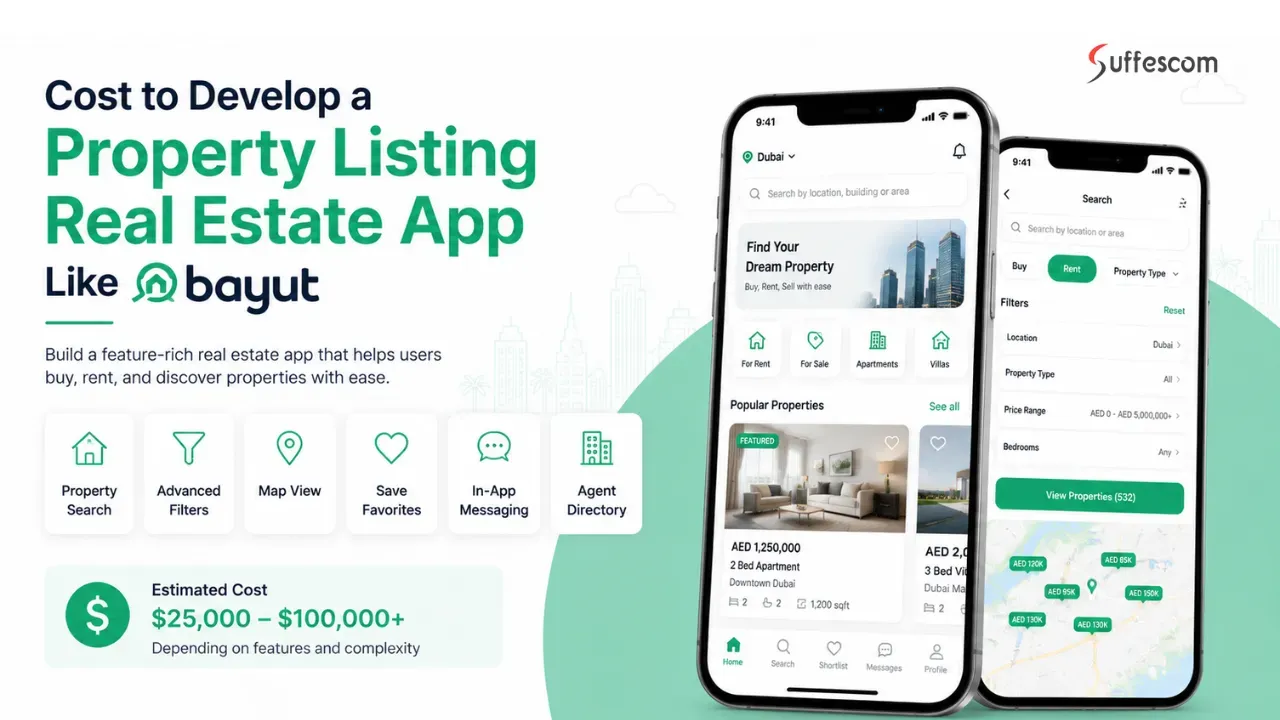
On the other hand, people now look for properties through mobile-first platforms. This is one of the primary reasons behind Bayut's immense success. The platform offers immediate listing updates, smart filters, and live chat options with agents. If this inspires you to build a platform like Bayut, but you're uncertain about the cost it takes to develop a property listing real estate app like Bayut, here you get all the insiders. From factors influencing the cost, hidden price drivers, and tips that help you plan your Bayut-like app development budget-friendly, we are covering everything here.
A property listing real estate app refers to an online software program that brings together property buyers, sellers, renters, and agents. The users do not have to visit any physical offices since the platform allows them to access verified properties, make comparisons, and communicate with agents all in one convenient platform. In the case of the UAE, such apps have become very instrumental due to the nature of the real estate market there.
The real estate marketplace application operates as a platform that involves two sides. The first side includes real estate owners and brokers listing their properties for sale or rent. The second side comprises prospective buyers and tenants who are able to search and shortlist properties according to the location, price range, and personal preference.
In contrast to regular listings, the platform provides additional value through such functions as verified listings, intelligent search filters, instant alerts, and in-app messaging. In the UAE, applications like Bayut have already established the standard, providing structured data on real estate and an extremely user-friendly interface.
Real Estate Buy & Sell Apps: The applications under this category deal with the transaction of purchasing real estate. They provide users with the opportunity to purchase villas, apartments, and off-plan properties. This category is very popular in Dubai and Abu Dhabi.
Real Estate Rent Apps: This category consists of applications that help users to rent out properties for short-term or long-term purposes. They are highly favoured by expatriates due to their constant movement within the UAE.
Commercial Real Estate Apps: This category consists of applications that help commercial users to purchase office spaces, retail outlets, warehouses, and other commercial properties.
Luxury Real Estate Apps: This category is made up of applications that are meant for affluent clients looking to purchase high-end villas, waterfront properties, and branded residences.
Real estate applications in the UAE cater to various types of users, such as:
Users interact with the application in distinct ways; hence, real estate apps have personalized dashboards based on roles.
A property portal is a large marketplace website where many agents or agencies list their properties. The emphasis here is on aggregation, discovery, and high traffic; such portals are similar to Bayut-style portals.
On the contrary, a real estate brokerage app is created to be used by one agency or organization alone. It makes sense because it helps them organise their listings, manage leads, and communicate with clients directly.
Put simply, a property portal is like a multi-vendor marketplace, whereas a brokerage app is an application created for one business only. Such applications and websites are common in the UAE.
The UAE real estate market is witnessing an increasing trend towards digitisation, with customers and investors now making extensive use of mobile apps to find and compare different properties. In light of increased competition within Dubai, Abu Dhabi, and other emerging property markets, companies are developing property listing apps for enhanced customer engagement and marketing purposes.
Searching for properties in the UAE has become predominantly mobile. Both buyers and tenants want applications that give them easy access to property listings, comparisons of prices, scheduling visits, and contacting agents from anywhere. Since there are always thousands of newly available properties every day, a mobile application can help users get instant access to all necessary data much quicker than using conventional property search techniques.
The use of an application for real estate purposes can greatly simplify the whole process of property finding for businesses as well as consumers. They will be able to effectively handle their listings, engage more customers, and receive high-quality leads thanks to efficient search filters, push notifications, and artificial intelligence recommendations. Also, they will enjoy improved brand presence and customer retention.
With a high level of competition in such cities as Dubai, real estate agencies have a strong competitive edge with a property app compared to those that operate only on their website. An application can significantly increase accessibility, create a reputation, and allow agencies to provide fast communication, certified listings, and excellent customer service.
Earnings for real estate applications can be made through various revenue streams such as featured listings, subscriptions, leads, advertising, and partnerships with developers. With the growth of the property market in the UAE, these applications have business opportunities available to them.
| Market Segment | Growth Potential | Revenue Opportunity |
| Residential Listings | High | Subscription + Ads |
| Luxury Properties | Very High | Premium Listings |
| Rental Apartments | High | Commission Model |
| Commercial Properties | Medium | Lead Generation |
| Off-Plan Projects | Very High | Developer Partnerships |
The cost for creating a property listings app such as Bayut in the United Arab Emirates will depend on many aspects, such as the complexity of the app, the number of its functions, the choice of platforms, the user interface design, etc. An MVP with basic listing functionalities will be far cheaper than an AI-driven marketplace.
There are a lot of factors that determine the cost of developing a real estate app. This mainly includes the design and backend development. Apart from this, API integration and maintenance also greatly influence the overall cost. Then, advanced features, such as AI development, predictive market analysis and a real estate tokenization platform can also hike up the price significantly.
Features of a basic property listing app consist of user account creation, property listing capability, filters, map integration, and means of contacting the agents. Such applications are best suited for startups and small real estate agencies looking to build an MVP.
Features of mid-level apps include advanced UI/UX design, advanced filtering capabilities, push notifications, messaging, analytics tools, and multilingual support. Such platforms are perfect for growing agencies that aim to attract large numbers of customers from Dubai and Abu Dhabi.
Advanced real estate applications offer features such as AI-based property suggestions, virtual tours of properties, predictive analytics, CRM integration, blockchain validation, and enterprise scalability. The development process of these applications involves bigger development teams and longer timelines.
The cost of developing such applications is also dependent on the platform to be used. Tools such as Flutter and React Native make the development process more cost-effective since they allow developers to approach both Android and iOS app development simultaneously, whereas native applications take up more resources.
| App Type | Estimated Cost (AED) | Development Timeline |
| Basic MVP development | AED 20k – 50k | 2 Months |
| Medium Real Estate App | AED 50k – 70k | 4 Months |
| Advanced Bayut-like App | AED 70k – 200k | 6 Months |
For a property listing app to be successful, there is more than just uploading properties. Today's UAE real estate consumers want a platform that offers instant searching, validated properties, intelligent suggestions, and efficient communications all in one place. The right mix of features will determine how successful the platform will be. That's why businesses are going for custom real estate app development for the UAE market rather than a generic, template-based build:
Your users must be able to register and create their profile based on which party do they belong to. They could be buyers, tenants, agents or property owners. Then, the second important thing is that you have to enable profile management options for them. This is important so they can book properties, manage inquiries, analyse the performance of their listing, and change preferences.
Users barely have time for anything complicated. They simply use the app for convenience. So, it is very important to make things simpler for them. And, in order to do so, you have to allow them to find the desired property based on categories. In real estate, the main categories are property, budget, size and facilities. It is a very important feature, especially when you are building an app with a large database of properties.
Integration with maps helps users find local schools, hospitals, transportation links, and business centres. Location-based searching is an important feature of property finding in the UAE market, particularly in Dubai and Abu Dhabi.
Quality images are very important in increasing the level of user engagement. The real estate application enables users to upload visual galleries, high-definition videos, floor plans, and interactive media to give users a better view of the property.
Virtual tours of the property can be conducted using this application to enable users to see the property virtually. Virtual tours will be more important to foreign investors looking for UAE properties.
The in-app messaging facility allows users to communicate directly with their realtors to set up visits and answer any queries raised by the buyers. Such communication helps increase user engagement.
Push notifications can inform users about new listings, changes in prices, property recommendations, and appointments. Push notifications will increase user engagement on the app.
The mortgage calculator allows the user to calculate monthly payments, loan qualification, and the cost of financing right inside the application. This tool is quite useful for financial calculations when searching for properties.
Artificial intelligence can analyse the user's behaviour, search history, and preferences to suggest suitable properties based on such data. Artificial intelligence makes property recommendations more convenient.
Given that the UAE is home to a large international community, multilingual support is extremely important. Successful real estate applications have both Arabic and English versions.
| Essential Features | Advanced Features |
| Login/Register | AI Recommendations |
| Property Listings | Virtual Tours |
| Search Filters | AR Property Viewing |
| Agent Profiles | Smart Analytics |
| Maps Integration | Voice Search |
| Favorites | Blockchain Verification |
The technology stack chosen to build a real estate app will have a direct impact on its performance, scalability, security, and maintenance costs in the future. Real estate marketplaces such as Bayut need to have strong frontend and backend systems along with cloud integration for efficient management of listings and traffic.
The frontend technologies define how responsive an application is. Many companies involved in the real estate business in the UAE use cross-platform technologies like Flutter and React Native since it saves time for development and allow developing both Android and iOS applications using one codebase.
The backend controls all processes, including property listings, user profiles, APIs, notifications, chat system, and administrative functions. Node.js and Laravel are commonly used technologies since they provide efficient architecture and quick processing of data.
The cloud hosting service guarantees reliability, security, and scalability of an application. Platforms such as AWS and Google Cloud will help in managing traffic on the website, along with property photos and videos.
Several APIs are used by real estate apps for various purposes, including map integration, payment gateway services, notification services, analytics, and communication. APIs allow developers to build apps faster while increasing functionality.
Databases that can store large amounts of structured and unstructured data are required for real estate applications. PostgreSQL is a popular choice for relational property data, whereas MongoDB is preferred for document-based data.
| Component | Technologies |
| Mobile App development | Flutter, React Native |
| Backend development | Node.js, Laravel |
| Database | PostgreSQL, MongoDB |
| Cloud Hosting | AWS, Google Cloud |
| Maps & Location | Google Maps API |
| Notifications | Firebase |
The cost of developing a real estate app such as Bayut is determined by multiple factors related to technical specifications, app design, and operational processes. The more advanced the platform specifications, the greater the time required for development and the development cost itself. Knowing the cost factors will help businesses budget better and avoid additional costs during the development process.
The level of complexity involved in UI/UX design is a determinant in the development costs. Applications that have custom animations, interactivity when browsing, advanced dashboard capabilities, and high-end designs take much effort to develop.
The cost of developing the app depends on the number of features that are to be integrated in the application. Some of the sophisticated features include AI recommendation, virtual tours, live chat, multilingual support, and analytical dashboards.
It is important to note that a custom design and user experience would enhance user interaction and branding, although this requires a considerable amount of research, developing a prototype, and testing. Apps for real estate that target luxurious houses invest heavily in their design.
The use of CRM integration helps to effectively manage leads, property queries, client interactions, and the sales funnel process. Integration of third-party CRM solutions like Salesforce or HubSpot makes development processes complex and costly.
The challenge of handling thousands of property listings, images, videos, price variations, and location data needs advanced backend architecture and proper database management. Large property listing real estate apps need advanced database management systems.
Real estate applications deal with personal data of users, financial data, and property records. Security solutions, such as encryption of communications, strong authentication, role-based access, and compliance with UAE regulations, make real estate apps more expensive.
APIs are needed for many of the app functionalities, such as Google Maps, payment processing, chat systems, analysis tools, and AI. While APIs help to develop an app faster, they can have ongoing expenses that businesses should be aware of.
All real estate apps begin with some market research. Businesses first learn how people find their properties in the UAE by studying such platforms as Bayut and Property Finder. Then they try to discover which features people like and dislike in these platforms. Some may want a quicker search for properties. Other people care about map view, verification or quick response from an agent. This phase allows businesses to find gaps in the market and create useful features rather than copy everything competitors have.
In this phase, everything is done for the best possible user experience. The design of each screen in the app is made clear and intuitive to ensure smooth browsing through the platform. Property cards, image galleries, filters, map views and chat buttons are all arranged properly. An app for finding real estate must not be overcrowded or complicated. All actions, such as searching for properties, checking prices and contacting agents, must be quick and easy.
This is the point where the development of the application commences. The developers develop the frontend, which is the part that the user will interact with, and the backend, which is the invisible part. Property listings, advanced filtering, login and signup functions, maps, saved properties, chat facilities, payment channels, and administrative backend are included in this process. The backend is built to accommodate large databases of properties, many images, activity, notifications, and real-time updates without hampering the performance of the app.
Before the app can go live, it undergoes various testing procedures. Developers test the performance of the app on different Android and iPhone devices. Search functionality, image quality, speed, payment channels, chat features, and security are among the things tested at this stage. Bugs, crashes, dead links, and slow pages are sorted out at this stage. The aim here is quite clear. It needs to run smoothly and without glitches on its first day of operation.
After the testing process is completed, the following process will be to release the app on the Google Play Store and the Apple App Store. In this case, the developers will load images, descriptions, icons, privacy policies, and other important details. The two stores will review the app before it is released to the public. This will take some time, depending on the nature of the app.
This process is not the end of the journey. There is a need for regular updates of real estate apps. Herein, there would be constant updates to fix the bugs, increase its speed, enhance security, and add features to it. With an increase in the number of properties featured on the app and increased traffic, maintenance of the app would become necessary.
A real estate app such as Bayut may make money via different channels. However, the specific approach used is determined by the nature of the target audience, scale of the platform, and type of business model used. The most effective property apps in the UAE use multiple revenue sources.
Estate agents and owners can be charged for featured properties, which are shown first in the search results. This is a very profitable monetisation method since featured listings get more views and inquiries than others.
Real estate apps usually offer subscription packages that are charged monthly or annually. Subscription packages normally offer brokers extra listing slots, access to analytics dashboards, and better lead management tools.
Popular real estate platforms earn some money from advertising. Developers, banks offering mortgages, and interior designers normally advertise on real estate apps.
Some mobile applications earn their income from successful buyer leads, property inquiries, or completed transactions. Such models work well for rental sites and property consultants.
Membership plans that offer users exclusive benefits such as early listing access and more can boost revenue streams and increase user engagement.
| Monetization Model | Best For | Revenue Potential |
| Featured Listings | Agencies | High |
| Subscription Plans | Brokers | High |
| Ads & Banners | Large Platforms | Medium |
| Lead Generation | Property Consultants | High |
| Premium App Access | Users | Medium |
Modern real estate apps are making use of AI and other technologies to enhance the experience of property discovery, customer interaction, and investment decisions. In the highly competitive property market of the UAE, the use of technologies such as AI, augmented reality/virtual reality, and blockchain enables the platform to provide an enhanced user experience that is fast, intelligent, and personalized.
AI recommendation systems are capable of analysing user behaviour, search history, preferred location, and budget patterns to recommend properties for users. This enhances customer engagement and property inquiry conversion rates.
Machine learning models enable the prediction of property prices based on historical pricing, trends, location demands, and developments.
AR and VR technology provide users with remote tours of the properties using 3D tours and virtual staging. Such features would be helpful to investors outside the country who wish to invest in real estate in the UAE.
Blockchain increases the transparency of property transactions through the provision of secure records, smart contracts, and property verification systems. It can help prevent fraud in the online real estate market.
Using AI, chatbots provide instantaneous answers to questions about property purchases, recommendations for suitable properties, scheduling appointments, and guiding the buyers or renters through the whole process.
Apps used for real estate involve managing thousands of property details, including images, video snippets, prices, and geographical information. Efficiently managing this amount of data requires good backend support as well as optimised databases.
The most serious issue for property platforms is to avoid fake and outdated property listings. To do this, apps need to introduce a verification system, ensuring the accuracy of listings and gaining user trust.
If the app gains popularity and attracts a large number of users and property listings, there is likely to be an issue with server overload and slow page loading time. Scalable architecture would address such an issue.
Applications gather confidential information of their users, which includes contact information, personal financial data, and property-related data. User data protection measures are required to ensure secure communication and authentication.
It is particularly vital for dynamic real estate markets like that of Dubai, wherein the availability of property fluctuates frequently. It becomes essential to have real-time updates for the user experience.
Opting for a UAE real estate app development company presents several benefits when compared to choosing any other company, as it understands the local real estate market well and can build apps that perfectly meet its needs.
The UAE real estate app development company will have in-depth knowledge about the way the local property market functions, including buyer requirements, off-plan projects, and more.
Real estate apps require compliance with local regulations in terms of data and property listings. UAE development companies know all these things perfectly well.
As the UAE is a multilingual country, it becomes necessary to provide two language support services. Developers working in the UAE can offer an excellent experience for users by designing applications in both Arabic and English.
A local development company can help businesses get faster technical assistance, updates, and maintenance services required for applications.
Local companies having knowledge about UAE property platforms will be able to design property search systems, CRM integrations, mapping listings, and lead management processes for their clients.
Within the UAE real estate sector, there is an increasing use of digital technology that will transform the customer experience and investment decision-making within the real estate industry. As consumer expectations shift, we can predict that future property apps will become smarter, immersive, and data-driven.
AI-powered search technologies will be able to enhance property searching procedures through intelligent recommendation, predictive filtering, and personalised search according to users’ behaviour.
Future property apps may support voice searches for properties as consumers demand faster and hands-free property browsing capabilities.
With the growing number of smart homes in Dubai, future property apps may feature IoT-based functionality that allows users to control their smart home appliances via their mobile phones.
As technology advances in the realm of the metaverse, it is predicted that virtual real estate experiences will also increase. This can include viewing digital real estate showrooms and virtual communities prior to purchasing a piece of property.
With the aid of predictive analytics tools, investors will be able to assess the market trends, demand for rentals, changes in prices, and ROI.
The real estate applications that are functioning within the UAE need to adhere to the property laws of the region, as well as the standards related to advertisements and data security.
The Dubai Land Department oversees real estate transactions and activities in Dubai. There may be a need to integrate some features in real estate platforms in regard to the regulations set by the Dubai Land Department.
The Real Estate Regulatory Agency is responsible for setting regulations concerning property advertising, registration of brokers, and listing of properties. Apps have to ensure that the properties listed are within the requirements.
Apps dealing with real estate collect sensitive user information, such as financial and personal information. Businesses should therefore ensure proper data security measures are in place.
The property ads should include the right price, the property owner, permits, and all other information that is necessary for the advertisement to be legal.
All apps that facilitate online payment or booking transactions should incorporate secure payment gateways and implement secure payment standards in their operations.
Property verification systems make it easier to avoid fraudulent listings and ensure the reliable and trustworthy operation of platforms by preventing any problems in the future.
| Compliance Area | Purpose | Importance |
| RERA Regulations | Property Listing Legality | High |
| DLD Integration | Property Verification | High |
| GDPR & UAE Data Laws | User Data Protection | High |
| Payment Security Standards | Safe Transactions | Medium |
| Anti-Fraud Verification | Fake Listing Prevention | High |
Integration with third-party services is a key component of enhancing the performance, automation, and user interface of the property listing application. Integration with proper tools can make real estate companies more efficient and effective in their business processes.
With Google Maps integration, users can search for properties according to their location, neighbouring buildings, commuting paths, school proximity, hospital distance, and business locations. Location-based search feature is one of the most critical features in any modern UAE real estate app.
CRM integrations allow the agency to effectively manage leads, customer communications, pipeline management, and property inquiries. It enhances the workflow and the customer relationship management process.
Integration of payment gateways allows users to make payments such as booking fees, subscription fees, or premium listing costs directly from the application.
The integration of WhatsApp and chats makes it possible for the buyer to communicate instantly with the real estate agent in case of any questions concerning the property. Fast communication may help boost conversion rates.
AI chatbots are used to respond to common queries, recommend properties to customers, and offer assistance during the entire process of searching for properties.
The reports and analytics dashboards provide information regarding the performance of listings, customer interactions, inquiries, and behaviour patterns. The data provided can be utilised for improving marketing and sales strategies.
Integration with MLS systems and UAE real estate portals improves listing synchronisation and inventory management across different platforms.
| Integration Type | Example Tools | Estimated Cost Impact |
| Maps Integration | Google Maps API | Medium |
| CRM Integration | Salesforce, HubSpot | Medium |
| Payment Gateway | Stripe, PayTabs | Medium |
| Chat Support | WhatsApp API | Low |
| AI Chatbot | OpenAI, Dialogflow | Medium |
| Analytics Dashboard | Google Analytics | Low |
The real estate market of the UAE is adopting digital transformation at an incredibly fast pace, making property listing applications even more important. Applications like Bayut have revolutionised the process of interaction with properties for buyers, renters, investors, and agencies, providing fast search options, verified listings, virtual tours, and instant communication.
The development cost of a real estate application like Bayut in the UAE would depend on certain aspects such as the complexity of the app, features, integrations, choice of platform, and scalability. Though a simple MVP app development cost in the UAE is moderate, a more complex application, especially one using AI technologies, would be costly.
Nevertheless, considering the rising demand for property, increasing usage of smartphones, and the expansion of the digital real estate market, the return on investment from a property listing app would be highly beneficial.
Typically, the starting price for creating a real estate application in Dubai would be AED 15. However, additional costs might apply depending on whether you choose to incorporate any advanced features into the app. Advanced features here refer to AI suggestions since they are quite popular in real estate apps nowadays. To get a closer approximation of the price, it is best to consult an expert. And that's precisely why our free consultation exists.
The schedule is flexible because each real estate app is unique. Usually, when you build a simple app with basic features, it takes about 2-3 months. On the other hand, when you decide to create a full-fledged marketplace, similar to Bayut, the schedule will definitely be longer than 7-12 months.
Based on our experience, we highly recommend using Flutter and React Native for front-end development. This is due to their capabilities for developing Android applications and iOS applications. As for the back-end, Node.js, Firebase, MongoDB, etc., are strongly advised.
These are some of the things that one simply cannot ignore nowadays. Listing of property, intelligent filtering, map integration, agent information, favourite listings, push notifications, and instant messaging are some of the must-have components. In addition, many organisations have begun incorporating AI recommendations and virtual tour facilities in response to increased consumer expectations in the UAE market.
Yes, it is completely possible. We specialise in cross-platform mobile app development. This way, rather than investing time and resources in building separate apps for iOS and Android, you can build one application that's accessible to both kinds of devices.
Real estate applications normally make money from several sources rather than sticking to just one. Some of the most popular ways of making money include featured properties, subscriptions by agencies, paid memberships, advertising, and lead generation. Developer collaboration and sponsored properties are other ways that large applications make money.
Yes, definitely. Since users have started to demand more personalised services rather than having random listings. AI technology can help with improving property recommendations, buyer interaction, price prediction, and automating customer service. This is one of the major factors that have made contemporary property websites incorporate AI-based services.
The real estate sector in the UAE is highly dynamic and investor-oriented, while in terms of technology, the growth rate of the same is extremely fast. Specifically, Dubai has witnessed a rise in mobile search for property deals, foreign investment, and off-plan properties.
Yes, definitely. Property platforms are always dealing with dynamic listings, user interaction, API integration, and security issues. Businesses will also have to upgrade the performance of their apps, add additional functionality, and increase scalability. Therefore, maintenance is a continuous process, not a one-off task.
Many times, annual maintenance costs tend to be in the range of 15-25% of the total development cost incurred. However, this varies according to the level of traffic, cloud hosting, integration, security, and frequency of updates to the software.
Absolutely, and in many cases, it becomes highly critical when the leads become consistent. CRM integration is helpful to agencies in managing leads, communicating with clients, and the entire sales process. This is the reason why many UAE real estate firms integrate platforms such as Salesforce or HubSpot.
Competing directly against Bayut would mean doing more than just imitating their features. The smarter approach would be to offer superior niche-targeting capabilities, superior user experience, fast app performance, localised service, AI-based search functionality, or unique property categories. In some cases, the faster-growing platforms are those that focus on solving one specific user need.

Senior Content Strategist
Jonathan Raabe is a content marketing professional, focusing on mobile apps, software engineering, artificial intelligence, SaaS, cloud computing, and digital transformation. Jonathan works with visionary brands to translate complicated concepts into content that can be easily understood by their audiences. As an expert in his field, Jonathan strives to create content that is thought-provoking and backed by facts, while at the same time building brand authority and trust.


Related Blogs
Hear directly from clients who partnered with Suffescom to turn their digital ideas into secure, scalable, and high-performing products.

“Suffescom delivered a HIPAA-compliant telemedicine app exceeding expectations, with strong data security and thoughtful development strategies from start to finish.”

“Suffescom helped us build a smart property management and virtual tour platform. Their expertise in AI helped us attract more qualified leads.”

“Suffescom delivered a modern hotel booking app perfectly aligned with customer expectations, which helped us boost sales by 40%.”

“We needed real-time fleet tracking and route optimization. Suffescom developed a platform that reduced our operational expenses in the first quarter.”

“We needed a smart itinerary planner with AI features for tourists. Suffescom delivered beyond our expectations and helped us increase bookings.”