Forex Trading App Development with Crypto Wallet: Features, Cost & Benefits
Key takeaways: The UAE is a serious market for fintech and digital-asset products. DIFC alone hosted 1,677 A [...]
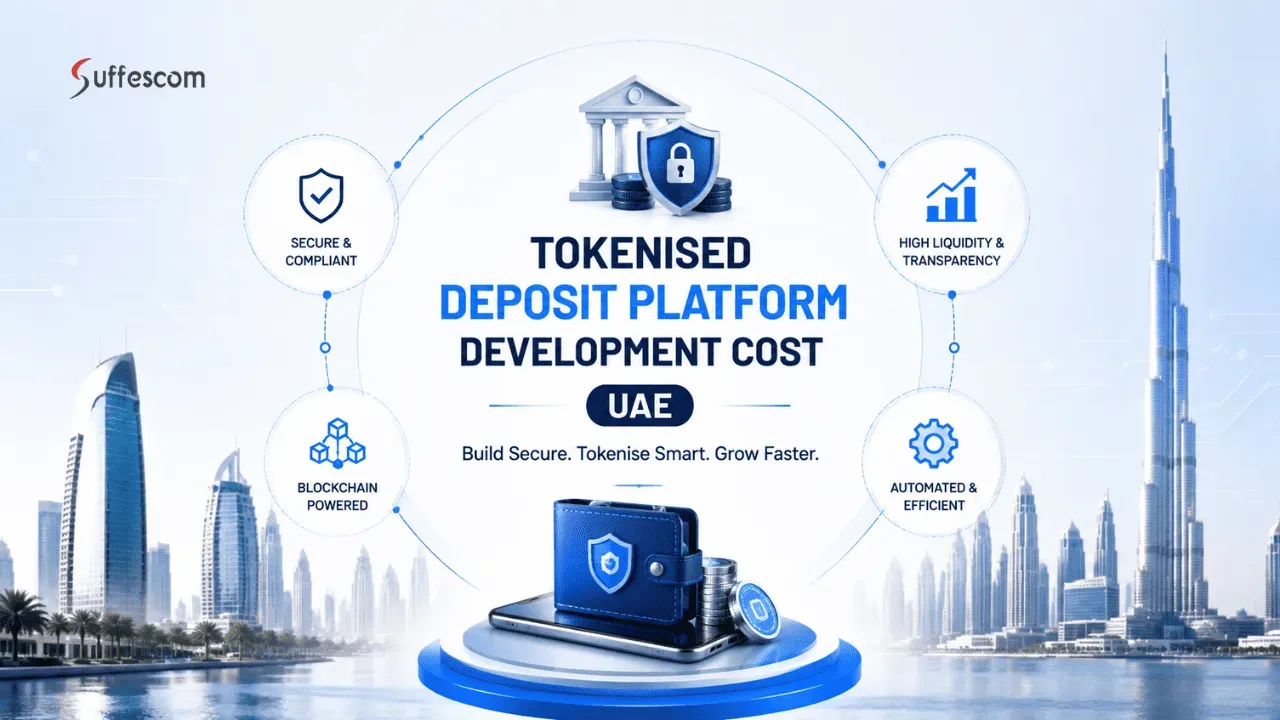
With the continued leadership of the UAE in blockchain innovations and digital banking through the regulation of VARA, banks, fintech companies, and financial institutions are working towards implementing tokenized deposits in their organizations for real-time settlement, increased operational efficiency, and reduced costs.
However, before venturing into developing your tokenized deposit platform, one of the most important aspects to consider is the cost involved in developing such a platform. The total cost depends on a number of elements such as the complexity of the platform, blockchain networks, smart contracts, and banking APIs, among others.
At Suffescom Solutions, we have assisted organizations in developing their blockchain and fintech solutions. Based on our development experience, understanding the major cost drivers before starting your project can help you optimize your budget and avoid unexpected expenses.
In this guide, we’ll break down every cost component to help you estimate the total tokenized deposit platform development cost and choose the right development approach. You'll also learn the key cost factors, development timelines, compliance requirements, and practical strategies to plan your investment with confidence.
Before getting into the cost estimates, let us have a brief look at the average costs of development, development duration, team composition, blockchain choice, and compliance for a token deposit platform in the UAE.
| Aspect | Overview |
| Average MVP Development Cost | AED 30,000 – AED 350,000+ |
| Development Timeline | 3–15 Months |
| Development Team | Project Manager, Blockchain Developers, Backend Developers, Frontend Developers, QA Engineers, DevOps, UI/UX Designers |
| Blockchain Options | Hyperledger Fabric, Ethereum, Polygon, R3 Corda, Canton Network |
| Compliance Requirements | KYC, AML, CBUAE, ADGM, VARA, Data Privacy |
| Best For | Banks, Digital Banks, FinTechs, Financial Institutions, Government Organizations |
The estimates above provide a general overview of tokenized deposit platform development costs in the UAE. Every project has unique requirements that influence the final budget.
The UAE’s leadership in tokenized deposit platforms is increasingly supported by real institutional adoption rather than early-stage experimentation. Global financial institutions are now deploying regulated tokenized deposit services in the region, marking a shift from pilot projects to production-level blockchain-based banking infrastructure.
To illustrate this, HSBC is now offering a tokenized deposit service in the United Arab Emirates, which allows for real-time settlement and transactions of funds using blockchain technology while retaining conventional deposit systems. This represents an increasing trend in the banking industry where settlement systems are becoming continuous and programmable.
Industry analysis also highlights that tokenization in the UAE is being driven by regulated financial frameworks and institutional adoption across banking ecosystems, positioning tokenized deposits as part of broader digital financial infrastructure evolution.
As adoption increases, tokenized deposit platforms are transitioning from experimental systems into core banking infrastructure, enabling faster settlement, improved liquidity management, and stronger integration between traditional finance and blockchain-based financial networks.
There is no one-size-fits-all price for building a tokenized deposit platform. Development costs depend on the platform's intended use, required features, blockchain infrastructure, regulatory obligations, and integration with existing banking systems. For example, a fintech company launching a tokenized deposit platform will have different technical and compliance requirements than a commercial bank deploying an enterprise-grade platform.
To make budgeting easier, we've broken down tokenized deposit platform development costs based on factors like platform complexity, helping you identify the investment range that best aligns with your business goals and technical requirements.
The cost of implementing a tokenized deposit solution in the UAE largely depends on the level of complexity of your project. If you need an MVP for testing your concept, then you will not have as many needs as for an enterprise-ready platform meant for large commercial banks or licensed financial organizations.
| Platform Complexity | Best For | Development Time | Estimated Cost (AED) |
| Basic (MVP) | Startups & Pilot Projects | 3–5 Months | 30,000 – 150,000 |
| Mid-Level Enterprise Platform | FinTechs & Digital Banks | 6–9 Months | 150,000 – 220,000 |
| Advanced Enterprise Platform | Banks & Financial Institutions | 9–15 Months | 220,000 – 350,000+ |
A basic MVP includes the bare-bones functionalities necessary to make your idea come to life, such as onboarding users, issuing/redeeming tokens, integrating digital wallets, basic smart contract functionality, an administrative portal, and payments. This gives you all the tools you need to jump into the market, but still allows you the ability to expand your offerings in the future.
The mid-level enterprise platform is created specifically for fintech companies or digital banks that want to have more features in their system besides the core ones. Such features include integration of banking APIs, KYC/AML processes, transaction monitoring, role-based access control, analytics, and reporting dashboards.
Typically built for commercial banks, financial institutions, and government organizations, designed to support high transaction volumes and strict compliance requirements. Core banking integration, permissioned or multi-chain blockchain technology, sophisticated smart contract logic, high-availability setup, disaster recovery, auditing capabilities, regulatory reporting capabilities, enterprise-class cybersecurity, and custom workflows for institutions.
Various businesses have various needs when it comes to operations, compliance, and scalability. Whereas the MVP strategy may be most important for startups, commercial banks and government entities need enterprise-class solutions, advanced security, compliance, and integration with core banking systems. Consequently, the cost of software development varies widely depending on the type of business developing the solution.
| Business Type | Estimated Cost (AED) | Typical Requirements |
| Startup | 30,000 – 80,000 | MVP, core tokenization features, basic security |
| FinTech | 60,000 – 150,000 | Banking APIs, KYC/AML, analytics, scalability |
| Digital Bank | 120,000 – 150,000 | Enterprise security, core banking integration, compliance |
| Commercial Bank | 180,000 – 350,000 | Permissioned blockchain, high availability, regulatory reporting |
| Investment Firm | 80,000 – 220,000 | Asset tokenization, custody, institutional workflows |
| Government Organization | 250,000 – 350,000 | National-scale infrastructure, strict governance, and custom compliance |
The process of creating the tokenized deposit application includes several stages; each of them has its own role in the total expenditure. Knowledge of such distribution of the costs will help banks and fintechs plan their budget better and understand where app development efforts are focused.
| Development Stage | Estimated Cost Share | Estimated Cost (AED) | Key Deliverables |
| Discovery & Planning | 5–10% | 15,000 – 30,000 | Requirements gathering, technical architecture, project roadmap |
| UI/UX Design | 8–12% | 20,000 – 45,000 | Wireframes, user journeys, prototypes, UI design |
| Blockchain Development | 20–25% | 70,000 – 110,000 | Blockchain network setup, ledger implementation, and node configuration |
| Smart Contract Development | 10–15% | 40,000 – 80,000 | Token issuance, redemption, and settlement automation |
| Backend & API Development | 15–20% | 50,000 – 90,000 | Core banking APIs, business logic, databases, integrations |
| Security & Compliance | 10–15% | 40,000 – 70,000 | Encryption, KYC/AML integration, access controls, compliance implementation |
| Testing & QA | 8–10% | 25,000 – 45,000 | Functional, performance, security, and UAT testing |
| Deployment & Launch | 3–5% | 15,000 – 25,000 | Cloud deployment, monitoring, and production launch |
An MVP could contain basic bank functions only, but a commercial platform needs much more compliance, security, integration, and automation features. Below is the estimation of the development costs for popular platform feature integrations:
| Feature / Module | Purpose | Estimated Cost (AED) |
| UI/UX Design | Creates intuitive user journeys, wireframes, and responsive interfaces. | 25,000 – 55,000 |
| User Registration & Authentication | Secure onboarding, login, identity verification. | 15,000 – 30,000 |
| Customer Portal | Manage deposits, wallets, transactions, and account settings. | 30,000 – 100,000 |
| Admin Dashboard | Central control for users, transactions, and reporting. | 25,000 – 80,000 |
| KYC & AML Integration | Identity verification and compliance automation. | 40,000 – 120,000 |
| Digital Wallet Development | Secure storage and transfer of tokenized funds. | 60,000 – 180,000 |
| Blockchain Integration | Connects the platform with blockchain networks. | 70,000 – 200,000 |
| Core Banking API Integration | Syncs banking systems with digital platforms. | 50,000 – 160,000 |
| Payment Gateway Integration | Deposits, withdrawals, and payment processing. | 20,000 – 55,000 |
| Transaction Monitoring & Audit Logs | Tracks activity and ensures compliance. | 30,000 – 90,000 |
| Analytics & Reporting | Financial insights and dashboards. | 25,000 – 70,000 |
| Multi-Currency Support | Enables multiple fiat/digital currencies. | 40,000 – 90,000 |
| Role-Based Access Control | Permission-based system access. | 20,000 – 60,000 |
| Notifications & Alerts | Real-time updates for users and admins. | 15,000 – 35,000 |
| Security & Encryption | Data protection and secure architecture. | 60,000 – 180,000 |
| QA Testing & Performance Testing | Stability, load, and security testing | 25,000 – 90,000 |
Technical aspects, apart from platform features and development phases, play a huge role in determining the total price of tokenized deposit platform construction. Decisions ranging from the selection of the appropriate blockchain network to the design of scalable infrastructure affect the amount of development work as well as the performance, security, and effectiveness of the system's further operation. Familiarizing yourself with all these details is important for the bank or fintech company to make the correct technological decisions and make the most of its investments.
The selection of the appropriate blockchain network determines the architecture of the platform, development difficulties, performance, and compliance. Public blockchains, such as Ethereum and Polygon, have the advantage of an abundant ecosystem, whereas permissioned blockchain networks, including Hyperledger Fabric, R3 Corda, and Canton Network, allow for more privacy and governance.
Hosting infrastructure plays a critical role in platform reliability and scalability. Organizations can deploy tokenized deposit platforms on cloud environments such as AWS, Microsoft Azure, or Google Cloud, or choose private and hybrid cloud deployments for greater control over sensitive financial data. Enterprise-grade infrastructure with high availability, disaster recovery, and continuous monitoring requires greater implementation effort but ensures uninterrupted banking operations.
The expected number of users and daily transactions determine how the platform is architected. A platform supporting thousands of retail users has different performance requirements than one processing millions of institutional transactions. Higher transaction volumes require optimized databases, load balancing, caching, and distributed infrastructure to maintain fast and reliable settlement performance.
A number of financial institutions are looking into interoperability among a variety of blockchain networks to increase flexibility and digital asset functionality. Working within multiple blockchain ecosystems entails more integration and synchronization processes and testing to allow for a smooth transition of assets and uniform transaction processing on all networks.
The platform for enterprise banking should be built to support growing volumes of transactions without slowing down the process, increasing security risks, or compromising the availability of the platform. The architecture for scalability is to be built on microservices, containerization, automatic scaling, high-performance databases, and robustness.
More and more often, artificial intelligence becomes an integral part of tokenized banking platforms to boost fraud detection, AML monitoring, identification of unusual transaction patterns, and generation of predictive financial insights. Although AI-enabled functionality boosts the efficiency and compliance of the platform, it also needs extra development, model training, and data pipeline building.
While many companies plan their budgets for the first stages of creating a tokenized deposit platform, they fail to consider the subsequent expenses that will be needed to keep the platform safe, regulated, and functional. Considering these expenses from the very beginning helps avoid surprises after the platform’s launch and maintain its safety, scalability, and compliance.
| Hidden Cost | Why It Matters | Estimated Cost (AED) |
| Security Audits | Identifies vulnerabilities through penetration testing and infrastructure assessments. | 30,000 – 120,000+ (one-time/periodic) |
| Smart Contract Audits | Ensure smart contract logic is secure before and after deployment. | 50,000 – 180,000+ (one-time / updates) |
| Infrastructure Scaling | Expands cloud resources as users and transactions grow. | 20,000 – 150,000+ annually |
| Compliance Updates | Keeps the platform aligned with AML/KYC and regulatory changes. | 25,000 – 120,000+ annually |
| Third-Party API Services | Fees for KYC providers, banking APIs, payment gateways, and blockchain services. | 10,000 – 80,000+ annually |
| Platform Maintenance & Support | Bug fixes, upgrades, monitoring, and feature improvements. | 15–20% of initial development cost per year |
| Disaster Recovery & Business Continuity | Backup systems, failover infrastructure, and recovery planning. | 30,000 – 150,000+ annually |
The launch of a tokenized deposit platform is just the starting point. In order to ensure that the platform will be safe, regulated, and properly performing in the long term, companies need to create a budget for its maintenance annually.
| Maintenance Expense | Estimated Annual Cost (AED) | Purpose |
| Cloud Hosting | 40,000 – 150,000 | Maintain scalable cloud infrastructure, storage, networking, and compute resources. |
| Security Monitoring | 50,000 – 200,000 | Continuously monitor threats, manage vulnerabilities, and respond to security incidents. |
| Compliance Updates | 40,000 – 160,000 | Implement regulatory changes, AML/KYC updates, and audit requirements. |
| Technical Support | 60,000 – 220,000 | Provide ongoing maintenance, bug fixes, performance optimization, and user support. |
| Smart Contract Updates | 30,000 – 120,000 | Upgrade contract logic, resolve vulnerabilities, and support new business requirements. |
Building a tokenised deposit platform doesn't always require the highest possible investment. With proper planning from an architectural standpoint as well as good decisions when developing, companies will be able to save money, deploy faster, and have better scalability in the future without sacrificing security or regulation.
Start out with an MVP product with just enough functionality that you can test its viability in the market. This way, the cost of development is minimised while the time taken to bring out the platform is also shortened since you get feedback on how the users interact with the minimum viable product before adding any additional functionality.
Ensure that the design of your platform uses a modular structure where each core functionality, like identity management, payments, token issuance, compliance, custody, and reporting, is completely independent of other modules in the platform. This will simplify the process of upgrading and integrating new functions.
Rather than investing a lot of money in buying physical hardware, you should go for cloud infrastructure for deploying your platform. This will provide benefits such as scalability and auto-scaling, high availability and disaster recovery, and pay-per-use.
DevOps, by using CI/CD pipelines, automated testing, infrastructure as code, and continuous monitoring, can be practiced. With automation, errors can be reduced, cycle time reduced, software quality enhanced, and costs associated with operations and maintenance reduced dramatically.
Practice DevSecOps by incorporating security throughout the whole process of software development through encryption, identity and access management, secure coding, vulnerability assessment, penetration testing, and compliance checks to avoid any high-cost security breaches, compliance violations, and costly redevelopment in the future.
Utilise software platforms, blockchain, databases, and development tools that are commonly used by enterprises. This way, you will be saving on licensing costs, will prevent vendor lock-in situations, will speed up your development process with the support of well-established ecosystems, and will have the freedom to customise in the future.
There is more to having a tokenised deposit system than just implementing the technology; it also needs to provide banking operations, compliance, and a good user experience. The list below is an example of the features necessary to have in such a platform.
Allow customers, banks, and enterprise users to sign up, perform their identity checks, and get access to the platform via automated onboarding flows. Onboarded users are able to make faster transactions, and the process helps meet the regulatory requirements.
Develop safe digital wallets that will let users store, transfer, receive, and manage tokenised deposits with balance tracking and a history of transactions provided. Enterprise-level security, a multi-wallet feature, and access control will help manage user assets safely.
Create blockchain-based tokens, which will be backed by 1:1 customer fiat deposits. The process of token creation has to involve reserve validation, configurable workflow, and automation.
Allow users to seamlessly convert tokenised deposits back into fiat currency through a secure redemption process. Redeemed tokens are automatically burned to keep the circulating token supply perfectly synchronised with the underlying bank reserves.
Automate KYC processes that help in verifying customers’ identities prior to granting access to financial services. The automation will enable the verification of identity documents, sanctions screening, and risk assessment to comply with regulatory requirements and improve the efficiency of onboarding.
The institution needs to continuously monitor transactions by making use of a smart rules engine, behaviour detection, and risk scoring capabilities to detect suspicious activity. The automated alerts and reporting workflows will help the institution improve its compliance with anti-money laundering practices.
Monitor all on-chain and off-chain transactions in real-time for full operational visibility. The process will make the transaction logs, statuses, and history of transactions easily searchable, transparent, and reconcilable.
Integrate your institution’s systems securely and easily with banking back-office systems, payment systems, settlement infrastructure, and third-party financial services through an API. It will make it easy to synchronise customer accounts, deposits, balances, and financial transactions.
Create an Admin Dashboard for the administrators to manage users, wallets, token distribution, configurations, compliance activities, and other operations. Real-time monitoring and administrative control will enable the maintenance of the security and efficiency of the platform.
Enable the compliance team to have an interface where they can monitor KYC verification, AML alerts, sanctions screening, regulatory reporting, and other risk management activities. The interface makes it easier to govern while maintaining compliance.
Keep permanent logs of all user activity, administrative actions, configuration changes, and financial transactions. Properly audited trails increase accountability and help with investigations, as well as external audits.
Provide real-time notifications for transactions, approvals, token creation, redemption, security events, compliance information, and account activities via email, SMS, push notifications, and in-app notifications to keep your users notified throughout all steps of the process.
Create full operation, finance, compliance, treasury, and transaction reports, which may be accompanied by dashboards and exports. Reports are used for regulatory reporting, analysis, reconciliations, and making decisions based on those reports.
Turn the platform data into business intelligence using analytics, such as transaction analytics, liquidity management, user analysis, operations analytics, and performance dashboards.
| Layer | Technologies |
| Frontend | React, Angular |
| Backend | Node.js, Java, .NET |
| Blockchain | Hyperledger Fabric, Ethereum, Polygon, R3 Corda |
| Smart Contracts | Solidity, Go, Rust |
| Database | PostgreSQL, MongoDB |
| Cloud | AWS, Microsoft Azure, Google Cloud |
| DevOps | Docker, Kubernetes |
| APIs | REST, GraphQL |
| Identity Management | OAuth 2.0, OpenID Connect, Keycloak |
Development of a tokenised deposit platform is not limited only to the application of blockchain technology. Financial organisations will have to upgrade their existing banking infrastructure, adapt to changing regulations, and provide enterprise-level security while ensuring a good customer experience. Understanding these challenges during the app development process helps organisations minimise project risks and ensure their successful execution.
Many banks rely on legacy core banking systems that were not designed for blockchain-based transactions. Use secure APIs, middleware, and phased integration strategies to connect legacy infrastructure with modern blockchain platforms.
Tokenised deposits must comply with banking regulations, AML/KYC requirements, and financial reporting obligations. Build compliance into the platform from the start with automated KYC, AML monitoring, audit trails, and regulatory reporting.
Financial platforms are prime targets for cyberattacks, fraud, and unauthorised access. Implement encryption, multi-factor authentication, smart contract audits, penetration testing, and continuous security monitoring.
Customers and enterprise users may be unfamiliar with blockchain-powered banking services. Design intuitive user interfaces, simplify onboarding, and provide education and support to improve adoption.
Growing transaction volumes can impact platform performance if scalability is not considered early. Adopt scalable cloud infrastructure, microservices, load balancing, and optimised blockchain architectures.
Cross-border payments involve multiple jurisdictions, currencies, and regulatory frameworks. Support interoperable payment networks, multi-currency capabilities, and compliance with international financial regulations.
Although building a tokenised deposit platform is expensive, the ROI goes well beyond cost savings for banks and financial organisations. The benefits include increased speed of transactions, better operational performance, improved compliance, and higher transparency. Furthermore, with the growing adoption of blockchain by financial companies, a tokenised deposit platform ensures that an organisation is prepared for further digital banking implementations and asset tokenisation scenarios.
Automate manual banking processes such as settlement, reconciliation, compliance checks, and transaction processing to reduce operational overhead. This enables teams to handle higher transaction volumes with greater accuracy while improving overall productivity.
Replace traditional settlement cycles with near-instant settlement capabilities powered by blockchain technology. Faster settlement improves cash flow, enhances liquidity management, and enables businesses to move capital more efficiently across financial ecosystems.
Reduce reliance on intermediaries, paper-based workflows, and manual reconciliation processes. Automation and blockchain-based recordkeeping significantly lower operational expenses while improving the efficiency of financial operations.
Maintain a single, immutable source of truth for every transaction recorded on the blockchain. Enhanced transparency simplifies audits, strengthens regulatory reporting, reduces disputes, and increases trust among customers, partners, and regulators.
Enable faster movement of funds and real-time access to tokenised deposits, allowing financial institutions to optimise capital allocation and improve liquidity management without being constrained by traditional banking settlement timelines.
Deliver faster payments, seamless digital onboarding, real-time account visibility, and 24/7 transaction capabilities. A modern tokenised deposit platform enhances customer satisfaction while meeting growing expectations for digital-first financial services.
Automate critical workflows including token issuance, redemption, compliance verification, transaction monitoring, reporting, and settlement. Intelligent automation reduces manual intervention, minimises operational risks, improves accuracy, and accelerates service delivery across the platform.
Create opportunities to launch innovative financial products, programmable payment solutions, cross-border settlement services, and blockchain-enabled banking offerings. A tokenised deposit platform not only reduces costs but also opens new revenue streams and strengthens long-term business growth in the evolving digital finance ecosystem.
| Blockchain | Transaction Speed | Development Cost | Banking Suitability | Best For |
| Hyperledger Fabric | High | Medium | Excellent | Permissioned banking networks, interbank settlements |
| Ethereum | Medium | High | Moderate | Public tokenisation, DeFi integration, broad ecosystem |
| Polygon | High | Medium | Good | High-volume transactions with lower network fees |
| R3 Corda | High | High | Excellent | Banks, financial institutions, and trade finance |
| Canton Network | High | High | Excellent | Regulated financial markets, institutional asset tokenisation |
| Quorum | High | Medium–High | Excellent | Enterprise blockchain applications with enhanced privacy |
Developing a tokenised deposit platform in the UAE is not only about technology. It is necessary to adhere to the rules of banking, anti-money laundering, data security legislation, and cybersecurity in addition to securing digital assets. The consideration of these regulatory factors from the very beginning will help minimise the risks of non-compliance, accelerate approvals, and build confidence among clients and regulators.
The tokenised deposit platforms should comply with the regulatory framework laid down by the Central Bank of the UAE (CBUAE), ADGM, DIFC, and other relevant authorities. Regulatory compliance will ensure that tokenisation, settlement, and banking activities are consistent with the financial regulations of the UAE.
A strong system of AML controls will be implemented by financial institutions to prevent money laundering. The institutions have to detect and monitor any suspicious activity, along with reporting it to the relevant authorities for further action.
KYC is an important process that involves the identification of the customer's identity prior to opening an account with the institution. It is necessary for detecting any fraudulent activities and ensuring that the customer is a genuine one.
Customers' financial and personal information should be handled according to the UAE data privacy laws. The data should be collected, processed, transmitted, and stored in a secure manner.
Since tokenised deposits involve high-value financial transactions, platforms must incorporate enterprise-grade cybersecurity measures such as end-to-end encryption, multi-factor authentication, real-time threat monitoring, vulnerability assessments, and incident response planning to protect against cyber threats.
Based on the business model and services provided by the organisations, licenses/approvals may be needed by the organisations from the respective UAE regulatory bodies prior to starting operations. Early communication with the regulatory bodies would go a long way in streamlining the process.
Financial institutions will have to develop robust risk management strategies that will enable them to address various kinds of risks associated with the platform, including operational risks, financial risks, compliance risks, legal risks, and cybersecurity risks.
| Feature | Tokenised Deposits | Stablecoins | CBDCs |
| Issuer | Commercial banks | Private companies or financial institutions | Central bank |
| Backing | 1:1 by commercial bank deposits | Fiat reserves or other assets | Sovereign currency issued by the central bank |
| Regulatory Oversight | Banking regulations | Varies by jurisdiction and issuer | Central bank regulations |
| Primary Use Case | Institutional payments, interbank settlements, and corporate treasury | Digital payments, trading, remittances | Retail and wholesale digital currency transactions |
| Settlement Speed | Near real-time | Near real-time | Real-time or near real-time |
| Programmability | High | High | Moderate to High |
| Price Stability | Stable (backed by bank deposits) | Stable if adequately collateralised | Stable (represents sovereign currency) |
| Enterprise Ready | Excellent | Limited to regulated banking | Excellent |
| Privacy & Governance | High (permissioned networks) | Depends on the user and the blockchain | High (government-controlled) |
| Banking Suitability | Excellent | Moderate | Excellent |
| Examples | HSBC tokenised Deposits, JPM Coin | USDC, USDT | Digital Dirham (planned), Digital Yuan |
The development timeline for a tokenised deposit platform varies depending on project complexity, regulatory requirements, blockchain architecture, and integration with existing banking systems.
| Development Phase | Estimated Duration |
| Discovery & Planning | 1–2 Weeks |
| UI/UX Design | 2-3 Weeks |
| Solution Architecture | 1–2 Weeks |
| Core Platform Development | 6–12 Weeks |
| Smart Contract Development | 4-8 Weeks |
| Integration & Testing | 3–5 Weeks |
| Deployment & Go-Live | 1–2 Weeks |
Building a tokenised deposit platform requires a multidisciplinary team, and that's exactly what Suffescom Solutions offers. Our expert team brings years of experience in blockchain development, enterprise software engineering, cybersecurity, and financial compliance to build secure, scalable, and regulation-ready tokenised deposit platforms. Depending on the level of complexity of the project, different team members can be engaged, but the following positions are usually needed to provide an efficient, secure, and compliant platform.
Project coordination from planning to implementation via the management of time, allocation of resources, communications with stakeholders, risk management, and milestones of delivery. The project manager ensures that the platform is developed within the designated time frame, budget, and goals of the business.
Designs and develops blockchain infrastructure, smart contracts, token issuance and redemption processes, and consensus and inter-blockchain functionality. They make sure the platform provides secure, transparent, and efficient operation of tokenised deposits.
Develops the backend architecture, logic, APIs, database structure, authentication system, and integration with the core banking platforms, payment gateways, and other third-party financial service providers. They ensure the high performance and reliability of the platform.
Develops the frontend of the platform, including user interfaces such as the customer portal, institutional portal, compliance portal, and administration portal with responsive designs.
Manage cloud infrastructure, deployment pipelines, infrastructure as code, containers, monitoring, auto-scaling, disaster recovery, and CI/CD. All of these components are responsible for ensuring the availability, security, and maintainability of the platform.
Perform full-scale functional, integration, regression, performance, usability, and security tests on the platform during the whole process of development. The thorough testing approach adopted by QA engineers allows for identifying problems earlier.
Protect the platform with the help of end-to-end encryption, authentication, identity and access management, key management, penetration tests, vulnerability tests, and security monitoring to ensure that digital assets and sensitive financial data of users will be safe.
Guarantee that the platform will be compliant with all financial regulations through the design of workflows related to KYC, AML, sanctions screening, transaction monitoring, audit trails, and reporting.
Businesses that intend to develop a tokenised deposit platform have to make a crucial choice, whether to build a custom platform or use a white-label one. Although the white-label option ensures quicker implementation and is cheaper at first, a custom platform guarantees better security and total control over it. The choice should be made according to business needs and goals.
| Criteria | Custom Platform | White-Label Solution |
| Initial Investment | Higher | Lower |
| Time to Market | 6-15 Months | 1–3 Months |
| Customisation | Fully Customisable | Limited Customisation |
| Ownership | Complete Source Code Ownership | Vendor-Owned Platform |
| Scalability | Highly Scalable | Depends on Vendor Capabilities |
| Regulatory Compliance | Tailored to Business & UAE Regulations | Limited to Built-In Compliance Features |
| Security | Custom Security Architecture | Standard Vendor Security |
| Banking Integrations | Fully Customisable | Limited Integration Options |
| Smart Contract Flexibility | Fully Customisable | Limited or Predefined |
| Long-Term Cost | Lower Total Cost of Ownership for Large-Scale Platforms | Recurring Licensing & Subscription Costs |
| Best For | Banks, Digital Banks, FinTechs, Government Organisations | Startups, Pilot Projects, Proof of Concept |
With the emergence of tokenised deposits in digital banking systems, financial institutions need systems that work in accordance with their objectives, regulations, and strategic plans. The difference between off-the-shelf systems and custom-built systems is that custom-built systems give more room for change and development in compliance with organisational and legal standards.
A custom-tailored tokenised deposits platform solution allows you to scale users, transaction volume, and infrastructure as your needs evolve. In contrast with out-of-the-box products, it can be upgraded and extended with additional functionality, additional markets, and additional integrations without any vendor limitations.
Guarantee complete ownership of the source code, IP rights, and product roadmap to ensure complete control over any further development, updates for security patches, and innovations without any vendor lock-in.
Regulatory compliance must be incorporated into the platform from the very beginning using solutions like workflows, security, auditing, and governance that comply with the UAE banking regulations and the AML/KYC norms.
Connect the platform effortlessly with core banking systems, payment gateways, ERP solutions, digital identity services, and other third-party financial applications. Custom integrations ensure smooth data exchange, automated workflows, and a unified banking ecosystem tailored to your operational requirements.
Although custom development requires a larger initial investment, it reduces recurring licensing fees, improves operational efficiency, and supports continuous innovation, delivering greater value over the platform's lifecycle.
The UAE has developed into a world centre for digital finance with progressive regulations, adoption of blockchain technology within institutions, and innovative initiatives supported by the government. With the further modernisation of payment systems at the banks, tokenised deposits will be an important element of modern banking. The following trends will define the future of tokenised deposits in the UAE.
The integration of AI and blockchain technology is enhancing tokenised banking systems with capabilities such as fraud detection, AML compliance, risk analysis, and real-time compliance. All these aspects help with increasing efficiency, security, and intelligent decision-making in the financial sector.
It is expected that commercial banks, fintech players, and financial institutions will move forward with adopting tokenised deposits for treasury services, wholesale payments, cash management, and interbank settlement. The reason for this is the increased regulatory certainty and enterprise-level blockchain infrastructure.
By using tokenised deposit services powered by blockchain settlement systems, cross-border payments will become faster, cost-effective, and more transparent. This way, one will not have to use correspondent banking anymore since near-instant settlement can be achieved.
Banking organisations are increasingly shifting towards the tokenisation of deposits and other forms of financial assets for programmable money, liquidity management, and the creation of novel financial products. This transformation is geared towards increasing automation and efficiency in banking operations.
Always-on real-time settlement functionality is replacing traditional batch processing systems in order to facilitate instant processing of transactions at any time. This makes it possible for financial organisations to have better management of their cash flows and settle their transactions instantly.
As digital assets, tokenised securities, and central bank digital currencies (CBDCs) continue to evolve, tokenised deposit platforms will play a critical role in connecting traditional banking with the broader digital asset ecosystem.
The UAE is rapidly developing into one of the most advanced markets for tokenised banking services, thanks to progressive legislation, the growing number of blockchain implementations at the institutional level, and high demand for real-time payment systems. With banks, fintech businesses, and other financial institutions increasingly embracing their digital transformations, tokenised deposit platforms are becoming more of a necessity and less of an experiment.
But creating a robust, reliable, and regulation-compliant platform entails significant efforts. From choosing a suitable blockchain network and integration with core banking systems to the implementation of smart contracts and compliance with regulatory requirements, every single decision affects the tokenised deposit platform development.
Here at Suffescom Solutions, we have extensive experience in building blockchain and software solutions for banks, digital banks, fintech companies, and other financial institutions. We help you develop an MVP, a POC, and even a full-fledged platform and estimate the cost of doing that.
A tokenised deposit platform is a blockchain-powered banking service that tokenises standard bank deposits while keeping a 1-to-1 correspondence with fiat money. Tokens could be transferred, settled, and redeemed instantly, allowing quicker transfers, better liquidity, and enhanced efficiencies. Stablecoins do not belong to this category, as they represent assets of their own and are not liabilities of the issuing commercial bank.
Costs vary between AED 30,000 for a basic MVP and AED 350,000 and higher for enterprise-level platforms. The total budget required will depend on many factors, including blockchain choice, level of platform complexity, smart contract development, banking API integration, and other factors.
The ideal blockchain depends on your needs. Blockchain options such as Hyperledger Fabric, R3 Corda, and Canton Network are usually selected by banks due to their permissioned nature and governance capabilities. For companies that look for cross-platform ecosystem compatibility, Ethereum and Polygon will be the right choices.
Tokenised deposits are supported by the UAE's progressive approach to digital finance, but businesses must comply with applicable regulations issued by authorities such as the Central Bank of the UAE (CBUAE), ADGM, DIFC, and VARA where relevant. The specific regulatory requirements depend on the platform's business model, services offered, and operating jurisdiction.
Typically, development time frames take from 3 to 15 months. The MVP with basic functionality can be launched within 3-5 months, and enterprise platforms that need integration with banks, advanced security, smart contracts, compliance workflows, and testing can take up to 9-15 months.
The main elements that determine the cost are platform complexity, choice of the blockchain network, smart contract development, integration with a banking API, security, compliance, cloud infrastructure, scalability needs, AI components, and custom development requested by the business.
Yes, modern tokenised deposit platforms are built in a way that allows them to integrate with current core banking systems via secure APIs and middleware.
Important security considerations are end-to-end encryption, MFA, role-based access control, smart contract auditing, penetration testing, continuous security monitoring, secure key management, disaster recovery plans, and audit logging to ensure the security of financial assets and customer data.
Tokenised deposits are digital representations of commercial bank deposits that continue to be regulated banking liabilities backed 1:1 by customers’ funds. In contrast, stablecoins are normally issued by private entities and are collateralised by reserves or other assets with varying degrees of regulatory oversight across jurisdictions and issuers.
Yes. Smart contracts facilitate key activities like issuing tokens, redeeming, transferring, settling, and processing transactions according to business logic.
Organisations developing tokenised deposit platforms should address KYC and AML obligations, banking regulations, cybersecurity standards, data protection requirements, risk management controls, audit capabilities, and any licensing or approval requirements applicable to their operating jurisdiction and business model.
Yes. Many companies start off with a minimum viable product (MVP) that contains all the necessary features, including onboarding, wallets, tokens, and compliance. Advanced features can be gradually integrated into the system later on.
Maintenance costs may include cloud computing fees, security costs, support costs, compliance updates, maintenance of smart contracts, and infrastructure costs. Based on the scale of the platform, companies need to have their annual budget allocated for its maintenance.
Some of the ways that banks will receive ROI from tokenised deposit platforms include speedier transactions, reduced costs, better liquidity management, automation of processes, better compliance, and enhanced customer experience.
In general, Hyperledger Fabric is preferred in most cases of enterprise banking applications because of its features of permissioned accessibility, privacy, governance, and scalability in terms of transactions per second. Meanwhile, Ethereum is more suitable for public blockchains and decentralised finance projects, although it can be considered more developed in terms of the size of its community and interoperability.
A good development partner should have a lot of experience in blockchain development, fintech solutions, and enterprise-grade custom software development services. In addition, it would be good to check their experience in working with smart contracts, banking APIs, cybersecurity, regulation, cloud infrastructure, and post-launch activities.

Senior Content Strategist
Jonathan Raabe is a content marketing professional, focusing on mobile apps, software engineering, artificial intelligence, SaaS, cloud computing, and digital transformation. Jonathan works with visionary brands to translate complicated concepts into content that can be easily understood by their audiences. As an expert in his field, Jonathan strives to create content that is thought-provoking and backed by facts, while at the same time building brand authority and trust.



Related Blogs
Hear directly from clients who partnered with Suffescom to turn their digital ideas into secure, scalable, and high-performing products.

“Suffescom delivered a HIPAA-compliant telemedicine app exceeding expectations, with strong data security and thoughtful development strategies from start to finish.”

“Suffescom helped us build a smart property management and virtual tour platform. Their expertise in AI helped us attract more qualified leads.”

“Suffescom delivered a modern hotel booking app perfectly aligned with customer expectations, which helped us boost sales by 40%.”

“We needed real-time fleet tracking and route optimization. Suffescom developed a platform that reduced our operational expenses in the first quarter.”

“We needed a smart itinerary planner with AI features for tourists. Suffescom delivered beyond our expectations and helped us increase bookings.”