Forex Trading App Development with Crypto Wallet: Features, Cost & Benefits
Key takeaways: The UAE is a serious market for fintech and digital-asset products. DIFC alone hosted 1,677 A [...]
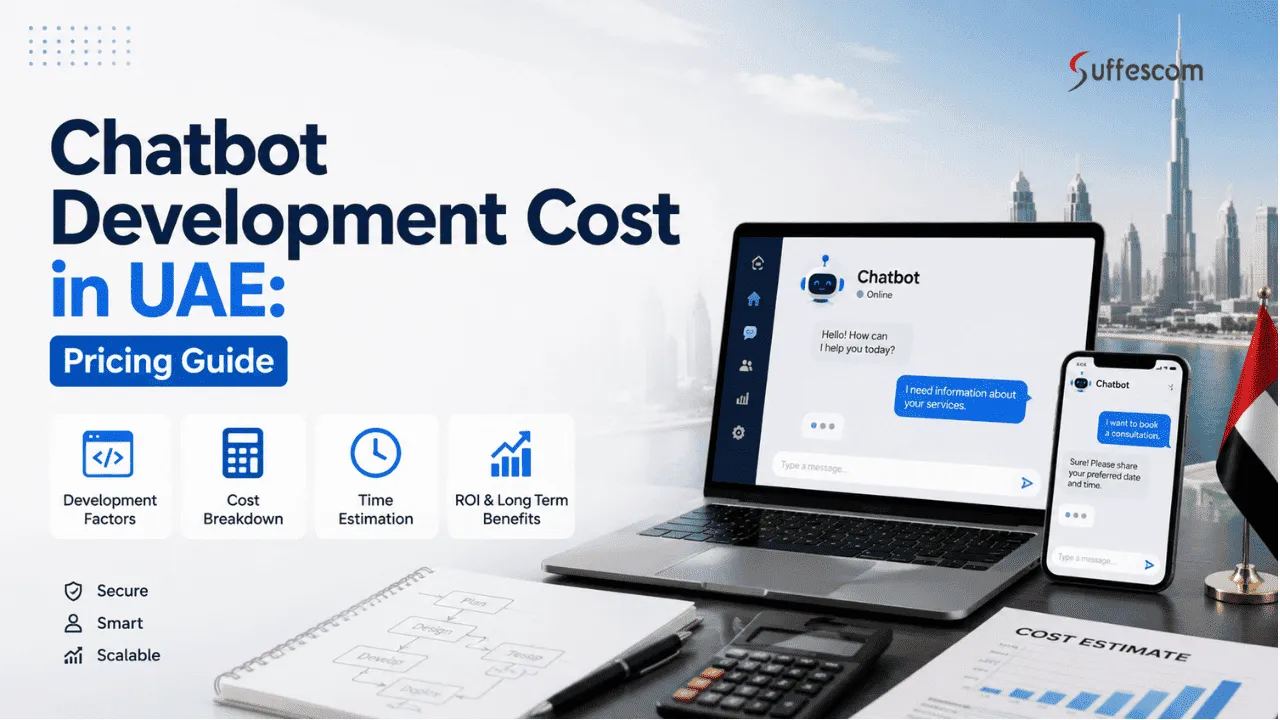
As companies in the UAE increase their pace of digital transformation, AI chatbots have proven to be a valuable asset that enables better customer support, automation of redundant processes, and increased engagement. Whether it is a startup from Dubai or a company from Abu Dhabi, everyone has started implementing conversational AI technology to make their customers' lives easier while lowering the operational costs.
The first question raised when the matter comes to chatbots is always, "How expensive is AI chatbot development in the UAE?" There are many factors that determine the price of chatbots' development – whether it is a simple rule-based chatbot or a powerful AI chatbot, integration, languages, etc.
Knowing the factors that determine the costs is crucial to set realistic expectations, avoid hidden costs, and select the right way of developing an AI chatbot. Whether you are building a customer service chatbot, a WhatsApp bot, a chatbot for sales, or any other enterprise conversational artificial intelligence platform, knowing the price is vital for making better business decisions.
In this chatbot development cost guide, we will discuss the cost breakdown for AI chatbot development, price formation factors, the classification of chatbots, the calculation of operational costs per month, the classification of the chatbot project's complexity, and useful budgeting advice. Additionally, you will see pricing charts, cost estimation formulas, an example of a chatbot project in the UAE, and many more.
The UAE has emerged to be one of the most rapidly developing centers of artificial intelligence in the Middle Eastern area owing to the prevalent use of intelligent automation in various sectors.
The United Arab Emirates' long-term strategy for being a global leader in AI has greatly increased the rate of uptake of AI in both public and private organizations, prompting organizations to adopt AI technology in their businesses, thus making chatbots powered by AI a reality.
The modern customer expects that businesses will always be there when the customer needs help. This means businesses have to be available all the time, not during working hours. The customer needs help at any time. Businesses can use chatbots to do this. Chatbots are great because they let businesses provide help to customers 24/7.
The modern chatbots can offer conversations. They do this by understanding what the user wants and knowing the situation. This helps companies respond in a way. They can suggest products or services. They can also help customers as they make a purchase. They provide a human-like experience. This is how chatbots can help companies sell their products.
One of the major factors for which companies choose to deploy AI chatbots is due to their capability to automate repetitive jobs like customer queries, appointment booking, order tracking, leads qualification, FAQs, and internal queries, and thus help companies cut down on manual workload.
The application of AI chatbots is increasing in the country's biggest business cities like Dubai, Abu Dhabi, and Sharjah, with organizations in various sectors such as financial institutions, health care, government, education, logistics, tourism, and e-commerce using the technology to optimize service delivery and operations.
With regards to the government’s investments in AI, smart cities, and digital government services, a conducive environment has been provided for AI uptake within the UAE. The environment promotes intelligent uptake of the new technology to help enhance efficiency and innovation within firms operating in the country.
Get a personalized cost estimate based on your business goals, required features, AI capabilities, and project scope.
By 2026, companies in the UAE will be able to estimate that the cost for developing a chatbot would vary between AED 12,000 for a simple chatbot to over AED 180,000+. The below-mentioned cost analysis will give you the information about what all features will be available at different cost levels, helping you make the right decision for choosing a chatbot.
Estimated Cost: AED 12,000 – AED 25,000
A basic-level AI chatbot is primarily used for automating simple conversations and addressing basic queries, and would suit businesses new to conversational AI that don’t have many specific requirements. These bots may not be intelligent, but they are efficient, meaning they save businesses time and human support agents.
Key Features
Best For: Any startup, small business, clinic, school, local restaurant, or local services business who want to cut down repetitive communication to customers without the need to spend a fortune on complex AI.
Development Timeline: 2–4 Weeks
Estimated Cost: AED 25,000–50,000
The mid-level AI bots offer a smarter form of conversation through Natural Language Processing, which helps understand the customers’ intentions. This tier of bots offers a dynamic form of conversation, integration with business apps, and helps automate sales, support, and appointment booking across many modes of communication.
Key Features
Best For: Businesses looking for automation services in customer care, lead qualification, enhanced customer interaction, and chatbot integration with current business applications.
Development Timeline: 4–8 Weeks
Estimated Cost: AED 45,000–80,000
High-end AI chatbots make use of LLMs, Generative AI, and intelligent automation of workflows to provide context-based customer engagements. The chatbots have the ability to comprehend complex questions, fetch data from databases, automate the processes of businesses, and integrate with various enterprise platforms.
Key Features
Best For: Medium to large businesses that need to automate customer support, sales processes, knowledge management and workflow processes as well as provide a very personalized customer experience.
Development Timeline: 8–14 Weeks
Estimated Cost: AED 80,000–180,000+
Custom Enterprise AI Chatbots are advanced assistants that are developed particularly for companies that face complex processes, large numbers of clients, or have security needs. Such services may include the use of AI-enabled assistants, process automation for enterprises, enhanced security options, multilingual communication, and integration with multiple company applications.
Key Features
Best For: Corporations, the public sector, financial institutions, the healthcare and insurance industry, logistics and transportation corporations, and companies that have a multinational presence, which demand customizable, secure, and adaptable AI chatbots.
Development Timeline: 3–6 Months
| Complexity Level | Estimated Development Cost (AED) |
| Basic | AED 12,000–25,000 |
| Mid-Level | AED 25,000–50,000 |
| Advanced | AED 45,000–80,000 |
| Enterprise | AED 80,000–180,000+ |
| Chatbot Type | Estimated Development Cost (AED) | Development Timeline | Best For |
| Rule-Based Chatbot | AED 8,000 – AED 18,000 | 2–4 Weeks | FAQs, basic customer support, appointment booking |
| FAQ Chatbot | AED 10,000 – AED 22,000 | 3–5 Weeks | Small businesses, websites, customer self-service |
| AI Customer Support Chatbot | AED 25,000 – AED 55,000 | 6–10 Weeks | Customer service automation and lead qualification |
| WhatsApp AI Chatbot | AED 22,000 – AED 50,000 | 5–8 Weeks | Customer engagement, sales, and order tracking |
| Ecommerce AI Chatbot | AED 30,000 – AED 70,000 | 8–12 Weeks | Product recommendations, shopping assistance, order management |
| Healthcare AI Chatbot | AED 40,000 – AED 90,000 | 10–14 Weeks | Appointment scheduling, patient support, symptom guidance |
| Banking & FinTech Chatbot | AED 60,000 – AED 130,000 | 12–18 Weeks | Secure banking support, KYC assistance, financial services |
| Enterprise AI Chatbot | AED 75,000 – AED 180,000+ | 3–6 Months | Large organizations with advanced workflow automation |
Estimate Your AI Chatbot Development Cost
Use the following formula as a simple framework to estimate your chatbot development cost:
Estimated AI Chatbot Development Cost = Base Development Cost + AI Features + Third-Party Integrations + Multilingual Support + Deployment Channels + Security & Compliance + Testing + Annual Maintenance
Many technical and business aspects influence the cost of building an AI-powered chatbot in the United Arab Emirates. The creation of a rule-based chatbot costs very little and takes little time, but making an AI agent for multilingual purposes or a multilingual generative AI chatbot will require time and investment.
In the table below, you can see the main factors that affect the cost of developing an AI chatbot in the UAE.
The chatbot type itself makes the most significant impact on the cost of development. Each kind of chatbot fulfills different business tasks and the more advanced a solution is, the more costly its creation.
While a fundamental chatbot will work perfectly fine in most cases to acquire leads, provide answers to frequently asked questions, and handle basic customer service, some organizations will require a more sophisticated chatbot for sales automation, workflow execution, or self-service.
Project complexity is the factor that affects the cost of a project most significantly since it indicates the amount of planning, design, development, and testing that the chatbot requires. In contrast to a simple chatbot, an enterprise chatbot requires significant resources and a lot of time for implementation.
The more business rules, scenarios, and automation levels the chatbot involves, the more money the project will cost. The level of complexity increases when it comes to supporting several teams, dealing with critical data, or implementing the chatbot at several customer touchpoints.
The higher the level of AI and NLP, the greater the cost of developing the chatbot. Intent recognition, entity recognition, contextual memory, sentiment analysis, and response generation are some of the features that increase the cost of development.
Natural Language chatbot technology is much more complex in making understanding, tracking history, and giving natural responses than compared with keyword matching chatbot.
Multilingual capabilities might become necessary in the case of the UAE since businesses usually have to deal with customers who speak both English and Arabic. The introduction of an Arabic language capability to the chatbot will increase the development time as well as the need for translation and localization.
Multilingual chatbot testing becomes quite critical in order to ensure tone, accuracy, and consistency between languages. In case the chatbot needs to support more languages than just English and Arabic, the cost will increase even more.
Conversational flow complexity also influences the pricing. Building a chatbot with simple flows is much easier than building a chatbot with complex flows with branching logic, handling multiple users, fallback flows, decision trees, etc.
As the number of use cases increases, the number of conversation mapping, testing, and optimization for the chatbot increases. Companies requiring the chatbot to perform sales, customer support, onboarding, booking, and internal request management usually require complex flows design, which costs more.
The chatbot becomes more valuable once it is integrated into the business system, but the cost of developing it will also increase. Integration implies that there will be a need for development of an API, testing, and maintenance.
Some common integrations include CRM, ERP, payment gateways, WhatsApp, mobile applications, websites, Slack, and Microsoft Teams. With the help of these integrations, the chatbot will be able to carry out some business operations like creating leads or processing orders.
The AI model chosen directly affects development costs and operational costs. A business could go for either a commercial AI model, an open-source AI model, or both.
Commercial AI models have the advantage of being easier to implement and manage. However, they may prove to be more expensive in usage than open-source AI models. Conversely, while open-source AI models prove cost-effective, they are difficult to implement and need a lot of technical input.
The chatbot with a customized user interface, branding, and interaction requires additional design work and frontend programming as compared to the ordinary chat widget. Better design and UI/UX will result in improved usability, better engagement, and enhanced perception of the brand, but it will also result in higher costs of the project.
Companies that require an exceptional level of service tend to develop customized chat windows, quick reply buttons, product cards, carousels, animations and support for rich media. All these elements improve the performance of the chatbot significantly.
In some cases, security and compliance requirements might considerably increase chatbot development expenses. Such situations arise for businesses from such spheres as healthcare, finance, insurance, and government. They might need encryption, authentication, logging, access control, and other mechanisms to protect data during communication.
If a chatbot will be processing any sensitive data related to customers, finances, or internal records of a company, special architecture will have to be designed. The process of testing will take more time due to added requirements.
Pricing is also impacted by the cloud architecture utilized for the chatbot. Hosting, database design, vector storage, scalability, uptime, and GPU usage impact the development cost as well as the operational cost of the application.
The chatbot that is lightweight and does not require any special hosting will be cheaper than the AI assistant for enterprises that requires high availability and fast response time with scalable cloud architecture.
The team’s experience is very crucial in determining the price. A development firm that is well-experienced in AI chatbots will end up charging more money upfront, but it ends up delivering better architecture, deployment speed, scalability, and reduced maintenance cost in the long run.
An experienced team does not have problems that can arise from a lack of expertise in conversation design, integration, or inefficient use of AI. Although low-priced teams help cut down on costs upfront, they end up being more costly eventually.
This is only one step in the whole process of creating the chatbot. It is necessary to ensure that there is constant maintenance and training of the AI, which is critical in maintaining accuracy, security, and ensuring that it meets the requirements of the business.
Maintenance usually entails such operations as updates for the AI models, conversation adjustments, bug fixing, patching for security issues, monitoring of performance, and enhancements. In case the chatbot uses machine learning or generative AI, there may be a need for its retraining or prompt updating.
Our AI experts can help you define the right features, technology stack, and budget to build a scalable chatbot tailored to your business.
The characteristics that you select will directly affect your budget for the creation of a chatbot. Although a simple chatbot with pre-set dialogue routes can be created rather quickly, implementation of sophisticated artificial intelligence and integration of workflows makes the process time-consuming and costly.
Below is a table showing an approximate cost effect and complexity of the most requested features of a chatbot.
| Feature | Estimated Cost Impact (AED) | Development Complexity |
| User Authentication (SSO, OTP, Login) | 5,000 – 20,000 | Low–Medium |
| Live Chat with Human Handoff | 8,000 – 25,000 | Medium |
| AI-Powered Responses (LLM Integration) | 20,000 – 80,000 | High |
| Voice AI & Speech Recognition | 25,000 – 100,000 | High |
| OCR & Image Recognition | 20,000 – 70,000 | High |
| Knowledge Base Integration | 10,000 – 40,000 | Medium |
| CRM Integration | 15,000 – 50,000 | Medium–High |
| ERP Integration | 25,000 – 80,000 | High |
| WhatsApp Business API Integration | 10,000 – 35,000 | Medium |
| Analytics Dashboard | 10,000 – 30,000 | Medium |
| Admin Panel & CMS | 15,000 – 50,000 | Medium |
| AI Workflow Automation | 30,000 – 120,000 | Very High |
There is variation in the cost of developing chatbots within different sectors owing to the fact that there are unique processes, regulatory requirements, client expectations, and integration needs within each industry. For instance, a chatbot within the healthcare industry will have unique requirements compared to one in the eCommerce industry.
The table below highlights the estimated cost of developing an AI chatbot within different industries in the UAE.
| Industry | Estimated Cost (AED) | Common Use Cases |
| Healthcare | AED 80,000 – AED 200,000 | Appointment booking, patient support, symptom checker |
| Banking & FinTech | AED 120,000 – AED 300,000+ | Customer support, KYC assistance, account services |
| Ecommerce | AED 50,000 – AED 150,000 | Product recommendations, order tracking, sales automation |
| Real Estate | AED 40,000 – AED 120,000 | Property recommendations, lead qualification, virtual assistance |
| Logistics | AED 60,000 – AED 180,000 | Shipment tracking, delivery updates, warehouse support |
| Education | AED 40,000 – AED 120,000 | Student assistance, admissions, course recommendations |
| Hospitality | AED 50,000 – AED 150,000 | Reservations, guest support, concierge services |
| Government | AED 150,000 – AED 500,000+ | Citizen services, document assistance, public information |
| Insurance | AED 80,000 – AED 220,000 | Policy information, claims assistance, customer support |
| Manufacturing | AED 70,000 – AED 200,000 | Internal support, maintenance requests, inventory inquiries |
Healthcare chatbots assist hospitals, clinics, and telemedicine organizations to automate appointment booking, answer patients' questions, remind them about taking medications, and complete other routine tasks. Because of high security and compliance standards, as well as integration with healthcare systems, such projects often cost more than regular customer service chatbots.
AI chatbots are employed by banks and financial companies to assist in account management, loan and mortgages issues, KYC, fraud detection, transactions, and education. The enterprise-level security and compliance along with core banking integration, make FinTech chatbots some of the most challenging and costly types.
Chatbots powered by AI technology have proved to be indispensable to online businesses in helping customers make decisions regarding purchases, providing product recommendations, answering queries, saving abandoned carts, and order tracking services. As these chatbots can be integrated into eCommerce software and payment systems, the cost varies depending on how automated the system needs to be.
The real estate industry adopts AI chatbots for qualifying prospects, recommending relevant properties, scheduling property visits, addressing queries from buyers or tenants, and follow-ups. The integration of databases and CRM platforms may raise development and cost issues.
AI chatbots are utilized by logistics firms in providing shipping status, delivery alerts, warehouse assistance, freight information, and automating customer services. The integration of transportation management systems and tracking platforms affects development costs.
Educational institutes and e-learning systems make use of chatbots for student admission procedures, answering questions related to courses, helping in enrollment process, providing program recommendations and learning material. Cost differs based on multilingual capabilities, student management software integration and AI tutor features.
Hotels, travel agencies and tourism industries leverage the potential of artificial intelligence chatbots in managing bookings, answering guest queries, recommending service, processing booking requests, and providing concierge services. Industries that require multilingual services and booking engine integration will have high costs.
AI chatbot technologies are employed in government agencies to enhance their service delivery through automated frequently asked questions, providing help with documentation, navigation through digital services, and easing administrative workloads. This technology usually includes sophisticated security mechanisms and accessibility features and can be integrated into various systems.
AI chatbots are introduced in insurance organizations for the automation of policy-related queries, helping customers file a claim, answering questions about coverage, and handling routine support issues. The integration with policy management systems and customer data handling makes the implementation rather expensive.
More manufacturers are turning to AI-based chatbots for assistance from within their organization, maintenance requests, production status, inventory queries, suppliers' contact information, and knowledge base. Integrations with ERP, inventory management systems, and production management software generally demand specialized software development, which increases costs.
A lot of businesses concentrate only on the cost of designing during the AI chatbot project planning phase. However, the cost of ownership goes beyond the design and implementation process. Once you deploy your chatbot, operational costs, including AI cost, cloud infrastructure, software maintenance, and security updates, will be necessary to ensure proper operation.
By considering all the hidden costs, companies can develop an effective budget and avoid additional costs.
Typically, most of the AI chatbots use commercial or publicly available large language models for delivering intelligence. When your chatbot makes use of applications like OpenAI, Claude, or Gemini or other types of AI applications, you will be charged depending on the amount of usage through requests, input-output tokens, and conversations. Companies facing growth need to check their AI usage to keep down their operating costs without affecting user experience.
The chatbot you have will need reliable cloud computing resources in order to be consistently accessible and protected. The costs involved in hosting depend on many things, including the number of servers, storage space, bandwidth, amount of traffic, geographical location, and high availability.
The AI chatbots are not rigid applications. In view of changing consumer behavior, changing nature of goods/services, and the processes involved in conducting business, the knowledge database and conversation model of the chatbot need to be constantly updated to remain accurate. Such regular training will ensure more relevant personalized responses.
The majority of AI chatbots offer functionality to connect to other applications, including CRM systems, ERP systems, payment processors, inventory systems, customer support tools, scheduling programs, and email systems. Although this allows for increased automation, there is an extra cost that comes with these connections in the form of monthly subscriptions or licensing fees.
For enterprises leveraging chatbot systems via WhatsApp based on AI, apart from the development cost, cost of conversations should also be considered. This will depend on the kind of messages exchanged, the number of conversations, destination country, and Meta’s pricing scheme. Companies that deal with numerous conversations need to factor these expenses in their total cost of ownership.
A particularly important element for organizations that offer services to customers in heavily regulated fields such as the healthcare, finance, government, and insurance sector. With security audits and reviews, companies can discover areas where there are opportunities for cyber attackers, determine regulatory requirements, protect the customers’ data and access rights.
An AI chatbot solution, similar to any other enterprise software, would need to be updated consistently in terms of the features provided and ensure the security, performance, and usability are on par with evolving technological trends. The services covered under annual maintenance services are Software updates, Bug fixers, API upgradation, performance enhancement, new feature inclusions and third-party integration compatibility.
Most of the development companies advise to invest 15-25% of the total development cost on yearly basis to manage its maintenance and enhancements.
Your chatbot will have to accommodate more conversations, more data, and more integration as your company grows. The process of scaling the system could include more cloud capacity, load balancing, improved databases, caching, and monitoring, among other things. Scaling from the start ensures that your system does not face any performance issues.
A question arises for enterprises that want to use conversational AI in their enterprise: Do they use custom AI chatbots or SaaS chatbot platforms? This depends upon many aspects like the goals of the business, the budget of the business, the need for customization, and many others.
Using SaaS chatbot platforms will help you to make your chatbot much faster and more economical as compared to custom chatbot development. But custom chatbot development will allow you to have full control on all aspects of the chatbot, from features to data.
| Feature | Custom AI Chatbot | SaaS Chatbot Platform |
| Initial Investment | Higher upfront cost | Lower monthly subscription |
| Customization | Fully customizable | Limited to platform capabilities |
| AI Capabilities | Advanced AI, Generative AI, AI Agents, RAG | Basic AI features with limited flexibility |
| Third-Party Integrations | Unlimited custom integrations | Limited to supported integrations |
| Branding & UI/UX | Fully branded and customized | Standard templates with basic branding |
| Scalability | Highly scalable for growing businesses | May require higher-tier plans as usage grows |
| Data Ownership | Business retains full ownership | Data stored and managed by the platform provider |
| Security & Compliance | Custom security controls and compliance measures | Depends on the vendor's security standards |
| Vendor Lock-In | No vendor dependency | High dependency on the SaaS provider |
| Long-Term Cost | Better ROI for large-scale deployments | Subscription costs increase over time |
Custom chatbot development is great for businesses that need features, strong security, and easy connection with the systems they already have. This way, companies can create intelligence solutions that fit exactly with how they work and what they want their customers to experience.
A custom chatbot is the right choice if you need:
The higher cost is a factor in custom chatbot solutions, but in return they often add value in ways that are missed with off-the-shelf and chatbot platforms due to their restrictive nature and constant monthly subscription fee.
A SaaS chatbot software is very ideal for companies that are starting out due to its ease of deployment. They consist of simple tools like drag-and-drop builders and templates, among other things.
A SaaS chatbot platform may be suitable if you:
Yet many companies eventually grow out of these solutions once their customer interactions begin to get a bit more complex or they want more in-depth automation and further integration.
Custom development of an AI chatbot is more likely to result in better ROI for organizations which place emphasis on sustainable growth. Although SaaS systems lower upfront costs, subscription fees, restricted functionality, and vendor lock-in may lead to increased costs in the long run.
Organizations which are expecting a higher number of users, complex automation tasks, or industry-related compliance may benefit from developing a custom AI chatbot. In contrast, businesses which have less sophisticated needs and shorter term goals may benefit from using a SaaS chatbot system as the initial step towards developing a custom one.
Our experts can help you prioritize the right features, select the ideal AI model, and build a scalable chatbot within your budget.
You can save money while developing your chatbot by beginning small, concentrating only on the basic functionalities, and building in scalability from the very start. What you are aiming at here is to develop a chatbot that can bring value without being expensive on unnecessary features.
The following are just some of the many ways through which you can cut down chatbot development costs.
The first step towards controlling the costs of development is building an MVP with just those functions necessary for solving the initial business problem. With such a solution in place, you can start making money quickly, test your assumptions, and add other features to the chatbot – support for multiple languages, CRM integration, analytics, AI agents, and more.
Not all features provide equal business benefits; hence, it becomes essential for you to know what capabilities would provide maximum ROI according to your objectives and customer requirements. Features like instant customer service, lead capture, appointment scheduling, order tracking, and CRM integration are some of those features that provide instant benefits, whereas some of those advanced features could be developed at a later stage in your business journey.
Designing everything from scratch is expensive and takes a lot of time; hence, it makes sense to use third-party APIs and already existing business systems as much as possible. The integration of payment gateways, authentications, CRM software, maps, email software, or messaging software using third-party APIs will be easier, faster, and less expensive compared to developing new technologies from scratch.
Selecting an appropriate AI solution according to your business needs is very likely to make a substantial difference to the expenses involved. Though there are many advantages of sophisticated large language models in terms of their ability to handle conversations effectively, it may not be needed by all chatbots; thus, a basic FAQ bot would be ideal for light-weight AI solutions or even rules.
Choosing the development partner on the basis of the lowest prices will only result in higher future costs owing to improper architecture. These amazing deals always have hidden agendas behind them. Experienced companies specialized in AI chatbots development can advise you on proper technology stack, prevent mistakes, and make your project scalable in the future.
A lot of firms underestimate future growth when developing a chatbot solution, which can result in costly reconstruction in the future since the existing bot won't be able to support an increasing number of customers, connections, or corporate requirements. The ability to easily incorporate new features, communication channels, and conversations is facilitated by modular architecture, cloud infrastructure, API flexibility, and scalability of AI models.
The best way to comprehend the cost involved and ROI that AI chatbots provide is through case studies that depict real-life experiences. The case studies provided below have been anonymized and are based on actual deployment practices observed in UAE businesses.
These case studies depict how an AI chatbot can be used to solve various business challenges and create ROI for the company.
Client Background
A medium-sized real estate firm based in Dubai required an enhancement in their property inquiry management process through their website and WhatsApp platforms. They had been getting too many repetitive inquiries daily, which made it hard for the sales department to reply immediately.
Business Challenges
Before the chatbot was introduced, the company faced several issues:
All the above problems impacted both customer satisfaction and sales process efficiency.
Proposed AI Chatbot Solution
AI-based chatbots with English and Arabic language capabilities were created for handling property-related queries, qualifying leads, recommending relevant properties, and booking viewings of those properties. Additionally, the chatbot was integrated with the company’s CRM system so that the qualified leads would be automatically directed to the sales team.
The AI chatbot was hosted on the website and WhatsApp Business platform, enabling customers to receive instant responses anytime.
Technology Stack Used
Total Development Timeline: Approximately 11 weeks
Total Development Cost
Roughly total cost of the project has been made – AED 135,000 in designing, AI, Chatbot build, multilingual features, Chatbot – CRM integration, Chatbot – Whatsapp integration, Testing & deployment.
The average monthly maintenance cost was about AED 4,500.
Business Outcomes & ROI
Within 12 months, the company achieved strong operational and commercial results:
Client Background
A private healthcare clinic in Abu Dhabi wanted to reduce front-desk and call center staff workload to free them from having to field calls on appointment availability and doctor timings, opening hours, and what insurance providers they accept, or to find general clinic info.
Business Challenges
The clinic was dealing with:
There was a need for an efficient and reliable way of automating patient communication without lowering the standards of service delivery.
Proposed AI Chatbot Solution
A healthcare chatbot was made to help patients with their questions, book doctor visits, send them reminders and get a person to help when the questions are really hard. This chatbot could talk to people in Arabic and English. It was made to be easy for patients to have a conversation with it.
The chatbot was connected to the clinic's system, for booking appointments and sending notifications so patients could book, change or cancel their doctor visits by talking to the healthcare chatbot.
Technology Stack Used
Total Development Timeline: Approximately 12 weeks
Total Development Cost
The total cost of development stood at roughly AED 165,000 considering the increased complexity of processes in the healthcare domain, appointments, multiple language support, and security features.
The total monthly running cost for hosting, monitoring, and maintenance stood at roughly AED 5,500.
Business Outcomes & ROI
After launch, the clinic reported measurable improvements:
For most UAE companies, creating an artificial intelligence chatbot is not only for better customer service but also for generating business ROI. But the ROI will vary depending on issues such as the approach that is taken to create the AI chatbot, the quality of the chatbot, the adoption rate, and optimization.
Some companies may start noticing the results after a few months while others take time because of the learning ability of the chatbot and other features.
Another quick method to obtain ROI from AI chatbots is lowering the expenses for customer support. This is achieved through automation of the most frequent queries made by clients regarding appointments, orders, and other services.
In this way, support staff can concentrate on handling complicated customer inquiries and cut down on costs.
AI chatbots are capable of interacting with site visitors, qualifying leads according to predetermined criteria, gathering customer information, offering suggestions regarding appropriate products or services, and scheduling consultations or appointments.
As opposed to traditional forms of contact information, AI chatbots offer real-time interaction with site visitors, decreasing the rate of bouncing and increasing the chances of lead generation.
In today's AI-based bots, customer assistance during their entire purchasing process involves answering their queries, handling objections, suggesting relevant products and helping them when needed.
It is for these industries – real estate, healthcare, retail, banking, and hospitality – that AI chatbots can be of great help to drive conversion.
Automation of the tedious processes performed by employees is done using AI chatbots. Service agents, marketers, HR personnel, and other types of office workers will spend less time responding to standard queries, leaving more time for the more complex tasks that need human intelligence.
Productivity of employees will increase, although additional hiring may not be necessary for that matter.
Customers demand rapid and reliable answers to questions on an on-going basis. Chatbots can give instant help on your website, on mobile, across WhatsApp, and much more; it’s always there, whatever time of day it is. The less wait time and the better a personal experience the customer gets, the more loyal they become and the more often they’ll choose your service over anyone else’s.
While AI chatbots can provide immense value to businesses, ROI is not necessarily immediate. There are instances when some businesses take longer to break even because of complexities associated with implementation and unrealistically high expectations.
ROI may take longer if:
Understanding these current trends is important for businesses intending to build chatbots in 2026 to future-proof their investment and maintain their competitive edge in line with changing customer demands.
The use of AI agents will be the next level in conversational AI since they have the ability to not only answer queries but also understand the objectives, make decisions, perform several tasks, and interact with business systems with very little human intervention. In the United Arab Emirates, businesses have begun using AI agents in various processes such as customer service, sales, HR, and finances.
In line with the growing number of digital products and services by companies in the Middle Eastern region, there is an increasing need for AI models that can speak Arabic and know about the local culture. The Arabic LLMs are beneficial for companies in ensuring the accuracy of the conversation, increasing customer engagement, and offering a better experience for Arabic-speaking customers through bilingual capabilities.
The rise in popularity of voice AI assistants is being observed in various sectors, including the health sector, banking sector, retail sector, hospitality sector, and automotive services. The customers do not need to type out their queries but use voice commands for booking appointments, viewing account details, placing orders, or seeking any help from the brand.
Today’s AI bots are developing further and going beyond just being able to interact using texts only. Multimodal AI enables these chatbots to recognize and comprehend various input formats like text, voice, image, documents, PDF, and video. Thus, companies can develop more intelligent assistants that will be able to analyze attached documents, verify customers’ identities, interpret images, and extract data from invoices.
The Retrieval-Augmented Generation (RAG) model has emerged to be one of the key breakthroughs in enterprise AI chatbot building as it enables chatbots to pull up data from various corporate sources like company documents, knowledgebase, policy documents, product catalogues, and internal databases before coming up with answers. RAG is particularly beneficial for applications like healthcare, finance, government, legal, and enterprise support scenarios where current information needs to be delivered to the customer.
Businesses are now starting to employ autonomous AI systems that have the capability to do business process tasks with minimal human supervision. This type of system can perform tasks such as workflow monitoring, triggering of actions, integration with other systems, reporting, scheduling, and decision making, and despite being a relatively new technology, this is sure to be an integral part of future enterprise automation.
Since WhatsApp is the most widely used means of communication in UAE, it is an excellent conversational commerce tool for businesses. More and more companies are adopting AI chatbots that can integrate with WhatsApp Business for product recommendation, answering queries, processing inquiries, cart recovery, and providing customer after-sales support services.
Chatbots that use AI technology have been integrated into the customer relationship management (CRM) software system for the purpose of generating and qualifying leads, following up on leads, segmenting customers, and handling the entire sales process. The integration of conversational AI with CRM will make it easier to handle sales and improve customer experience.
The choice of the appropriate chatbot development company is as crucial as determining your project requirements. With the right technology partner, you can be guaranteed of developing an effective and scalable chatbot that will benefit your organization in the long run. When choosing a chatbot development company for your project, consider the following criteria.
The creation of an AI chatbot for the modern age demands more than basic programming skills. It is imperative that your technological partner possess practical knowledge of LLMs, Generative AI, RAG, AI agents, NLP, and enterprise AI integrations.
Enquire about their experience in relation to AI models, prompt engineering, integration of knowledge base, multi-lingual chatbots and AI optimization. A technically knowledgeable team can offer you an appropriate architecture that suits your business objective and not use a blanket approach.
Each business operates with a specific workflow, regulatory framework, and customer needs. The chatbot developed for use within the healthcare industry will differ greatly from the chatbot for banking, retail, transportation, or governmental organizations.
Select a vendor that knows about your industry’s difficulties and has already implemented chatbots for other companies from your industry. Business industry experience minimizes the risks of failure during the implementation process.
For those who run a business in the UAE, their chatbot development agency needs to be aware of various regulations and data protection concerns in the country. This is particularly true of companies that process personal data of their clients, financial data, health care records, or even any kind of government service-related information.
A qualified chatbot development agency will be acquainted with some of the key UAE regulations, which include UAE PDPL, free zone regulations, and DIFC, ADGM, Healthcare, Banking, Insurance, and Government Regulations.
There are users from different parts of the world using the UAE market including people conversing in Arabic, English, Hindi, Urdu, Tagalog, and several more languages. The use of a single-language chatbot could have limited interaction and decrease customer satisfaction levels.
Select a service provider with the capability of developing multilingual chatbots which are able to understand and converse naturally in languages pertinent to your audience. This means that for many companies operating in the UAE, the capability of developing Arabic-English chatbots will be crucial.
AI Chatbots regularly handle information related to customers, businesses, and private conversations. Thus, security becomes an important criterion to consider, especially within sectors such as the health care industry, banks, insurance companies, government, and law.
Ask potential development partners about:
A security-first approach protects both your business and your customers.
Launching an AI chatbot is just the start. Constant updates will be needed to ensure that the chatbot stays performing, accurate, compliant, and compatible with any advancements in AI technology.
An efficient chatbot development company will provide after-launch services. Regular maintenance will guarantee that your chatbot will continue bringing you business benefits as customer demands change.
From strategy to deployment, we develop AI chatbot solutions that improve customer experience and business efficiency.
In UAE, bots are no longer seen as only a support system, but as a crucial part of the lead generation, customer service, and automation processes in business in the region. No matter what you want to get from your chatbot – a simple tool able to answer FAQ questions or some sort of advanced AI-based helper – you can find a suitable chatbot that will allow you to reach your objectives.
Knowing how much money you have to spend on creating a chatbot in the UAE, it is important to remember that there are many things apart from the price of development itself that will influence your final costs. These are such things as AI capabilities, integration opportunities, multi-language features, security issues, and others.
If your objective is to boost customer engagement, minimize manual labor, and remain ahead in the rapidly evolving market environment, then the time to consider implementing a customized AI chatbot solution for your business is now. Working with an established chatbot development company in UAE and thinking about scaling down the line will allow you to create an AI chatbot that will provide ROI for your business in the years to come.
The price of developing chatbots in the United Arab Emirates depends on many factors such as the kind of chatbot, AI features, level of complexity, integration, multilingual capability, and security, and the amount can vary from AED 12,000 to AED 180,000+. Rule-based chatbots are cheaper compared to the other types.
Some of the elements that affect the pricing of chatbots include the chatbot category, AI type, conversational difficulty, integrations required, delivery methods, support for Arabic and multiple languages, UI and UX design, cloud service, security considerations, testing, and maintenance.
The price for creating an automated WhatsApp AI Chatbot is approximately AED 22,000 to AED 50,000. The actual amount will depend on factors such as CRM integration, payment gateway functionality, multi-language conversation, and AI functionality.
Absolutely. AI-powered chatbots make use of complex technology such as NLP, large language models (LLMs), and machine learning algorithms and are thus costly compared to rule-based chatbots. But then again, there are many benefits that come with AI chatbots.
Development timescales will depend on the level of complexity involved. Chatbot development is expected to take around 2–4 weeks, but AI chatbots will generally take 2–4 months to develop. Enterprise-level AI chatbots and AI agents can take between 4–8 months or more.
The application of AI chatbots offers immense value in various sectors such as healthcare, banking, Fintech, e-commerce, retail, real estate, logistics, education, hospitality, insurance, manufacturing, and government services. Any business dealing with repetitive customer engagements can gain by automating with chatbots.
The development process for enterprise AI chatbots usually begins at around AED 80,000 - 180,000+. However, the price of more sophisticated AI agents could go up to AED 300,000 or even higher.
The cost per month will generally be between AED 2,900 and AED 30,000+, which includes the usage of AI API, cloud infrastructure cost, monitoring, third party integrations, and maintenance fees. The businesses having more conversations should also budget for extra AI usage charges.
Yes. The modern chatbots of AI are capable of offering bilingual services in both Arabic and English languages. Many companies in UAE use multilingual chatbots which facilitate communication in other languages too like Hindi, Urdu, and Tagalog.
The optimal AI model will vary according to your business needs. There are distinct pros and cons associated with commercial large language models, open-source models, and hybrid AI models when it comes to accuracy, flexibility, speed, security, and cost of operation.
Apart from development expenses, companies need to plan their budget towards costs of AI API usage, cloud hosting, scaling of infrastructure, security audits, subscription fees for third-party APIs, re-training of AI models, software upgrades, monitoring and annual maintenance.
Yes, indeed. There can be integration of custom-built AI chatbots with CRMs, ERPs, payment gateways, helpdesk solutions, inventory management solutions, calendar solutions, WhatsApp Business API, and many more such business applications.
Yes, that is definitely true. Most businesses develop their MVP chatbots for customer support, leads generation, or appointment setting purposes. It is better to start with basic functionality in order to decrease your expenses at the beginning stage and scale the chatbot later.
Yes, but only when they have been developed in accordance with the best standards of the industry. Enterprise chatbots that incorporate artificial intelligence normally possess features such as encryption, secure authentication, role-based authorization, auditing, secure APIs, and more.
Companies may get ROI by reducing the cost associated with customer support, faster reaction times, improved lead acquisition, high conversion rate, increased productivity of employees, and enhanced customer satisfaction. The time taken to get ROI will be determined by the use of the chatbot.
The ideal fit for companies that require only basic automation tasks and have a restricted budget would be the SaaS chatbot platform. However, a bespoke AI chatbot would be the right one for those who need advanced AI functionalities and other things like enterprise integration and multi-language capability.
Check their expertise in AI, industry background, past works, and in-depth knowledge of the UAE regulations and policies, languages supported, their security measures, and their charges. They should be transparent and offer support even after project completion with evidence from client reviews.
Some of the effective ways include building an MVP in the initial stage, choosing and using effective features only, leveraging existing APIs, opting for appropriate AI models, employing proficient software engineers, and developing a scalable framework, which will not require complete rebuild as the business grows.

Senior Content Strategist
Jonathan Raabe is a content marketing professional, focusing on mobile apps, software engineering, artificial intelligence, SaaS, cloud computing, and digital transformation. Jonathan works with visionary brands to translate complicated concepts into content that can be easily understood by their audiences. As an expert in his field, Jonathan strives to create content that is thought-provoking and backed by facts, while at the same time building brand authority and trust.



Related Blogs
Hear directly from clients who partnered with Suffescom to turn their digital ideas into secure, scalable, and high-performing products.

“Suffescom delivered a HIPAA-compliant telemedicine app exceeding expectations, with strong data security and thoughtful development strategies from start to finish.”

“Suffescom helped us build a smart property management and virtual tour platform. Their expertise in AI helped us attract more qualified leads.”

“Suffescom delivered a modern hotel booking app perfectly aligned with customer expectations, which helped us boost sales by 40%.”

“We needed real-time fleet tracking and route optimization. Suffescom developed a platform that reduced our operational expenses in the first quarter.”

“We needed a smart itinerary planner with AI features for tourists. Suffescom delivered beyond our expectations and helped us increase bookings.”