Forex Trading App Development with Crypto Wallet: Features, Cost & Benefits
Key takeaways: The UAE is a serious market for fintech and digital-asset products. DIFC alone hosted 1,677 A [...]
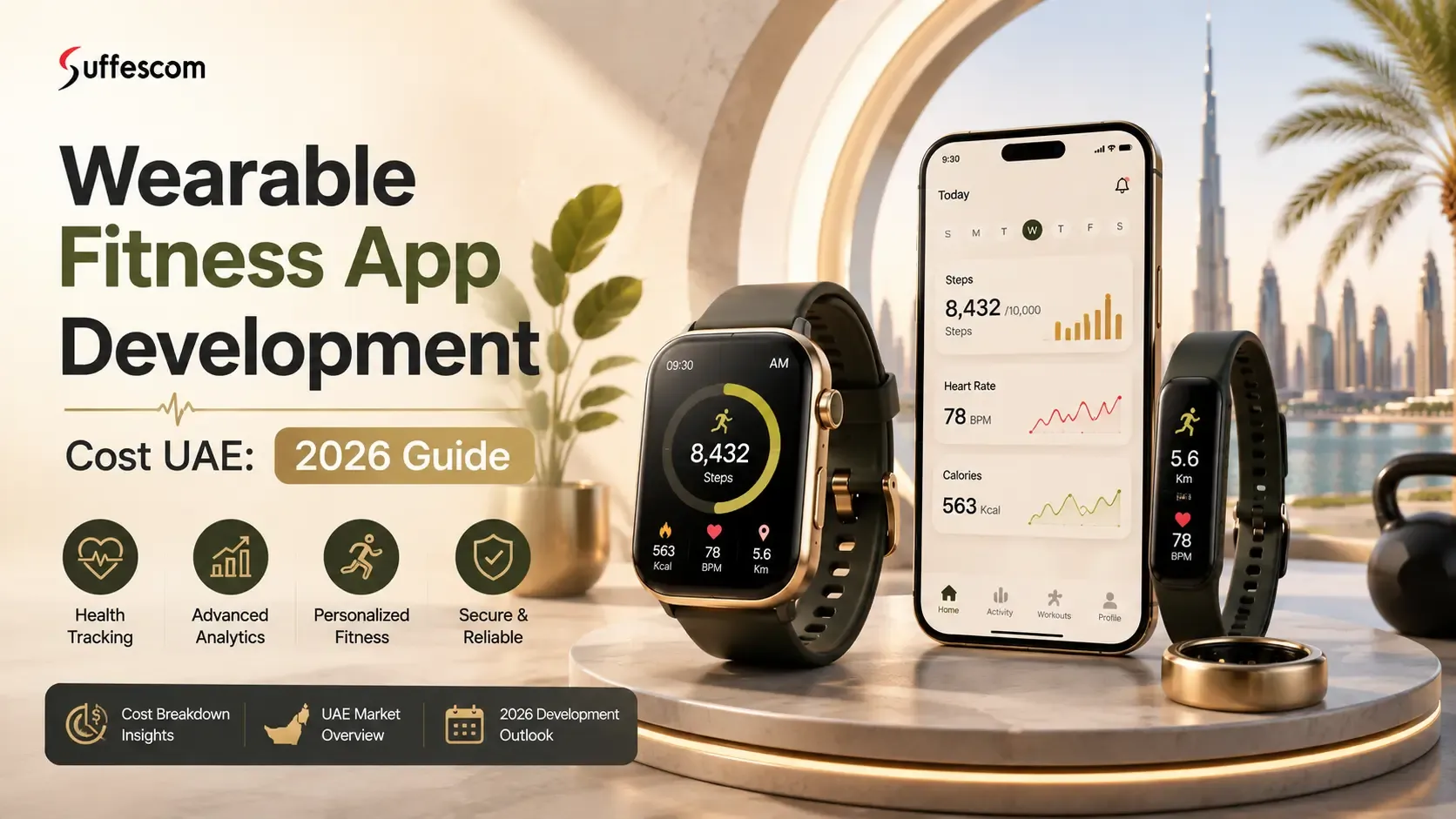
The UAE fitness application market is currently experiencing robust growth. This means there are many opportunities to develop fitness and connected wearables products. Market revenue was estimated at USD 90.8 million in 2025 and is expected to increase to USD 264.6 million in 2033, recording an annual 14.1% CAGR from 2026 to 2033.
Startup businesses, gyms, wellness companies, healthcare providers, and businesses are all heavily investing in fitness and healthcare app development. But then again, the cost of wearable fitness app development greatly depends on several factors. Generally, the cost of developing a wearable fitness app in the UAE is around AED 150,000-550,000+, based on its functionality. But this is just an overview. There are a lot of considerations that you need to be aware of while planning to build an app as per your vision or business requirements.
In order to help you understand how expensive the process of developing such an app would be for you in the UAE, here in this blog post, we have explained all the factors that make up the cost. So, let's get started!
Due to the UAE's evolving digital health ecosystem, increasing adoption of smartwatches, and government healthcare reform, there is a great opportunity in wearable fitness applications. Many sectors are already examining how wearable technology can benefit their operations.
The wearable fitness mobile app development cost falls in the range of AED 150,000 to AED 550,000+ and above. The cost may vary based on different factors such as platforms and devices, sensors, artificial intelligence, security, and backend.
| App Type | Estimated Cost (AED) | Typical Timeline |
| MVP Wearable Fitness App | AED 150,000–220,000 | 3–5 months |
| Mid-Level Fitness App | AED 220,000–350,000 | 5–7 months |
| AI-Powered Fitness App | AED 350,000–550,000 | 7–10 months |
| Enterprise Wearable Platform | AED 550,000–900,000+ | 10–15+ months |
Each of the developmental stages adds differently to the final budget, with wearable integration and development of artificial intelligence adding considerable expense due to the need for specialized engineering and testing.
| Development Stage | Timeline | Estimated Cost (AED) |
| Discovery & Planning | 2–4 weeks | AED 15,000–30,000 |
| UI/UX Design | 3–6 weeks | AED 20,000–45,000 |
| Mobile App Development | 8–16 weeks | AED 60,000–140,000 |
| Wearable Integration | 4–10 weeks | AED 30,000–80,000 |
| AI Development | 4–12 weeks | AED 40,000–120,000 |
| QA & Device Testing | 3–6 weeks | AED 20,000–45,000 |
| Deployment & Launch | 1–3 weeks | AED 10,000–25,000 |
You might feel the complexity is one of the biggest factors impacting the cost of your wearable fitness product.
The estimated figure is merely an initial ballpark calculation; your actual budget for a wearable fitness app in the UAE may vary depending on the technological choices and decision points made during the planning stages of the application's development, ranging from supported devices and the use of AI to security necessities.
The right set of features is related to your target users, wearability environment, and business model. An initial MVP can focus on monitoring and engagement features, while a highly developed one may include intelligence, health information, and luxury elements.
This set of features forms the basis of the user experience and allows them to monitor progress right from their smartphone or wearables.
Businesses can manage users, content, subscriptions, analytics, and wearable-generated data using admin capabilities.
AI can help make a fitness app a truly personalized digital fitness assistant rather than just a tracking application.
Premium features can elevate a simple tracker into an ongoing revenue-generating fitness platform.
When planning your app or software development budget, it's important to prepare for more than just the initial development costs. There are also several hidden and ongoing expenses that you need to consider.
Applications in wearable technology constantly gather and synchronize activity data. The cost of cloud infrastructure will rise as the user base increases since there will be an increased demand for space, computing capability, databases, and data processing.
The Bluetooth Low Energy (BLE) technology facilitates the link between compatible wearable devices and smartphones. It is crucial to develop BLE optimally since its bad implementation may lead to loss of connection, synchronization delays, or high battery consumption.
Using an application that continuously uses sensors, Bluetooth, GPS, or background synchronization may reduce the device's battery capacity. The developers would have to fine-tune the rate at which data is collected and how communication takes place.
Wearable manufacturers periodically update device firmware. These changes can affect how sensors, connectivity, or APIs behave. Businesses may therefore need additional testing and development to maintain compatibility after major firmware releases.
The updates of watchOS, Wear OS, Garmin OS, or any other wearable software can bring about new APIs, limitations, or behavioral changes. Compatibility will be an ongoing cost after launch rather than a development cost.
AI-powered features can create recurring costs after launch. Every AI-generated recommendation, coaching interaction, or analysis may consume API credits or cloud computing resources. Costs can therefore rise alongside user activity and AI feature usage.
The fitness application can handle personal and health-related data. The security assessment, penetration test, vulnerability management, encryption review, and compliance audit can demand extra specialized resources.
Production monitoring is useful for identifying any failures in the API, synchronization issues, crashes, unusual traffic, and performance issues. Monitoring and maintaining the wearable application on an ongoing basis is important to ensure reliability after deployment.
A system that is built to serve 5,000 users will not be efficient when serving 500,000 users on the same platform. Companies will require load balancing, optimization of databases, caching, autoscaling, and enhanced data-processing architecture.
| Hidden Cost | Why It Matters | Budget Impact |
| Cloud Scaling | More users generate more health and activity data to process and store. | Recurring infrastructure cost |
| AI APIs | AI interactions can create usage-based API and computing expenses. | Recurring; increases with usage |
| BLE Testing | Reliable device connectivity requires testing across devices and conditions. | Moderate additional development cost |
| Device Testing | Multiple watches, firmware versions, and OS versions increase QA requirements. | Moderate to high |
| Security | Audits and penetration testing help protect sensitive user data. | Periodic specialist cost |
| OS & Firmware Updates | Platform changes can require compatibility fixes. | Ongoing maintenance cost |
| Battery Optimisation | Poor optimization can reduce user satisfaction and device performance. | Additional engineering and testing |
| Monitoring | Production systems need continuous performance and error monitoring. | Recurring tools and operations cost |
The number of supported sensors in an application will be directly proportional to the amount of data that needs to be gathered, analyzed, synchronized, and interpreted. The availability of sensors may differ between various types of wearable devices.
| Sensor | Primary Use | Complexity | Cost Impact |
| Heart Rate | Track heart rate during rest and workouts | Medium | Moderate |
| ECG | Capture electrical activity of the heart | High | High |
| GPS | Track distance, routes, and outdoor workouts | Medium | Moderate |
| SpO₂ | Monitor blood oxygen levels | High | High |
| Accelerometer | Detect movement, steps, and activity | Medium | Moderate |
| Gyroscope | Measure rotation and movement | Medium | Moderate |
| Skin Temperature | Track temperature variations and wellness trends | High | High |
This part gets more tricky than tracking occasional heart rate measures, because the app has to deal with readings in real-time. The more wearable brands you have to cover, the more different approaches for handling the data you can find and the more testing and synchronization you have to provide.
Technical and regulatory burden is significantly higher on ECG than any other sensor (e.g., activity tracker); business decisions you need to make are regarding device compatibility, interpretation of the ECG trace, safe data transfer, presentation of the results and user management if a medical application is expected to emerge from the initial product.
GPS can get trickier if the app is going to show you real-time tracking, pace, geofencing, outdoor workout route maps, etc. Continuous tracking of a location also brings increased battery load and performance optimization effort.
SpO2 is sensitive because the device vendors implement and offer it to the consumer quite differently (when and how the device actually measures it). The same applies to health/wellness analysis with SpO2 and its interpretation to the end user; you need to care about accuracy and applicable regulatory frameworks.
An accelerometer is a fairly common sensor to integrate into an app, but it can be more complex if you use it for automatic recognition of the user's activities, the exercise in progress, and movement classification. Advanced use cases will require additional algorithms.
The Gyroscope can enhance the body/exercise analysis by complementing Accelerometer measurements, but it adds another data stream that needs to be processed efficiently. Using it for motion recognition or the "body form" will probably require more sophisticated algorithms and device-dependent testing.
The skin-temperature sensor could be added for wellness and recovery use cases, but this feature isn't readily available across every device; therefore, it would require more research into device integration, compatibility, and data normalization.
The technology stack needs to be built around the Wearable Platforms you'll be supporting, the amount of Data, AI requirements, and your future plans for scalability. Building the right tech stack allows for much quicker development while remaining nimble enough for additional Devices and Features.
The use of Swift and SwiftUI is recommended for Apple Watch and iPhone apps, whereas Kotlin and Jetpack Compose are the recommended stack for Android Wearable devices and for Android apps. Flutter can be considered for the mobile application if quicker cross-platform development is necessary, but wearable-specific features might still require native builds.
Node.js with the NestJS framework or Python with FastAPI is recommended for a wearable fitness platform. It allows handling API calls, authentication, wearable data syncs, notifications, subscriptions, and integrations with the ability to scale as the volume of data grows.
AWS, Google Cloud, or Microsoft Azure offer the required infrastructure for storing API's, analytics, logging, and auto-scaling. The Cloud architecture needs to support encrypted data storage and elastic scalability, as a wearables App might generate a continuous stream of user data.
PostgreSQL is great for storing user data in an organized way, subscriptions, and exercises. It is efficient when dealing with structured data in relation to user permissions. Redis can be used for caching, short-lived data, time-series, and analytics if the amount of sensor readings needs processing.
When creating AI-driven fitness features, Python is the main language and framework for Machine Learning thanks to its extensive ecosystem. PyTorch or TensorFlow can be used to support model development, and LLM's for conversational coaching and personal suggestions. The model would depend on whether you plan to generate suggestions, analyze sensor readings, or use it in real time to coach the user.
Usually, wearables need to be connected to Apple HealthKit, Google Health Connect, Garmin, Fitbit, and Samsung Health, among others. REST APIs and webhooks can be used to link services with your wearable backend, while SDK's are often required for the actual wearable features.
Docker and Kubernetes for seamless deployments and scalability for the backend services, and CI/CD pipelines will be required to allow automatic deployments and testing. CloudWatch, Firebase Crashlytics, or similar services will provide monitoring for the application.
Artificial intelligence can help evolve a wearables fitness application from a mere monitoring device to a personalized fitness partner. The most valuable features are the ones that leverage the information provided by the wearables and make actionable suggestions, drive engagement, and give reasons to opt for premium subscriptions.
An AI workout coach evaluates goals, activity levels, prior workouts, and wearable fitness data to build and modify workout programs.
Nutrition AI could utilize users' goal setting, activity level, previous exercise routines, and nutritional preferences to suggest meals and offer nutrition advice.
Recovery AI is capable of analyzing available inputs such as physical activity, sleep, heart rate, and intensity of workouts to make recommendations about recovery.
AI can detect patterns related to overtraining or alteration in activities and warn or suggest preventive action. However, it must not be offered as a medical diagnosis without suitable validation of the product.
AI will be able to examine sleep metrics and activities, find patterns, and give personalized sleep advice.
AI can combine information related to the user's workout history, fitness goals, activities, preferences, etc., and make recommendations for exercises, goals, recovery actions, and more.
Predictive analytics can recognize patterns from activity, engagement, performance, or any other metric and use it to predict future behavior.
It is more beneficial to begin by adding personalization features along with an AI workout coach to the MVP than incorporating all the AI features in the MVP itself. Features such as recovery, sleep analysis, advanced health-based features, and predictive analytics can be added when enough data has been accumulated through the platform.
Third-party integrations provide an opportunity for the wearable fitness application to gather data, integrate with various ecosystems, and facilitate payments and backend functionality without having to start from scratch for all of these features. The problem is that each integration brings extra expenses and effort.
It does not depend just on the number of APIs. The level of integration plays a more significant role. The integration of one wearable for collecting basic activity information is easy. To integrate six wearable ecosystems, several types of sensors, back-end sync, live updates, and history data can take significantly more engineering effort.
That's why startups need to understand which ecosystem is more important for them first and proceed with integration gradually.
This does not just come down to the number of APIs you need to use. Rather, integration complexity will determine your total costs. Integrating a single device for gathering basic activity information can be done relatively easily. On the other hand, supporting six wearable ecosystems, different sensors, background sync, real-time data, and historical information may involve significant efforts.
This is why it makes sense for a startup to choose the wearable ecosystem it needs to support initially and integrate the rest incrementally.
Fitness wearables apps may process data about activities, locations, vital signs, and health. Hence, it is crucial to think about compliance when creating the architecture of such apps rather than at the end of the development process. The specific criteria will vary according to the users, data, and business model of the application.
The Personal Data Protection Law of the United Arab Emirates (FDL No. 45 of 2021) offers a set of rules related to personal data protection and the processing, storage, use, and sharing of such data by organizations.
Regarding a wearable app, the organizations need to consider the above aspects at an early stage of development.
GDPR will apply if the applicability criteria of the GDPR are met, for instance, providing services in the EU where the situation comes within the scope of the regulation. Health information gets extra protection as a special category of personal information under Article 9.
With respect to wearables, companies need to consider legal grounds for processing information, data minimization, transparency, consent when required, and rights of users.
HIPAA does not necessarily apply just because an application captures health or fitness information. It usually applies to covered entities such as healthcare providers, health plans, and healthcare clearinghouses as well as their business associates.
In case of collaboration between a UAE-based wearable platform and a HIPAA-covered entity in the US dealing with protected health information, HIPAA requirements might come into play.
The data collected from wearables must be encrypted during transmission as well as storage of that data. The data protection requirement becomes more crucial in cases when the application works with personal health, biometric, location, or authentication information.
It is necessary to make users aware of what kind of data the application gathers, for what reason, and how the gathered data is used. The permissions must be asked based on the functionality provided by the application and not just randomly.
These are the links that connect the mobile application, wearable platforms, cloud services, and third-party services to each other. The security must be implemented through authentication, authorization, encryption, input validation, rate limiting, and monitoring.
Everyone in the organization does not require access to all kinds of user information. That is where the role-based access control (RBAC) comes into play.
| Compliance Standard | When It Applies | Why It Matters |
| UAE PDPL | When processing personal data within the law's scope | Establishes requirements for personal-data protection, processing, consent, and transfers. |
| GDPR | When GDPR's territorial requirements apply | Provides enhanced protection for health data and establishes requirements around lawful processing and user rights. |
| HIPAA | When working with covered entities or business associates in applicable US healthcare contexts | Requires appropriate safeguards for protected health information. |
| ISO 27001 | When an organization wants a formal information-security management framework or certification | Provides requirements for establishing and continually improving an information security management system. |
Development of a wearable fitness application is different from regular mobile application development because the product needs to function on mobile devices, wearable technology, sensors, APIs, and in the cloud. Process-based development is necessary in order to manage cost and risk.
First, we'll need to identify all the business needs, target customers, wearable devices to support, core features, business model, and the budget for your project. We'll also decide if it will be a fitness/wellness/health app, as each may require different data handling policies and standards.
Key activities: Defining Product scope, user roles, chosen platforms, features prioritization, feasibility, and project plan.
Next up, we'll carry out research into your potential competitors, customers, wearable ecosystem, and technical limitations, as well as their user expectations. For a UAE-based app, we would also need to assess local regulations surrounding health and data privacy.
Key activities: Competitor analysis, user research, wearable device research, market research, and regulatory audit.
We then design a mobile & wearable user experience centered on quick access to fitness data on the move. We'll need to pay special attention to the display of glanceable information for small screens and optimizing wearability with a touch interface.
Key activities: User flows, wireframes, mobile screens, smartwatch screens, design systems, prototypes, and Usability testing.
Developers now build the mobile app and all necessary backend components such as the database, authentication, dashboards, notification system, subscriptions, and core fitness app function. For platform-specific wearable support, we may need to develop natively.
Key activities: Frontend development, backend APIs, database design and build, authentication setup, user management, and development of features.
Now, the app will be linked up with your target wearable ecosystem or health platform such as HealthKit, Health Connect (from Google), Garmin, Fitbit, Samsung Health, or Huawei Health.
Key activities: SDK integration, sensor data syncing, permissions, background data handling, BLE connectivity, and data normalization.
Given the fact that you will be developing for many phones, watches, OS, firmware, and connectivity conditions, rigorous testing is essential.
Key activities: Functional testing, API testing, wearable device testing, BLE testing, performance testing, security testing, battery usage optimization, and Usability testing.
After the product has been tested thoroughly and is compliant with all relevant requirements, it is ready to be deployed to the necessary app stores and wearable ecosystems. Prior to launch, cloud configuration, monitoring, analytics, subscriptions, and security would need to be established.
Key activities: App Store submission, Production deploy, analytics configuration, monitoring, final security check, and Launch support.
Developing wearable technology is an ongoing process and goes far beyond the launch of the product. For instance, operating system upgrades, the release of new wearable devices, changes to smartwatches, and API improvements will constantly require development support.
Key activities: Bug fixes, OS version updates, wearable upgrades, security patch releases, performance monitoring, cloud server load balancing and capacity, and feature enhancements.
Wearable fitness apps can generate revenue through subscriptions, B2B partnerships, premium services, and licensing. The best model depends on your target users and the value your platform delivers.
| Revenue Model | Best For | Revenue Potential |
| Subscription | Consumer fitness and wellness apps | High |
| White-label | Gyms, wellness brands, enterprises | High |
| Corporate Wellness | Employers and HR platforms | High |
| Telehealth | Healthcare platforms | High |
| Insurance Partnerships | Insurers and wellness programs | High |
For wearable apps to be successful, it is important that all four of the above are dealt with together. If any problems arise, early detection is the key for organizations not to incur costly repairs.
Problem: There could be synchronization problems between the wearable device and the mobile application.
Reasons: API, connectivity protocol, operating system, and format used by devices are all different. Also, Bluetooth issues and background limitations will influence the synchronization process.
Impact on business: Lack of data can negatively affect user experience and make it hard to get correct information about fitness.
Suggested solution: Develop a strong synchronization mechanism with retries, background synchronization, and connection failure handling.
Problem: Continuous tracking might drain the battery quite a lot on the wearables and smartphone.
Reasons behind the problem: Sensor polling frequency, GPS, Bluetooth communication, and background processes might keep the hardware awake for a long time.
Impact on the business: The users might turn off tracking or even uninstall the app due to its impact on the battery life.
Solution: Optimize sensor polling, background processes, BLE communication, and synchronization of the data. Poll the data as required by each scenario and not continuously.
The problem: Wearable measurements can differ from one device and application scenario to another.
Reasons for that: Quality of sensors, their positioning, motion, environmental conditions, and algorithms of different manufacturers influence measurement results.
Consequences for business: Low-quality data may result in inaccurate dashboards and suggestions.
Recommendations: Normalize data if needed, compensate for individuality of each device, double-check weird data, and disclose limitations of measurements provided by wearables.
Problem: The user might lose interest in using the app once the novelty of linking their wearable ends.
What causes it: Displaying the number of steps and heart rate is sometimes not sufficient.
Impact on business: Retention rate is low and negatively impacts the subscription and the customer lifetime value.
Solution: Create personalized goals and challenges for users to encourage them to use the app.
Problem: Wearable applications can handle very sensitive information like personal, health, biometric, and locational data.
Justifications: Information is shared between wearable apps and smartphones, APIs, cloud storage, and third parties.
Impact on business: The security threat can cause financial loss, penalties, damage to reputation, and lack of trust.
Recommendations for improvements: The following elements should be used in the application development process: encryption, secure authentication, role-based access, API security, vulnerability management, and privacy by design.
The problem: The AI-generated advice about exercise or wellness is sometimes not accurate or relevant.
Root cause: It all depends on the data that a model has access to: the data volume, its quality, and context. Inconsistent data from wearable devices can also affect models.
Business risk: Poorly targeted advice can lower users' trust and become particularly dangerous if the features start offering health advice.
Solution recommended: Test models on real datasets, control their outputs, create safety limits, and involve humans if it's necessary for a certain use case.
Problem: Architecture, which is suitable for an MVP, may fail as the number of users and data points from wearables rise.
Causes: The constant need for gathering data through sensors imposes new demands on the API, database, cloud storage, analytics, and real-time processing.
Impact: Bad performance, misalignment of the system components, and service downtime may result in poor user experience and additional costs.
Solution: Cloud-based infrastructure, caching, data storage optimization, asynchronous processing, and monitoring should be taken into consideration right at the start of architectural design.
Saving on development costs does not entail cutting down on features that are essential for the product. Instead, one should control the initial scope and make decisions that allow future implementation of advanced features.
Begin with the functionalities that are needed to prove the validity of the core concept, which include user profile, activity monitoring, simple synchronization of wearables, dashboard, and notifications. AI, sensors, and devices can be introduced afterward once validation of demand is proved.
Cost effectiveness: Saves initial effort in developing the system and allows you to invest only based on customer feedback.
The support of all wearables right from their launch can make the development and testing process expensive. Start with the platform that is applicable for your end-users, such as HealthKit from Apple or Health Connect from Google.
Cost savings: Minimal integrations result in minimal SDK development, minimal device testing, and minimal maintenance.
Make the application out of independent modules covering topics like authentication, wearable data, payments, artificial intelligence, analysis, and notifications.
Cost benefit: Any new feature can be added or changed without the need to modify most of the application.
Develop backend APIs which can handle more than one mobile and wearable client instead of developing individual logic for each and every client.
Advantage with respect to cost: Reusable APIs prevent rework.
Tools like Flutter allow reducing duplication in mobile applications that do not need many features specific to the platform.
Cost savings: Having a single codebase allows saving time in development without eliminating the ability to create native modules.
You do not necessarily have to start out with all the functions of AI at once. You can begin with somewhat narrow-scope applications like personalized recommendations or an AI fitness assistant before adding on to them later on with things like recovery intelligence or predictive analytics.
Benefit of reduced cost: Lower upfront costs for AI development, infrastructure, data, and API services.
An experienced team that knows wearable technology integrations, mobile development, artificial intelligence, cloud architecture, security, and health data systems can spot technical challenges prior to development.
Cost benefits: Appropriate expertise can help avoid rework, integration problems, compatibility issues, and unnecessary and expensive architectural rewrites in the future.
Main concept: Build only what is required to validate the business proposition, but design the architecture in such a way that rebuilding it will not be necessary when the product scales.
These successful cases demonstrate that apps in the health and fitness market compete not only in data gathering but in creating an entire ecosystem, which includes personalization, community, coaching, gamification, and other elements. They give some great insights for UAE startups to follow.
Core differentiation: Strava provides an integration between activity tracking and a robust social component. It offers the ability to track one's activities, follow other athletes, perform comparisons, engage in challenges, and share one's achievements. It also has a connected-device ecosystem where data from compatible watches and fitness devices can be input into the system.
Business model: Strava follows a freemium model where basic activity features are available free of charge while more advanced ones are available via its subscription model.
Lesson for UAE entrepreneurs: A wearable application does not have to differentiate itself based on the sheer amount of supported sensors. Engagement of a community based on the collected data is more effective. This business model can be leveraged by UAE startups via various fitness challenges, gym communities, running groups, and corporate wellness competitions.
Key difference: The emphasis of WHOOP is on recovery, strain, sleep, and performance insights as opposed to step tracking. It tracks all the metrics from its wearable technology and generates scores and insights aimed at helping users track their body responses to training and recovery.
Business model: WHOOP mainly makes money from the subscription-based membership services model, which incorporates wearable technology with software and insights.
Learning for UAE startups: It is not only about collecting data on wearables; the real challenge is to convert it into insights. A UAE fitness application could use AI to create unique recovery insights, personalized workouts, or coaching as opposed to creating yet another activity tracker.
Core Differentiator: The Apple Fitness+ product is closely linked to the greater Apple ecosystem, as it uses guided training along with activity and health metrics from Apple Watch.
Business Model: Fitness+ is a subscription-based product as part of the overall Apple ecosystem.
Lesson for UAE Startups: Ecosystem integration can be a significant competitive strength. Rather than trying to create every piece of hardware, the startup should focus on creating an excellent software experience in combination with the existing wearable ecosystems and investing in content, coaching, personalization, and engagement.
Key difference: The central role of Garmin Connect is that of a platform that integrates Garmin’s wide range of sports and fitness offerings into one ecosystem.
Business model: The overall business model of Garmin is highly aligned with the sale of hardware, with the software ecosystem complementing its wearables and promoting usage.
Learning for UAE startups: Device integration can generate significant ecosystem effects. Sports-oriented startups should aim at performance analytics, niche sports, recovery, and advanced dashboards instead of covering all cases of fitness.
Key point: Samsung Health is a combination of fitness, wellness, health tracking, and connected devices in Samsung's ecosystem. Users can have access to their activity, exercises, sleep, and other health parameters through one platform.
Business model: Samsung Health's business model is focused on Samsung's ecosystem development, as opposed to a standalone fitness subscription model.
Lesson for UAE companies: A wearable platform becomes more beneficial when it incorporates different areas of a person's life. UAE firms should think about incorporating fitness, nutrition, sleep, wellness, and coaching in one package instead of providing standalone functions.
Differentiating factor: STEPPI employs rewards and gamification to motivate users to behave better. STEPPI has created a system where activities come with rewards, thus making daily activity more engaging compared to ordinary fitness trackers.
Business model: STEPPI works through partnerships and rewards programs. The system allows companies and organizations to reach out to people via rewards for their activities.
Lesson learned for UAE startups: Localization is a key differentiator. A UAE-specific wearable technology platform may collaborate with gyms, retailers, businesses, insurance companies, and wellness brands for rewarding activities of the users.
Differentiator: Fitze aims to make fitness more attainable through a combination of activities, rewards, challenges, and wellness engagement. Its solution is based on linking the user to the larger fitness ecosystem, rather than confining them to wearables.
Business model: Fitze utilizes the ecosystem approach to business where users, fitness companies, and brands work in the ecosystem.
Lesson for UAE startups: Ecosystem creation adds value over creating a standalone fitness tracker. It is possible to link wearable data with gyms, trainers, wellness companies, corporate fitness plans, and rewards providers.
These examples highlight seven possible paths to creating a competitive wearable fitness venture:
Thus, the key to success of a UAE-based venture does not lie in imitating a single successful mobile app, but rather in combining the approaches that work best for its target demographic and business model.
Fitness wearables are evolving from merely tracking activities to a continuous, intelligent, and connected health journey. The next evolution for UAE companies will revolve around AI, Connected Healthcare, Personalized Insurance, and Invisible Computing.
AI will become a health and fitness companion that analyzes data from wearable technology and gives conversation-based advice.
What users should expect: Users might ask about how much they have been moving around or sleeping and get personalized answers using their own information.
UAE business opportunity: AI companionship can create more engagement and create high-value coaching/subscription options.
The concept of digital twins can help in creating a dynamic digital replica of one’s personal health and fitness profile by analyzing the data gathered over time.
Expectation: In contrast to analyzing one particular metric, an AI-based system can analyze trends in activity levels, sleep patterns, recovery periods, among other data available.
Opportunity for the UAE: The application of this technology can facilitate personalized fitness programs as well as preventive healthcare solutions.
The future of fitness tracking will be beyond watches and wristbands. Smart fabrics or intelligent textiles may integrate sensors into apparel worn while participating in sports, training, or physical therapy.
Expectation: The clothes, shoes, and other products that are wearable devices might track movement and biological signals without having to wear an ordinary watch.
Opportunity in UAE: Sports and fitness-related companies can create special applications for this data source.
Edge AI does some amount of computation right from the wearable or mobile device itself without needing to upload all information to the cloud.
What to anticipate: Speed, less reliance on connectivity, and potentially enhanced privacy for particular computations.
Potential for UAE businesses: Edge computing could have immense value in real-time workout monitoring, movement recognition, and personalization with reduced cloud computation needs.
Wearables can move beyond mere notification about what has occurred to detecting patterns that might need to be addressed.
What to look out for: AI could assess alterations in levels of activity, sleep, heart rate, etc., and provide predictive alerts/recommendations.
Business opportunity for UAE companies: Predictive ability could create business opportunities in preventive medicine/remote monitoring, but health predictions should be clinically validated and properly regulated.
Future wearable application developments will more likely be required to exchange their relevant information with digital health and healthcare systems.
Expectations: With proper consent and technological specifications, data from wearable devices can contribute to workflows for patient and wellness management.
Business opportunity for the UAE: Companies that will develop their technology with an eye to interoperability can position themselves for collaboration with healthcare providers.
Wearables may be useful in the delivery of personalized insurance wellness programs subject to applicable regulatory guidelines.
What to expect: Insurers can use activity-based programs, rewards and personalized wellness programs to motivate healthier habits.
Opportunity for UAE companies: There is a chance that such a B2B model can emerge whereby wearables become a technological link between users, insurers and wellness programs.
Ambient computing reduces visibility of technology through enabling interconnected systems to operate in the background without much user involvement.
What to Expect: Applications related to health and wellness could start automating and analyzing information in watches, phones, smart clothing, and other connected devices.
Opportunities for UAE businesses: The ideal user experience might not be based on repeatedly opening an application but rather on continuously providing relevant recommendations with minimal interactions.
Bigger change: By 2030, wearable applications related to fitness will focus more on interpreting continuous information, creating a personalized experience, integrating with the healthcare ecosystem, and recommending valuable insights.
The next generation of wearable apps will not simply collect more health data. They will use that data in more contextual ways—considering the user's environment, behaviour, language, healthcare journey, and fitness goals. For UAE businesses, this creates several opportunities to build experiences that feel more relevant than generic global fitness apps.
An AI coach becomes more useful when it can explain why it made a recommendation.
Instead of simply saying that a user should reduce training intensity, the app could point to a combination of poorer sleep, elevated resting heart rate, and a higher recent training load.
Product opportunity: Build AI insights around a small set of reliable signals and make the reasoning behind each recommendation understandable. This can increase user trust and make premium coaching more valuable.
The UAE’s climatic condition opens up an opportunity in product development which might not be taken into account by general fitness apps. Training sessions outdoors can factor in temperature, humidity, intensity of exercise, time of the day, and previous activity.
For instance, the app can advise on relocating a high-intensity outdoor training session to indoors because of the weather.
Opportunity for product development: Use weather information in coaching logic as opposed to just showing the weather separately. This is more relevant to running clubs, sports academies, hoteliers, and corporate wellness programs.
Wearable data can become more valuable when it supports experiences beyond fitness tracking. A physiotherapy programme could use selected movement data, while a healthcare provider could review appropriate readings between appointments with the user's consent.
This approach is consistent with the increased emphasis that the UAE has been giving to connected and artificial intelligence-based health care. The Department of Health in Abu Dhabi, for instance, has been working on building population health capabilities using clinical, behavioral, and environmental information.
Opportunity: In case healthcare integration is part of the plan, design interoperability and consent management into the architecture from the start.
Most fitness apps tell users what has already happened. Predictive wellness can help identify patterns before they become obvious to the user.
A combination of declining sleep, reduced activity, and changes in recovery could trigger a recommendation to reduce the next workout or revisit a fitness goal.
Product opportunity: Keep predictive features focused on wellness and clearly communicate their limitations. For corporate and insurance programmes, use aggregated insights where appropriate rather than exposing individual risk scores.
Voice can make wearable fitness devices more functional for users who would not like to interact with the tiny screen while exercising.
The fact that there is a possibility to create voice experiences that support activities performed by UAE users like beginning their workout, monitoring their progress, accelerating or decelerating their activity level, or pausing their training is an example of a product opportunity for UAE users.
Product opportunity: Begin with creating an efficient voice command set rather than developing a huge but inefficient voice interface.
A digital fitness profile can continuously evolve as the application receives new activity, sleep, recovery, and performance information.
Instead of generating the same workout plan repeatedly, the system can adjust future recommendations based on what has changed in the user's recent behaviour.
This direction is already gaining relevance in Abu Dhabi's healthcare ecosystem, where digital-twin approaches are being explored alongside AI-powered population health management.
Product opportunity: Start with a few reliable signals and gradually expand the model rather than attempting to create a complete digital representation of the user from day one.
The wearable will increasingly become one component of a broader connected fitness environment.
Future platforms can connect with treadmills, strength equipment, body-composition systems, access control, studio bookings, and other gym technologies. This allows workout information to move automatically between the physical facility and the user's digital profile.
The “gym of the future” that Abu Dhabi is testing provides another example of such technology integration, through sensors, biometrics scanning, personalized workouts planned using AI and personalized nutrition advice.
Product opportunity: Gym operators in UAE have an opportunity to adopt such technology into their business and provide their customers with a digital experience.
The more advanced the fitness AI systems become, the more the organizations have to consider how much personal data is really necessary for the modeling process.
The privacy-preserving technique allows organizations to build better models without unnecessary movement of sensitive data.
Product opportunity: Follow a data-minimisation approach. Collect and process information because it serves a defined product purpose—not simply because the wearable makes it available.
The future fitness experience will not necessarily live inside the smartphone app.
A user might receive a voice instruction through earbuds, visual guidance on a phone, and real-time performance feedback through a smartwatch during the same session.
Product opportunity: Design the experience around the workout context. Voice may work best while running, video may be better for strength training, and a watch may be ideal for quick performance metrics.
Selecting the right mobile app development company in Dubai is key if your product requires integration between mobile apps, wearable technology, health, AI, and cloud computing. At Suffescom, we have the combination of product engineering and the technical know-how required to develop wearable fitness solutions.
Our team has knowledge about the technical needs involved in developing fitness, wellness, wearable, and health tracking applications. We will be able to design an appropriate set of features, wearable ecosystem, architecture, and development roadmap in accordance with your business needs.
Our solutions include building applications with AI capabilities that include personalized suggestions, AI-based fitness coaching, predictive analytics, recovery insights, and conversational agents. We prioritize designing solutions that leverage AI in ways that add value to the product rather than simply for the sake of having AI in the product.
The need for data management, security, privacy, and interoperability becomes critical when we develop a wearable product in the direction of healthcare applications.
Our development methodology is iterative in nature, enabling businesses to release an MVP, gather feedback from users, and implement advanced features in phases, helping you manage the initial expenditure while ensuring the ability to further grow the product.
Wearables deal with personal and health-related data. Our development methodology includes authentication, encryption, API security, access control, testing, and monitoring processes.
Starting from product discovery, UX/UI design, wearable technology development and integration, testing and deployment, to post-launch maintenance, our team is able to cover the entire product life cycle.
No matter whether you plan to develop an AI fitness app, a smartwatch application, a health tracking portal, or even a system of several wearables, our team can help you make your idea into reality.
Looking to estimate your wearable fitness app development cost in the UAE? Contact our experts to receive a personalized estimate.
The cost to develop a wearable fitness app is approximately AED 150,000-550,000+ in the UAE. A basic MVP may be cheaper, while an advanced AI-enabled platform as well as enterprise wearable platforms might even cost more than AED 550k.
A minimum viable product will usually take 3-5 months, while a mid-level application will take 5-7 months. AI-based and enterprise solutions will take 7-15+ months, depending on many factors.
Select the platform that your target customers mostly use. The Apple Watch can work well with iOS-based products, whereas the Wear OS can be considered for Android-based products. You may consider including Garmin, Fitbit, Samsung, or Huawei support with increasing maturity of the product.
Yes. Flutter is suitable for cross-platform mobile app development, although certain features of smartwatches and other devices could need to be programmed using native languages such as Swift or Kotlin. This depends on what wearable functionality your app requires.
The cost involved in creating an Apple Watch app may range from AED 50,000 to 150,000+ based on the features, integration with HealthKit, design for the watch, real-time requirements, and back-end connections. It becomes more economical when developed in conjunction with an iOS-based fitness application.
Some recurring costs are cloud infrastructure, AI API fees, wearable SDKs, testing of devices, security audits, maintenance, and scalability. All these should be considered as part of the product's budget.
Ongoing maintenance will generally take between 15% and 25% of the development costs for the first year, depending on the number of platforms, integrations, and users. New major operating system updates and integrations with new wearables may affect these costs.
A single fitness platform is able to work within multiple ecosystems via their respective software development kits (SDKs), application programming interfaces (APIs), and health data platform. Nevertheless, each extra wearable device adds integration, testing, synchronization, and maintenance.
Features such as an AI workout coach, personalized recommendations, recovery tips, nutrition advice, and predictive analytics can offer immense value. Startups should focus on AI features that enhance engagement, retention, or premium subscriptions.
The PDPL and Healthcare rules will apply to the product and data in question, based on their nature. Other relevant policies that might apply would be GDPR or HIPAA, depending on the operational scope of the app in question.
Integration includes apps like Apple HealthKit, Google Health Connect, Garmin, Fitbit, Samsung Health, and Huawei Health. Additional payment services may also be integrated if required by the business model.
Yes, wherever possible from a technical and legal perspective. It is possible to design such a platform to share information via APIs and interoperability standards with healthcare organizations. But there are some other considerations when it comes to healthcare integration.
Subscription is one of the most frequently used business models for consumer fitness apps. Other ways include white label, corporate wellness, telemedicine, and insurance programs. Most advanced apps use more than one revenue model.
Develop a minimum viable product (MVP), focus on one or two wearable ecosystem systems, apply reusable API's, use a modular approach, use cross-platform development wherever possible, and implement AI capabilities incrementally.
Identify a partner who has experience in wearable SDKs, mobile app development, integration of health data, artificial intelligence, cloud computing, security, and scalable architecture. Check their previous cases and confirm that they will be able to continue supporting the product post-launch.

Senior Content Strategist
Jonathan Raabe is a content marketing professional, focusing on mobile apps, software engineering, artificial intelligence, SaaS, cloud computing, and digital transformation. Jonathan works with visionary brands to translate complicated concepts into content that can be easily understood by their audiences. As an expert in his field, Jonathan strives to create content that is thought-provoking and backed by facts, while at the same time building brand authority and trust.



Related Blogs
Hear directly from clients who partnered with Suffescom to turn their digital ideas into secure, scalable, and high-performing products.

“Suffescom delivered a HIPAA-compliant telemedicine app exceeding expectations, with strong data security and thoughtful development strategies from start to finish.”

“Suffescom helped us build a smart property management and virtual tour platform. Their expertise in AI helped us attract more qualified leads.”

“Suffescom delivered a modern hotel booking app perfectly aligned with customer expectations, which helped us boost sales by 40%.”

“We needed real-time fleet tracking and route optimization. Suffescom developed a platform that reduced our operational expenses in the first quarter.”

“We needed a smart itinerary planner with AI features for tourists. Suffescom delivered beyond our expectations and helped us increase bookings.”