Forex Trading App Development with Crypto Wallet: Features, Cost & Benefits
Key takeaways: The UAE is a serious market for fintech and digital-asset products. DIFC alone hosted 1,677 A [...]
Want similar results? → Get free consultation
Digital banking in the UAE has moved far beyond mobile apps and online transactions. Today, customers expect banks to anticipate their needs, provide real-time financial guidance, and automate routine tasks. This shift is accelerating AI adoption across the financial sector. According to the Emirates NBD–PwC FinTech 2025 report, 89% of UAE consumers now use digital-first bank accounts, while the country's fintech market is projected to grow from USD 3.16 billion in 2024 to USD 5.71 billion by 2029.
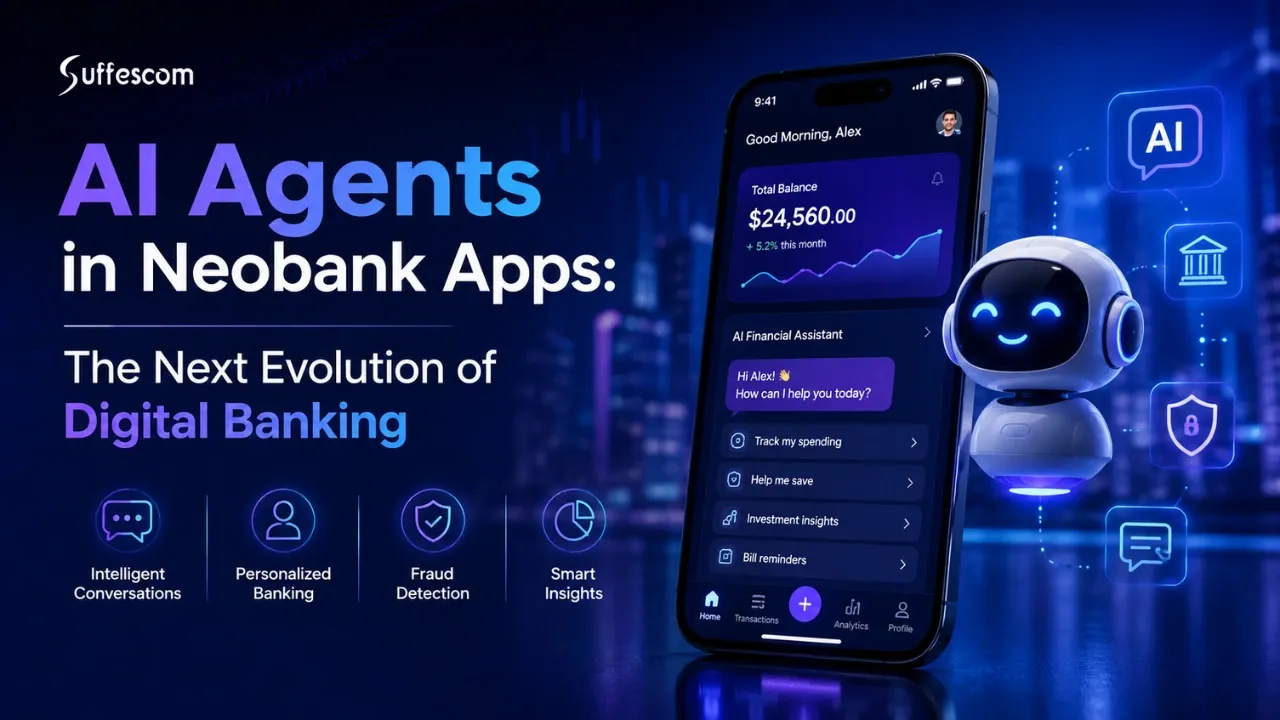
This growing demand is driving the rise of AI agents in neobank apps, intelligent systems that go beyond answering questions to analyzing spending behaviour, recommending financial actions, detecting fraud, and even executing approved banking tasks autonomously. In this guide, you'll learn how AI agents are transforming digital banking, the technologies behind them, development costs, security considerations, and what it takes to build an AI-powered fintech app for the UAE market.
AI agents in neobank applications are smart software programs capable of understanding customers' needs, analyzing financial data, making contextual suggestions, and performing authorized banking operations with limited human intervention. While banking operations through traditional automation are done according to preset algorithms, AI agents constantly learn about the customer's behaviour, interaction with the application, transactional history, and financial activities.
For instance, besides showing the account balance, an AI agent can recognize strange spending, make suggestions about changing the budget, remind customers about due payments or give them investment suggestions in accordance with their financial aspirations. This way, neobanks get the possibility of giving financial assistance to their customers in a proactive manner instead of providing customer support reactively.
There is extensive investment by the UAE Government in AI technology, and a new study published by KPMG titled 'Is Your Finance Function AI Ready?' reveals that organizations are quite ready to embrace this technology. According to the report, 49% of organizations have already developed and implemented an AI strategy for their finance function. Moreover, 59% of companies are currently piloting or implementing AI, while 33% are in the process of planning and early testing of AI.
AI banking agent refers to a digital agent that is capable of automating the completion of certain banking activities by using different technologies, including LLMs, ML, NLP, and predictive analytics. Apart from being able to respond to one command at a time, AI banking agents are also able to analyze contextual situations as well as make recommendations or perform the right action within the financial world.
A typical AI banking agent makes decisions through:
| AI Agent Workflow Stage | What Happens |
| Understands customer intent | Interprets text or voice requests to identify the customer's objective, such as transferring money or checking loan eligibility. |
| Analyses financial data | Reviews transaction history, spending behaviour, account balances, and financial patterns to build context. |
| Generates recommendations | Suggests personalized actions such as saving more, reducing unnecessary expenses, or selecting suitable financial products. |
| Executes approved actions | Completes authorized tasks like scheduling bill payments, freezing a debit card, or transferring funds. |
| Learns continuously | Improves future recommendations by analyzing customer preferences, feedback, and interaction history over time. |
While both AI agents and banking chatbots engage customers in conversations, they are quite different in terms of functions. Chatbots are meant to provide answers to pre-programmed questions, while AI agents are capable of reasoning and making recommendations based on customer data.
The table below illustrates the distinctions between these two.
| Feature | Traditional Banking Chatbot | AI Banking Agent |
| Intelligence | Rule-based responses | AI-driven contextual reasoning |
| Learning Capability | Limited to predefined flows | Continuously learns from customer interactions |
| Personalisation | Generic responses | Tailored financial insights and recommendations |
| Banking Actions | Answers queries only | Executes approved banking tasks |
| Decision Support | No | Yes, with predictive recommendations |
| Customer Context | Minimal | Uses transaction history and behavioural patterns |
| Availability | 24/7 | 24/7 with proactive assistance |
For example, when a customer asks, "Am I able to afford AED 12,000 holidays next month?", a standard chatbot may simply show the existing bank balance. But an AI-powered banking agent will analyze the regular payments, expected earnings, upcoming bills, and savings objectives and give personalized advice on how to manage money and recommend the best way to pay for the holiday. Such capabilities distinguish AI agents from other neobanks.
Talk to our fintech experts to validate your idea.
The United Arab Emirates (UAE) has developed into one of the leading digital banking markets worldwide due to its technologically advanced population, favourable government policies, and fintech community. Due to the rising demands of customers for instantaneous, personalized, and anytime access to their financial activities, the basic capabilities of digital banking have become insufficient for the neobanks' differentiation. The introduction of AI agents can solve the problem by offering intelligent assistance, automation of financial processes, and a personalized experience.
The use of AI agents is now becoming a necessary strategy for fintech firms and digital banks in order to ensure customer satisfaction and improve their operations.
The UAE vision of creating a global fintech center has led to increased use of artificial intelligence in the banking industry. The UAE Artificial Intelligence Strategy 2031 and innovation ecosystems of Dubai International Financial Centre (DIFC) and Abu Dhabi Global Market (ADGM) provide an ecosystem where digital-first banks can thrive.
On the other hand, consumer behaviour is changing at the same pace. As per the Emirates NBD–PwC FinTech 2025 report, 89% of consumers in the UAE now have digital-first bank accounts. Also, the UAE fintech market is anticipated to expand from USD 3.16 billion in 2024 to USD 5.71 billion in 2029. The growth in the UAE fintech market shows consistent investment and demand for smart financial solutions.
In light of the above, neobanks should move ahead from digital self-service to develop AI agents who can offer proactive advice on financial matters, automate mundane banking tasks, and operate efficiently.
Banking customers today have much higher expectations than simply being assured of having a safe place for their transactions and balance verification. They require banking apps to make financial management easy for them, foresee their demands and offer assistance when needed.
This is how modern AI agents contribute:
The integration of AI agents is changing the landscape of digital banking through the creation of intelligent banking apps that learn about customer behaviour, automate processes, and offer personalized suggestions on demand. Rather than having customers look up information and perform repetitive tasks, AI agents can analyze data, identify what is required and help the user at every step of the process.
From handling day-to-day expenses to speeding up loans and making investment choices, AI agents in banking are optimizing user experiences and operations. Below are some of the most effective uses of AI agents in modern banking apps.
Customers have different behaviours when it comes to their finances, spending patterns, and financial aspirations. AI agents provide customized recommendations through analyzing these behavioural patterns instead of just giving general financial advice.
Through constant monitoring of transaction history, income patterns, recurrent payments, and saving behaviours, AI agents allow customers to make better financial decisions without expending too much effort.
Common uses include the following:
For example, a customer spends more than AED 1,500 per month on food delivery services. An AI agent monitors such behaviour, calculates possible annual savings, and makes recommendations to limit the spending to some extent and automatically deposit the saved amount to the special account.
Customer support is one of the most resource-consuming functions performed by any financial company. The automated process of answering clients' questions via AI agents will not only increase the speed of the process but will do so without affecting the quality of the service.
In contrast to regular bots whose responses are predetermined, an AI agent will be able to identify the customer's intention, obtain the necessary information about the client and perform banking activities in a single conversation.
Typical customer support activities include:
Personal finance management requires the completion of several repetitive tasks, from payment of utility bills to subscription management and keeping track of monthly expenditures. The role of AI agents here includes automation of financial management and allowing customers to better control their cash flow.
These include the following abilities:
Example:
In advance of the salary coming in, the AI agent predicts the period of cash crunch due to utility bills and loan repayment.
The traditional lending process usually involves static credit scores and manual assessments. However, AI agents make it possible to take an all-encompassing approach that involves analyzing various financial indicators in order to determine whether people qualify for loans and credit services.
Such intelligent agents are able to examine transaction behaviour, income stability, history of repayments, and expenditures.
AI lending capabilities may involve the following:
Such an approach allows financial companies to provide their customers with wider access to credit products.
Management of investments is not reserved for only wealthy clients anymore. The AI agents allow neobanks to offer personalized investment management services to their customers using intelligent finance advice and automated investment management services.
Based on the client's objectives in investing, his/her income and risk tolerance, the AI agents can suggest appropriate investment strategies while constantly tracking the performance of the investment portfolio.
The following are some of the features of wealth management services based on AI:
For traditional banks, it has been a reactive process whereby customers realize their needs, approach the bank and wait for a reply. In the case of AI-enabled neobanks, however, this is not the case, as customers' needs will be predicted through continuous analysis of their transactions, behaviour, financial goals and more. The AI agent in this case does not only work as an auxiliary but becomes a proactive advisor providing recommendations while allowing customers to remain in control of their decisions.
This paradigm shift from a reactive process to a predictive one allows neobanks to create a more engaging experience for their customers.
The following table gives a comparative representation of the two processes.
| Traditional Banking Journey | AI-Powered Banking Journey |
| Customer identifies a financial need | AI detects a financial opportunity or potential issue |
| Customer contacts the bank | AI proactively sends a personalized recommendation |
| Bank provides information or available options | AI analyses customer data and recommends the most suitable action |
| Customer manually completes the process | AI automates approved tasks while keeping the customer informed |
| Limited follow-up after completion | AI continuously monitors outcomes and provides ongoing financial guidance |
The true power of AI agents is in their ability to offer contextual help at various stages of a customer's financial life cycle. Instead of offering help based on one-off requests, they assess real-time financial events and make recommendations to help customers make better decisions.
Take the following examples of how an AI banking agent can personalize banking experiences
| Customer Activity | AI Agent Action |
| Salary is credited | Analyses monthly income, automatically recommends a personalized savings plan, and suggests allocating surplus funds toward investments or financial goals. |
| Monthly spending increases | Detects unusual spending trends, highlights categories exceeding budget, and recommends practical ways to reduce unnecessary expenses. |
| International travel is detected. | Suggests enabling international card usage, provides foreign exchange insights, recommends travel insurance, and alerts customers about international transaction fees. |
| A large purchase is planned. | Evaluates available funds, predicts the impact on future cash flow, recommends suitable payment options, or checks eligibility for instalment plans or short-term financing. |
This way, AI-driven interactions turn ordinary digital assistants into smart financial companions. Thanks to proactivity, neobanks are able to offer their customers a truly personalized experience that results not only in better financial performance but also in higher levels of customer trust and loyalty.
The AI capabilities of agents depend on a number of technologies used together to recognize customer intent, to process financial information, to make decisions, and to provide personalized bank services. In contrast to a single technology used by one artificial intelligence, today's neobanks use several technologies to ensure the security and efficiency of recommendations and transactions.
It is important to understand these technologies to be able to select appropriate architecture for your AI-driven neobank app development.
Generative AI and LLMs allow AI banking agents to comprehend natural language, keep conversation context, and respond as humans would do. In contrast to usual chatbots, which use pre-written scripts, LLMs are able to comprehend customer requests and give relevant responses according to banking policies and customer information.
In a neobank setting, they become intelligent financial assistants who are able to:
The development of LLMs allows AI agents to provide natural, accurate, and engaging financial services without the help of people.
Machine learning helps AI agents find patterns in large amounts of financial data and continually learn from them to enhance their predictions over time. In contrast to reacting to past events, machine learning helps banks predict what their customers' needs will be in the future.
Predictive analytics helps AI agents provide recommendations using their insights into transaction history, customer behaviour, and financial trends.
Some of the most common uses of predictive analytics are:
For instance, if the AI agent notices that a customer saves considerable money every month, it may offer a high-interest savings or investment product even before the customer begins to look for one.
The ability of an AI agent to understand, comprehend, and reply to the input in both text and speech forms is referred to as Natural Language Processing (NLP). The bridge that NLP helps to create between customers and the banking system ensures that natural language is used in communication instead of complex menu structures or defined commands.
Some examples of how NLP can be useful in banking include:
AI agents need a strong digital backbone to facilitate their use of banking services, processing of customer information, and provision of recommendations instantly. The use of open APIs, cloud, and backend technology ensures that the AI models can easily interface with payment gateway services, core banking systems, compliance systems, and financial services providers.
This constitutes the core of the intelligent banking environment.
| Technology | Role in AI-Powered Neobank Apps |
| Open Banking APIs | Connect AI agents with banking systems, payment services, and authorized third-party financial providers. |
| Cloud Computing | Provides scalable infrastructure for AI model training, real-time processing, and secure data storage. |
| Core Banking Integration | Enables AI agents to access account information, transaction records, loans, and payment services securely. |
| Security & Identity Services | Supports authentication, encryption, biometric verification, and secure access to sensitive financial data. |
An AI neobank's success is not only dependent on the use of a language model or virtual assistant. Companies require AI technology that would enhance the customer experience while increasing operational efficiency at the back end. An effective AI agent should be able to guide customers through their financial life cycle and assist bank teams in making decisions.
Below is a list of features necessary for a neobank application.
Customer-facing AI capabilities are intended to make everyday banking easier, offer personalized financial advice, and make managing finances less cumbersome. Such capabilities enable the creation of an intelligent financial buddy rather than one that just reacts to customer requests.
| AI Feature | Purpose |
| AI Financial Assistant | Delivers personalized financial advice, answers banking queries, and recommends suitable products based on customer behaviour. |
| Voice Banking | Enables customers to perform banking tasks through secure voice commands, improving accessibility and convenience. |
| Smart Notifications | Sends real-time alerts for unusual transactions, bill due dates, spending limits, and account activities. |
| Expense Tracking | Automatically categorizes transactions, analyses spending habits, and provides actionable budgeting insights. |
| Automated Payments | Schedules recurring bill payments, subscription renewals, and fund transfers while reducing missed payment risks. |
In addition to user-friendly functionality that improves the experience of customers, neobanks can use artificial intelligence on the backend side, enabling more efficient, secure and scalable operation of the bank.
The key backend features of artificial intelligence used by neobanks are:
As soon as the customer-facing intelligence is supported by the backend operations using artificial intelligence, neobanks will be able to offer their customers fast services, make more accurate decisions, decrease operational costs and provide a secure banking environment.
The value of AI agents is not only limited to providing intelligent conversation, but they actually transform the entire process of delivering banking services. For the customers, they offer personalized financial advice, faster support, and increased control over finances. For the neobanks, they decrease the cost of operations, automate routine activities, and create new sources of income.
With time, the scope of AI is increasing, and financial organizations which implement intelligent agents in their digital banking systems are sure to have a competitive advantage.
AI agents make banking easier and more natural for people by assisting customers in handling their finances proactively rather than reactively. Users can receive instant responses and recommendations rather than surfing multiple screens or reaching out to customer care.
The main benefits of AI in banking are as follows:
All these features allow customers to make smart financial decisions and have an amazing digital banking experience.
For neobanks, AI agents are not just a means for engaging customers; rather, they are a resource that allows for improved operations, customer interaction, and sustainable growth of the business.
The table below illustrates the value of AI agents to digital banks.
| Business Benefit | How AI Agents Deliver Value |
| Reduced Operational Costs | Automate repetitive support requests, customer onboarding, and administrative workflows, lowering the need for manual intervention. |
| Higher Customer Engagement | Deliver personalized recommendations, proactive alerts, and intelligent financial guidance that encourage frequent app usage. |
| Improved Customer Retention | Provide consistent, tailored experiences that increase customer satisfaction and strengthen long-term loyalty. |
| New Revenue Opportunities | Recommend relevant lending products, premium financial services, insurance, and investment solutions based on customer behaviour. |
| Scalable Customer Support | Handle thousands of simultaneous customer interactions while maintaining consistent response quality and reducing support costs. |
Creating an artificial intelligence neobank mobile app means not only building a mobile banking application but also integrating AI algorithms into the system along with secure banking technologies, a payment system, and cloud architecture that would provide a great user experience. Therefore, the price of such an app will depend on how much AI intelligence is needed, how many banking services it should offer, and how complex the security and compliance requirements are.
Whatever kind of project you are going to create – whether MVP or the whole digital banking ecosystem, you need to know about the main cost factors.
Total investment will depend on the scale of the platform, AI capabilities, and requirements for its integration. The basic AI assistant can manage conversational banking and financial advice, while an enterprise platform can provide automated financial management, advanced fraud detection, predictive analytics, and even AI-powered loans.
The table below provides estimated development costs for different project scopes.
| App Complexity | Estimated Development Cost (AED) |
| Basic AI Banking Assistant | AED 147,000 – AED 294,000 |
| Medium AI Neobank Platform | AED 367,000 – AED 918,000 |
| Advanced AI-Powered Neobank Ecosystem | AED 1.10 million – AED 2.57 million+ |
Note: These estimates may vary depending on AI model selection, regulatory requirements, third-party banking integrations, cloud infrastructure, and the complexity of the overall banking ecosystem.
Each bank-specific implementation of an artificial intelligence system is distinctive in terms of technical and commercial demands, and therefore cannot have a rigidly set development budget. The most significant elements affecting the total cost include the following.
The complexity of your AI agent will be one of the key factors affecting costs. Simple chatbots will need much lower development resources compared to AI agents which will be able to perform analysis of financial behaviour, provide context-based recommendations and learn from customer interactions.
Typical elements of increased AI complexity are:
As the scope of financial services grows, so does the need for integration, testing, and compliance. Moving beyond basic banking features increases the time needed for development and makes the infrastructure more complex.
Cost-related features are as follows:
Platform building technologies have a direct effect on the scalability, performance, maintenance, and cost of operation of the product. Enterprise-level infrastructure could be more expensive initially, but it is more reliable and scalable in the long run.
Main technology blocks:
The software used in banking is one of the sectors that is highly regulated around the world. Ensuring security and compliance involves further development, testing, auditing, and monitoring during the entire project lifecycle.
The key compliance requirements are:
Building compliance from the start ensures compliance risks are minimized.
Creating an AI-driven neobank requires a sequential approach through stages of strategy, design, implementation of artificial intelligence, banking integration, security testing, and compliance testing. How long it will take depends on the complexity of the project and how many features it has.
| Development Stage | Estimated Duration |
| Research & Planning | 4–8 weeks |
| UI/UX Design | 6–10 weeks |
| App Development | 4–8 months |
| AI Integration | 2–4 months (overlaps with development) |
| Testing & Launch | 1–2 months |
Trust is a basic requirement for all successful banking transactions. The use of AI development in digital banking allows for a faster and more personalized banking experience; however, it also involves processing sensitive data and making important decisions regarding customers' finances. This is why security, privacy, and regulatory compliance become crucial factors during the development of AI-powered banking services.
An effective neobank powered by AI technology needs to guarantee the safety and confidentiality of data, as well as the transparency and fairness of AI operations in accordance with financial regulations.
Modern fraud is becoming more sophisticated, which reduces the effectiveness of traditional fraud detection systems based on rules. AI agents enhance the security of banks through continuous transaction monitoring, behavioural anomaly detection, and suspicious activity detection in real time.
As opposed to traditional fraud detection systems, which are based on predefined rules, the AI technology analyzes several data points at once to detect suspicious behaviour.
Some of the best AI-based fraud prevention tools include:
Example:
If the customer usually makes local transactions in Dubai and suddenly starts making international transactions with large amounts from a new device, the AI agent will temporarily stop the transaction, ask for identity verification, and inform both the customer and the fraud investigation team of the bank about it.
AI agents require large amounts of financial and behavioural data for delivering a personalized banking experience. Though it allows for better recommendations, it also increases the liability for financial institutions to ensure security and transparency regarding customer data.
When designing AI-enabled neobank applications, there are a number of privacy issues businesses have to consider:
AI-enabled banking systems in the UAE are required to ensure compliance not only with banking regulations but also with data privacy laws. Given that AI agents usually handle highly sensitive financial data and can influence the decisions of customers, compliance needs to be incorporated into the system at an early stage of its development.
The following table contains some of the most important regulations that need to be considered by companies developing AI-powered neobank solutions in the UAE.
| Regulatory Area | Why It Matters for AI Neobank Apps |
| UAE Central Bank Regulations | Ensure AI-powered banking services comply with licensing, risk management, cybersecurity, and consumer protection requirements. |
| UAE Personal Data Protection Law (PDPL) | Governs how customer personal data is collected, processed, stored, and shared while protecting user privacy. |
| AML & KYC Compliance | Requires continuous identity verification, transaction monitoring, and reporting of suspicious financial activities. |
| Cybersecurity Controls | Mandate secure authentication, encryption, access controls, and continuous monitoring to safeguard financial systems against cyber threats. |
AI-based agents are quickly moving beyond chatbots and towards becoming autonomous financial entities which would be able to perform increasingly complicated activities in the realm of banking. Whereas today's AI systems provide help to customers through recommendations and transactional processes, future intelligent banking would entail proactive analysis of customers' financial situations, predictions of their needs and carrying out the necessary steps with limited human involvement.
For neobanks operating in the UAE, the transition towards autonomous banking is an opportunity to offer more personalized solutions, to increase the efficiency of operations and to stand out in the competitive fintech environment.
The future applications of AI in the banking industry are not limited to only customer service roles. Technology advancements are creating intelligent financial partners out of AI, which can constantly optimize financial decisions for individuals and companies.
The AI-powered assistants of the future will operate almost in the manner of dedicated relationship managers, with the only difference being that they will be able to handle the needs of millions of customers at once. Not waiting for the user to ask for help, these assistants will analyze the financial state of affairs and make recommendations to customers at all stages of their financial lives.
Some possible recommendations may include:
Instead of contacting different banks, customers will get the recommendations from one intelligent assistant.
The new generation of AI agents will automate financial decisions while still leaving the authority for approval and expenditure limits with customers.
These types of automated financial management may include:
This will result in reduced effort in financial management while making better financial decisions.
Technological innovations in conversational artificial intelligence and speech recognition will transform voice as the main channel in banking, instead of being one of the alternatives.
Consumers will do sophisticated tasks through conversation, such as:
Voice authentication will add more convenience to this kind of banking experience.
Despite small and medium-sized businesses having difficulties handling their cash flow and operational issues, most are not able to access a dedicated financial advisor. AI agents have an important role to play in this area by offering financial support for businesses that are intelligent and suited to their needs.
Some future AI capabilities in SME banking might be:
This will help SMEs make financial decisions quickly.
The most profound neobank AI agents development may include the ability of these programs to predict customer needs even before money problems emerge. AI agents will not be based on past data but on current financial data and predictive analytics for making proactive recommendations.
For instance, an AI agent will:
With the growing precision of predictive analytics, AI agents will move from being reactive banking assistants to being decision-making tools in finance.
In the case of banking entities functioning in the UAE, the future of banks is going to be determined by intelligence and not digitization alone. The neobanks which embrace AI-enabled automation, predictive capabilities, and personalized banking today stand a better chance of addressing their customers' changing needs in the future. The AI agents have gone beyond mere digital banking to help craft the future of autonomous finance.
AI-powered agents are already changing the way that financial institutions offer their services, ranging from customer service, fraud protection, loans, and personal finance management. Instead of functioning as isolated virtual assistants, these intelligent agents are integrated into the banking system in order to streamline processes, inform decisions, and provide a better customer experience.
Below are examples of how AI agents bring value to both customers and neobanks.
Customer support is one of the most popular uses of AI in digital banking. AI agents can give immediate, context-aware support by comprehending the user's needs, accessing pertinent account data, and executing banking transactions automatically.
Unlike traditional chatbots, AI agents can keep the conversation history, personalize responses, and handle several requests in one conversation.
Some examples of customer support use cases are as follows:
For example:
A customer contacts the bank about the loss of their debit card. Instead of just giving instructions, the AI agent blocks the card immediately, starts the process of issuing a new one, suggests turning on the virtual card for uninterrupted payments, and gives an estimate of the shipment period.
Fraud detection involves analyzing a large number of transactions to determine fraud in real time and prevent financial loss. The artificial intelligence agents will analyze customer behaviour, the transactions being made, and the device and location from which they are made to detect any irregularities.
Fraud detection features include:
Example:
If an account which has been used domestically for years suddenly starts making many transactions abroad within minutes, the AI agent will hold those transactions and ask the customer to authenticate himself biometrically to continue making payments.
Loan approval has long been a cumbersome task which is associated with document checking, manual analysis, and credit evaluation. AI-powered agents help to speed up the process by providing automated data gathering, analysis of the financial situation, and making faster loan decisions.
Some of the abilities of AI-powered lending assistants include the following:
For many customers, AI agents are at their most useful by providing them with tools that help them better handle their day-to-day personal finance. They do more than just record transactions; they look at spend trends and make suggestions for how a customer can do better for their personal finances. AI personal finance assistants can: Review a customer's monthly spending by category.
Recommend a monthly budget for the customer that aligns with income and savings goals.
Suggest where a customer might be able to improve savings. Remind a customer when a bill is upcoming. Help the customer monitor their progress towards savings goals. For example: A customer wants to have AED50,000 saved to put towards purchasing a home in the next two years.
An AI agent uses the customer's income and typical spending to calculate the target spend, monitor performance in the background, and even tell the customer when they might need to cut spending to meet their goals.
When we see examples such as these, we are not looking at science fiction anymore. AI agents are part of the day-to-day reality of digital banking, and their use in neobanks enables customers to have a FASTER, SAFER and more enjoyable banking experience.
Designing an AI banking Neobank involves much more than slapping a model onto your existing application. To succeed, you should consider your business goals, your AI model architecture, your underlying secure banking infrastructure, the strict regulations you must adhere to, and the after-launch updates to your AI model for enhancement.
These seven steps offer an approach to successfully building and deploying an AI-enabled Neobank application:
All successful AI applications in banking start with defining the tasks AI will tackle. Rather than implementing AI just for the sake of innovation, organizations need to focus on use cases that enhance user experience, automate processes, or provide a clear business benefit.
Typical examples of AI use cases in banking are:
Defining such goals makes it easier to prioritize functions, assess neobank AI agents development costs, and choose suitable AI technologies.
The design of the AI architecture will define the level of intelligence, scalability, and security that the banking system will have. Enterprises should choose an architecture that suits the functionality, regulatory compliance, and long-term product vision.
Architectural considerations include:
Scalability of the architecture makes it possible to add new AI features without stopping banking services.
The most sophisticated AI would not have much use if its users cannot easily engage with it. User experience must make engaging with AI assistance seamless, effortless, and natural along the customer's banking journey.
Among the most important design considerations are:
Intuitive design helps build confidence in adopting AI-driven banking solutions.
The AI bots need real-time access to the banks' systems in order to provide personalized recommendations and automation for their financial operations.
Common integration examples are:
All integrations should comply with robust authentication, encryption, and API security standards.
With the technical architecture in place, it becomes necessary to train the machine learning models to understand banking jargon, customer behaviour, and workflows in the financial industry. Constant optimization guarantees that the recommendations provided stay relevant even as customer expectations and services change in the industry.
The training process is aimed at:
Pre-launch testing of all AI banking systems is critical to verify their ability to meet the required financial industry standards regarding security, reliability, and compliance.
Tests must include:
Handling all issues before the system goes live greatly mitigates risk post-launch.
Launching a neobank app is just the start, not the finish line, of AI development. Customer behaviour, compliance standards, and AI functionalities change constantly, so continuous optimization is necessary for sustained success.
Once launched, the company must constantly monitor:
Thinking of AI as a constantly improved tool and not just a one-off project allows neobanks to offer an ever-more intelligent, secure, and personalized banking experience while staying ahead in the competitive fintech landscape.
The technology stack decides how secure, scalable, and intelligent the AI-powered neo-banking platform will be. Since these are financial applications that involve transactions and algorithms, it is necessary for businesses to choose technologies that guarantee high levels of performance and integration.
The table below gives a description of key technologies utilized for building AI-based neobank solutions.
| Category | Recommended Technologies | Purpose |
| Mobile App Development | Flutter, React Native, Native iOS (Swift), Native Android (Kotlin) | Build responsive, high-performance mobile banking applications across multiple devices. |
| Backend Development | Node.js, Java (Spring Boot), Python (.NET optional) | Handle business logic, APIs, transaction processing, and banking workflows securely. |
| Artificial Intelligence | Large Language Models (LLMs), Machine Learning, Natural Language Processing (NLP), Predictive Analytics | Power conversational banking, personalized recommendations, fraud detection, and intelligent automation. |
| Database | PostgreSQL, MongoDB, Redis | Store customer profiles, transaction records, AI data, and application information with high availability. |
| Cloud Infrastructure | Amazon Web Services (AWS), Microsoft Azure, Google Cloud Platform (GCP) | Provide scalable infrastructure, AI model deployment, secure storage, and disaster recovery. |
| Security & Compliance | End-to-end Encryption, Multi-Factor Authentication (MFA), Biometrics, OAuth 2.0, JWT | Protect customer data, secure account access, and meet banking security requirements. |
Apart from the selection of programming languages and cloud vendors, a number of technical aspects affect the success of an AI-driven banking platform in the long run.
A robust technology stack offers much more than technical features—it ensures the foundation for offering secure and intelligent digital banking solutions for the future.
Our free strategy session can give you the right head start!
Though conventional banks have done a great deal of work to transform themselves into digital entities, many are stuck with outdated systems which restrict automation and personalization. Neobanks, however, are designed with cloud-based architecture and artificial intelligence technologies that enable them to provide fast, intelligent and customer-oriented financial solutions.
The main distinction between traditional and AI-enabled neobanking can be found in the decision-making process. In traditional banking, customers submit requests, and the banks act accordingly. Artificially intelligent neobanks take the opposite approach and use artificial intelligence to predict customer needs and provide appropriate recommendations before they make their request.
Below are some comparisons between AI agents and traditional banks.
| Area | Traditional Banking Systems | AI-Powered Neobanks |
| Customer Service | Primarily human-assisted with limited automation | AI agents provide instant, context-aware support while escalating complex cases when required |
| Personalisation | Standardized products and recommendations | Hyper-personalized financial guidance based on customer behaviour and goals |
| Availability | Dependent on branch and support hours, with limited self-service | 24/7 intelligent banking assistance across digital channels |
| Automation | Automates selected banking processes | Automates customer service, payments, fraud detection, financial planning, and operational workflows |
| Data Insights | Uses historical reports to support decisions | Continuously analyses real-time customer data to deliver predictive insights and recommendations |
In order to choose between upgrading current banking systems or developing an AI-powered neobank, businesses need to take into account the future implications for the user experience, efficiency, and scalability.
AI-powered neobanks are not only a way to implement innovative technologies; they are also the way to build the future of customer-centric smart banking in the rapidly changing fintech environment of the UAE.
Developing an AI-driven neobank is not merely about providing customers with a superior banking experience; this venture involves developing a viable business model. The introduction of AI agents creates several sources of income due to the provision of personalized financial services, enhanced customer interactions, and adoption of premium banking packages. In contrast to the traditional transaction-based model, companies can generate revenues through subscription-based services, lending, investments, and partnerships.
The monetization models listed below have proven to be the most effective for AI-based neobanks.
| Revenue Model | Example |
| Subscription Banking | A premium plan priced at AED 49/month includes higher transaction limits, free international transfers, and priority customer support. |
| Premium AI Financial Assistant | Users upgrade to access AI-powered retirement planning, portfolio analysis, and personalized investment recommendations. |
| Transaction Fees | The neobank charges a small fee for international remittances or currency conversion while keeping standard transfers free. |
| Digital Lending Services | Based on a customer's financial profile, the AI agent recommends a pre-approved personal loan with competitive interest rates. |
| Investment Products | Customers invest in diversified portfolios through the AI assistant, while the platform earns an advisory or asset management fee. |
| Strategic Partnerships | When a customer books an international trip, the AI agent recommends travel insurance from a partner company and earns a referral commission after the purchase. |
AI agents are capable of greatly improving the digital banking sector; however, they are also associated with certain problems. As AI processes financial information and makes vital banking decisions, firms should consider both aspects of AI agents development and security when implementing AI agents.
Being aware of the problems faced helps fintech and neobanking companies develop safe and scalable AI solutions.
The success of an artificial intelligence-based bank agent largely depends on the quality of the data provided. Otherwise, wrong recommendations may be issued, the algorithm might not be able to detect fraud properly, and the user will have a bad experience interacting with the agent.
Some common obstacles associated with data are:
How to overcome it:
Apply proper data governance methods, validate data continuously, and retrain AI algorithms on banking data regularly.
The financial sector is highly regulated, and AI-based banking solutions should meet changing legislative and compliance requirements at all stages of their development.
Among major compliance hurdles are the following:
How to overcome it:
Engage compliance experts at the initial stages, perform regular audits for regulatory compliance, and develop explainable and auditable AI solutions for finance.
Even though artificial intelligence is becoming increasingly accepted, many customers of banks still tend to be skeptical of letting such technology have any impact on financial decisions and access personal data. In this respect, gaining the trust of customers is just as important as having highly advanced AI technologies.
Elements that determine customer trust are:
How to overcome it:
Present AI not as a substitute but as an aid to customers in their decisions. Explain AI recommendations clearly and get customer consent before making any financial decisions.
AI agents are not stationary entities. Customers' behaviour, methods of fraud, financial instruments and regulatory framework keep changing constantly, which means that the AI requires constant monitoring and optimization in order to stay effective.
Otherwise, without any updates, the performance of AI can deteriorate and negatively affect recommendations and create unnecessary risks.
The key maintenance tasks include:
How to overcome it:
AI agents should be treated not as a finished product, but as an entity that continuously evolves. This would mean continuous monitoring and re-training of the model.
A successful solution to all these issues opens up possibilities for businesses to use AI-powered banking to its full potential.
The creation of the AI-based neobank involves knowledge in artificial intelligence, fintech, cloud technology, cybersecurity, and regulatory requirements. By partnering with the right development firm, you can be assured that your platform will not only be intelligent but will also be secure, scalable, and capable of growing for years to come. With Suffescom, you get both innovations in AI and fintech development expertise to build the digital bank of the future.
Our team has vast experience in designing applications, fintech products, and enterprise software using AI technologies to address problems in the business world. We design AI technologies like intelligent banking assistants, fraud detection systems, and AI-powered financial analytics to improve the customer experience and increase efficiency.
We provide the entire life cycle of development, thus helping organizations build their neobanks using AI-based apps faster and with more confidence.
We deliver services including:
Security is incorporated in every phase of our development process. We develop banking apps with architectural solutions that allow for high transaction capacity and keep financial information secure.
Every financial company has its own unique needs and expectations. We do not use any ready-made artificial intelligence; we create our own, customized artificial intelligence that matches your business model, processes, and product development plans.
If you need a customer support artificial intelligence assistant, intelligent lending system, fraud detection machine, or a robot financial adviser, our team will be glad to help you integrate it into your banking system.
Effective fintech solutions require a constant collaboration process. From discovery workshops to post-launch optimization, we cooperate with your stakeholders in order to make sure that every feature is tailored to your business goals, compliance needs, and customer needs.
An agile development approach allows us to provide you with:
Be it a neobank solution that will disrupt the UAE market or integration of AI agents into your banking application, Suffescom offers you safe, scalable and smart solutions that will enable your business to accelerate its digital transformation process.
Partner with Suffescom to develop a secure and intelligent banking solution tailored to your business goals.
AI agents are changing what customers expect to get from neobanks. These intelligent solutions cannot only automate some operations but also provide personalized financial advice, strengthen security measures, make lending decisions faster, and create a user-friendly interface tailored to each customer. In light of the UAE's continuous efforts to establish itself as a world leader in fintech and AI innovations, implementing AI agents in neobanks will become an advantage rather than a prospect in the future.
However, the development of an artificial intelligence-driven neobank is not limited to the use of new AI solutions. The security of your app architecture, the fulfillment of all legal requirements, scalability, and understanding of customer expectations are essential factors that should be taken into account. Choosing the right development approach today will allow you to develop smart and competitive products tomorrow.
Ready to launch your own advanced fintech app powered by AI? Share your requirements with us, and we’ll help you plan and build your mobile app with the right strategy from the start. Your first consultation is free and comes with no obligation. Book your session today!
Intelligent software applications that can comprehend requests from customers, process financial data, and make tailored offers, such as paying bills, managing a budget, checking for fraud and preparing financial plans. They are capable of operating banking functions, as and when required, with very little human intervention.
AI-based digital banking can enhance financial services with customer service support round-the-clock, automate repetitive banking transactions, provide personalized financial advising, detect financial fraud activities, and assist with financial decisions that help customers save smarter.
While traditional chatbots use set answers to questions, AI agents learn how people shop and their behaviour and suggest specific products, as well as process allowed transactions from the bank when acting on behalf of people by AI bots.
Your cost of development would depend on the complexity of the product, the scope of AI solutions you intend to use, the integrations that are needed, and also the various compliance procedures you will need to adhere to. However, you would be able to develop an entry-level AI-powered banking assistant for $40k to $80k, while a complex neobank platform may require more than $700k.
An AI neobank app takes between 8 and 14 months from inception through design, development, AI implementation, Security testing, up to deployment, depending upon the size and requirements of the features involved.
Yeah, as long as your banking AI is done right. Encrypted communication, multiple points of authentication, security biometrics, analysis of behavioural patterns and an intelligent real-time fraud detection layer should all be considered essential components in protecting customer data and transactions.
You can allow AI agents to take permitted actions such as setting up payments on your bills, transferring funds, blocking your payment cards, and managing the number of subscriptions that your payment cards can use based on your authentication and consent.
AI agents examine historical transactions and habits, cash objectives, and spending choices so as to make personalized budget advice, recommendations to help with savings, lending programs, and investment guidance.
In general, the AI Banking Assistant technology stack includes ML (Machine Learning), LLMs (Large Language Models), NLP (Natural Language Processing), predictive analytics, cloud technologies and a framework that involves secure banking API.
Yes, they are, and the region saw strong interest from financial and tech firms alike that are all pushing to implement AI for better customer engagement, greater efficiency in operations and processes, more robust fraud management, and richer digital experiences.
It absolutely does. Many startups start with a minimum viable product with a focus on basic banking and an AI financial assistant, and then expand into complex functions such as lending, investments and self-driving financial advisory.
AI agents assist fintech companies in decreasing their overhead expenses, automating client assistance, growing customer involvement and retention, reinforcing their fraud defence system and generating brand-new income streams with individually tailored financial products.
These automated systems are monitoring the data 24/7; they monitor transactions, analyze customer behaviour and usage patterns, look for out-of-the-ordinary account behaviour, find fraud, and can institute further customer verification procedures before potentially anomalous transactions clear your account.
Nope. That just won't be how things play out. AI is here to augment the skills of human banking professionals – handling more mundane tasks and churning out recommendations where appropriate - but when it comes to expert financial advice, critical regulatory decisions, and building and managing strong relationships between customers and the bank, there's nothing quite like a human.
The digital banking use case for AI in the future includes self-managing accounts, AI personal Banker, real-time future financial forecasting and planning, voice-based banking and real-time data-enabled deeply personalized experiences, and finally smart SME banking.
To adopt banking AI agents, companies should work to establish specific business use cases for the AI agents; to identify and use a fitting architecture, the bank should utilize secure banking APIs; the company then must institute compliance and controls of security to manage AI systems and their banking; utilize actual banking data and train artificial learning (AL) on it, and track the banks AI (banking operations) and adjust this AL after it's been made public.

Senior Content Strategist
Jonathan Raabe is a content marketing professional, focusing on mobile apps, software engineering, artificial intelligence, SaaS, cloud computing, and digital transformation. Jonathan works with visionary brands to translate complicated concepts into content that can be easily understood by their audiences. As an expert in his field, Jonathan strives to create content that is thought-provoking and backed by facts, while at the same time building brand authority and trust.



Related Blogs
Hear directly from clients who partnered with Suffescom to turn their digital ideas into secure, scalable, and high-performing products.

“Suffescom delivered a HIPAA-compliant telemedicine app exceeding expectations, with strong data security and thoughtful development strategies from start to finish.”

“Suffescom helped us build a smart property management and virtual tour platform. Their expertise in AI helped us attract more qualified leads.”

“Suffescom delivered a modern hotel booking app perfectly aligned with customer expectations, which helped us boost sales by 40%.”

“We needed real-time fleet tracking and route optimization. Suffescom developed a platform that reduced our operational expenses in the first quarter.”

“We needed a smart itinerary planner with AI features for tourists. Suffescom delivered beyond our expectations and helped us increase bookings.”