Automotive Software Development in the UAE: Guide to Solutions, Costs, Technologies, and Future Trends
Key Takeaways Automotive software is responsible for developing connected cars, smart fleet management, EV [...]
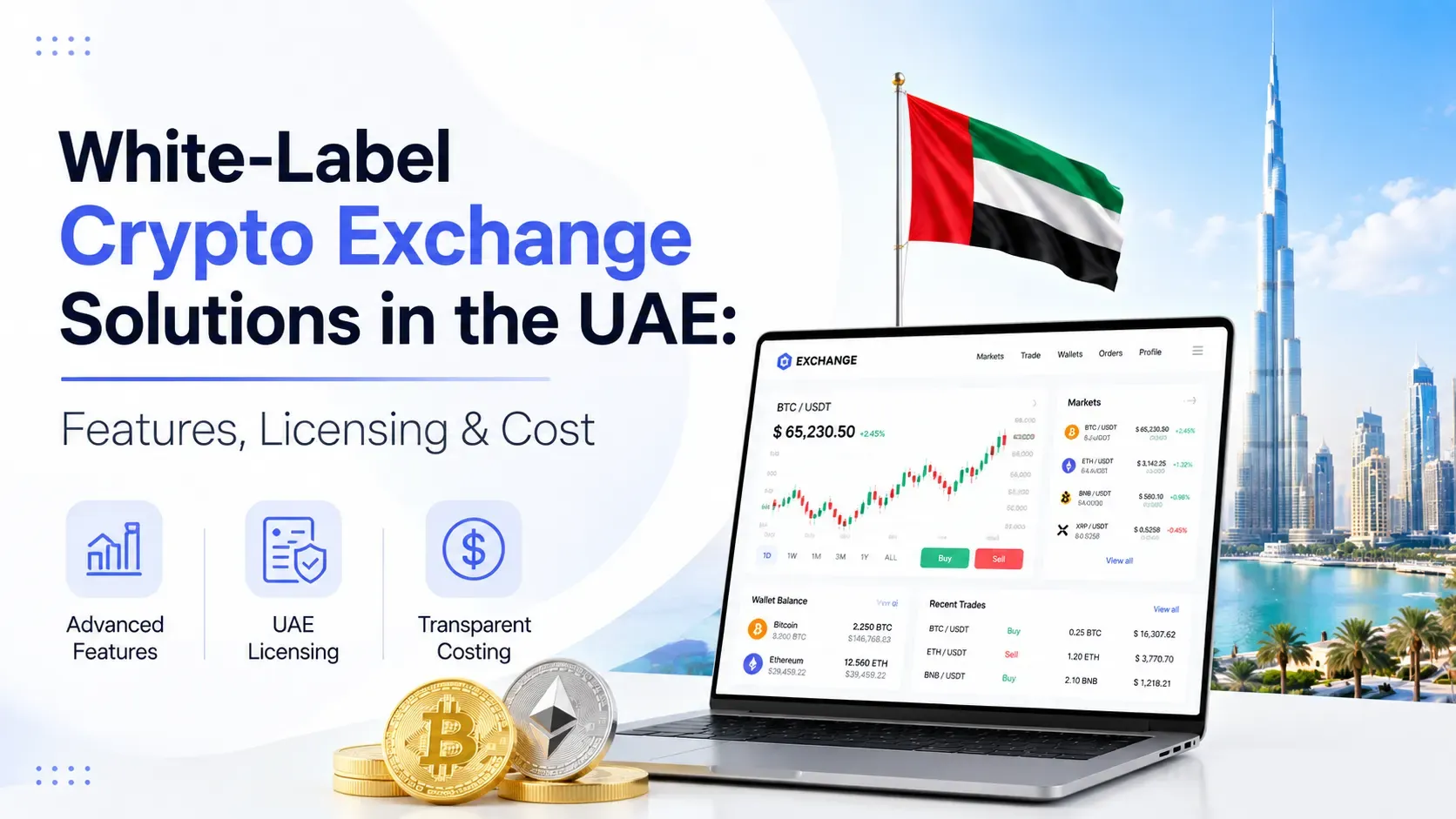
The UAE has turned into one of the best places for virtual asset companies, thanks to its favourable legislation, supportive attitude towards blockchain technologies, and institutional investors' interest in digital assets. Dubai is now the world's largest licensed virtual assets market, with regulated virtual asset transaction volumes reaching nearly AED 2.5 trillion in 2025 under VARA's supervision. Institutional participation also pushed regulated digital asset assets under management beyond AED 9.6 billion. Now, thanks to well-developed licensing procedures in Dubai and Abu Dhabi, business people feel more comfortable launching cryptocurrency exchanges.
But creating a cryptocurrency exchange is a rather costly and complicated procedure that may require additional time. That is why more and more businesses are opting for white-label crypto exchange platform development in the UAE. In this way, they get a pre-prepared exchange solution, which can be launched quickly and cost-effectively.
This article will tell you everything you need to know about launching your crypto exchange platform in the UAE in 2026 – development costs, licensing procedures, compliance obligations, important features of a good cryptocurrency exchange platform, and other key points.
One of the most favourable regulatory environments for virtual assets businesses has been set up by the UAE due to its innovative regulatory framework and fast-growing fintech industry. While there are many countries that do not yet have a clear regulatory regime for cryptocurrencies, the UAE stands out because of its clarity in regulations.
One of the major reasons why firms opt for the UAE is that it has a specialized regulation system for virtual assets. The VARA in Dubai takes care of all VASPs, whereas the FSRA in ADGM deals with the activities related to digital assets in a clear legal context.
The regulatory system gives clarity about licensing and other compliance procedures that need to be fulfilled by the companies before entering the market.
Maturity in the framework is evident from the market itself. By July 2026, VARA's public registry has already listed over 50 Virtual Asset Service Providers (VASPs) that have either received licenses or are approved in principle. This indicates increasing levels of trust in the regulated environment for virtual assets in Dubai. In addition, VARA has listed eight types of regulated virtual asset activities, providing companies with clear guidance on the licenses needed for various services.
Strategic benefits that the UAE provides to cryptocurrency exchange business go beyond regulation. The table below shows how the listed factors may affect the success of the crypto exchange business.
| Advantage | Business Impact |
| Regulatory clarity | Simplifies licensing and builds investor confidence |
| Global connectivity | Enables access to international traders and investors |
| Strong financial ecosystem | Improves opportunities for banking and strategic partnerships |
| Growing blockchain talent | Supports hiring skilled developers and compliance professionals |
| High investor interest | Creates better fundraising and expansion opportunities |
Business models in the UAE digital asset ecosystem vary, making it easier for companies entering the market to leverage their strengths and growth plans.
As the UAE builds up as a major digital asset center, businesses that offer regulatory-compliant technologies will be more successful in seizing these opportunities.
For many companies, finding a market might not be the issue, but rather creating the technology. The creation of a crypto exchange from scratch is something that will cost a lot of money and time, and require some high-level tech skills. A white-label exchange provides you with a ready-made solution.
A white-label crypto exchange is a set of ready-made solutions that contains all the necessary components for running an exchange platform for cryptocurrencies. Companies do not have to start from scratch in order to build a cryptocurrency exchange but rather can tailor the platform to meet their needs through customization.
Founders can concentrate on other issues, such as growth, regulatory compliance, and marketing, with a proven technological base.
Comparing white label and custom solutions is more efficient when one knows the differences between the two approaches.
| Component | White-Label Solution | Traditional Build |
| Backend | Ready-made infrastructure | Built from scratch |
| Launch time | Weeks to a few months | Several months to over a year |
| Initial cost | Lower | Higher |
| Customisation | Moderate to high | Virtually unlimited |
| Maintenance | Vendor-supported | Managed in-house |
Even though a white label platform comes ready-made, it depends upon certain layers of systems for secure and efficient trading.
All these layers together form the basis of a crypto exchange platform.
Our blockchain experts can help you choose the right approach.
For businesses looking to enter the UAE cryptocurrency market, there are two main paths that they can take. These include using a white-label exchange platform or creating an exchange platform entirely from scratch. While both strategies can lead to success, they vary greatly in terms of costs involved, time required, and the level of control over the project.
White labelling is ideal for firms that need to roll out their offering as quickly as possible without spending lots of time developing the technology. The basic technologies have been built, and the firms just need to focus on branding, compliance, and getting customers.
White labeling is ideal in the following cases:
White-label platforms are perfect for many firms, but some organizations need complete control over every component of their trading platform. Custom development allows the highest level of flexibility and ownership. It's the preferred option for businesses with specific operational or technical demands:
Both development approaches can support successful crypto exchange businesses, but they address different business priorities. The following comparison highlights the key differences to help founders evaluate which model best fits their budget, timeline, and long-term vision.
| Factor | White-Label Exchange | Custom Exchange |
| Development Timeline | Faster launch using pre-built infrastructure | Longer development from the ground up |
| Initial Investment | Lower upfront cost | Higher development investment |
| Technical Ownership | Core platform maintained by the provider | Complete ownership of the entire platform |
| Customisation | Moderate to high | Virtually unlimited |
| Scalability | Depends on the provider's architecture | Fully controlled and expandable |
| Maintenance | Vendor-supported updates and maintenance | Managed by the internal development team |
| Best Suited For | Startups, fintech companies, and businesses seeking rapid market entry | Enterprises, institutional exchanges, and businesses requiring unique functionality |
The total cost of creating a crypto exchange platform in the UAE goes beyond just the software development cost. The level of complexity of the platform, security, regulations, and additional features play a role in influencing the total cost of creation. It is important to be aware of the factors that affect the cost for budget planning purposes.
White label platforms are relatively cheaper when compared to building an exchange from scratch due to the presence of ready-made architecture. The actual cost will depend on how much customization is needed.
| Platform Type | Estimated Cost (USD) | Best For |
| Basic White-Label Exchange | AED 73,000–183,500 | Startups and MVP launches |
| Professional Trading Platform | AED 183,500–440,500 | Growing fintech companies |
| Enterprise-Grade Regulated Exchange | AED 440,500–1,101,000+ | Financial institutions and large-scale businesses |
These figures usually include costs for software development and customization. Costs related to licensing, legal matters, compliance, and operations should be budgeted separately.
Not all exchanges will have the same budget for their development because every project has different technical and business requirements. The following elements influence the final cost:
Development is just one component of the investment process. Most companies do not take into consideration the continuous cost involved in running a compliant and competitive crypto exchange.
A few of the costs associated with running a crypto exchange include the following:
These costs should be taken into consideration when planning the development of a cryptocurrency exchange platform.
Establishing an exchange in the UAE is not only about incorporating the company. Businesses engaged in virtual asset services require obtaining the necessary regulatory approval prior to offering any of the above-mentioned services. The licensing process will depend on the location of incorporation and the services you wish to offer.
For companies working in Dubai, the Virtual Assets Regulatory Authority (VARA) is responsible for Virtual Asset Service Providers (VASPs). The authority has created a separate regulatory regime to determine licensing conditions, operational procedures, and compliance for crypto firms.
Depending on your business model, your firm may require approval for the following activities:
The licensing procedure involves an assessment of the business plan, risk and compliance, governance, cybersecurity measures, and evidence that the business can maintain regulatory compliance.
For companies looking for institutional customers, Abu Dhabi Global Market (ADGM) can be taken into consideration. Digital asset operations in ADGM are governed by the Financial Services Regulatory Authority (FSRA), which has created one of the most developed frameworks in the region for virtual assets.
Some of the main benefits that can be derived from an ADGM license are:
The most appropriate licensing path will depend on your business model and growth strategy.
A number of entrepreneurs start their firms in free zones like DMCC due to the favourable business climate and exposure to a developing blockchain environment.
It is critical to know the distinction between company incorporation and regulatory authorization.
| Business Setup | Purpose |
| Free zone or mainland company registration | Establishes your legal business entity in the UAE |
| Crypto exchange licence | Authorizes you to provide regulated virtual asset services |
Registering your own business will not be enough to allow you to run your cryptocurrency exchange. You also need to get the proper approval from the relevant authorities in order to provide your virtual asset services to clients.
The best way to do that is by choosing the right country where you will register your business.
Let's simplify the licensing journey.
License acquisition is just the beginning. For crypto exchange operators to operate effectively and create trust, their businesses require compliance measures that ensure the security of their users, prevent any criminal activity, and comply with the existing regulations. All controls serve one purpose – to create a safe environment for trading.
Anti-Money Laundering (AML) and Know Your Customer (KYC) protocols are an essential component of any licensed crypto exchange. These procedures allow the identification of customers, assessing the risks, and spotting any suspicious behaviour that might endanger the service.
Compliance will be ensured by having the following procedures on board:
Effective AML and KYC protocols not only contribute to compliance but also increase trust and decrease the chances of financial crimes.
Travel Rule of the FATF necessitates VASPs to provide certain information related to the originator and recipient of the crypto transactions that fall into this category.
For compliance with this requirement, exchanges need to put in place a system that:
With increasing international crypto transactions, Travel Rule compliance has emerged as an important aspect of running a regulated exchange.
Protecting customers' assets is one of the most critical duties any cryptocurrency exchange should take into account. Security custody helps avoid risks of theft, any kind of unauthorized access, and potential malfunctions.
Security strategies are:
Cyber attacks against crypto exchange platforms occur very often, making the security process ongoing instead of once-off. A proper cybersecurity architecture would ensure security on b`oth the platform and user ends.
Security measures should be:
By ensuring compliance and security from the very beginning of the development process, companies can limit their risks, fulfill the regulatory requirements, and develop a reliable platform.
The white-label platform serves as the starting point for establishing an exchange, but whether it will succeed or not hinges on what kind of features it will have. For one, the platform must provide a seamless experience for trading while giving the admin the means to manage everything.
The following features form the core of a modern crypto trading platform and help improve usability, engagement, and trading efficiency.
| Feature | Purpose |
| User dashboard | Displays portfolio, balances, and account activity |
| Spot trading | Enables users to buy and sell cryptocurrencies |
| Market charts | Provides real-time price data and technical analysis |
| Instant buy/sell | Simplifies crypto purchases for beginners |
| Mobile app | Allows users to trade anytime and from anywhere |
Trained traders usually look beyond just buying and selling. These advanced capabilities help improve trading precision, implement automated trading strategies, and execute a large number of trades.
Such capabilities are:
The backbone of each successful trading platform is an efficient admin panel that streamlines the process and assists in complying with the regulations.
Some of the essential elements of the admin panel are:
An effective white label trading platform provides its users with not only a convenient interface but also high-end administration and regulatory compliance services.
Get a customized cost breakdown for your crypto exchange.
Once the decision to invest in a white-label crypto exchange is taken, the focus is no longer limited to developing software; it is about developing a business that is not only compliant but also scalable and secure. This means that merely getting yourself the ready-to-go platform is not all that matters in the success of your exchange.
This is how the journey of development goes with a competent crypto exchange development firm.
Successful transactions always begin with the development of an effective business strategy. At the early stages of development, attention is paid to the vision, target audience, business model, and regulations of your company.
In this regard, your development partner helps you to choose:
These questions should be settled in advance to eliminate expensive changes in the future.
In contrast to custom development, the white-label exchange already possesses the main infrastructure. Next comes customization to align with your company's brand image and customer expectations.
These may include:
It is all about creating something new yet saving time on its development.
A crypto exchange relies on several third-party services to operate efficiently. During this stage, developers connect the platform with the infrastructure required for trading, compliance, and asset management.
Common integrations include:
| Integration | Why It's Required |
| Liquidity providers | Maintain competitive pricing and deeper order books |
| Crypto wallets | Enable secure deposits and withdrawals |
| KYC verification | Verify customer identities during onboarding |
| AML monitoring | Detect suspicious transactions and support compliance |
| Payment gateways | Process fiat deposits and withdrawals |
| Market data feeds | Deliver live prices and trading information |
These integrations transform a basic platform into a fully operational crypto exchange.
Platform configuration occurs before launch to ensure all necessary regulatory and security standards are met.
Such tasks as:
These can be accomplished before the platform is launched to minimize risks.
Once the development is completed, the entire exchange will be thoroughly tested to confirm that all features work according to their specifications. The testing process includes validation of trading, wallet, liquidity, and compliance systems prior to the launch of the platform for users.
The post-launch phase is dedicated to platform optimization through regular updates, security monitoring, scalability of infrastructure, and implementation of additional features.
While a white-label exchange might include infrastructure, it is the technology that powers it that determines how efficient the platform is going to be and whether it will be able to cope with further business requirements. Selecting an appropriate technology stack allows achieving all of this.
It is the backend that drives all the fundamental activities at a crypto exchange, such as conducting trades, managing accounts, and handling thousands of transactions at once. Most of the contemporary exchanges make use of architecture that scales up with the increase in trading volume.
Some of the most popular backend platforms include:
| Technology | Why It's Used |
| Node.js | Handles high volumes of real-time trading requests with low latency |
| Java | Delivers stability and performance for enterprise-grade exchanges |
| Python | Commonly used for analytics, automation, and AI-powered features |
| Microservices Architecture | Allows individual components to scale and update independently |
The cryptocurrency exchange should be able to safely store digital assets and facilitate cross-chain transactions between various blockchain networks. In this case, the wallet system should be efficient and secure.
Major elements of the system will include:
A blockchain-based infrastructure will also make it easier to introduce new cryptocurrencies as needed.
Artificial Intelligence (AI) is slowly becoming a critical component in modern crypto exchanges through improved security, efficiency, and user experience. AI does not seek to replace any existing system but complements it through automation and real-time decision-making.
Some of the most crucial AI-powered features include:
| AI Feature | Business Benefit |
| Fraud detection | Identifies suspicious trading patterns and unusual account activity |
| Predictive risk scoring | Assesses user and transaction risks in real time |
| Compliance monitoring | Automates AML checks and flags potential violations |
| AI customer support | Provides faster responses through intelligent chatbots and virtual assistants |
| Market analytics | Delivers trading insights by analyzing historical and real-time market data |
With continued development of AI technology, they are being used to enhance security, ease of compliance, and personalization of the trading experience – factors that make them useful additions to the new age of crypto trading.
Opening a cryptocurrency exchange is merely the first move. It takes various sources of revenue to create a profit-making venture, and the more diversified these sources are, the less dependent the business becomes on trading alone. Although trading revenue is the main one, it is not uncommon for exchanges to have other services as well.
Transaction fees represent the main revenue generator for many crypto exchanges. For each trade made by a user, the exchange earns a certain percentage of the transaction size.
The following are popular pricing schemes:
Maker fees that provide liquidity are lower than the fees that withdraw liquidity from the order book, thus creating a balanced marketplace.
Example: A trader purchasing cryptocurrency worth AED 36,725 would pay approximately AED 73.45 in trading fees if the exchange charges a 0.2% taker fee.
Discounted fees apply to users who trade at high monthly volumes. For example, while a retail user may pay a 0.2% transaction fee per trade, an institutional client trading over AED 37 million per month may qualify for a reduced fee of 0.05%.
This is where certain exchanges set fixed fees per selected trading pairs and services.
Example: An exchange charges a fixed fee of AED 7.35 for each instant crypto transaction.
The more trading transactions there are, the better for earning transaction fees.
Renting exchange trading capacity can leave you subject to market fluctuations. By offering other related services, you can earn more consistent revenue while delivering a better overall user experience.
The following table presents the list of opportunities to earn money from your crypto exchange business:
| Revenue Stream | Revenue Opportunity |
| Trading fees | Percentage earned on every executed trade |
| Listing fees | One-time payment for listing digital assets |
| Premium subscriptions | Recurring monthly or annual subscription revenue |
| Staking services | Share of staking rewards |
| Institutional APIs | Paid enterprise API access |
| OTC trading | Service fees on large private transactions |
| Deposit & withdrawal fees | Processing charges for fiat and crypto transfers |
While the UAE provides an excellent environment for virtual asset companies to thrive, getting a license and putting up a virtual platform is not enough to start a profitable crypto exchange. The reason for project failure lies in the lack of strategic decisions taken before the development process begins. Making sure that your crypto business will be successful means not repeating these mistakes.
Regulatory compliance must be a consideration right from the beginning of the process, rather than a consideration only prior to launch. The wrong choice of licensing approach, or a failure to consider regulatory considerations, may result in delays in securing approvals and higher compliance costs.
Prior to development, companies need to determine:
Lower development costs sound tempting, yet without conducting a thorough analysis of security and scalability features of a low-cost platform, there might be a lot of potential threats involved.
When choosing among white label trading platforms, make sure to consider the following criteria:
A secure and well-supported platform is worth all efforts and expenses.
Even the most well-featured exchange would be hard-pressed if traders could not trade effectively. Lack of liquidity leads to bigger spreads, price slippages, and overall bad experience for traders, which makes customer acquisition impossible.
Businesses need to set a strong liquidity strategy prior to the exchange's launch by:
While many business owners budget for platform development, they tend to forget about the cost of maintaining a regulated exchange. Such costs are incurred even after the platform has gone live, and they must be considered in the business plan.
The regular costs may be:
The UAE is still gaining ground in becoming an international center for digital currencies, thus presenting new chances for operators in crypto exchanges. In light of maturing regulations and widespread adoption of blockchain technology, it will be necessary for exchanges to transform into more than just trading platforms.
There is an increasing interest in the tokenization of real-world assets (RWA), as firms consider the use of blockchain technology for ownership of assets like real estate, private equity, commodities, and bonds. With the rise of regulated tokenized assets, exchanges listing them will be able to attract a wider array of investors.
Digital asset investments have increasingly been seen from banks, investment companies, and family offices, creating demand for more professional platforms that allow trading digital assets. Such a trend pushes exchanges to improve custody services, reporting, and advanced security.
AI is revolutionizing compliance through automation of processes which usually involve heavy manual work. Some of the areas in which AI is being employed in today's exchanges include:
Centralized exchange platforms have started incorporating DeFi solutions to offer more options to investors. The introduction of features like staking, decentralized liquidity, and cross-chain transfers has increased the scope of the exchanges from just trading purposes.
With evolving compliance regulations, the use of digital identity technology is gaining importance during user onboarding. The use of advanced methods for identity verification, reusable digital credentials, and secure authentication could help make the KYC process easier.
Stablecoins are now considered a crucial part of the global digital asset environment, providing fast settlement, cross-border payments, and reduced transaction costs. With the increasing demand, exchanges that will be able to provide their customers with stablecoins and fiat-backed digital assets that comply with the regulations will have an advantage over others.
The future crypto exchanges will include such important components as safety and readiness for innovations. Companies that will be ready to implement these features into their work will definitely have an advantage in the UAE digital asset economy. Entrepreneurs find themselves in a dilemma when it comes to selecting between tokenized deposits and stablecoins; however, the decision ought to be made based on what business model and type of users are being served, as well as any regulations. Taking all these considerations into account will allow the business to select the most suitable digital asset option for itself.
Let's discuss your requirements.
Creating a successful cryptocurrency exchange platform needs more than installing software. It requires having a tech partner who is knowledgeable in blockchain technology, cybersecurity measures, and regulations. At Suffescom, we work with our clients to build a secure, scalable white-label cryptocurrency exchange platform that is compliant with UAE regulations.
In choosing a crypto exchange platform development company to partner with, it is equally critical to assess their technical abilities as well as the platform itself. Below is a checklist that will help identify the knowledge that the business should consider.
Experience in working with blockchain technologies, exchange infrastructure, wallets, smart contracts, and multi-chain systems to create robust and scalable trading platforms.
Incorporation of enterprise-level security features such as encryption, multi-factor authentication, role-based access control, secure wallet design, pen testing, and continuous security monitoring.
Understanding of regulatory compliance frameworks along with the ability to incorporate vital compliance attributes like KYC, AML, transaction monitoring, audit trails, and Travel Rule compliance in the platform.
Experience providing cryptocurrency exchanges, digital assets, and blockchain-based finance services with emphasis on performance, scalability, and great user experience.
One reason why the UAE is regarded as an ideal market for establishing regulated crypto exchanges is its advanced regulations related to virtual assets and the growing interest in blockchain innovations within the country's financial ecosystem. Thereby, entrepreneurs and fintech companies get a chance to take advantage of these favourable conditions.
White label crypto exchange development allows one to leverage the advantages of already established infrastructure, which will make the process of entering the market easier. Nevertheless, there is more to launching a successful crypto exchange than just using reliable technologies. Choosing an adequate licensing option, ensuring compliance, securing infrastructure, and planning for further scaling should be considered as well.
As an experienced fintech app development company in the UAE, we understand the evolving digital asset landscape, regulatory requirements, and the technical challenges of building secure, scalable financial platforms. Whether you're launching a crypto exchange, digital wallet, or tokenized asset platform, our team can help you bring your vision to life. Get your project off to the right start with a free, no-obligation consultation from our experts.
A white-label crypto exchange platform refers to an already developed platform for trading cryptocurrencies, where business owners can put their own branding and unique features. This will help the entrepreneur set up their crypto exchange in less time and money than if they had built the platform from scratch.
On average, developing a white-label crypto exchange costs around AED 73,000- AED 1,101,000+, depending on customization level, security functions, compliance, and other factors.
The development of a white-label cryptocurrency exchange will usually take anywhere from 6 to 16 weeks, depending on the amount of customizations needed, integration work, security testing, and any licensing requirements.
Businesses providing regulated virtual asset services within the UAE need to get the right kind of approval from the regulatory authority before setting up their cryptocurrency exchanges.
It normally consists of choosing the right activities for Virtual Asset Service Providers (VASPs), supplying business and compliance documents, satisfying governance and security criteria, and getting clearance from the regulator.
White label platforms are ideal for start-ups since they save on development time and upfront investment costs and offer a proven exchange platform that can be modified as the business expands.
User registration, spot trading, wallet management, market data, KYC and AML, administration features, two-factor authentication, and LP integration are essential components of any contemporary crypto exchange. Additional functions that some advanced exchanges might offer include margin trading, API integration, and institutional trading features.
Cryptocurrency exchanges are obligated to adhere to certain licensing requirements, anti-money laundering and know-your-customer rules, transaction monitoring requirements, cybersecurity rules, and other regulatory obligations according to UAE regulations.
White-label platforms work perfectly well for businesses seeking to set up fast without spending too much money on development. However, when it comes to the need for full ownership or very specialized requirements, custom development is more appropriate.
Security of a white-label exchange is dependent on the quality of infrastructure it runs on. Reliable solutions usually have security measures such as encryption, multi-factor authentication, cold wallet facility, role-based authorization, among others.
Indeed. Nowadays, many white-label platforms accommodate various cryptocurrencies and blockchain protocols, which means that companies can add various digital assets and increase their portfolio over time.
Crypto exchanges typically leverage technologies like Node.js, Java, and Python with microservice architecture, cloud architecture, blockchain networks, safe wallet systems, and APIs for liquidity, payment, and compliance purposes.
Revenue streams for most exchanges come from trading fees, listing fees, premium subscriptions, staking service fees, OTC trading, institutional API fees, and withdrawal fees for fiat or cryptocurrency withdrawals.
The systems are crucial in verifying customers' identity, monitoring transactions, minimizing financial crime risk, and ensuring compliance with regulatory requirements.
The cost will depend on certain elements like virtual asset service types, licensing, fees, compliance costs, and business costs. As there could be some changes in the fee structure, it is important to consider the most up-to-date guidelines provided by VARA or seek professional advice on the matter.
Yes, white-label crypto exchanges may include such features as the provision of banking services, payment gateways, and fiat on-/off-ramp options for users to deposit/withdraw/trade with fiat currencies that are supported by the exchange.
Ensure that the company has blockchain experience, knows how to build crypto exchange platforms, has a good security record, understands UAE laws, and can integrate wallets, liquidity providers, payment methods, and KYC/AML services.
Institutional embracement, tokenization of real-world assets, AI-assisted regulation, expansion of stablecoins, digital identification systems, and enhanced blockchain implementation will bring about new opportunities for crypto exchanges in the UAE.

Senior Content Strategist
Jonathan Raabe is a content marketing professional, focusing on mobile apps, software engineering, artificial intelligence, SaaS, cloud computing, and digital transformation. Jonathan works with visionary brands to translate complicated concepts into content that can be easily understood by their audiences. As an expert in his field, Jonathan strives to create content that is thought-provoking and backed by facts, while at the same time building brand authority and trust.



Related Blogs