Forex Trading App Development with Crypto Wallet: Features, Cost & Benefits
Key takeaways: The UAE is a serious market for fintech and digital-asset products. DIFC alone hosted 1,677 A [...]
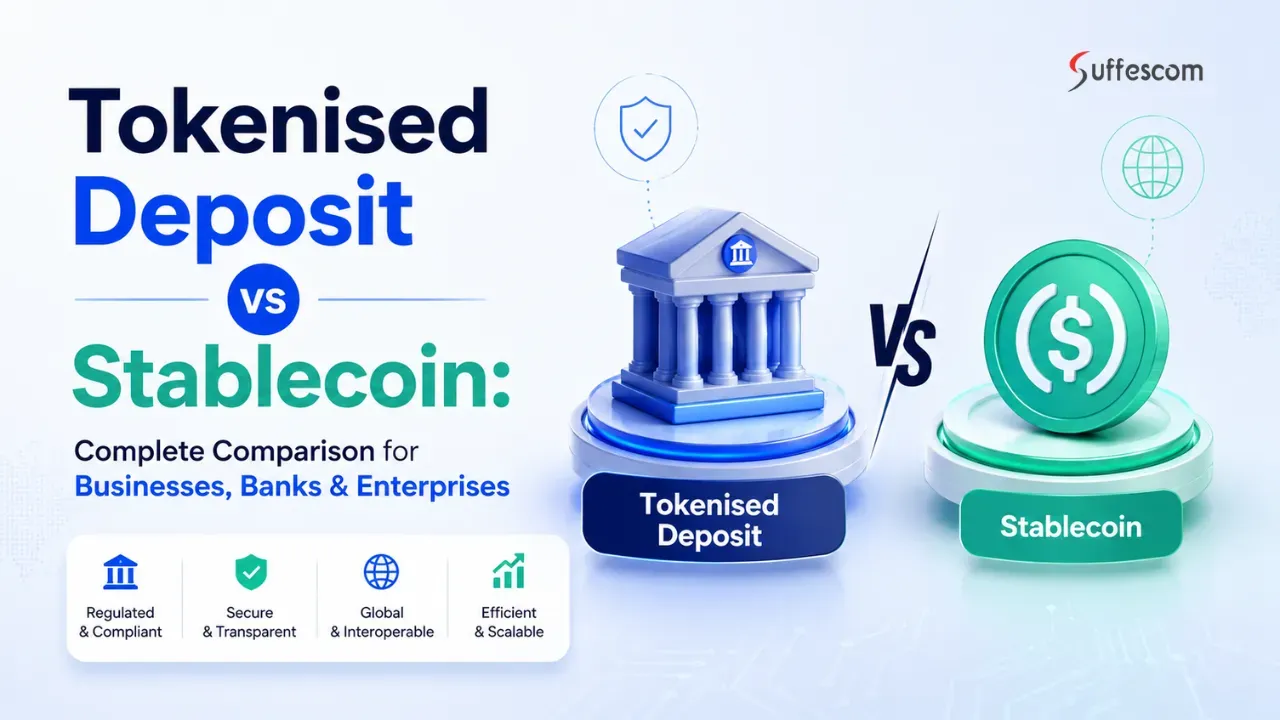
The world of finance is quickly adopting digital currencies through the use of tokenized deposits and stablecoins as two main models for making use of blockchain technology in payments and settlements. Though these two provide fast and programmable transactions, they differ in terms of issuance, regulation, risk, and application in enterprise businesses.
The UAE is a leader of change within the global economy, supported by the development of blockchain regulation laws, digital assets and initiatives, as well as innovation centres like ADGM, DIFC and VARA. Modernising payment infrastructures in order to decide on tokenized deposits or stablecoins is now an important strategic choice.
Regardless of whether you are looking for tokenization deposit platform development, the integration of blockchain technology into banking infrastructure, or the development of enterprise-level payment solutions, understanding each model will be beneficial.
This guide covers the comparison of tokenized deposits and stablecoins in terms of architecture, application use cases, compliance, advantages, and more.
A tokenized deposit is a digital representation of fiat currency held in a regulated commercial bank, issued on a blockchain or distributed ledger system. Each token corresponds directly to a unit of money deposited in a bank account and remains fully backed on a 1:1 basis by the issuing institution.
Unlike cryptocurrencies or privately issued stablecoins, tokenized deposits do not introduce new forms of money. Instead, they convert existing commercial bank deposits into a programmable, blockchain-based format that can be transferred and settled in real time.
Tokenized deposits operate by combining traditional commercial banking systems with distributed ledger technology (DLT) to enable real-time, programmable settlement of fiat-backed money. The core idea is that bank deposits are represented digitally on a blockchain while remaining fully backed and recorded within regulated banking infrastructure.
Deposit and Account Linking
This starts with the depositing of fiat money by an individual or business entity in a commercial bank account that is regulated. This is done through the core banking system of the bank and through the verified identity of the individual.
Token Creation on Blockchain (Minting)
Once the deposit is confirmed, the bank issues an equivalent amount of digital tokens on a permissioned blockchain network. These tokens represent the deposited funds and are created only under strict bank authorisation.
Each token is:
Transfer and Real-Time Settlement
After issuance, tokenized deposits can be transferred between participants directly on the blockchain. Unlike traditional banking systems that rely on intermediaries and batch settlement cycles, these transfers settle almost instantly.
The blockchain acts as a shared settlement layer where:
Redemption (Burning)
As the user seeks to exchange tokenized deposits for fiat money, the tokens are destroyed in the process, which means they are “burnt” on the blockchain. Then the equivalent amount of fiat money becomes available in the user’s conventional banking system account.
This ensures:
Tokenized deposits are issued in a strictly controlled and regulatory-compliant manner that ensures all the digital tokens issued by the bank are fully backed by fiat deposits and in compliance with banking and financial regulations. The tokenization of deposits process is not decentralised; it is strictly controlled by the financial institutions which are licensed to perform such an operation within the given regulatory frameworks.
Prior to the issuance of the tokens, the bank performs a complete KYC (Know Your Customer) and AML (Anti-Money Laundering) check on the customer or enterprise. This guarantees that only those customers who have been verified and approved can become part of the tokenization of deposits process.
Once onboarding is complete, the customer deposits fiat currency into their bank account. This deposit is recorded in the bank’s core banking system and becomes part of the institution’s regulated liabilities. At this stage, the funds exist in the traditional banking system and are fully governed by standard banking laws.
After the deposit is confirmed, the bank issues an equivalent amount of digital tokens on a permissioned blockchain network. This process is known as "minting". Each token represents a direct claim on the underlying bank deposit and cannot be created without a corresponding fiat inflow.
The minting process is controlled by the bank’s authorised systems, ensuring:
Once tokens are minted, they are linked back to the bank’s internal core ledger. This creates a dual-record structure where both systems reflect the same financial position. The blockchain shows token ownership and movement, while the bank ledger maintains regulatory accounting records.
This synchronisation ensures:
Banks implement strict governance frameworks around token issuance. Every transaction is subject to internal controls, supervisory oversight, and regulatory reporting requirements. Smart contract rules may also be embedded to enforce compliance logic automatically at the protocol level.
This ensures that tokenised deposits remain fully aligned with:
For every token issued, banks maintain a 1:1 reserve of fiat deposits. These reserves are continuously monitored and reconciled to ensure there is no mismatch between circulating tokens and underlying funds. This reserve discipline is what differentiates tokenised deposits from unregulated digital assets and ensures institutional trust.
Tokenisation of commercial bank money brings to the forefront a regulated form of money that is both digital-native in nature and retains the security of the deposits. The following attributes of the tokenised deposits are institutional-grade attributes.
All tokenised deposits are 100% backed by an equivalent value of fiat currencies held in regulated commercial banks. In doing so, tokenised deposits are non-speculative in nature.
While privately issued digital assets do not come under the jurisdiction of financial regulators, tokenised deposits are fully compliant with the existing financial regulations. In other words, they fall under the purview of financial regulators and auditing based on banking norms.
Transactions done using tokenised deposits are instantaneously settled on distributed ledger systems. Such transactions have the ability to avoid delays seen in payment systems through batch processing, correspondent banks, and SWIFT-led systems.
Tokenised bank money can be embedded with smart contract logic, enabling automated financial workflows. Conditional payments, escrow services, trade settlements through automated processes and treasury execution using rules are all included in this.
All transactions are stored on a common ledger system, providing a complex audit trail. This streamlines the process of reconciliation and makes reporting less complex while improving the transparency of financial processes for regulators.
As tokenisation takes place within the system of regulated banks and uses deposits as the underlying asset, risks from counterparty default are considerably lower than for private digital tokens and unregulated stablecoins.
Tokenisation of deposits is built in parallel with the existing core banking system, thus enabling banks and other institutions to use blockchain capabilities without affecting their financial system.
Access to the tokenisation platform of banking institutions is permissioned. Only authorised participants are able to make transactions, providing efficient identity management and a secure operations environment.
Tokenized bank deposits give companies a state-of-the-art financial settlement system which allows faster and more efficient handling of money transactions while ensuring complete regulatory compliance. The integration of enterprise blockchain solutions is especially useful for the treasury, payments and liquidity management functions of corporations, fintechs and banks.
Enterprises benefit from near-instant settlement of transactions, removing the delays associated with traditional banking systems such as batch clearing, correspondent banking networks, and end-of-day reconciliation. This enables real-time movement of funds across subsidiaries, partners, and financial institutions.
Visibility of account balances and cash flow gives an enterprise additional capabilities for managing liquidity. With greater visibility of cash flows, treasuries will be able to manage cash more efficiently, allocating funds in a more optimal way.
Tokenized bank deposits allow for minimising the dependency on multiple intermediaries involved in the transaction process. This is due to the direct settlement of funds in a shared ledger.
Enterprises can automate financial workflows using programmable logic embedded within tokenized deposits. The processes involved include automatic supplier payments, milestone-based payouts, trade finance transactions, and conditional payouts, thereby minimising manual involvement and operational delays.
Since tokenized deposits are conducted in a regulatory environment for banks, enterprises get to enjoy the benefits of having compliance built right into the system. This includes enforcement of AML/KYC compliance, transaction recording suitable for auditing, and financial statement requirement alignment in various jurisdictions.
By reducing intermediaries, manual reconciliation, and payment inefficiencies, enterprises can lower operational costs. This includes savings in transaction processing, reconciliation, and cross-border settlement expenses.
Tokenised deposits can be integrated into the existing enterprise resource planning systems and payment gateway systems. This helps in facilitating better automation of finances within enterprises.
Every transaction is recorded on a shared ledger, giving enterprises real-time traceability of fund movements. This improves internal controls, audit readiness, and financial governance across business units.
While tokenized deposits offer significant advantages for enterprise payments and digital banking, they are still an emerging innovation. Their adoption depends on regulatory developments, banking participation, and the maturity of blockchain infrastructure. Understanding these limitations helps businesses determine whether tokenized deposits are the right fit for their financial operations.
Tokenized deposits are currently offered by only a small number of financial institutions through pilot programmes and controlled commercial deployments. Since each bank develops its own infrastructure and participation models, businesses may have limited access depending on their banking partners and geographic location.
Tokenization of deposits in many cases implies the use of permissioned blockchains created for a certain banking environment. In this respect, it becomes rather difficult to transfer tokenised deposits from one bank to another or from one blockchain network to another in the absence of standardised solutions.
While public blockchain tokens can be moved independently from traditional financial systems, tokenised deposits require an issuing bank to issue and manage them. It means that these tokens are limited by the technical platform and policies of the issuer.
Despite the active work of regulatory bodies on tokenised financial infrastructure, some requirements continue to develop. The standards of issuance, settlement, reporting, and cross-border transactions may vary from jurisdiction to jurisdiction; thus, companies need to stay aware of regulatory updates.
As far as regulatory, confidentiality, and security reasons imply the development of tokenised deposits on permissioned or private blockchain networks, it limits the interaction with public blockchain ecosystems and DeFi applications.
Implementing the use of tokens in deposits requires more than just the use of blockchain technology. The banks and organisations need to develop core banking systems, digital identity management, smart contract systems, payment systems, security systems, and compliance systems. Such technical and procedural needs may elongate the process of implementation and increase the costs of implementation, especially for big corporations.
Though there is increased interest in the use of tokenised deposits by financial institutions, such payments have not been adopted universally. The traditional payment systems, stablecoins, and CBDC ecosystems are still coexisting; thus, the organisation has to cater to multiple kinds of digital currencies.
A stablecoin is a digital asset that operates on a blockchain network whose value is pegged to a reference asset. The reference asset is usually fiat money, such as the US Dollar or the Euro. Each unit of a stablecoin is expected to have an assured exchange value, hence functioning as a medium of exchange and storage of value.
As compared to tokenized deposits, which are commercial bank liabilities and therefore regulated, stablecoins are issued by private institutions or blockchain networks, and their value is stabilised either using reserve assets, collateral, or algorithms.
Stablecoins do not all maintain their value using the same methods. Although they have the commonality of reducing price volatility, the means by which this is done differ. It affects the visibility, regulation, risk, and adoption possibility of the stablecoin in an enterprise.
There are four main types of stablecoins, which are fiat-backed stablecoins, crypto-backed stablecoins, commodity-backed stablecoins, and algorithmic stablecoins.
Fiat-Backed Stablecoins
Fiat-backed stablecoins are the most popular type of stablecoin in terms of commercial application. They keep their value thanks to being backed by fiat currency held in banks or any other financial institution. For each stablecoin issued, there is an equivalent in fiat money or cash equivalents.
The presence of the reserve makes it possible for the users to exchange the stablecoin for the underlying fiat money and keeps its stable price on the market. Due to being relatively simple and broadly accepted, fiat-backed stablecoins are often used for payment processing and cryptocurrency trading purposes.
Crypto-Backed Stablecoins
Unlike fiat currency-based stablecoins, crypto-backed stablecoins are secured not with fiat currency but rather with cryptocurrency. Due to the natural volatility of the cryptocurrency, it is important to have overcollateralisation of these stablecoins.
To illustrate, the user will need to collateralise digital assets that cost $150 in order to create stablecoins with the value of $100. In case the collateral value drops to a certain pre-set level, the liquidation of the collateral may occur automatically with the help of smart contracts.
Commodity-Backed Stablecoins
Commodity-secured stablecoins are tied to some real-world asset like gold, silver, or any other valuable commodity. Each token represents the ownership or rights over a certain amount of the underlying asset, providing an opportunity to gain access to tangible assets through blockchain technology.
These stablecoins provide a combination of liquidity and tradability of the digital assets along with the stability of the real-world asset.
Algorithmic Stablecoins
Algorithmic stablecoins seek to stabilise the price of the token in question without using any conventional form of reserve asset. In this approach, smart contracts and automated money systems can either increase or reduce the supply of the token according to market infrastructure demands.
In case of rising market demand for the tokens, additional units could be released to mitigate the upward pressure on the price of the token. On the other hand, where there is reduced market demand for the tokens, the protocol seeks to pull the tokens out of circulation.
Despite being very capital-efficient and fully automated, the algorithmic method has been found to be the most experimental and risky type of stablecoin since some well-known algorithmic stablecoins have fallen off the price peg due to insufficient collateral in certain cases of market volatility.
It is clear that the major reason for establishing stablecoins is to stabilise the price of the coin irrespective of the movement of the entire cryptocurrency market. While traditional cryptocurrencies derive their value from the market alone, stablecoins are backed by specific strategies which help maintain their value similar to the value of the underlying asset.
The success of a stablecoin relies heavily on the stability mechanism employed, the management of reserves, and trust from the market. Although there are various kinds of stablecoins employing distinct strategies, they all try to reduce fluctuations in price.
For fiat-backed stablecoins, price stability is primarily maintained through a 1:1 reserve model. Every token issued is backed by an equivalent amount of fiat currency or highly liquid reserve assets held by the issuer. In case the market price differs from the actual one, it is possible for the users to exchange their tokens for the real asset, thus providing for an automatic arbitrage mechanism and the restoration of the peg.
For instance, if there is a stablecoin traded at $0.98 which can be redeemed at $1.00, it is rational for people to purchase tokens and redeem them, thus raising the market price to its intended level.
Crypto-backed stablecoins operate under the principle of having more collateral in the form of cryptocurrency than the tokens issued. As a result, it is necessary to have overcollateralisation to be able to account for possible volatility in the markets.
The smart contract system constantly monitors the worth of the collateral. In case it is less than a certain point, the collateral is sold off in parts so that all stablecoins can be covered by it.
Algorithmic stablecoins do not hold reserves but rather utilise algorithmic methods to control the supply of tokens. In case the price exceeds the target because of increased demand, new tokens are supplied on the market.
While this approach is highly automated, its effectiveness depends heavily on market confidence and has historically been less reliable during periods of financial stress.
Apart from technical solutions, the maintenance of a stable valuation is associated with the trust of users in the issuer and reserves. Constant attestation of reserves, independent audit and reporting, as well as the presence of clear policies on redemptions, will allow maintaining a high level of confidence among users in terms of proper backing of the stablecoin and its ability to maintain the necessary value.
The problem of transparency is especially critical for enterprises and banks because it affects their risk management and compliance.
Regulation is also becoming an increasingly relevant factor in ensuring the stability of stablecoins. Currently, many countries obligate the issuers to keep quality reserves, develop effective governance, and provide financial reporting. These factors increase the confidence of the market participants and decrease the risks of de-pegging and liquidity problems.
Attracting enterprises to stablecoins with proper regulation and reserve management is likely to become possible in the future.
There has been an increase in the issuance of various stablecoins within the last decade that offer digital assets meant for payments, trading, remittances, and enterprise finance. Although all stablecoins aim at holding their value steady, they differ in how they manage reserves, regulation, blockchains and specific applications, among others.
Some of the best-known stablecoins include the following:
Tether is the biggest stablecoin in terms of market capitalisation and is often utilised in crypto exchanges as well as in transactions. Tether is a stablecoin because there is one US dollar in every unit of Tether.
Due to high liquidity and wide blockchain support, Tether is one of the most commonly used stablecoins for trading digital assets and foreign transactions, although concerns about reserve transparency and regulations make it one of the most regulated stablecoins.
USD Coin is a fully backed US Dollar stablecoin issued under stringent regulations and transparency considerations. It is widely used by financial institutions, fintech and enterprise payment platforms due to regular reserve attestation and increasing institutional adoption.
Because of its focus on compliance and operational transparency, USDC has become a preferred option for enterprise stablecoin payments, treasury management, and blockchain-based financial applications.
PYUSD is a US dollar-backed stablecoin introduced to support digital commerce within PayPal's payment ecosystem. It is designed to facilitate blockchain-based payments while leveraging PayPal's existing financial infrastructure and customer base.
Although still expanding its adoption, PYUSD reflects the growing interest of traditional financial companies in integrating stablecoins into mainstream payment services.
EURC is a euro-based stablecoin that has been made available specifically for corporations and people who operate in the European financial system. It offers an electronic form of the euro to facilitate quicker settlements and cross-border transactions, as well as financial activities using blockchain technology without the need for currency exchange every time.
The use of EURC by businesses gives them a choice other than dollar-based stablecoins for making payments in euro-related businesses.
RLUSD is a regulated US dollar-based stablecoin created to help corporations make payments as well as to enable blockchain technology applications by institutions.
Its launch reflects the increasing convergence of traditional financial institutions and blockchain technology in enterprise payment ecosystems.
It all depends on the business goals of the entity and the kind of payment systems being used. Some stablecoins might be focused on liquidity and worldwide availability, while others may place more emphasis on regulation or integration.
Some important aspects to consider for enterprises when assessing enterprise stablecoins are:
These factors become particularly important for banks, fintech companies, and enterprises seeking stablecoins for large-value settlements, treasury operations, or cross-border payment solutions.
Stablecoins are becoming popular for business transactions as an improved payment method in contrast to conventional payment methods. Through using the power of blockchain technology along with stability in value, stablecoins provide enterprises an efficient way to carry out their transactions.
For companies doing business in several markets, stablecoin platform development acts as a payment layer to speed up the settlement process.
The traditional approach for making payments in the international space usually involves the use of intermediary banks, currency exchange, and a delayed settlement process, which could take a number of days. Stablecoins offer the chance for transferring value instantly on the blockchain platform, thus making it possible to settle payments instantaneously between business entities and other parties.
The quickness of transactions facilitated by the use of stablecoins is highly beneficial for firms operating globally and engaging in numerous cross-border payments.
Through the continuous process of fund transfers, enterprises get improved options for working capital and cash management. There is no need to keep funds in reserve pending banking times and settlement times.
Transaction cost savings become possible through minimising intermediation and usage of correspondent banking networks through the use of stablecoins.
Stablecoins work well with smart contracts, allowing businesses to automate financial operations depending on certain predetermined criteria. Payments could be automatically made upon completion of certain milestones of the contract, delivery verification, or invoice approval.
Using stablecoins allows businesses to make international digital payments at any time of the day, without being limited by the local bank's operating hours or local payment systems.
For enterprises participating in tokenized assets, blockchain-based marketplaces, or digital finance platforms, stablecoins provide an efficient settlement medium. They enable businesses to move funds seamlessly between digital asset platforms, payment applications, and blockchain networks while maintaining predictable value.
There are several possibilities for incorporating stablecoins into digital wallets, payment gateways, treasuries, and other financial tools via APIs and blockchain technology. Such flexibility may help companies create new approaches to payments, improve user experience and develop new digital business models.
While upgrading their finances, companies find stablecoins to be an essential part of digital payment infrastructures. With proper governance, compliance, and risk management in place, they can work alongside banking infrastructures and help companies create faster and more automated financial ecosystems.
Still, despite all the benefits that stablecoins provide, there are several risks for companies that must be assessed before integrating such tools. Knowledge of those is vital to make the right choice regarding blockchain payment infrastructure.
Although stablecoins have become increasingly popular, there are also certain risks involved in their use. The usage of stablecoins is dependent on different factors like reserve management, regulation, governance, and market confidence. It implies that while using stablecoin payment systems, businesses should take into consideration the above-mentioned risks.
Though many contemporary stablecoins have become better in terms of operations, enterprises need to conduct due diligence on all issuers of stablecoins.
Regulations of stablecoins are developing very fast around the world. Governments and financial regulators have introduced various regulations regarding the issuance, reserve requirements, consumer protection, and licensing. With the development of these regulations, it might be necessary for enterprises to adjust their payment systems.
For multinational companies, changing regulations might affect the way of issuing, holding, or transferring stablecoins.
The sustainability of fiat-backed stablecoins depends on the ability of the issuer to hold enough reserves to sustain each token that is out in the market. Failure of reserve management to be transparent and liquid could result in problems for the user in times of distress, when trying to redeem their coins.
These factors make it necessary to consider the financial capability, credibility, and management style of the issuing authority while choosing a stablecoin to use within an enterprise environment.
Stablecoins aim to remain at a fixed value but sometimes fail to do so due to extraordinary market conditions. Lack of liquidity, rapid requests for redemptions, speculation in the market, or failure of stabilisation methods could see the market price move away from its set value.
This risk poses potential danger for businesses involved in large transaction volumes or treasury management.
Stablecoins exist on blockchain networks and sometimes depend on smart contracts for their management. Similar to any technology, there might be risks related to errors in the coding, potential cyberattacks, or even unauthorised access due to a lack of proper development and audits of the technology.
It is important for businesses to estimate the level of security that will be provided by both the stablecoin issuer and the blockchain network itself.
In contrast to the tokenization of deposits, where the liability of the deposits remains with regulated commercial banks, most of the stablecoins are issued by privately owned organisations. This implies that companies have to rely on the issuer of the stablecoin to handle its reserves, redemptions, continuity of business, and regulations.
The financial soundness, structure of governance, and transparency of the issuer of the stablecoin will determine its sustainability.
The performance of stablecoins depends on the blockchain network itself. Any issues with the network, such as congestion, fee hikes, validator downtime or even upgrades of the blockchain, may affect the performance of transactions.
In line with the growth of digital money in today’s world of finance, more and more organisations are finding themselves comparing tokenized deposits vs stablecoins in terms of which solution suits their needs better in terms of technology, regulation and operations. While both types of money allow payments and programmable transfers through blockchain, there is a fundamental difference between the financial and legal nature of each of these products.
While 'tokenized deposit' refers to a digital form of tokenized commercial bank money issued by a financial institution authorised to do so, a stablecoin is most likely a product of a private company maintaining stability in value via a reserve mechanism or collateral.
This difference has consequences ranging from regulatory issues and finality of settlements to risk management. It is crucial for banks, fintech organisations and enterprises operating in the UAE to understand the distinction.
| Feature | Tokenized Deposit | Stablecoin |
| Issuer | Licensed commercial bank | Private company or blockchain protocol |
| Regulatory Framework | Governed by banking laws and financial regulators | Governed by crypto or digital asset regulations, depending on jurisdiction |
| Underlying Value | Commercial bank deposits | Fiat reserves, crypto collateral, commodities, or algorithms |
| Reserve Model | 1:1 bank deposits | Varies depending on the issuer and stablecoin type |
| Risk Profile | Generally lower due to banking oversight | Varies based on reserves, governance, and regulation |
| Transparency | High, supported by banking supervision and audits | Depends on issuer disclosures and reserve reporting |
| Redemption | Direct redemption through the issuing bank | Subject to issuer policies and eligibility requirements |
| Settlement Speed | Real-time or near real-time | Near-instant on supported blockchain networks |
| Smart Contract Compatibility | Yes | Yes |
| Compliance | Built into regulated banking infrastructure | Varies by issuer and jurisdiction |
| Institutional Adoption | High and growing among banks and enterprises | Growing across enterprises, fintechs, and digital asset markets |
| Consumer Adoption | Limited to approved banking ecosystems | Widely adopted across crypto and payment ecosystems |
| Cross-Border Payments | Highly effective within participating banking networks | Highly effective across global blockchain networks |
While both tokenized deposits and stablecoins use blockchain technology to facilitate digital transactions, their underlying architectures are designed for different purposes. The following comparison highlights the key technical differences:
| Architecture Component | Tokenized Deposits | Stablecoins |
| Blockchain Type | Primarily permissioned/private blockchain | Primarily a public blockchain |
| Issuer | Licensed commercial bank | Private company or blockchain protocol |
| Source of Value | Customer deposits held by the issuing bank | Fiat reserves, crypto collateral, commodities, or algorithmic mechanisms |
| Ledger Integration | Connected to the bank's core banking system | Managed through the issuer's reserve and token management systems |
| Smart Contracts | Automate issuance, transfers, redemption, and compliance | Manage token issuance, transfers, redemption, and supply mechanisms |
| Identity Management | Restricted to verified users with KYC/AML | Depends on issuer policies; public blockchain access is generally open |
| Governance | Controlled by regulated financial institutions | Controlled by the issuer or a decentralised governance model |
| Compliance Layer | Built directly into banking infrastructure | Added through issuer controls and regulatory requirements |
| Primary Focus | Regulated institutional payments and settlements | Digital payments, trading, remittances, and DeFi applications |
Although both models leverage distributed ledger technology (DLT), the blockchain infrastructure supporting them differs significantly.
Though tokenized deposits and stablecoins allow value transfer through blockchain, the differences between them come down to issuance, trust, and risk factors. This is what matters for UAE banks, fintechs, and businesses.
Tokenized deposits represent tokenized commercial bank money, meaning they are direct liabilities of regulated banks and sit within the traditional financial system.
Stablecoins, in contrast, are privately issued digital instruments where value depends on external reserves or collateral mechanisms rather than on being part of a bank’s balance sheet.
Tokenized deposits’ explained function within the existing regulatory framework, which includes aspects such as capital adequacy, auditing, and supervisory requirements, has been developed for jurisdictions such as the UAE (ADGM and DIFC regulations).
Stablecoins function within the developing regulatory framework of digital assets, which varies according to the jurisdictions and continues to evolve in terms of licensing requirements, reserve requirements, and redemption rights.
Tokenized deposits provide legal settlement finality via banking rails, ensuring that transactions are both technically settled and legally settled within the banking rails.
Stablecoins offer network finality for settlements, but legal finality depends upon the jurisdiction, the structure of the issuer, and the contractual arrangements made.
Tokenized deposits involve the trust model of banks, which are under the supervision of central banks, the deposit framework, and audited balance sheets.
Stablecoins use the trust model of issuance, where there can be transparency with regard to reserves and attestations, but not necessarily any supervisory structure as per banks' standards.
Tokenized deposits are based on the trust of banks, which are then supervised by the central banks and have deposit frameworks and audited balance sheets.
Stablecoins use issuer credibility and transparency with regard to reserves, often with the help of attestations or audits, but not necessarily banking-grade supervision.
Tokenized deposits exist within permissioned closed banking networks that are restricted to institutions and entities that are regulated. Stablecoins are found within an open blockchain ecosystem that facilitates interoperability with other wallets, exchanges, and DApps across the world.
Tokenized deposits integrate directly into existing core banking systems, acting as an extension of traditional money infrastructure.
Stablecoins typically require new operational layers, including wallets, custody solutions, and blockchain payment rails alongside banking systems.
With companies speeding up their digital transformations, tokenized deposits and stablecoins are advancing from mere experiments to practical finance infrastructures. Below are use cases where each technology adds the most value, and a combination of both can yield better results.
Many times, cross-border payments take a lot of time, go through different parties, and incur expensive transaction fees. Using tokenized deposits will allow banks and regulated companies to process cross-border payments within the participating financial institutions and stay compliant with banking regulations. On the other hand, stablecoins will allow businesses to move value on global blockchain networks instantly and 24/7.
Treasury departments of companies are becoming more and more interested in using blockchain technologies as an infrastructure for their financial processes to make them more efficient and automate operations. In this case, tokenized deposits are more applicable in treasury processes which have to be integrated with commercial bank systems, like intercompany transfers and cash concentration.
Requires fast, open, and reliable payments among buyers, suppliers, manufacturers, and logistics providers. Tokenized deposits facilitate regulated and programmable payments that could be released automatically upon the fulfilment of predefined contractual agreements. Stablecoins help expedite payments to overseas suppliers, especially in areas where banking systems are not as efficient.
Is multilateral and requires a lot of paperwork as well as time. Through the integration of smart contracts and tokenized deposits, companies can automate the process of making payments once they are satisfied with the shipment documents or confirmation of delivery. Enterprises engaged in global trade can use either model depending on their regulatory obligations and payment ecosystem.
Managing payroll for international employees and contractors can be expensive and time-consuming using conventional payment systems. Stablecoins allow businesses to distribute salaries globally with faster settlement and lower cross-border transfer costs. For regulated organisations operating within banking ecosystems, tokenized deposits provide a compliant alternative for domestic and institutional payroll processing. Automated payroll execution through smart contracts further reduces administrative overhead and improves payment accuracy.
Blockchain technology is being used in capital markets to enhance the process of settling equity, bond and tokenized security transactions. The use of tokenized deposits can ensure delivery versus payment since both assets and money can be exchanged simultaneously. Stablecoins may also be used within digital securities platforms, but regulated financial institutions often prefer tokenized deposits due to their stronger alignment with existing banking infrastructure and financial regulations.
With the increase in popularity of tokenized assets, companies need an efficient way to settle such transactions. For this purpose, stablecoins have been used extensively to settle transactions on cryptocurrencies, tokenized assets, and decentralised applications owing to their high level of liquidity and compatibility. Tokenized deposits, on the other hand, offer a regulatory layer for settling digital asset transactions in compliance with financial governance rules.
Enables properties to be divided into digital ownership units, making investment more accessible while improving transaction efficiency. Stablecoins are commonly used as the payment medium on tokenized real estate platforms due to their compatibility with public blockchain ecosystems. Tokenized deposits complement these platforms by enabling regulated settlement for high-value property transactions between investors, developers, and financial institutions.
The cost of developing a tokenization deposit platform depends greatly on factors such as the extent, asset class, security structure, and integration with financial systems already in existence. In markets that have regulations like the UAE market, the cost of compliance usually constitutes a large part of the overall cost involved.
| Complexity Level | Ideal For | Timeline | Cost Range (AED) |
| MVP Tokenized Deposit System | Proof-of-concept/sandbox banking | 2–4 months | 30,000 – 120,000 |
| Enterprise Banking Integration | Fintechs / regulated pilots | 4–7 months | 120,000 – 250,000 |
| Banking-Grade Tokenization Platform | Banks (ADGM / DIFC ecosystem) | 8–12 months | 250,000 – 350,000 |
| Institutional Multi-Bank System | Large-scale financial networks | 12+ months | 200,000 – 350,000+ |
Tokenized deposit platforms are driven mainly by banking integration depth, regulatory compliance, and institutional security requirements. Since they extend regulated financial systems into blockchain networks, every component must align with strict banking standards and audit expectations.
Support for KYC, AML, transaction monitoring, and audit reporting is necessary on the day of the platform launch. If we are talking about UAE regulatory structures, such as ADGM or DIFC, then some additional legal layers will also need to be incorporated in the design process. This makes regulatory alignment one of the most expensive components.
These platforms must connect directly with core banking systems to function correctly. All tokens that are created within the blockchain must reflect a corresponding transaction on the bank’s ledger system instantly. Secure APIs, reconciliation processes, and data synchronisation in a way that is highly resilient to failures are necessary for this to happen. The deeper the banking connection, the higher the cost.
Tokenized deposits mostly operate through private or permissioned blockchain networks. Permissioned blockchains have access control measures in place, and they involve validation and governance procedures. Unlike public blockchains, the implementation of permissioned blockchains includes defining network permissions for an institution. This controlled environment increases both the build and maintenance costs.
Smart contracts handle issuance, redemption, and transfer of tokenized deposits. These contracts must follow strict regulatory logic and financial rules. Each contract requires detailed testing and formal audits before deployment. Even small errors can create financial or compliance risks. This makes development slower and more expensive.
Security is critical because these systems represent regulated tokenized commercial bank money. Platforms must include encryption, identity verification, and multi-layer authentication. Additional controls like multi-signature approvals and real-time monitoring are standard. Systems must also defend against cyber and insider risks. Higher security standards significantly increase cost.
Large deployments often require integration between multiple banks or institutions. Every contract undergoes thorough testing and audits before implementation. Even a minor mistake may pose certain risks from the standpoint of money and compliance. It becomes costly and time-consuming to implement new developments.
Every transaction must be fully traceable for regulators and internal audits. This requires real-time reporting dashboards and structured financial data flows. Systems must support compliance reporting across jurisdictions. Maintaining synchronised blockchain and banking records adds complexity. These requirements significantly expand backend development.
Tokenized deposit platforms must handle high-value, high-frequency financial transactions. Performance requirements include low latency, high uptime, and zero settlement errors. Infrastructure must be designed for banking-grade reliability. Load balancing and disaster recovery are essential. Scaling financial systems increases infrastructure investment.
| Complexity Level | Ideal For | Timeline | Cost Range (AED) |
| MVP Stablecoin Wallet / App | Startups / basic transfers | 1–3 months | 40,000 – 100,000 |
| Enterprise Payment Gateway | Fintechs / PSP integrations | 3–6 months | 100,000 – 220,000 |
| Scalable Stablecoin Payment System | Global businesses / APIs | 6–10 months | 220,000 – 400,000 |
| Institutional Payment Network | Exchanges/fintech ecosystems | 10+ months | 300,000 – 400,000+ |
The factors determining the stable coin platforms include blockchain selection, wallet infrastructure, liquidity and ecosystem integration. Stablecoin platforms differ from traditional banking in that they work using public blockchains and prioritise accessibility and flexibility in payments.
Stablecoin platforms frequently operate on several networks such as Ethereum or Solana, where each network presents a trade-off in terms of costs and performance characteristics. Supporting multiple blockchain networks increases development efforts. Cross-chain interoperability is required in many cases. This leads to increased engineering expenses.
A wallet system is an integral part of the process of managing stablecoins. It has to provide encryption and key management capabilities. Enterprise custody solutions add compliance and security layers. These systems must also ensure a smooth user experience. Custody design is a major cost component.
Stablecoin platforms rely on exchanges and liquidity providers for smooth value flow. APIs must be built for real-time trading and settlement. Liquidity management ensures stable value and transaction efficiency. Multiple integration points increase system complexity. The broader the ecosystem, the higher the cost.
Smart contracts govern minting, burning, transfers, and supply control. Some systems also include collateral or algorithmic stability logic. These contracts require careful design and rigorous audits. Any vulnerability can impact financial stability. The complexity of token logic directly increases cost.
Stablecoin systems operate on public networks with variable transaction fees. Developers must optimise gas usage and contract efficiency. Network congestion can affect the speed and cost of transfers. Ongoing optimisation is required for scalability. This adds continuous engineering effort.
Regulations vary across jurisdictions and continue to evolve. Platforms must support AML, travel rule compliance, and licensing requirements. Unlike banking systems, rules are less standardised globally. Systems must remain flexible to regulatory changes. This increases the long-term maintenance cost.
Open blockchain environments increase exposure to cyber threats. Platforms must include audits, penetration testing, and continuous monitoring. Smart contract vulnerabilities are a key risk area. Incident response systems are also required. Security investment is significantly higher for public networks.
Stablecoin platforms integrate with wallets, merchants, and payment gateways. APIs must support high-volume, global transactions. Compatibility across systems is essential. Real-time processing increases technical complexity. Integration scope directly impacts cost.
Such systems run 24/7 in worldwide marketplaces. The system has to cope with unknown transaction peaks. The distribution of the system guarantees its uptime and availability. Failover and redundancy systems should be in place. Global scalability substantially raises the costs of infrastructure.
It will depend on compliance with regulations, objectives of operations, and degree of integration with the banked financial sector. Both provide means for electronic currency transfers:
When regulatory certainty and banking integration are essential. They are ideal for banks, regulated fintechs, and enterprises operating within supervised financial systems. If direct integration with core banking infrastructure is required, this model is a natural fit. It performs best where auditability, compliance control, and settlement finality matter. Common use cases include institutional payments, treasury management, and interbank settlements. For successful implementation, partnering with an experienced company offering tokenization development services helps ensure secure, compliant, and scalable deployment.
If international connectivity, speed, and availability of blockchain are important factors but not bank integration. Suffescom builds compliant fintech app solutions, payment systems, and tech companies that work internationally. If you want to be involved in cross-border payments, digital transactions, and the cryptocurrency world, then stablecoins provide you with more versatility. This makes them suitable for fast, global payment environments.
A hybrid model works when businesses need both banking compliance and blockchain flexibility. Tokenized deposits can handle regulated internal and banking workflows, while stablecoins manage external and cross-border payments. This approach balances control with operational speed. It is increasingly relevant for large enterprises and global financial institutions. It also improves interoperability across traditional finance and blockchain systems.
The decision comes down to four factors: regulation, transaction scope, ecosystem needs, and infrastructure readiness. If compliance and banking alignment are primary, tokenized deposits are the better choice. For global reach and speed considerations, stablecoins work much better. Companies need to take into account scalability and integration approaches for the long term. There is an easy way to ensure that the right fit is made both technically and financially.
The UAE is positioning itself as one of the world's leading digital finance ecosystems through progressive regulation, blockchain adoption, and central bank initiatives. With the rollout of the Digital Dirham, expanding tokenization frameworks, and regulatory support from the Central Bank of the UAE, the country is building the foundation for a financial system where tokenized deposits, stablecoins, and regulated digital assets can coexist alongside traditional banking services.
Banks and financial institutions across the UAE are increasingly integrating blockchain into production-grade financial infrastructure rather than limiting it to pilot projects. Current initiatives focus on tokenized deposits, cross-border payment systems, and real-time settlement infrastructure to improve transaction efficiency, transparency, compliance, and international money movement. The Central Bank's Financial Infrastructure Transformation (FIT) Programme and the Digital Dirham initiative further reinforce this transition.
The tokenization of real-world assets, including real estate, investment funds, bonds, commodities, and private securities, is expected to continue growing as regulatory frameworks mature. Tokenization enables fractional ownership, greater liquidity, and faster settlement while expanding investment opportunities. Financial free zones such as ADGM and DIFC continue to develop regulatory environments that support institutional participation and digital-asset innovation.
Artificial intelligence will increasingly integrate with blockchain-based financial systems to enable intelligent automation of financial operations. AI will support fraud detection, compliance monitoring, liquidity forecasting, and smart contract optimisation. Combined with tokenized infrastructure, this will enable real-time decision-making in financial transactions. Enterprises will use AI-driven tokenization systems to optimise treasury operations and payment flows. This convergence will enhance efficiency and reduce operational risk in financial systems.
Traditional banking in the UAE is evolving into hybrid digital ecosystems that combine conventional banking services with tokenized financial infrastructure. As the Digital Dirham ecosystem develops, banks are expected to introduce more programmable payment capabilities, automate treasury operations, and integrate blockchain-based settlement into core banking platforms while maintaining regulatory compliance.
Financial infrastructure will move from being siloed banking infrastructures to connected tokenized networks, which will facilitate real-time settlements, interoperability across institutions, and programmable finance. Businesses will become increasingly dependent on tokenized infrastructure for making payments, managing trade finance, and liquidity management. This will establish a more unified and efficient digital financial ecosystem.
The UAE continues to strengthen its position as a global digital asset hub through regulatory initiatives led by the Central Bank of the UAE, ADGM, DIFC, and VARA. Combined with continued investment in financial infrastructure, blockchain innovation, and digital asset regulation, these initiatives are attracting banks, fintech companies, blockchain providers, and institutional investors. As the ecosystem matures, the UAE is well positioned to play a leading role in shaping the future of regulated digital money and tokenized finance.
The following is a list of essential elements that a company needs to consider when adopting tokenized deposit systems or stablecoins for payment infrastructures. These elements help measure readiness for adoption.
Firstly, companies need to consider the alignment of digital money adoption with the operational and financial strategy of the organisation. The potential uses include payment purposes, treasury management, or international transactions. Business models should support digital financial workflows. Clear ROI expectations should be defined before implementation.
Businesses need to identify any pertinent regulatory framework applicable in their regions, including the UAE region, which may include licensing, compliance, and reporting. They will need to identify if they will be subject to banking laws, fintech, or any other type of law related to digital assets. Legal structuring and jurisdiction are key considerations.
Any existing technology needs to be considered for compatibility with blockchain-based technology, including core banking technology, ERPs, and payment gateways. The business will need to assess whether APIs, data models, and security frameworks can support the required integration. Any gap that may exist in the current infrastructure may mean that they will need to upgrade.
Vendors play a very important part in the success of the initiative. Businesses will need to ensure that vendors have the capability in terms of blockchain, fintech, and regulated financial services. Other criteria to consider include architecture capability, security, and compliance experience. Past enterprise and banking initiatives need to be considered.
Security frameworks will need to be put in place to address aspects such as encryption, identity management, smart contract audits, and access control. Continuous monitoring and response will be required. Risk management protocols must be clearly defined. Security readiness is a core requirement for deployment approval.
A phased deployment approach is recommended for tokenized and stablecoin systems. It normally entails pilot testing, roll-out, and then full-scale deployment. Performance and compliance assessments must be part of each of these steps. The integration with the financial system is crucial to manage properly. A well-planned roadmap ensures lower operational and compliance risks.
Both tokenized deposits and stablecoins allow the creation of digital money using blockchain technologies, but each is designed for a different financial system. Tokenized deposits function under the rules of VARA regulations, providing better compliance and governance, whereas stablecoins allow for payments at a higher speed across various public blockchain networks.
It is necessary to decide based on regulatory needs, goals, and the development level of infrastructure. Banking organisations and enterprises prefer to use tokenized deposits, whereas Fintechs and global payment organisations prefer to use stablecoins. Hybrid solutions can be very effective in many situations.
Suffescom Solutions, being a leading tokenization platform development company, helps organisations create a good tokenization system that corresponds to the rules of both banking and blockchain systems.
A tokenized deposit represents regulated commercial bank money issued on a blockchain and backed 1:1 by bank deposits. A stablecoin is a privately issued digital asset backed by fiat reserves, crypto collateral, or algorithms. Tokenized deposits are bank-regulated, while stablecoins depend on issuer models and reserve mechanisms.
Generally, yes. Tokenized deposits are formed through banks that are regulated and financially regulated, thus mitigating counterparty risk. A stablecoin is dependent on the clarity of its issuer, its reserves, and the regulation involved.
Yes. Tokenized deposits can operate within regulated frameworks such as ADGM, DIFC, and VARA, subject to applicable licensing and compliance requirements. As a form of commercial bank digital money, they support the UAE's growing digital finance ecosystem while meeting regulatory standards.
Yes. UAE enterprises can use stablecoins for cross-border payments, provided they comply with applicable regulatory requirements. As digital asset regulations continue to evolve, businesses should ensure their payment infrastructure aligns with the latest compliance framework.
Banks issue digital tokens representing fiat deposits held in regulated accounts, creating commercial bank digital money on a permissioned blockchain. Each deposit is tokenized on a 1:1 basis, enabling programmable money, faster settlement, and secure redemption through the issuing bank.
Tokenization platform development enables real-time transaction processing, smart contract automation, and improved financial transparency. It also supports asset digitisation and helps enterprises modernise their payment infrastructure while maintaining regulatory compliance.
The cost of tokenization platform development typically ranges from AED 30,000 to AED 350,000 for tokenized deposit platforms and AED 40,000 to AED 400,000 for stablecoin platforms. The final investment depends on factors such as platform complexity, regulatory compliance, blockchain integration, security requirements, and custom features. Choose Suffescom for your asset tokenization platform development and get a quote within 24 hours.
MVP development takes approximately 2-4 months, whereas enterprise-level solutions are developed within 4-7 months. Banking-grade tokenization platforms can be developed within 8-12+ months.
Permissioned blockchains are recommended for tokenized deposit platforms due to regulation capabilities. Public blockchains, such as Ethereum or Solana, are usually used for stablecoin platforms.
Yes. Advanced platforms can support fiat deposits, real estate, commodities, securities, and other tokenized assets depending on system architecture and compliance scope.
Key features of tokenization platform development are encryption, identification, auditing of smart contracts, multi-signature authentication, role-based access control, and continuous monitoring.
Yes. Tokenized deposits are designed to integrate seamlessly with core banking systems, enabling real-time synchronisation between traditional banking ledgers and blockchain networks. Effective tokenization platform development ensures secure data exchange, smooth financial operations, and minimal disruption to existing banking infrastructure.
The most beneficial industries are banking, fintech, asset management, real estate, supply chain finance, and capital markets due to faster settlement, automation, and increased transparency.
AML and KYC are integrated into tokenization platform development through secure onboarding, identity verification, and continuous transaction monitoring. These compliance measures ensure that only verified users can access the platform while supporting regulatory reporting, auditability, and secure enterprise transactions.
Businesses should choose a tokenization platform development company with expertise in tokenization platform development, regulatory compliance, smart contract development, and enterprise-grade security. Experience in building asset tokenization platforms, blockchain payment solutions, and digital asset infrastructure, along with seamless enterprise integration, ensures a secure, scalable, and compliant solution.
A tokenisation platform development company like Suffescom Solutions delivers end-to-end tokenisation platform development services, from platform architecture and smart contract development to digital asset platform development, banking and payment system integration, regulatory compliance, and scalable enterprise deployment.

Senior Content Strategist
Jonathan Raabe is a content marketing professional, focusing on mobile apps, software engineering, artificial intelligence, SaaS, cloud computing, and digital transformation. Jonathan works with visionary brands to translate complicated concepts into content that can be easily understood by their audiences. As an expert in his field, Jonathan strives to create content that is thought-provoking and backed by facts, while at the same time building brand authority and trust.



Related Blogs
Hear directly from clients who partnered with Suffescom to turn their digital ideas into secure, scalable, and high-performing products.

“Suffescom delivered a HIPAA-compliant telemedicine app exceeding expectations, with strong data security and thoughtful development strategies from start to finish.”

“Suffescom helped us build a smart property management and virtual tour platform. Their expertise in AI helped us attract more qualified leads.”

“Suffescom delivered a modern hotel booking app perfectly aligned with customer expectations, which helped us boost sales by 40%.”

“We needed real-time fleet tracking and route optimization. Suffescom developed a platform that reduced our operational expenses in the first quarter.”

“We needed a smart itinerary planner with AI features for tourists. Suffescom delivered beyond our expectations and helped us increase bookings.”