Forex Trading App Development with Crypto Wallet: Features, Cost & Benefits
Key takeaways: The UAE is a serious market for fintech and digital-asset products. DIFC alone hosted 1,677 A [...]
Want similar results? → Get a Free Quote
Building a neo bank in the UAE is the most profitable path that fintech startup founders can choose if they want to disrupt digital banking in the region. The UAE neobanking industry is fast-growing, and its value is around $1.5 billion. The growth can be attributed to increased cashless payments and the backing by the Central Bank. The UAE represents a perfect environment for fintech founders to launch their own neo banks.
The development of a neo bank entails more than just the creation of an application. Fintech founders should take care of licensing problems, create alliances with banks, ensure that the KYC/AML procedures are compliant, adhere to cybersecurity requirements, and construct a scalable tech stack.
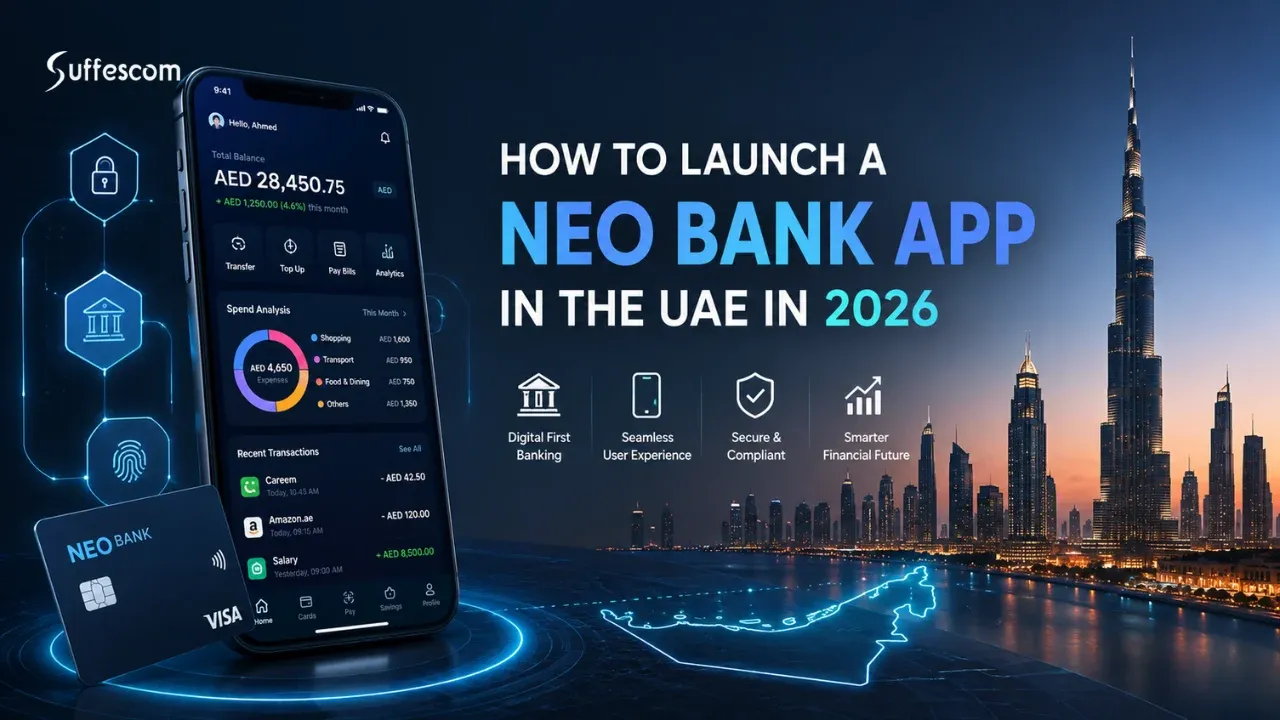
This guide will provide information on everything about starting a neo bank from scratch and launching a neo bank app in the UAE in 2026. In particular, you will find out how to choose the right business model, meet the regulatory requirements, develop a budget for your project, construct a tech stack, and implement AI into banking.
The UAE has emerged as one of the top fintech markets in the region due to digital transformation, regulation, and increased demand for mobile banking. In light of the increasing preference for convenient and personalized financial solutions, neobank app development is revolutionizing the banking sector. An understanding of their business models and the UAE's fintech landscape is important prior to embarking on digital banking.
UAE neobanking market highlights:
(Source: GrandView Research)
A neo bank can be defined as a digital-only bank that offers banking services through apps and does not have any brick-and-mortar branches. The banking system leverages cloud-based technology, API, workflow automation, and AI to offer convenient banking experiences to its clients. Based on the business model, neobanks can either run their operations using their licenses or collaborate with a licensed financial institution using BaaS.
Traditional banks depend on brick-and-mortar branches and existing infrastructure to provide financial services. Neo-banks function completely online; clients can use banking services remotely, and the transactions become much more efficient and inexpensive for both parties.
| Feature | Traditional Banks | Digital Banks (Neo Banks) |
| Banking Model | Operate through physical branches and online channels | Operate entirely through mobile and web applications |
| Account Opening | Requires branch visits or lengthy verification | Fully digital onboarding with eKYC verification |
| Customer Support | Branch staff, phone, and email support | AI chatbots, in-app support, and live chat |
| Operating Costs | Higher due to physical infrastructure | Lower operational costs with digital infrastructure |
| Financial Services | Standard banking products and services | Personalized, AI-powered, and mobile-first banking services |
| Customer Experience | Branch-dependent with limited digital convenience | Fast, seamless, and accessible 24/7 from any location |
Mobile banks have been created for smartphones, thus allowing consumers to do everything related to their accounts, such as opening bank accounts, transferring money, managing their cards, making payments, and tracking their transactions in one app on their smartphone.
AI assists neo banks in delivering personalised financial insights, automating customer support, identifying fraud, and analysing spending trends. This will enhance customer experience while improving operational efficiency and security.
The neo banks make it easier for customers to open accounts via e-Know Your Customer (eKYC). Customers can complete their identity check, document upload, and biometrics remotely.
Let's build a secure, compliant, and future-ready digital banking platform together.
This has enabled the UAE to be positioned as one of the most promising locations in the region for the fintech industry through investment in digital technologies, innovations, and financial regulations. In addition, the high consumer demand for digital finance services also presents the UAE as a promising destination for neo banks.
The UAE boasts the world's highest smartphone penetration rate. Hence, neo banks can easily reach out to their clients using mobile banking. There is less need for brick-and-mortar branches, which allows quick adoption of digital finance.
UAE has one of the best-developed digital ecosystems globally, with mobile Internet having a prominent place in daily operations. It is used almost universally, and by 2025 it is expected that the mobile Internet penetration rate will be 95%. In terms of mobile Internet speed, the UAE is only surpassed by Qatar and ranks second in the global rating.
There is fast uptake of digital payment methods, online banking, and contactless payments among consumers and organizations operating in the UAE. These developments make it easier for neo-banks to launch new products and also get digitally savvy clients.
UAE's neobanking market is estimated at $1.5 billion, driven by the increasing adoption of digital banking services, technologically literate people, and rising Fintech solutions in Dubai and Abu Dhabi.
A considerable portion of the UAE's population comprises digital-savvy businessmen who want convenient banking services through their smartphones. This need for easy access drives the growing popularity of neo-banking applications.
The UAE government is also known to encourage fintech innovations using various policies and programs aimed at facilitating digital transformations. There are various programs developed under the UAE FinTech Strategy, while the innovation ecosystems established by DIFC and ADGM allow entrepreneurs to benefit from financial and regulatory support.
The important government programs that have been fostering development in the field of fintech in the UAE include:
The developed banking system, advanced payment systems, and clear regulatory framework in the nation allow fintech firms to collaborate with established financial institutions and provide secure digital banking services.
In line with the growing numbers of start-ups and small businesses, there is a need for digital business banking services, hence presenting neo banks with an opportunity to provide specialised products such as business accounts, expense tracking, and automation of finance processes.
| Growth Factor | Impact on Neo Banks |
| High smartphone penetration | Accelerates adoption of mobile banking services. |
| Faster digital adoption | Increases demand for digital financial solutions. |
| Young population | Drives preference for app-based banking experiences. |
| Government fintech initiatives | Supports innovation and fintech ecosystem growth. |
| Strong financial infrastructure | Simplifies banking partnerships and secure transactions. |
| Expanding SME sector | Creates opportunities for digital business banking services. |
To launch your neo bank, you need to plan more than just developing an app. Each of these steps forms the basis for creating a successful digital banking product, from selecting a business model to complying with regulations and creating a reliable tech stack. This is how to begin.
The first stage in this process is defining your specific neo bank type. To do that, you need to determine your target audience, financial services you would like to provide, and the way you would monetize your business. A business model defines the product strategy and determines licensing and regulatory considerations.
For instance, if your target customer is SMEs, then your platform will have such features as business accounts, expense control, and invoicing tools. In case your target customer is an individual, you will most likely offer such services as a digital wallet, instant payments, and budgeting.
Here are some typical examples of business models for neo banks.
| Neo Bank Type | Target Customers | Revenue Sources |
| Consumer neobank | Individuals | Fees, subscriptions |
| SME neobank | Businesses | Account fees, lending |
| Islamic neobank | Sharia-compliant users | Banking products |
| Embedded banking platform | Companies | API partnerships |
Choosing the right business model from the outset ensures your platform is designed around the needs of your target customers while establishing a sustainable revenue strategy.
Once the definition of your business model has been established, the subsequent decision relates to the manner in which the neo bank would function in the UAE. The choice of your licensing model would determine the speed of establishment, your regulatory responsibilities, and control over the banking operations.
For instance, if you are a fintech startup that aims to prove the viability of its idea, you could consider partnering with an already licensed bank or using a BaaS provider. Here, the licensed institution acts as a guarantor of the regulated infrastructure of the bank, while you develop the customer interface, i.e., a mobile application for users. Conversely, if the aim of your future business operations is to work independently and provide all banking services, then getting your own banking license is more suitable.
The table below gives a comparison of the most typical licensing models.
| Licensing Option | How It Works | Best For |
| Full Banking License | Operate as a licensed digital bank under UAE regulations. | Established businesses with long-term expansion plans. |
| Banking Partnership | Collaborate with a licensed bank to provide banking services. | Startups seeking faster market entry. |
| Banking-as-a-Service (BaaS) | Use a licensed provider's banking infrastructure through APIs. | Fintechs looking for a cost-effective and scalable launch. |
After determining your licensing approach, you will need to ensure that your neo bank is in line with the UAE's financial regulations. It is necessary to have regulatory compliance for the sake of securing customers' data and preventing any financial crime.
For instance, if one uses the app to open a bank account, their identity must be authenticated before allowing the use of banking services. In addition, all transactions must be scrutinized for the purpose of complying with the anti-money laundering regulations.
Below is a table illustrating the basic requirements for compliance in starting a neo bank in the UAE.
| Requirement | Purpose | Why It Matters |
| Know Your Customer (KYC) | Verifies customer identity during onboarding. | Prevents identity fraud and fake accounts. |
| Anti-Money Laundering (AML) | Monitors transactions for suspicious activities. | Helps detect and prevent financial crimes. |
| Data Protection | Secures customer information and financial records. | Protects sensitive data and ensures privacy compliance. |
| Cybersecurity Controls | Safeguards banking systems against cyber threats. | Reduces security risks and protects customer funds. |
Once your regulatory framework is set in place, the next stage would be creating the features that make up the customer experience of your neo bank. Prioritize the basic functionalities that will allow customers to effectively and efficiently manage their finances. Advanced features can follow after.
For instance, a recently created neo bank may start with functionalities like digital onboarding, account management, and payment features. After increasing its user base, it can provide services such as AI-based financial analytics, investments, or loans.
The following table provides the list of features that any neo banking application must have.
| Feature | Purpose | Customer Benefit |
| Digital account opening | Enables customers to register and verify their identity online. | Faster and paperless onboarding. |
| Account management | Allows users to view balances, statements, and transaction history. | Complete control over finances in one place. |
| Fund transfers & bill payments | Supports instant transfers and utility payments. | Convenient everyday banking. |
| Card management | Lets users freeze, unfreeze, or manage debit cards. | Improved security and flexibility. |
| Expense tracking | Categorises spending and monitors budgets. | Better financial planning. |
| Push notifications | Sends real-time alerts for transactions and account activity. | Greater transparency and fraud awareness. |
The implementation of a trustworthy technology stack is vital for developing a secure and scalable neo bank. The selected technologies should be capable of providing real-time transactions, smooth integrations, security, and future scalability without performance degradation.
In the case of a neo bank anticipating fast customer growth, a cloud-based architecture with microservices can be implemented. Such an approach will let each service, like payments or user authentication, scale separately according to its load.
The following table presents the list of basic technologies utilized in developing a neo banking application.
| Technology Layer | Common Technologies | Purpose |
| Frontend | Flutter, React Native | Build responsive mobile applications. |
| Backend | Node.js, Java, .NET | Process banking operations and business logic. |
| Database | PostgreSQL, MongoDB | Store customer and transaction data securely. |
| Cloud Infrastructure | AWS, Microsoft Azure, Google Cloud | Ensure scalability, availability, and reliability. |
| APIs | Banking APIs, Payment APIs | Connect with banks, payment gateways, and third-party services. |
| Security | Encryption, MFA, OAuth 2.0 | Protect customer accounts and sensitive financial data. |
Once the basic platform is developed, you will need to connect banking capabilities, which will help your neo bank run efficiently. Integrations will help in making payments, verifying identities, issuing cards, and communicating with customers seamlessly.
In an instance where a user opens an account, your application can automate the whole process of verifying identity using an eKYC provider, issuing a virtual debit card through card networks, and transferring funds instantly using a payment gateway—all without any manual assistance.
Below is the list of integrations that should be available in your neo banking app.
| Integration | Purpose | Benefit |
| Payment Gateway | Process deposits, transfers, and bill payments. | Enables secure and seamless transactions. |
| eKYC & Identity Verification | Verify customer identities digitally. | Speeds up onboarding while ensuring compliance. |
| Card Issuance | Issue physical and virtual debit cards. | Allows customers to make online and offline payments. |
| Notification Services | Send real-time alerts and account updates. | Improves customer engagement and transparency. |
| Analytics & Reporting | Monitor user activity and platform performance. | Supports data-driven decision-making and service improvements. |
Prior to offering your neo-bank to customers, test it comprehensively to confirm its security, reliability, and seamlessness. After deployment, you should continually monitor the application and improve it as per the customers' feedback and market requirements.
For instance, even before launching the application, you can test its onboarding, payments, and security, among others, to detect any problems that may exist. After deployment, analysing users' feedback might prompt the inclusion of certain features such as expense categorisation, budgeting features, or multilingual capabilities.
Below is a table of the main tasks carried out during this stage.
| Stage | Purpose | Outcome |
| Functional Testing | Verify that all app features work as intended. | Smooth and error-free user experience. |
| Security Testing | Identify vulnerabilities and strengthen security. | Better protection against cyber threats. |
| Performance Testing | Evaluate app stability under different workloads. | Reliable performance during peak usage. |
| App Launch | Release the platform to the target audience. | Begin customer acquisition and onboarding. |
| Continuous Optimisation | Monitor performance and roll out updates. | Improved user satisfaction and long-term growth. |
AI is changing the face of digital banking in the UAE in a number of ways. For instance, AI allows banks to automate customer interaction, improve fraud detection, and provide personalised financial advice to customers. The need for AI banking is on the increase in the UAE, and thus intelligent financial services will be a core factor in the success of neo banks in the UAE.
AI-based virtual assistance allows the neo-bank to offer instant assistance to customers round the clock. The virtual assistant is capable of answering standard questions, guiding customers through the account processes and solving their problems without any human assistance.
Example: An AI chatbot will assist the customer to reset his debit card PIN number, check his account balance and even clarify charges related to transactions.
The AI technology constantly monitors the transaction trends in order to spot any abnormal or suspicious transactions in real time. Rather than depending only on the rules that are already predefined, machine learning algorithms are capable of adjusting according to the changing fraud patterns.
Example: If a debit card is used in another country right after a transaction in the same country, a real-time fraud alert can be triggered, and the transaction can be blocked until it is verified.
AI is able to create personalized recommendations for clients through analyzing their spending patterns, savings habits, and financial objectives. It results in providing a more customer-oriented experience with banking.
Example: A budgeting app can analyze a person's common spending categories and provide them with personalized budgets and savings plans.
A lot of the traditional analysis for credit is done using very lengthy manual analyses. However, artificial intelligence helps simplify this process by analysing various financial criteria, resulting in quick and accurate decisions on lending. For neo-banks, this translates into quicker approval of loans for their customers.
Through predictive analytics, banks can predict the requirements of their customers through trend analysis and prediction of financial behaviour. Predictive analytics enable banks to provide appropriate products, retain customers, and make informed business decisions.
For instance, where there is an observed trend of a customer saving a certain amount of money every month from transaction data, then the bank may suggest an appropriate product at the appropriate time.
With artificial intelligence applied in customer service, fraud detection, loans and financing, as well as financial planning, neo banks are able to automate banking processes in such a way that ensures security, operational efficiency, and very intelligent banking services.
The cost to develop a neobank app in the UAE is influenced by different factors, such as the complexity of the app, its security, compliance issues, technical stack, and integrations. While the minimum viable product (MVP), which is a basic banking app, will require less investment to develop, a digital banking app, which is equipped with AI functions and high security, will cost more. It is crucial to be aware of the major cost factors to make better investment decisions.
The following table outlines the cost of major development components.
| Development Component | Estimated Cost Range (AED) |
| UI/UX Design | AED 29,380 – AED 73,450 |
| Mobile App Development | AED 110,175 – AED 293,800 |
| Backend Infrastructure | AED 91,813 – AED 257,075 |
| Security Implementation | AED 55,088 – AED 146,900 |
| Testing & Maintenance | AED 36,725 – AED 110,175 |
There are a number of factors which affect the total cost associated with building a neo-banking app. These can be considered in advance to enable companies to budget effectively and reduce unforeseen costs in the process.
The most influence on costs is exerted by the scope of your application. An MVP concentrates primarily on core banking services, whereas an enterprise product involves advanced AI technologies, loan management tools, analytics, and integrations with third parties.
| App Complexity | Estimated Cost (AED) | Ideal For |
| MVP App Development | AED 146,900 – AED 293,800 | Startups validating a business idea |
| Mid-Level Platform | AED 293,800 – AED 661,100 | Growing fintech companies |
| Enterprise Neo Bank | AED 661,100 – AED 1,836,300+ | Banks and large financial institutions |
Implementing the required regulations of the UAE entails the use of electronic KYC, AML monitoring, data protection, and cybersecurity. These aspects need special development and testing that raise the overall project costs.
Neo banks require integration with services like payment gateways, Banking APIs, card issuance tools, identity verification solutions, and currency conversion API. The number and level of integration affect the time and cost of development.
To create a safe bank application, one needs to incorporate functionalities like encryption, multi-factor authentication, biometric login, a fraud detection system, and constant security testing. Since financial software development deals with confidential data of customers, it is important to invest in safety solutions.
The cost of fintech app development depends on the location of your technology partner. If you work with an experienced fintech development company that has knowledge of UAE banking laws, it will help to optimize the costs of the development process.
Get a custom cost breakdown based on your business requirements.
One of the main considerations when it comes to the development of a neo bank in the UAE is regulatory compliance. Apart from creating a robust and compliant fintech app, startups have to meet certain financial regulations for obtaining licenses, verifying customers, ensuring anti-money laundering policies, managing risks, and protecting data. Integrating your regulatory compliance into your platform is key to success.
The Central Bank of the United Arab Emirates (CBUAE) controls the operations of banks in the country and sets the regulations to be followed by digital banks. Whether it is your license or that of your banking partner, it is imperative to adhere to these regulations before engaging in regulated financial activities.
The table below highlights all the key regulations that the neo banks have to comply with.
| Regulatory Area | Requirement for Neo Banks |
| Banking Licence | Permission to provide regulated financial services. |
| Customer Verification | Digital KYC and identity verification processes. |
| AML Controls | Monitoring and reporting suspicious transactions. |
| Data Protection | Safeguarding customer and financial information. |
| Cybersecurity | Implementing controls to prevent digital banking threats. |
| Risk Management | Maintaining operational resilience and financial stability. |
Identity confirmation and AML measures are essential for any neo banking system. Such tools will assist banks in confirming the identity of the customers, identifying suspicious actions, and preventing financial fraud in compliance with UAE regulations.
For instance, upon opening an account by a customer, the system may apply electronic KYC to confirm government identification documents, conduct biometric checks, and verify customer data before enabling the account.
In addition, in order to increase the level of AML compliance, neo-banking applications must incorporate sanctions checking, ongoing transaction monitoring, and reporting about suspicious activities. Automated processes will be very helpful in such a case.
Digital-first banks or neo-banks are required to ensure protection against cybersecurity threats for sensitive customer information. Utilizing various levels of security is important in protecting customer information and banking systems.
Below is a list of some of the security controls required.
| Security Layer | Implementation |
| User Authentication | Biometrics and multi-factor authentication (MFA) |
| Data Protection | End-to-end encryption |
| Transactions | Real-time monitoring and fraud detection |
| Infrastructure | Secure cloud environment and regular security audits |
The concept of open banking provides new opportunities for neo banks to offer interconnected and personal financial services by implementing the necessary security measures to enable account aggregation, payment initiation, and embedded financial services to customers.
It is important to implement these integrations in a secure manner. Fintech firms need to get customer consent before disclosing their financial information, secure API communications using robust authentication and encryption methods, and consistently monitor third-party connections.
Adherence to open banking guidelines enables fintech firms to develop new financial products while meeting changing UAE regulations.
Security is the first priority of all neo banking platforms. Digital banks deal with confidential information of their customers, and thus they need to establish a strong security system to ensure that there is no fraud, cyber attack, or any kind of unauthorized access. The security system would help firms to stay compliant with UAE regulations.
With biometric authentication, consumers have the ability to log into their accounts through fingerprint or facial recognition technology, and not just passwords. This system makes both the process more secure and convenient for the consumer as well as decreases the chances of unauthorized use of the account.
Example: Suppose a consumer accesses the bank application through their smartphone; they can be authenticated by the facial recognition system.
All communications and transactions made through neo banking apps need to have end-to-end encryption for security purposes. This is to ensure that any personal data like bank account information, payment information, etc., is safe when being sent from one user to another.
The use of artificial intelligence makes it possible for neo banks to keep an eye on transactions and identify suspicious behaviour in real-time.
For instance, machine learning algorithms can be used to identify any abnormal spending behavior that would otherwise allow for any potential fraudulent transactions to be executed.
This would involve identifying an account where a number of international transactions occur from a new location.
Device verification makes sure that only trusted devices are able to access customer accounts. In case someone tries to log in using a new device, the application may ask for additional authentication using an OTP or biometrics.
Security is an ongoing process and not a one-off activity. Frequent assessments for vulnerabilities, penetration testing, and security auditing enable the identification of possible weak links in security systems that can be exploited by hackers. Security monitoring will keep the platform compliant with the latest standards and regulations regarding cybersecurity.
Combining biometric authentication, encryption, AI-enabled fraud detection, device identification, digital asset regulation, and security monitoring will enable business organizations to create a neo banking platform that secures customers' financial assets and ensures secure digital banking operations.
The UAE's digital banking ecosystem is continuously changing because of new technologies that are changing the way financial services are being delivered. In the coming few years, neo-banks will leverage intelligent technologies, embedded financial services, and digital-first experiences to meet the demands of their customers. Recognizing such trends would enable fintech start-ups to create platforms that would remain relevant even after 2026.
Financial services are more often getting integrated with non-bank entities to make sure that consumers don't need to switch platforms to use banking solutions. This way, companies have an opportunity to provide payment services, financing services, and digital wallets within their own ecosystem.
Example: In an eCommerce environment, consumers will be able to make immediate payments or get business financing while checking out.
Open Banking will continue to promote collaboration among banks, fintechs, and other service providers using APIs. Customers will be able to manage their several bank accounts via one application, which will give them access to personalised financial products.
The role of artificial intelligence will become an important component in digital banking as it enhances customer services, fraud prevention, financial planning, and credit evaluation. With the advancements in AI technologies, neo banks will offer highly personalised and automated bank services.
For example, AI assistants can give out tips on how you should save your money based on your transaction history or even notify you of upcoming payments.
It is anticipated that blockchain banking apps will increase the speed, transparency, and efficiency of cross-border payments. This can be done using blockchain networks through neo-banks, where transaction processing time will be decreased.
Digital identity verification will make customer onboarding easier while improving security. Biometric authentication and digital identity services will enable financial institutions to better verify customers and prevent identity fraud.
As the need for Sharia-compliant finance grows, Islamic neo banks are poised to develop more technological offerings that cater to consumers who are seeking ethical financing. This represents a tremendous chance for fintech startups that want to cater to their growing clientele in the UAE.
By adopting such trends, fintech startups will be able to create neo banks that are forward-thinking in providing financial services that evolve alongside customers' changing needs.
The amount of time needed for a neo bank to go live will depend on several variables, including how you license your service, its complexity, any required regulatory approvals, and third-party partnerships. Although each project has a unique timeline, knowledge of each step allows entrepreneurs to better prepare.
All successful neo banks begin by doing proper planning. This includes knowing who your market is, verifying the business model, conducting competitor analysis, and establishing features and how the revenue will be generated.
For instance, a company looking at the small to medium enterprises market in the UAE can use this time to do some research on the issues surrounding business banking.
How long this period takes will be determined by the licensing strategy you have selected. Startups that collaborate with a licensed bank or work with Banking as a Service companies can start more quickly than companies trying to license their own digital banking system. Documentation and compliance are important considerations here.
Once the planning and regulatory phase is done, development starts. In this phase, we work on UI/UX design, frontend and backend development, API integration, cloud infrastructure implementation, and security and compliance features implementation. Development time mainly relies upon the features that we implement and the complexity of the platform itself.
The app is tested extensively before its release to ensure that all aspects of performance, functionality, and security are satisfactory. Fixing any problems at this point contributes to a safe and stable environment for the banking clients.
This step involves the launch of the application, running compliance checks, planning the marketing campaign, onboarding the initial users, and analysing the performance of the platform once it goes live. It guarantees that the neo bank launches its product on time and has a solid plan for acquiring customers.
Despite the fact that the timing depends on the particular project, the right development roadmap and cooperation with a professional fintech development company can help you save some time.
The table below provides an estimated timeline for each stage involved in launching a neo banking app in the UAE, from business planning and regulatory approvals to development, testing, and market launch.
| Development Stage | Estimated Timeline | Key Activities |
| Market Research & Business Planning | 1–2 Months | Validate the business model, define target audience, analyze competitors, and prepare the product roadmap. |
| Licensing & Regulatory Approvals | Varies | Complete licensing requirements, regulatory documentation, and compliance approvals. |
| UI/UX Design & App Development | 3–6 Months | Design the application, develop frontend and backend, integrate APIs, and implement core banking features. |
| Testing & Quality Assurance | 3–6 Weeks | Perform functional, security, performance, and compliance testing before deployment. |
| Launch Preparation & Go-Live | 2–4 Weeks | Deploy the application, onboard users, execute marketing campaigns, and monitor post-launch performance. |
Fintech app development in the UAE requires much more knowledge than the one needed for building a mobile application. It requires knowledge of regulations concerning financial technology, secure banking solutions, scalable cloud architecture, and integration with third-party applications. Suffescom assists startups, fintech companies, and financial organizations in building secure, regulated neo-banking solutions for the UAE market.
We develop highly secure and scalable digital wallets, payment solutions, and mobile banking applications with embedded AI and AI-based banking digital products.
From consulting and UI/UX Design through Development, Integration and QA, to Deployment and Support – we ensure a complete neo banking software lifecycle process for your solution.
Encryption techniques, Biometric Security, and MFA (Multi-Factor Authentication), secured API integration with financial institutions, Intrusion Prevention Systems, Fraud Detection – data safety comes first in everything we do.
Leverage cutting-edge, scalable infrastructure and microservice architecture for ultra-high transaction throughput and a seamlessly expanding neo-banking experience.
Seamlessly integrated solutions with eKYC modules, AML checks, advanced Transaction monitoring, Data protection protocols, and secure online transaction records management.
Our engagement with you doesn't end post-mobile app deployment. We ensure smooth operation and performance through constant maintenance and optimization for the future.
Contact Suffescom to kickstart your neobanking app development.
Get a tailored development roadmap from our fintech experts.
On average, you can estimate a price range between $40k and more than $500k to develop a neobank app in the UAE, based on your specific project requirements. Do keep other factors in mind, such as licensing & certification, cloud infrastructure, security measures, integration with third-party service providers, compliance requirements, support, etc. To get an accurate app development quote, talk to our expert for free!
Yes, banks operating licensed banking operations in this sector have to be approved by the UAE Central Bank (CBUAE), whereas startups may enter the market using, or with support from, a licensed banking establishment or alternatively via a Banking-as-a-Service (BaaS) that partners with a bank rather than apply for its own banking license.
This will be dependent upon the complexity and nature of the licensing. The development process of an MVP that has key banking functionalities will take less time compared to an enterprise-level neo banking platform with AI functionalities.
Yes. Many fintech companies work with licensed banks or Banking-as-a-Service platforms that provide digital banking capabilities without actually having to be a regulated bank itself.
A modern neo banking app should include digital account opening, eKYC verification, instant payments, digital wallets, card management, expense tracking, AI-powered financial insights, transaction notifications, and robust security features such as biometric authentication and fraud detection.
Cloud computing, microservices, API, artificial intelligence, secure databases, and advanced frontend technology form the backbone of neo banking technologies. Some neobanks utilise blockchain for cross-border transfers and management of digital assets.
These neo banks earn money via subscription, transaction charges, interchange fees, lending, foreign exchange fees, premium banking and Banking-as-a-Service.
The Central Bank of the UAE expects digital banks to adhere to licensing requirements, customer identification (KYC) regulations, anti-money laundering (AML) rules, cyber security requirements, customer protection regulations, and operational risk management processes.
Yes. The UAE has a rising market for Islamic fintech services. Islamic neo banking fintech companies can build banking solutions that offer Sharia-compliant digital financial products.
These include biometric authentication, multi-factor authentication (MFA), end-to-end encryption, AI-based fraud detection, transaction monitoring, device verification, and continuous security assessments.
Yes. Foreign businesses can open an office in the UAE and create a neo-banking platform either by fulfilling regulatory compliance or by collaborating with licensed entities and Banking-as-a-Service firms.
The future of neo-banking in the UAE will revolve around AI banking, embedded finance, open banking, digital identity solutions, payments through blockchain, and the growing need for personalised banking services.
Financial technology apps are designed to provide particular financial services like payments and investments, while a neo bank provides a complete banking solution, comprising accounts, payments, cards, loans, and other banking services, provided that regulations allow them.
Digital marketing, referral programs, partnership strategies, personalised financial services, loyalty programs, and a smooth mobile banking experience that meets customer requirements can help startups acquire users.
Companies should select a fintech development company that specialises in digital banking, regulatory compliance, secure cloud infrastructure, API integrations, AI-enabled banking solutions, and scalable application development for the UAE market.

Senior Content Strategist
Jonathan Raabe is a content marketing professional, focusing on mobile apps, software engineering, artificial intelligence, SaaS, cloud computing, and digital transformation. Jonathan works with visionary brands to translate complicated concepts into content that can be easily understood by their audiences. As an expert in his field, Jonathan strives to create content that is thought-provoking and backed by facts, while at the same time building brand authority and trust.



Related Blogs
Hear directly from clients who partnered with Suffescom to turn their digital ideas into secure, scalable, and high-performing products.

“Suffescom delivered a HIPAA-compliant telemedicine app exceeding expectations, with strong data security and thoughtful development strategies from start to finish.”

“Suffescom helped us build a smart property management and virtual tour platform. Their expertise in AI helped us attract more qualified leads.”

“Suffescom delivered a modern hotel booking app perfectly aligned with customer expectations, which helped us boost sales by 40%.”

“We needed real-time fleet tracking and route optimization. Suffescom developed a platform that reduced our operational expenses in the first quarter.”

“We needed a smart itinerary planner with AI features for tourists. Suffescom delivered beyond our expectations and helped us increase bookings.”