Forex Trading App Development with Crypto Wallet: Features, Cost & Benefits
Key takeaways: The UAE is a serious market for fintech and digital-asset products. DIFC alone hosted 1,677 A [...]
Want similar results? → Get a Free Quote
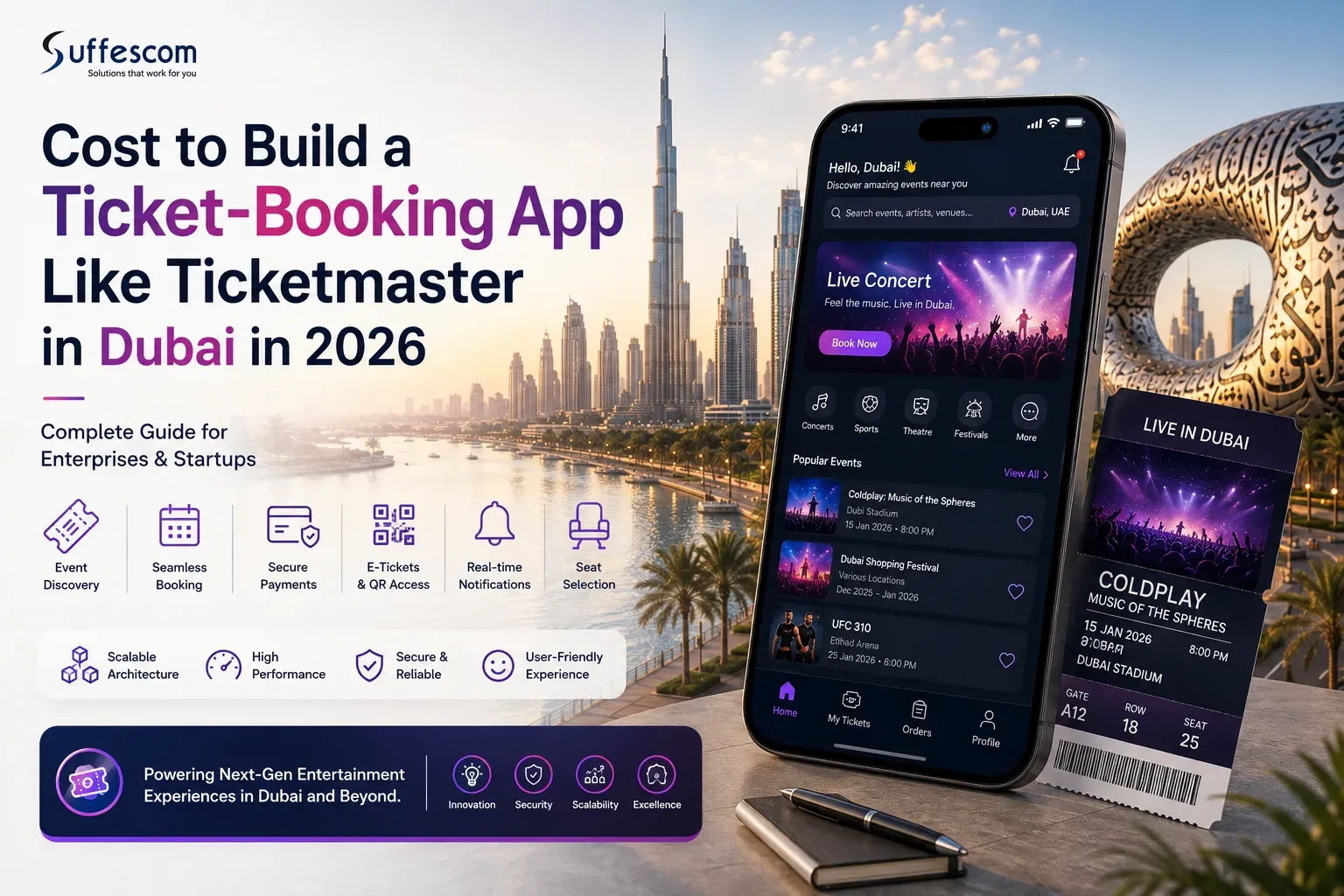
The cost to build a ticket booking app like Ticketmaster in Dubai can range from about AED 70,000 for a basic MVP prototype to more than AED 750,000 for a sophisticated, scalable ticket marketplace platform. As a practical planning estimate, businesses can expect:
MVP: AED 70,000–150,000
Mid-level platform: AED 150,000–350,000
Advanced Ticketmaster-style marketplace: AED 350,000 – 750,000+
These are indicative ranges and not fixed quotations. The actual cost of a Ticketmaster-like app development will be influenced by a wide range of factors, including functionality, third-party integrations, scalability requirements, compliance requirements, development region, and the complexity of the product overall.
As Dubai's events and tourism sector expands, the demand for digital ticketing also rises, presenting a lucrative opportunity for these platforms. In 2025, the city hosted 19.59 million international overnight visitors, a 5% increase from the previous year. The UAE smart ticketing market is growing at a 16.6% CAGR and is expected to reach USD 1.88 billion by 2033.
In this guide, we'll break down the development cost, key cost factors, essential features, and budget considerations involved in building a scalable ticketing platform.
The cost to build a Ticketmaster-like app is influenced by the complexity and necessary features of the product, the technical architecture, integrations, security measures, and the composition of the development team. These figures are not quotations but a 'budget band'.
| App type | Estimated Dubai budget | Approx. timeline | Suitable for |
| Basic MVP | AED 70,000–150,000 | 1–2 months | New ticketing startup |
| Standard platform | AED 150,000–350,000 | 2–4 months | Growing event business |
| Advanced marketplace | AED 350,000 – 750,000+ | 4–8+ months | Multi-organiser platform |
But an inexpensive “clone” shouldn't be considered a replacement for Ticketmaster's production infrastructure. A smaller clone app for Ticketmaster can have a lower price, while a bigger marketplace demands more security, integrations, reliability, and scalability.
A "Ticketmaster clone" is any product with similar functionality to a large ticket marketplace. It should never duplicate proprietary branding, source code, designs, or other intellectual property.
So, you can create the following based on your business model:
The ticket purchase screen is not the largest cost driver. It provides the tools needed to reliably manage multiple users, organisers, venues, payments, and tickets at the same time. Marketplace, transaction, inventory, and event operations workflows are all combined into a Ticketmaster-like app development. The number of these functions that are in the initial release will be a reflection of the development effort.
A big event ticketing application for UAE businesses might need multiple interfaces and permissions for multiple user groups, as compared to a basic consumer application.
If multiple users attempt to purchase the same tickets at the same time, real-time inventory can become more complicated. To avoid overselling, the platform should have features like inventory locking, temporary seat reservations, and automatic booking release for abandoned or expired reservations. It should also be capable of processing multiple orders at the same time without causing race conditions where two or more users try to buy the same ticket at the same time.
Another significant challenge for Ticketmaster-like app development is interactive seat maps. In contrast to a general admission event, a Reserved Seating event must have the platform configured to reflect a specific seating configuration and keep track of which seats are live and which ones are not.
Depending on the venue, the system might require support for the following:
A ticketing platform manages payments, customer accounts, and digital tickets, so security is a major consideration in the ticket booking app development cost that Dubai businesses will have to take into account. Some key security measures are bot protection, rate limiting, secure payment, account protection, suspicious activity monitoring, and QR/token-based validation to prevent duplicate tickets.
For such peak event launches, scalability is also essential, as sudden traffic surges could impact ticket availability and checkout. It takes more architecture, infrastructure, and quality assurance to design and test the platform for these peak periods.
The appropriate ticket booking app depends on the platform you're constructing. The following are the features that are commonly taken into account when creating a Ticketmaster-like site.
The user-facing app should facilitate the entire ticketing process, such as finding an event, booking it, and sharing the ticket at the event.
Event businesses should be able to manage event listings, tickets, sales, and attendance without relying on the platform team to help them with basic tasks using the organiser portal.
You'll find a central point for controlling the platform's activity within the admin panel. It assists the platform owner in user, organiser, event, transaction, content, and risk management.
The more sophisticated the features are, the more additional backend logic, integrations, testing, and infrastructure will be needed, which can drive up the cost of developing an app like Ticketmaster. These are typically added on to the core platform as the business model calls for additional personalisation, pricing, marketplace capabilities, or demand for high-traffic events.
Recommendations based on AI can assist users in finding events that are more aligned with their preferences and past experiences. But for this capability to be implemented, AI app development can help with appropriate data collection, recommendation logic, and constant optimisation of the model or rules must be provided.
Dynamic pricing enables ticket pricing to be adjusted based on a set of rules or business conditions. What's hard is that you need to link pricing to inventory, sales activity, promotions, and the checkout process without causing any conflicts.
On top of these challenges comes a resale marketplace, which needs to have its own ticket ownership and seller/buyer process, pricing rules, and transaction controls. This functionality will need to be carefully designed for the product and tech to allow for revalidated tickets being transferred or resold.
A high-traffic ticket launch demands infrastructure that can handle unforeseen traffic spikes in order not to overwhelm ticket inventory or ticket checkout systems. These capabilities tend to raise development and infrastructure expenses as a result of the specialised architecture, load testing, and continuous operational monitoring that are needed.
These requirements should be coordinated in the planning stage of the product rather than at the stage of product development. Specific responsibilities may differ depending on the business model, nature of the event, legalities involved, payment structure, and jurisdictions involved.
Note: This section is for general information only and does not constitute legal or tax advice.
According to Dubai's Department of Economy and Tourism, organisers with a valid ticketed event permit are required to apply for ticketing and determine the ticket seller or registration provider, as applicable. Therefore, it is crucial for businesses to establish their own role, whether as a ticket provider, technology provider or integration provider, since this can influence platform workflows and integrations.
It is important to have a plan in place from the beginning to implement Arabic and English support. RTL requirements may impact aspects of navigation, text alignment, forms, icons, checkout processes, notifications, and more. When developing websites and smart applications, they should also be built while taking into account the accessibility of the site for a wide audience.
Payment architecture needs to be planned carefully, as the purpose of the platform in the transaction can create a change in its technical and operational needs. Depending on the commercial model chosen, a ticketing application can be connected to a bank or payment gateway, an acquirer or another payment service provider authorised by the bank.
The Central Bank of the UAE regulates retail payment services and card schemes and prescribes requirements for the licensed payment service providers. It includes its framework, which encompasses payment security, technology risk, information security, authentication, and protection of payment and personal data.
An event ticketing platform in UAE should be able to record a separate line for the following: ticket price, taxes, platform fees, payment charges, discounts, refunds, and organiser settlement. The VAT and invoicing treatment will vary depending on the nature of the transaction. Therefore, it is recommended that businesses consult with a competent tax expert in UAE to set up financial workflows.
For instance, you can have a field for the ticket's value, applicable tax, platform commission, payment charges, discounts and net settlement amounts. This can save for bigger financial changes that are needed later as the platform grows.
Personal details and information like names, contact information, booking history, device information, location data, payment transaction information, etc., are usually collected on ticketing platforms. The UAE Federal Decree by Law No. 45 of 2021 on the Protection of Personal Data provides guidelines and restrictions on processing personal data and its protection.
Consider privacy from the get-go, especially for the implementation of behavioural analytics, location-based discovery, personalised recommendations, and automated profiling.
Knowing the total cost to create a Ticketmaster-like app is essential, but it's equally vital for businesses to understand where the money is going. A ticketing platform is the integration of customer-facing experiences with backend systems, operational dashboards, integrations and infrastructure, all wrapped in one.
| Development component | Approx. share of budget | What it covers |
| Business analysis | 5–10% | Requirements, workflows, technical planning |
| UI/UX design | 10–15% | Wireframes, prototypes, design system |
| Customer app/web | 20–30% | Discovery, booking, checkout, tickets |
| Backend/API | 20–30% | Users, inventory, bookings, payments |
| Organiser/admin panels | 10–15% | Event and business management |
| Integrations | 5–15% | Payment, notifications, maps, analytics |
| QA/security | 10–15% | Functional, performance and security testing |
| DevOps/deployment | 5–15% | Cloud, CI/CD, monitoring and releases |
However, it is still necessary to conduct a detailed discovery process to know the accurate app development quote for a particular product.
Various features have varying impacts on Ticketmaster-like app development costs. The following table outlines the level of complexity and cost associated with common features, relative to the other features.
| Feature | Complexity | Relative cost impact |
| Registration/login | Low | Low |
| Event listings | Low | Low |
| Search & filters | Low–Medium | Low–Medium |
| Push notifications | Low | Low |
| Online payments | Medium | Medium |
| QR ticketing | Medium | Medium |
| Ticket transfer | Medium–High | Medium–High |
| Seat map | High | High |
| Real-time inventory | High | High |
| Organiser dashboard | High | High |
| Multi-organiser marketplace | High | High |
| Dynamic pricing | High | High |
| AI recommendations | High | High |
| Ticket resale | Very high | Very high |
| Virtual queue | Very high | Very high |
| Fraud/bot prevention | Very high | Very high |
No single stack is for all Ticketmaster-type app development projects. The best one for you will depend on what you're planning to launch first and how you believe the platform will develop.
The mobile approach impacts development velocity, upkeep, performance and the mobile app development cost in Dubai.
The backend is responsible for handling the data and business logic of the platform. The technology selection should cater to APIs, user authentication, ticket inventory, booking workflows, payments and communication between various applications.
Common options include:
Cloud infrastructure enables applications to be hosted and databases to be stored, monitored, backed up, and scaled. A ticketing platform should be geared towards typical traffic flows as well as average daily data, particularly for popular event launches that could have a sudden surge in demand.
There are a number of options available when it comes to common infrastructure, such as:
The platform can be expanded with third-party integrations, so that all features don't need to be created in-house. With each integration, though, there are implementation, testing, security and long-term maintenance issues to consider.
Some common integrations with a ticketing platform are:
The subsequent steps outline a workable plan for businesses seeking to launch a ticket-booking platform in Dubai.
To begin with, it is crucial to define your target audience, event categories, competitors, and gaps that your platform can fill. The local event ecosystem, customer expectations, pricing models and current ticketing systems should also be explored.
Determine the platform's operation BEFORE finalising the feature scope. These can be a consumer ticketing app, a white-label solution, a multi-organiser marketplace or a SaaS platform. At this time, revenue sources, commissions, organiser payouts and the tasks of the organiser should also be decided.
Identify key customer, organiser and administrator journeys. Before development starts, wireframes and prototypes are used to outline significant workflows, such as event discovery, ticket selection, checkout, and event management, among others.
Develop basic product validation and support for the initial product launch. Initially, the most critical workflows should be focused on, and the MVP should not try to cover every advanced functionality.
Set up the payment mechanism and establish transaction, refund and settlement procedures. The platform should also have the necessary ticket validation methods, such as QR or barcode scanning, depending on the nature of the event and the participants.
Check the platform on important user journeys, devices, browsers and integrations. Before going live, development teams must also evaluate performance, authentication, transaction processing, access controls and other pertinent security issues.
Once deployed, track the real-world performance, usage, booking activity and user feedback. Future development can then be directed towards the improvements of the product and the incorporation of features as per the business priorities, customer behaviour and the growth of the platform.
The development schedule will vary between platforms based on the complexity of the platform and the scope of the initial release. A simple marketplace with just basic functionality and simple workflows can be created quicker than a multi-organiser marketplace with advanced functionality and complex workflows.
| Project scope | Estimated timeline |
| Basic MVP | 3–5 months |
| Standard ticketing platform | 5–8 months |
| Multi-organiser platform | 8–12 months |
| Advanced marketplace | 12–18+ months |
The above timelines are indicative and are not binding. The actual development time may vary based on the size of the team, the scale of the features, the technical architecture, the number of platforms, third-party integrations, testing needs, design iterations, and stakeholder approval cycles, which can also impact the total Ticketmaster-like app development cost.
A ticketing platform might be capable of accommodating a lot of people yet have a handful of challenges throughout a significant on-sale. The issue is not the volume of traffic, but concurrent demand.
For instance, the arrival of 10,000 users over an hour can be a vastly different load pattern than the arrival of 100,000 users in a few minutes. It is harder when hundreds of thousands or even 1 million people try to buy the same event sale at the same time.
At a big sale, several systems may be subjected to the pressure at once:
High-demand Ticketmaster-like app development requires more than adding extra servers. A scalable architecture should use load balancing to distribute traffic, keep APIs flexible during sudden spikes, and separate critical booking requests from background tasks. Caching tools such as Redis can reduce database pressure, while queues can handle notifications, analytics, and other non-critical processes without slowing down ticket purchases.
The database must maintain accurate inventory and use proper concurrency controls to prevent overselling or duplicate bookings. During major on-sales, virtual queues, rate limits, bot protection, and temporary inventory locks help manage access and availability. Building this infrastructure requires additional engineering, testing, monitoring, and optimisation, which can increase the cost to create a Ticketmaster-like app for high-demand events.
With high-volume customer-order apps, concurrency engineering can be a high cost, more of a factor than the number of screens. The major on-sales can necessitate an architecture that is specialised, as well as the management of queues, inventory reservations, load testing, and failure-recovery mechanisms. This means that with similar features, two apps can have very different budgets if one needs to deal with a large amount of concurrent traffic that happens all of a sudden.
A UAE ticketing platform must be able to meet the needs of events here and make it easier to scale to more cities, event types and market segments.
The city of Dubai is a great choice to start from, as it is well known for its various events, concerts, sports, attractions, exhibitions and entertainment activities that are all a part of the tourism industry. As the platform expands in the number of locations, venues, organisers and categories, its architecture should be flexible in these factors. The event ticketing platform in UAE should be scalable so that it can be expanded without rebuilding the core system.
A successful platform must cater to both ends of the market. Organisers require a solution that allows them to sell, control, validate and analyse tickets, and consumers need to find an event to attend and buy tickets. A more holistic ticketing platform is realised when both are designed from the beginning, instead of the consumer booking app.
Localisation should be a key consideration in the product strategy right from the start. As a business owner, you must be aware of why sometimes mobile apps fail in the UAE to avoid localisation. The UAE market might have some key priorities, such as:
This can help ease the burden of expansion as well, since the platform is designed for regional needs, not retrofitted once it is out in the market.
The first stage of the investment is just a portion of the overall investment. After the platform launches, sustaining the operation may impact the platform's long-term economics.
App service charges are based on application traffic, database consumption, storage, bandwidth, monitoring, backups and scalability needs. The budget may be around AED 2,000–15,000+ per month. Platforms with variable demand may require extra capacity during large event launches, too.
Depending on the provider and commercial agreement, the payment providers can set up, process, or charge transaction or other fees. These are costs that should be distinguished from any initial development costs in the business plan.
As the number of users increases, recurring costs from transactional communication can arise. A smaller platform spends around AED 500–5,000+ per month on communication. Costs might increase depending on the number of booking confirmations, OTPs, reminders, event updates, and customer support messages.
There are costs associated with the developer's account, as well as costs related to the platform, that may be recurring when you publish mobile apps. These should be taken into consideration when working out the continuous cost of running iOS and Android apps.
On an ongoing basis, depending on the platform risk profile, contractual requirements and internal security policies, security reviews and penetration testing may be performed periodically. This may cost approximately AED 10,000–50,000+ per assessment. As more integrations are added to the platform and the number of transactions grows, so do costs.
Support costs are the staff, tools and processes needed to deal with booking problems, payment enquiries, refunds, access to tickets and event communications. This cost can range between AED 5,000 and 30,000+ per month. The minimum support range may increase greatly during large-scale events.
There is a continuous effort to resolve bugs, ensure compatibility with operating systems and third-party service updates, enhance performance and introduce new functionalities. The maintenance should be considered a cost of operation and not a cost. This can include 15–25% of the initial development.
There are a number of ongoing expenditures that need to be made to attract customers, event organisers, etc., such as paid campaigns, content, partnerships, promotions, referral programmes, and more. Its growth strategy and target market will be significant determining factors of the budget.
Legal review, regulatory review, tax consultation and accounting, contracts and other professional services can be costly. These costs vary depending on the platform's business model, activities, transaction structure, and applicable UAE regulations, so they need to be taken into account by qualified local professionals.
You don't have to sacrifice key functionality and reliability by lowering development costs. Instead, it is better to define scope, leverage existing technologies that are already proven, and spend dev effort on things that add the most business value.
Begin with basic functions essential for validating the business model, such as event listings, choosing tickets, and checkout, as well as payment processing and electronic delivery of the ticket. More sophisticated capabilities can be integrated as more people use the platform and more products are needed.
Prioritise the first budget for functionality that directly impacts ticket sales and event operations, as well as the user experience. The rest of the functionality that is not as critical may be planned for future releases, depending on feedback from customers and organisers.
Using frameworks like Flutter or React Native can save time in development, as they support multiple platforms, including iOS and Android, from the same codebase. But this approach should be used depending on the product requirements and not used as the default for all platforms.
Cloud services like managed databases, storage, authentication, monitoring and others can minimise the effort needed to construct and maintain infrastructure in-house. They are also able to spend more time on the proper functioning of products than on development.
Services can be used for payment, notifications, maps, analytics, and authentication by existing services. This can save time in development, but remember to consider integration, security review and continuing third-party costs.
Modular architecture makes sense because it enables the other components of the platform to be developed, enhanced, or scaled without affecting the entire platform. As the product evolves, this can help decrease the expense of big changes.
Test high-risk workflows early in development, including workflows such as ticket selection, inventory reservation, checkout, payment processing, and ticket validation. It is often cheaper to solve problems before they go into production than to try to redesign fundamental workflows when it's already up and running.
Recommendations powered by AI can be complex, as can resale marketplaces and dynamic pricing. Adding these kinds of components to the initial business model might lower the investment, unless they are part of the core business model.
There are a number of revenue streams available for a ticketing platform. The appropriate model will depend on the relationship it has with organisers, customers, payment providers, and other business partners.
The site will have a set fee or percentage fee for customers to pay for each successful booking. The fees imposed should be made clear prior to the transaction.
The platform can make a commission based on ticket transactions made by event organisers. They may differ depending on the volume of tickets sold, the nature of the event, commercial agreements or other services they may offer.
Organisers are able to have extra visibility by paying for feature placement on the home page, category pages, search results or other promotion areas.
A SaaS-based approach may provide organisers with subscription plans that will allow them access to certain features, reporting tools or increased usage limits. Various plans may be developed to meet the needs of small and large event businesses.
Advertising revenue can be generated on the platform either from sponsorships for events or through relevant brand partnerships. Wisely planned advertising is important to prevent the disruption of the ticket-buying process.
Core services can include basic reporting, with premium services for advanced analytics. This can involve a more detailed view of sales trends, customer behaviour, and performance of campaigns.
The platform may be white-labelled for venues, organisers or other businesses. The client can pay for setup fees, subscription fees, transaction fees or a mixture of these.
If resale is a permitted business model, fees can be levied on permitted resales. The rules and buyer protection, organiser policies and transaction costs should be taken into account in the model.
A simple revenue model is represented as:
Potential Gross Platform Revenue = Ticket Value × Platform Commission + Appropriate Service/Booking Fee
Actual revenues will be subject to volume, ticket pricing, organiser deals and business model. Other fees related to taxes, payment processing charges, refunds, chargebacks, operational costs, and any applicable UAE regulations should be taken into account when predicting profitability.
A ticketing platform requires more dependencies than a typical booking website. The following pitfalls can be avoided to minimise expensive changes after and during development.
Ticketing includes time-sensitive inventory, transaction processing, ticket issuance and event-day operations. All the above should be addressed from the outset in the design of the platform.
The platform is a two-sided business, with customers being one side. Organisers also require tools to plan events, keep track of inventory, sales, attendance and relevant reporting.
Average daily traffic is not a measure of the pressure during a large sale! If necessary, based on the business model, the platform should be tested and designed for a suddenly high number of concurrent users.
There should be clear rules established around ticket inventory with regard to availability, temporary bookings, confirmation, cancellation, and failed payments. Poor inventory logic can result in oversales and operational challenges.
An overly complex MVP development will take longer to develop and be more costly to validate. Prioritise first the workflows needed to start the product and introduce secondary features based on the actual product needs.
If Arabic support is added late in the design process, the interface may have to be completely modified. Design and front-end development should take bilingual and right-to-left into account.
Security must be built throughout the development process, especially in authentication, access control, transactions, personal data, and ticket validation. Adding security controls after the fact can entail significant changes.
The lowest quote might not be representative of the skills required to develop a complex inventory, payment or high-concurrency workflow. Consider technical capability, relevant experience, development processes and long-term support, as well as pricing, to select the right mobile app vendor.
Not all payments are successful, and not all events occur as intended. The platform should establish clear procedures for transactions that fail, transactions that are cancelled, transactions that are refunded, and communication with customers about each of these.
Using a proven product as a model to grasp features and workflows is appropriate for a platform but should not involve duplicating proprietary code, brands, designs or other protected IP. Rather, it's about creating a product that fills a specific need in the target market, the event system, and the customer experience.
When creating a platform that integrates real-time bookings, payment processing, ticket management, organiser tools and customer apps, selecting the right development partner is crucial. From concept through to post-launch, Suffescom can assist businesses throughout the product development lifecycle.
Suffescom has experience developing custom mobile and web solutions with complex booking, marketplace, payment, and management workflows. The team will be able to help you turn your ticketing business needs into a realistic product plan.
We develop the technical structure based on the platform's anticipated processes, connections and future development goals. This enables businesses to anticipate more transactions, events, organisers and users without having to rebuild the entire platform.
Suffescom provides support across business analysis, UI/UX design, frontend and backend development, third-party integrations, testing, deployment, and launch. This provides a more defined process for development, from idea to production.
Development doesn't stop after the first release. We can support you continually with maintenance, performance enhancements, security updates, feature enhancements and future product expansion.
The cost of building a Dubai Ticketmaster-like app can vary from AED 70,000 to AED 750,000+, depending on the complexity of the platform, features, integrations, scalability, and the app's peak traffic. While a focused MVP can help you test your idea with a smaller start-up investment, a more advanced marketplace will need a more sophisticated infrastructure and booking system.
Building a successful ticketing platform requires the right technology, scalability, and development strategy from the start. Partnering with an experienced app development company in the UAE can help you turn your idea into a secure, scalable, and custom solution.
The cost to build a Ticketmaster-like app in Dubai can range between AED 70,000 and 150,000, while an advanced Ticketmaster-style platform can be AED 350,000 to 750,000+. The final price would vary depending on the features, integrations, scalability, and the complexity of the platform.
For the majority of cases, a basic ticket-booking MVP is categorised in the range of AED 70,000-150,000. Payment integration, admin tools, ticket validation, etc., and platform requirements can drive up the budget.
Depending on the scope of the project, a custom platform similar to workflows used in ticketing can cost AED 150,000 - 750,000 or more. A "clone" should be considered a reference to a feature and NOT include proprietary code, branding or design.
A basic MVP will take anywhere from 3 to 5 months; a standard platform will take 5-8 months. For more complicated multi-organiser or marketplace platforms, it can take 8-18 months.
Common core features are user registration, event discovery, search, event ticket selection, event checkout, secure payment, digital tickets, QR validation, notifications, and booking history. Additional panels like organiser and admin panels are also crucial for event management and platform functioning.
The cost to build a Ticketmaster-like app in Dubai will vary based on venue complexity, reserved-seating logic, real-time availability and number of supported configurations. The seat map feature is a custom feature and can be expensive to develop if it has to be integrated in close association with ticket inventory.
Not necessarily. The development of both platforms can be supported by cross-platform frameworks like Flutter or React Native, or by native apps if there are specific performance or platform requirements.
The addition of an admin panel is an additional cost, as it necessitates additional workflows to run, such as user management, event approvals, payments, refunds, reports, and platform controls. The actual cost to build a Ticketmaster-like app in Dubai will vary on the type of functionality and number of user roles.
Yes. It will support both languages, Arabic right-to-left, if needed. It is easier to plan bilingual support when designing the UX and frontend than during the back-end implementation.
Depending on your business model and provider needs, there are a number of options out there. Choosing an appropriate payment provider depends on various factors like payment methods supported, settlement requirements, technical integration, and UAE-specific regulations.
It will depend on the event, business model and your ticket sales role. The policies and regulations governing events and tickets in Dubai should be checked by businesses with the authorities concerned, and expert guidance should be sought if required.
The cost of maintenance depends on hosting, infrastructure, support, upgrades, security, third-party services, etc., and feature development. Therefore, a realistic maintenance cost to create a Ticketmaster-like app should be planned separately from the initial investment for the development.
Eligible ticket resale is possible with additional features like secondary listing, ticket ownership updates, pricing controls and buyer protection workflows, before putting the business model and relevant requirements into practice.
A custom platform is usually the longer-term option, as it can be tailored in accordance with your business model and target market. Proprietary technology or branding is not required, and existing platforms can be utilised as feature references.
Take an MVP approach and focus on the most valuable features, leverage a cross-platform development approach where applicable, and use trusted third-party services where relevant. The core product and business model can be validated, and advanced features can be added afterwards.
There is no one best stack for all projects. Technologies like Flutter or React Native, Node.js, Python, Java, .NET, AWS, Azure, or Google Cloud can be selected based on scalability, integrations, performance, and team expertise.

Senior Content Strategist
Jonathan Raabe is a content marketing professional, focusing on mobile apps, software engineering, artificial intelligence, SaaS, cloud computing, and digital transformation. Jonathan works with visionary brands to translate complicated concepts into content that can be easily understood by their audiences. As an expert in his field, Jonathan strives to create content that is thought-provoking and backed by facts, while at the same time building brand authority and trust.



Related Blogs
Hear directly from clients who partnered with Suffescom to turn their digital ideas into secure, scalable, and high-performing products.

“Suffescom delivered a HIPAA-compliant telemedicine app exceeding expectations, with strong data security and thoughtful development strategies from start to finish.”

“Suffescom helped us build a smart property management and virtual tour platform. Their expertise in AI helped us attract more qualified leads.”

“Suffescom delivered a modern hotel booking app perfectly aligned with customer expectations, which helped us boost sales by 40%.”

“We needed real-time fleet tracking and route optimization. Suffescom developed a platform that reduced our operational expenses in the first quarter.”

“We needed a smart itinerary planner with AI features for tourists. Suffescom delivered beyond our expectations and helped us increase bookings.”